


New NDIS plan: your first 30 days, in order
A new plan arrives and nothing tells you what to do first. Here is the order we work through with families in South West Sydney, and the two mistakes that cost the most.


NDIS transport assistance often sits in a gap between what families assume is covered and what actually appears in their plan. The scheme funds support that helps participants reach community activities, social connections, and everyday destinations. But without a provider who shows up reliably and knows your family member’s routine, that funding sits unused. Worry about cancellations or last-minute changes is real—it breaks the confidence that lets people venture out.
Community Access & Social Participation works because it pairs transport with purpose. A support worker doesn’t just drive; they travel with your family member to activities they’ve chosen, stay present during the outing, and help build the confidence to go again next time. The mechanism is simple: consistency builds trust, and trust builds independence. When the same worker arrives on the same day at the same time, participants stop bracing for disappointment.
Here’s what that looks like in practice. You book a two-hour Wednesday afternoon support visit to the local community centre or a Friday outing to the shops. The same worker arrives on time, knows your family member’s preferences, and understands the routine that makes the trip feel manageable. Over weeks, your family member relaxes. They stop asking if the support will actually happen. That shift—from doubt to expectation—is when real participation begins, and when you feel the provider is genuinely part of your family’s team.
NDIS transport assistance is often the difference between a participant staying home and actually getting out into their community. But here’s what we hear from families in South West Sydney: the transport piece feels confusing. You’re not sure what your NDIS plan covers, who arranges it, and whether the support worker shows up reliably when you need them.
The truth is, transport isn’t just about getting from point A to point B. It’s about choice and control. When a participant can’t drive, or when anxiety makes public transport feel overwhelming, reliable transport assistance opens doors. A trip to the shops. A community group. A friend’s place. These aren’t luxuries—they’re the everyday moments that build confidence and connection.
What we hear from families is that consistency matters more than anything else. If the support worker cancels last minute, or if they’re always running late, the whole plan falls apart. Your family member stops trusting the arrangement. They stop wanting to go out. The isolation gets worse, not better. That’s why we’ve built our Community Access and Social Participation support around one simple promise: we show up on time, every time.
NDIS transport assistance sits within your plan’s community participation budget, but navigating what that actually means—and how to match it with the right support worker—takes clarity. Some participants need a support worker who understands sensory sensitivities on the bus. Others need someone who speaks Arabic or Spanish at home, then supports them confidently in the community. Some need someone patient with routine changes; others need someone who can help them try new things.
The starting point is understanding what you’re actually after. Are you looking for regular outings? One-off trips? Support building independence with transport itself? When you’re ready to explore what that looks like for your family, we’re here to help.
NDIS transport assistance covers two very different things, and knowing the difference matters when you’re planning your support. One is getting to essential appointments—a GP visit, a therapy session, a support coordinator meeting. The other is getting out into the community because you want to, because it builds confidence and connection. Both are valid. Both matter. But they’re funded and supported differently.
Here’s what that looks like in practice. Your son is an autistic adult who loves the local library but hasn’t been in three months. He needs someone to travel with him on the bus, wait while he browses, and travel home. That’s community participation transport—it’s about choice, about him doing something he enjoys, about building his independence and confidence in a familiar space. A support worker from Guia would arrive at 2 p. m. on a Tuesday, check what books he’s looking for, travel with him on the bus, maybe grab a coffee nearby while he’s inside, and travel home. The worker notices he’s more relaxed this week than last; they leave a note for you: “He found three new titles. Chatted to the librarian about the sci-fi section. ” Small things. Real things.
Transport to a medical appointment is different. It’s getting him there safely, on time, with any documents he needs. Both are legitimate uses of NDIS support funding, but community participation transport is where the real growth happens—where your family member builds friendships, tries new places, feels more in control of their week.
If you’re unsure whether your current plan covers what you’re hoping to do, or if you’d like to talk through how community participation transport could work for your family member, we’re here to help. Enquire about support and let’s work out what’s possible.
Many families think NDIS transport assistance means we’ll just drive their family member to appointments and back home. It sounds practical on the surface, but it misses what community access actually does.
Transport is the tool, not the goal. When we organise NDIS transport assistance, we’re solving the real barrier that stops participants from getting out into their community in the first place. Without reliable, consistent transport, even the best social opportunities stay out of reach.
Here’s what that looks like in practice. A participant might have funding for community activities—a weekly art class, a sports group, volunteering at a local charity—but no way to get there. Family members are often working, tired, or live too far away to drive. Public transport might feel overwhelming or unsafe. That’s where we step in. We arrange transport with a trained support worker who knows the participant, understands their needs, and shows up reliably every single time.
But the transport itself is just the beginning. During those trips, our support workers build confidence, help participants navigate community spaces, and create real connections with people and places. A participant might arrive at a community group nervous and uncertain. Our worker stays nearby, offers encouragement, and helps them feel safe enough to try something new. Over time, that person builds confidence and independence—and sometimes friendships that extend beyond the activity itself.
The misconception often comes from thinking about transport in isolation. In reality, NDIS transport assistance is part of a bigger picture: helping participants feel confident, valued, and genuinely part of their community. That’s the difference between getting somewhere and belonging somewhere.
If you’re thinking about community access support for your family member, we’d like to hear what barriers are stopping them from getting out. When you’re ready, enquire about support and we’ll talk through what’s actually possible.
Community Access & Social Participation is NDIS support that helps you get out into your community, build real connections, and do the things that matter to you. It includes group activities, social outings, and the transport assistance that gets you there.
NDIS transport assistance covers the cost of getting a participant to and from community activities funded by their plan. This might be a support worker driving you to a local sports club on Thursday afternoons, or helping you catch the bus to a community group. Transport is not separate funding—it’s part of your Community Access budget, so the cost comes from the amount your NDIS plan sets aside for this type of support.
Here’s what that looks like in practice. Your plan might say you have $2,000 per quarter for Community Access. If a two-hour social outing with transport costs $120, that comes from your $2,000 budget. Distance doesn’t have a set limit—what matters is whether the activity itself is reasonable and achievable within South West Sydney. Your support coordinator or provider will help you plan activities that fit both your goals and your funding.
What Community Access does NOT include is transport for medical appointments, school, or work (those have their own funding categories). It also doesn’t cover transport costs if you’re travelling alone without a support worker, or if you’re using standard public transport without assistance.
The key thing to know is that you’re in control. Your plan is yours. You choose which activities matter to you, and your provider helps you get there reliably, on time, every time. If you’re not sure whether a particular activity or distance fits your plan, that’s exactly what your support coordinator is there to help you work out.
When you’re ready to explore how Community Access & Social Participation could work for you or your family member, enquire about support. We’ll walk through your plan and show you what’s possible.
NDIS transport assistance sits within Community Access & Social Participation, and it works differently depending on what your family member needs. The scheme funds transport as part of a broader goal: helping participants get out into their community, build connections, and do the things that matter to them.
Transport can be funded through Core Supports if it’s directly tied to daily activities—getting to a regular appointment, attending a community group, or visiting a friend. Your support worker arranges the transport and travels with your family member, making sure they get there safely and on time. This is where reliability matters most. We show up when we say we will, every single time.
Some families find that Capacity Building supports work better for their situation. These funds help build your family member’s independence over time—for example, learning to use public transport with support, or practising the route to a regular activity until they feel confident going alone. It’s about growing skills and choice, not just getting from A to B.
The NDIS expects participants and families to have a say in how transport is arranged. That means you and your family member decide together: Do you want a support worker to travel with you? Would you prefer help planning the route and timing; do you need transport tailored around sensory needs or routines? Your plan should reflect what actually works for your life.
What we hear from families is that the uncertainty stops when you have a provider who listens to what you need and delivers it consistently. If you’d like to talk through how NDIS transport assistance could work for your family member, we’re here to help you think it through without pressure.
Enquire about support and we’ll walk you through your options in plain language.
When you’re arranging NDIS transport assistance, it helps to know exactly what sits in your court and what doesn’t. That clarity means you can plan with confidence and spot where support actually makes a real difference in your family member’s life.
Here’s what’s your call to make:
At Guia, we match support workers thoughtfully. If your family member needs a Spanish-speaking support worker, or someone experienced with autistic adults, or a particular communication style, we listen to that. We show up on time, every time. That reliability matters when transport is the bridge between home and the community your family member wants to be part of.
Here’s what sits outside this support:
The point is simple: you’re in charge of the shape and purpose of the support. We’re here to deliver it with dignity and consistency. If you’d like to explore how NDIS transport assistance could work for your family member, we’re ready to talk through the detail.
Enquire about support and let’s work out what makes sense for your situation.
Community Access & Social Participation is right for your family member if they’re spending more time at home than they’d like, or if getting out into the community feels harder than it should. That might mean they want to join a local group activity, visit the shops, catch up with friends, or try something new—but transport or confidence is holding them back.
Check your NDIS plan summary. Look for funding under “Assistance with Community, Social and Civic Participation” or similar language. If it’s there, you likely already have budget set aside for this. You don’t need to wait for a plan review to start using it—many families don’t realise the support is already available to them.
Here’s what that looks like in practice: Your adult son wants to go to the local community centre on Wednesday mornings, but he needs someone to travel with him and help him get ready. Or your daughter enjoys social outings but anxiety about unfamiliar places makes it hard to go alone. Or your family member uses a wheelchair, and accessing transport that works with their equipment has been the missing piece. NDIS transport assistance through Community Access & Social Participation covers exactly these situations.
It’s also worth knowing that consistency matters more than frequency. A reliable support worker who shows up the same day and time each week builds confidence over time. That’s the foundation for real independence—not rushing into activities, but showing up steadily until your family member feels secure enough to try new things.
If this sounds like what your family needs right now, there’s no pressure to have all the answers yet. We can help you work out what’s already in your plan and what a realistic first step might look like. When you’re ready, get in touch and we’ll talk through how Community Access & Social Participation could fit your family’s life.
An autistic adult living in Bass Hill wanted to join a weekly community art class in Bankstown. Getting there meant a bus trip he’d done before, but the unpredictability of crowds and noise made it hard to manage alone. His mum worried about him travelling without support, and he worried about letting anxiety stop him from doing something he loved.
NDIS transport assistance through Community Access & Social Participation meant Guia arranged a support worker to travel with him each week. Not to do the activity for him — to be there during the journey. The worker knew his sensory preferences: quieter times to board, a seat near the door, a familiar routine he could count on. Within four weeks, he felt confident enough to manage the bus stop independently while his support worker waited nearby.
What mattered wasn’t the transport itself. It was choice and control returning to his week. He chose when to go, what to make in the class, and how much support he needed on any given day. His mum stopped holding her breath every Wednesday. He stopped cancelling because anxiety had won.
This is how NDIS transport assistance works in practice. It’s not just about getting from A to B. It’s about building the confidence and routine that make community participation real and sustainable. A Spanish-speaking support worker, an Arabic-speaking coordinator, or an Auslan-trained assistant — we match the person to the participant’s actual needs.
If your family member wants to join a group, attend an appointment, or explore their suburb but transport or anxiety is the barrier, that’s exactly what we support. When you’re ready to talk through what would help, enquire about support and we’ll listen to what matters most.
NDIS transport assistance sits within your plan’s Core Supports or Capacity Building budget, depending on what your plan says you need. If your support plan includes community access and social participation, the funding is already there — it’s about how you use it.
Here’s what that looks like in practice. The NDIS uses a price guide to set reasonable rates for different support activities. Transport to a community outing — say, a Tuesday afternoon at the local library or a weekly group activity — is costed based on the support worker’s time and travel. Your plan approval tells you how many hours you have available each week or month for community participation. Transport is part of that allocation, not a separate line item.
What matters is that your support plan clearly describes what community access looks like for you or your family member. Does it mean weekly outings? Monthly activities? Transport to a specific place, or flexible access to different community spaces? The clearer your plan, the easier it is for a provider to deliver what you actually need and to cost it accurately against your approved hours.
If your current plan doesn’t include enough hours for the community participation you want, a support coordinator can help you talk to the NDIS about adjusting it at your next review. That conversation is worth having — many families find that building in regular community access actually builds confidence and independence over time, which can reduce pressure on informal carers.
We work with families to match support workers who understand your transport needs and show up reliably. Consistency matters more than you’d think — the same worker, the same day, the same route builds trust and routine. When you’re ready to explore how NDIS transport assistance could work for your family, we’re here to walk you through it.
Transport is often the piece that makes or breaks community participation. Without reliable NDIS transport assistance, a participant might have funding for a social group or activity but no way to get there. That’s where the conversation starts with us.
When you call Guia, you’ll speak with someone who listens first. We ask about your situation: Does your family member need transport to a specific activity each week? Are they building confidence in using public transport with support? Do they need help getting to appointments or community spaces in South West Sydney? These details shape what works for you, not the other way around.
From that first chat, we’ll explain how NDIS transport assistance sits within your plan. It might be funded under Community Access or Daily Personal Activities—the registration group matters because it affects how the support is delivered and documented. We’ll walk you through this in plain language, no jargon; if you’re not sure what’s in your plan or how much is available, that’s normal. We help families untangle that.
Next, we’ll match a support worker who fits your family’s needs. In South West Sydney, that often means finding someone who speaks your language—Arabic, Spanish, English, or Auslan—and understands your community. We’re multilingual by design, not by accident. The match happens before the first visit, so there’s no awkward surprises.
Your first visit is straightforward. The support worker arrives on time, meets your family member, and you talk through what the routine looks like. If it’s a weekly activity, you’ll plan the pickup time, the route, and what happens when you arrive. We’re here to build confidence and independence over time, not to create dependence on us.
When you’re ready to start, enquire about support and we’ll take it from there.
Choosing the right NDIS transport assistance provider matters. Your family member’s confidence, safety, and connection to community depend on it. Before you commit, it’s worth asking the right questions upfront.
At Guia, we prioritise consistency, cultural match, and genuine choice. Our support workers are qualified and screened. We listen to what matters to your family member — not what we think should matter. Ready to explore how NDIS transport assistance could work for you? Enquire about support and let’s talk through your situation.
When a family member drives your relative to activities or appointments, NDIS transport assistance can cover their time and fuel. But not every provider handles this well. Here’s what to watch for when choosing Community Access & Social Participation support.
At Guia, we match support workers with care for consistency and fit. We show up on time, every time. We explain what’s covered in plain language and respect your family’s routines and preferences. If you’re looking for NDIS transport assistance you can rely on, enquire about support and let’s talk about what works for your family.
When NDIS transport assistance is working well, you’ll notice the small things first. The same support worker shows up on the same day, at the same time, week after week. Your family member stops asking “Who’s coming today? ” because they know. That consistency builds trust—and trust is where real participation begins.
You’ll also hear about what happened during the outing, not just that it happened. A good support worker checks in with you regularly—a quick text, a call, a conversation at pickup. They tell you what your family member enjoyed, what made them laugh, what they want to do next time. This isn’t just politeness. It’s evidence that your family member’s voice is steering the ship, not the provider’s schedule.
Look for shifts in confidence and choice. Does your family member suggest activities now? Are they asking to go back to the same café, the same community group, the same park? That’s agency. They’re not just being transported to fill a support hour—they’re building a life they actually want. You might notice them talking about “my support worker” the way they’d talk about a friend, not a service.
Finally, watch whether the support is building skills and independence over time, not creating dependence. A support worker might start by helping your family member navigate the bus, then gradually step back as they grow confident. Or they might help them join a community group and then stay in the background once friendships form. That’s empowerment in action—your family member gains control, not loses it.
If these signs are missing—cancellations, no communication, your family member’s priorities ignored—that’s worth raising. When you’re ready to explore NDIS transport assistance that centres your family member’s choices and builds real connections, enquire about support with Guia.
If NDIS transport assistance isn’t working the way you need it to, you have options. The goal of support is to fit your life—not the other way around. Here’s what choice and control actually looks like in practice.
Start with your support provider directly. Tell them what’s not working: maybe the driver arrives late, or the routes don’t match your family member’s interests, or communication feels unclear. A good provider listens and adjusts. If you’re working with Guia, you can raise this with your support worker first, then escalate to a manager if needed. Most issues resolve at that level.
If feedback doesn’t lead to change, ask for a different support worker. Personality, reliability, and cultural fit matter. You’re not being difficult—you’re being clear about what your family member needs. A provider worth trusting will respect that request and work to match someone new.
You also have the right to switch providers entirely. Your NDIS plan belongs to you. If another provider in South West Sydney offers Community Access & Social Participation support that feels like a better fit, you can make that change. Talk to your support coordinator about the process—it’s straightforward.
For formal concerns about a provider’s conduct or compliance, the NDIS Quality and Safeguards Commission handles complaints and investigates breaches of the NDIS Code of Conduct. You don’t need a lawyer. You can lodge a complaint online or by phone if you believe your rights or safety have been compromised.
The point is this: you’re not locked in. Support should feel reliable, respectful, and genuinely matched to what matters to your family member. When you’re ready to explore options or discuss what better support might look like, reach out to us.
Getting your family member out into the community shouldn’t depend on whether transport is available on the day. NDIS transport assistance is designed to remove that barrier—but it only works when the support shows up reliably and knows how to get where you’re going.
What we hear from families is that consistency matters more than anything else. A support worker who cancels last-minute leaves your family member disappointed and you scrambling for a backup plan. A worker who arrives on time, knows the route, and treats the journey as part of the outing itself—that’s the difference between transport and genuine community access. That’s what builds confidence over time.
At Guia, we’ve built our transport assistance around showing up. Every support worker is qualified, screened, and matched to your family member’s needs—whether that’s a Spanish-speaking worker, someone trained in Auslan, or a person who understands the routines and sensory needs that matter to your son or daughter. We work across South West Sydney, from Bass Hill to Campbelltown and beyond, so we know the local community and the routes that work.
Here’s what that looks like in practice: your family member gets to the same community group every Tuesday afternoon. The same worker picks them up, they know the stops along the way, and they arrive ready to participate. Over weeks and months, that consistency builds real friendships and genuine belonging—not just transport, but actual community participation.
If that sounds like the kind of support you’re after, there’s no rush to decide today. Enquire about support whenever you’re ready, and we’ll walk through what NDIS transport assistance actually covers and how it could work for your family member. When you’re ready to explore, we’re here.
A new plan arrives and nothing tells you what to do first. Here is the order we work through with families in South West Sydney, and the two mistakes that cost the most.

Aged care at home South West Sydney from Guia. Reliable support workers who show up consistently and become part of your family’s everyday routine.

NDIS allied health support sydney from Guia. Reliable support workers who show up consistently and become part of your family’s circle. Peace of mind fo…
The Community Participation Playbook for NDIS Families
How to use NDIS Community Access funding to actually build connection, confidence, and independence — not just attendance.
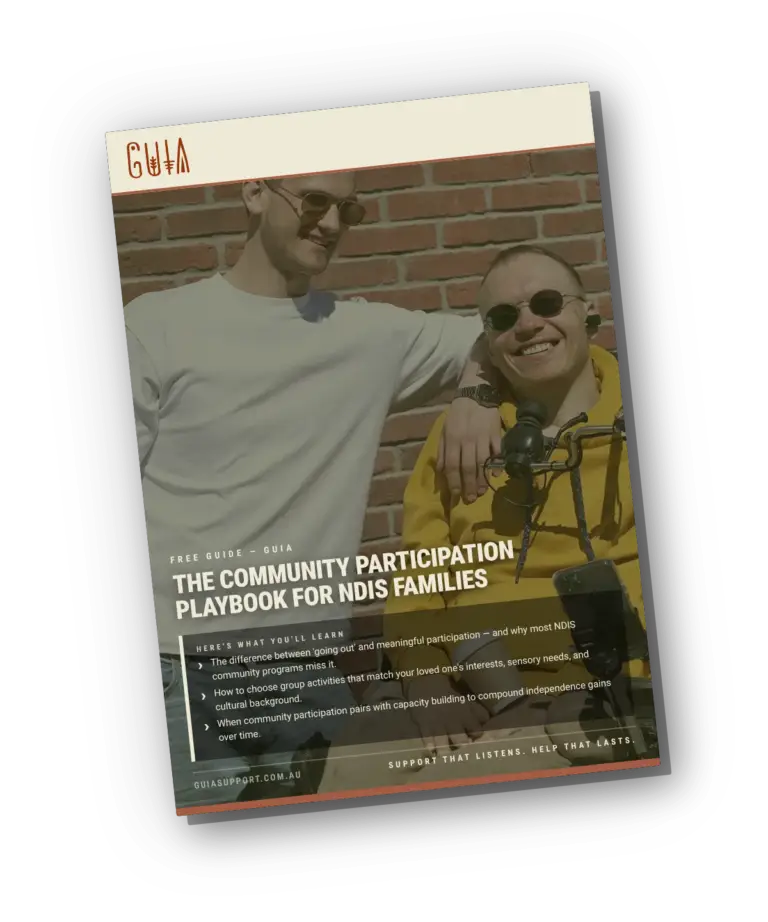
Here's What You'll Learn:
The difference between 'going out' and meaningful participation — and why most NDIS community programs miss it.
How to choose group activities that match your loved one's interests, sensory needs, and cultural background.
When community participation pairs with capacity building to compound independence gains over time.
ARE YOUR NDIS SUPPORTS WORKING FOR YOU?
GET A FREE NDIS PLAN MANAGEMENT REVIEW