
NDIS support for Psychiatric Disability South West Sydney
NDIS support for Psychiatric Disability South West Sydney
Support That Feels Safe: NDIS support for Psychiatric Disability South West Sydney
NDIS support for Psychiatric Disability South West Sydney
NDIS support for Psychiatric Disability South West Sydney
Support That Feels Safe: NDIS support for Psychiatric Disability South West Sydney
ARE YOUR NDIS SUPPORTS WORKING FOR YOU?
GET A FREE NDIS PLAN MANAGEMENT REVIEW
NDIS support for Psychiatric Disability South West Sydney works best when it meets you where you’re—not where a system thinks you should be. Whether you’re navigating your own plan and choosing the right provider, or you’re a family member researching what good support actually looks like, this page is for you. We work with participants managing anxiety, depression, psychosis, trauma responses, and other conditions that affect how you move through daily life. What matters is that your support respects your capacity to make decisions about yourself, even on the harder days.
Below, we cover what NDIS support for psychiatric disability looks like in practice—from daily living assistance to community connection to employment pathways. We’re NDIS-registered since 2022, our team speaks English, Arabic, and Spanish, and we match support workers based on what actually works for you, not on availability alone. If you’d like to explore how Guia might fit your plan, you’ll find a clear next step at the bottom of this page.
NDIS support for Psychiatric Disability South West Sydney works best when it meets you where you’re—not where a system thinks you should be. Whether you’re navigating your own plan and choosing the right provider, or you’re a family member researching what good support actually looks like, this page is for you. We work with participants managing anxiety, depression, psychosis, trauma responses, and other conditions that affect how you move through daily life. What matters is that your support respects your capacity to make decisions about yourself, even on the harder days.
Below, we cover what NDIS support for psychiatric disability looks like in practice—from daily living assistance to community connection to employment pathways. We’re NDIS-registered since 2022, our team speaks English, Arabic, and Spanish, and we match support workers based on what actually works for you, not on availability alone. If you’d like to explore how Guia might fit your plan, you’ll find a clear next step at the bottom of this page.
The NDIS Family Decision Guide
Helping Australian families make confident NDIS decisions for the person they care about — without the jargon, the runaround, or the regret.
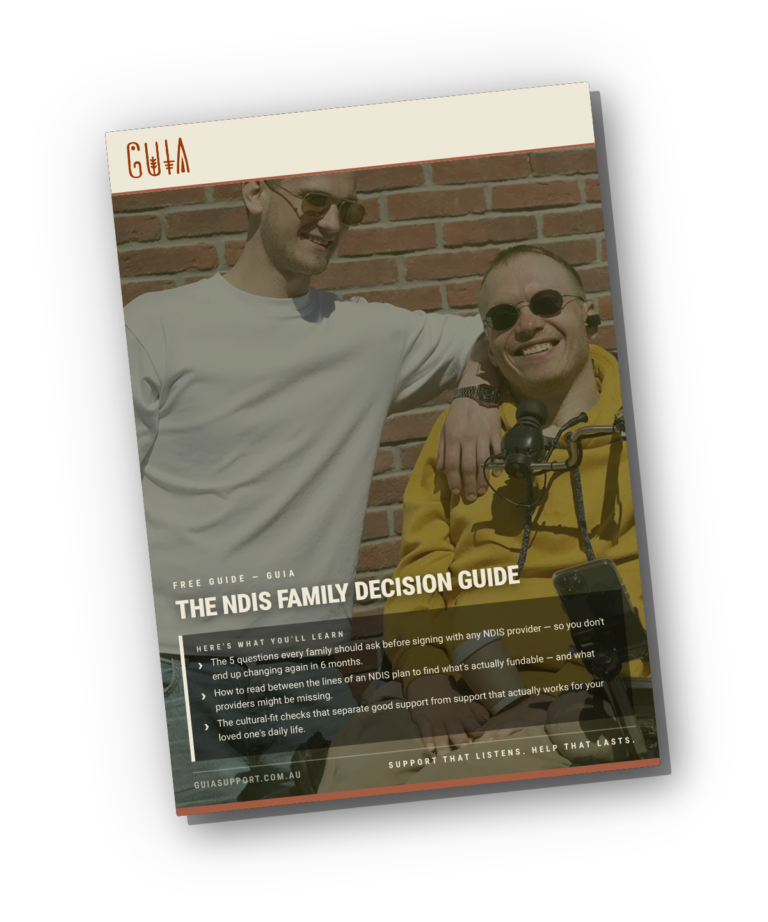
Here's What You'll Learn:
The 5 questions every family should ask before signing with any NDIS provider — so you don't end up changing again in 6 months.
How to read between the lines of an NDIS plan to find what's actually fundable — and what providers might be missing.
The cultural-fit checks that separate good support from support that actually works for your loved one's daily life.
NDIS support for psychiatric disability in South West Sydney
Psychiatric disability often means managing your own recovery while also managing how others see you. You might be building real stability—working more hours, sleeping better, showing up—but the people around you still treat you like you need protecting. Or you’re the family member watching someone you love work hard at their own independence, and you’re unsure whether stepping back means you’re being supportive or neglectful.
The right support changes that dynamic. When a support provider understands psychiatric disability—the wins that matter, the setbacks that don’t erase progress, the difference between safety and control—both you and your family can breathe. You get to make your own decisions. Your family gets consistency and trust. That’s when real independence becomes possible.
Read More - See what consistent, reliable support actually looks like
Living with a psychiatric disability means your capacity, energy, and what you need on any given day can shift without warning. You might be ready to engage one week and need to step back the next. Your family sees this pattern too—they’re managing their own concerns about consistency, safety, and whether the support you receive actually respects these natural fluctuations or punishes them. The right NDIS — National Disability Insurance Scheme support doesn’t treat these shifts as failure; it’s built to move with you.
What good support looks like in practice is straightforward: workers who show up without judgment when your energy is low, who don’t reframe your need for space as non-compliance, and who understand that recovery isn’t linear. Your family needs to see this consistency too—the same trained, reliable person arriving on schedule, knowing your patterns, and communicating openly about what’s working and what needs to adjust. This isn’t about managing you; it’s about creating the stable ground from which you can actually build independence and confidence over time.
Trauma-informed care is the foundation here. It means your support workers understand how past experiences shape your responses now, and they’re trained to recognise when you’re overwhelmed without making you feel ashamed. Recovery-oriented support builds on this—the focus is never custodial or controlling. Instead, it’s about identifying what matters to you, what small steps feel possible right now, and designing your support around those goals. Your family can see the difference immediately: you’re being asked what you want, not told what you need.
In-home daily living support and community access work together here. The first gives you the stable base—help with personal care, household tasks, whatever lets you manage the day-to-day without crisis. The second builds outward—activities, social connection, and transport that help you stay engaged with community at a pace that suits your capacity. Both are staffed by workers matched to you personally, trained in psychosocial disability support, and experienced in the rhythm of how capacity actually works. Over time, NDIS — Finding and Keeping a Job and NDIS — Social and Community Participation compound naturally alongside Psychiatric Disability — together they build the daily rhythm and outward connections that make real independence stick.
Guia has been supporting people with psychiatric disabilities across South West Sydney since 2022, NDIS-registered and Code of Conduct compliant, with a team trained in exactly this approach. Your family deserves to know the support is consistent, dignified, and genuinely recovery-focused—not just a service ticking a box. When you’re ready to explore what this looks like for you, Enquire about support.
What good support for psychiatric disability looks like
Living with a psychiatric disability often means managing good days and hard days—and sometimes wondering whether the support around you truly understands the difference. When you’re making decisions about your own life, you need a provider who speaks to you directly, not about you. When you’re supporting a family member, you need to know that person-centred approach is real, not just words on a website.
The right NDIS support for psychiatric disability in South West Sydney means you’re not caught between two separate conversations—one where the participant is heard as a capable adult, and another where family concerns about consistency and safety get sidelined. It means showing up reliably, understanding what triggers and routines matter, and building confidence over time rather than managing crisis to crisis. That’s where real independence begins.
Read More - Come talk through what could work for you
When you’re managing a mental health condition alongside NDIS support, the difference between feeling heard and feeling like a project comes down to one thing: does the provider talk to you or about you? Many families tell us they’ve sat through meetings where the conversation happened around their loved one, not with them. You deserve to be in the room as the expert on your own life. Your family needs to know that the support respects your capacity to make decisions, even on days when that capacity fluctuates. The NDIS — National Disability Insurance Scheme funds support that builds independence, not dependence. That means speaking directly to you about what matters, not treating your family as the permanent gatekeeper.
Recovery-oriented support looks different in practice. Instead of a support worker showing up to manage your day, they’re showing up to help you manage it yourself. When you’re having a harder day, they don’t step in and take over—they adjust the level of help and check in about what you actually need right now. Your family sees consistency in this approach: the same worker, the same time, the same respect for your routines. They’re not waiting for crisis moments; they’re building your confidence in the space between them. That’s what shifts the dynamic from custodial to collaborative.
Trauma-informed practice means the team understands that mental health disability often carries a history. It shapes how you respond to change, how you experience trust, and what kind of support environment helps you settle. A worker trained in this approach doesn’t take things personally when you need space. They don’t assume you’re being difficult; they recognise you might be protecting yourself. Your family can relax knowing the support worker gets this. They won’t push when you need to pull back. They’ll notice the small signals and adjust without making it a negotiation.
What this means day-to-day is straightforward. Support Coordination helps you navigate your plan without the jargon, and Psychosocial Recovery Coaching gives you someone in your corner who understands the mental health system specifically. In-home support handles the practical tasks—personal care, daily living, household help—so you can focus on what matters to you. Community Access gets you out and connected, not isolated. The mix depends on your plan and what you actually need. Your family gets visibility into how these pieces fit together and confidence that the support is building your independence, not replacing it. Over time, NDIS — Finding and Keeping a Job and NDIS — Social and Community Participation compound naturally alongside Psychiatric Disability — together they build the daily rhythm and outward connections that make real independence stick.
When you’re ready to explore what NDIS support for psychiatric disability could look like for you or your loved one, the next step is a conversation without pressure or assumptions. We’ve been supporting participants across South West Sydney since 2022, and we know this terrain. We’re NDIS-registered, all staff are qualified and worker-screened, and we’re built on lived experience of disability and family caregiving.
What happens when psychiatric support falls through the gaps
When you’re managing a psychiatric disability, the support that matters most is the kind that treats you as someone who knows your own mind—not as a condition to be managed from the outside. Yet many families find themselves caught between wanting to protect their loved one and worrying they’re stepping on independence. That tension is real, and it shouldn’t mean choosing between safety and respect.
The right NDIS support for psychiatric disability in South West Sydney works differently. It builds your confidence and your family’s peace of mind at the same time—through consistency, clear communication, and support workers who understand that recovery and independence grow together. When both you and your family feel heard in the same conversation, everything shifts.
Read More - See what consistent support actually feels like
Living with psychiatric disability means managing unpredictable days; some mornings you wake ready to engage with the world. Other days, concentration, motivation, or emotional regulation feel out of reach. If you’re directing your own NDIS plan, you need support that adjusts to your capacity without judgment. If you’re supporting a family member, you need reliability and consistency—workers who show up understanding that good days and hard days are both part of recovery. The NDIS — National Disability Insurance Scheme funds support for exactly this kind of fluctuation, but only if your provider understands what it actually looks like in practice.
Trauma-informed care isn’t a buzzword—it’s a specific operating principle. It means your support worker recognises that many people with psychiatric disability have experienced trauma, and that certain interactions (sudden changes, raised voices, feeling rushed, loss of control) can trigger distress or withdrawal. When your team is trained to notice these patterns and adjust their approach, you stay calmer and more engaged. For families, this means fewer crisis calls, less worry about whether the support is making things harder, and confidence that the person you love is in an environment designed to help them feel safe.
Capacity fluctuation is the core reality of psychiatric disability support; your energy, focus, and emotional resources change day to day, hour to hour. A provider who understands this doesn’t interpret a quiet day as laziness or resistance. They recognise it as part of your condition and work with you to identify what small steps feel manageable. This might mean a shorter outing one week, a longer one the next. It might mean shifting from a group activity to one-on-one support when you’re struggling. The mechanism is simple: when support adapts to your actual capacity, you build trust and stay engaged with your recovery goals.
Recovery-oriented support means the focus is always on what you’re building, not what you’re managing. This might look like employment assistance that helps you move toward work at your own pace, or community access that reconnects you with activities and people that matter to you. It could be support coordination that helps you understand your NDIS plan and make decisions about how to use it. The difference is subtle but real: custodial support keeps you safe but dependent. Recovery-oriented support keeps you safe and helps you move toward greater independence and control over your own life. Over time, NDIS — Finding and Keeping a Job and NDIS — Social and Community Participation compound naturally alongside Psychiatric Disability — together they build the daily rhythm and outward connections that make real independence stick.
Guia has been supporting people with psychiatric disability across South West Sydney since 2022. We’re NDIS-registered and Code of Conduct compliant, with all staff qualified and worker-screened. Our team includes Spanish-speaking and Arabic-speaking workers, because language and cultural connection matter when you’re building trust during vulnerable moments. We match participants with workers based on what feels right for you, not just availability. When you’re ready to explore what NDIS support for psychiatric disability could look like for you or your family member, Enquire about support.
How NDIS support actually works for you
Psychiatric disability affects how you experience daily routines, relationships, and your sense of safety. When you’re managing this alongside an NDIS plan, you need support that acknowledges both your capacity and your real limits — not a provider who talks about you as a case to manage.
The right support means you stay in control of your own decisions while your family knows there’s consistency, reliability, and someone trained to understand what trauma-informed care actually looks like in practice. That’s the foundation for real independence and genuine partnership.
Read More -Send us an enquiry and let’s explore what fits your situation
Send us an enquiry and let’s explore what fits your situation
When you’re living with a psychiatric disability, the difference between support that works and support that doesn’t often comes down to one thing: whether the people helping you understand that your capacity, energy, and clarity shift day to day. Good support doesn’t treat those shifts as failures. It treats them as normal. On the days when motivation feels impossible, when anxiety makes decisions harder, or when you need to step back from plans you made last week, the right provider sees that as part of —not a problem to fix. That’s what trauma-informed, recovery-oriented NDIS support for Psychiatric Disability actually looks like in practice.
For families and carers, this approach shifts something important too. Instead of managing your loved one’s support like a project—check-ing boxes, enforcing routines, being the gatekeeper between them and independence—you become part of a team that’s working toward the same goal: helping them build confidence and control over their own life. When your family member has a setback, you’re not left feeling like the support has failed. You’re working with people who expected this, planned for it, and know how to move forward without shame or judgment attached.
The mechanism here is straightforward. Fluctuating capacity is a real feature of psychiatric disability, not a bug in the person. A support worker trained in trauma-informed practice recognizes this. They don’t push harder on bad days. They don’t withdraw support on good days. They stay consistent, reliable, and flexible—showing up the same way whether you’re having your best week or your hardest one. That consistency, over time, builds trust. And trust is what allows real change to happen. For participants, that means you can take genuine risks toward your goals without fear that one difficult day will undo weeks of progress. For families, it means you can finally exhale.
Recovery-oriented support also means the work is never about keeping you stable or managing you. It’s about building your skills, confidence, and independence step by step. Whether that’s through Support Coordination to help you navigate your NDIS plan, Employment & Capacity Building to move toward work, or Community Access & Social Participation to rebuild connections and confidence, every service is designed with one direction in mind: toward what you want, not away from what you’re afraid of. The timeline is yours. Progress isn’t measured by how quiet or compliant you’re. It’s measured by what you’re able to do and choose for yourself. Over time, NDIS — Finding and Keeping a Job and NDIS — Social and Community Participation compound naturally alongside Psychiatric Disability — together they build the daily rhythm and outward connections that make real independence stick.
Guia has been supporting people with psychiatric disability across South West Sydney since 2022. Our team is NDIS-registered, trauma-informed trained, and built on lived experience of disability and family caregiving. We match support workers to participants with care—because the right person makes all the difference.
What good support looks like in practice
When psychiatric disability affects your daily life, the support you need isn’t just about managing symptoms. You need someone who shows up consistently, respects your capacity to make your own choices, and treats you as a capable adult—not a case to be managed. Your family needs to know that support strengthens your independence rather than deepening dependence on them.
That shift happens when a support provider listens to what you actually need day-to-day, works with your routines and goals, and helps you build confidence in your own decisions. Your family can step back from being the constant gatekeeper. You stay in control. Here’s what that looks like in practice with Guia.
Read More - Start a conversation about what consistent support could mean for you both
When you’re living with a psychiatric disability, what you need from support isn’t crisis management or constant monitoring. You need someone who understands that your capacity shifts day to day, and that’s not a failure on your part. Your family member needs to know that the support provider will show up reliably, respect their loved one’s autonomy, and communicate clearly about what’s actually happening. The gap between these two needs — participant independence and family confidence — is where most NDIS support for Psychiatric Disability falls short. It’s not about choosing between them. It’s about finding a provider who builds both at the same time. That’s what the NDIS — National Disability Insurance Scheme exists to fund: support tailored to your real life, not a one-size .
Trauma-informed care isn’t a buzzword here. It means your support worker has been trained to recognise that what looks like resistance or withdrawal might be a protective response, not non-compliance. When your capacity fluctuates — when anxiety spikes or motivation dips — a worker who understands this won’t interpret it as you “not trying. ” For families, it means fewer phone calls saying “your family member didn’t engage today” and more conversations about what actually happened and what helped. The shift is subtle but profound: the worker becomes curious about barriers, not judgmental about outcomes.
Recovery-oriented support means the goal isn’t managing your disability indefinitely. It’s building your confidence, independence, and capacity to make your own choices over time. This works through practical, everyday moments. A support worker might help you plan a community outing not because you can’t plan it yourself, but because planning while managing anxiety is harder — and doing it together, repeatedly, builds your skills. Your family sees this as genuine progress, not endless dependency; the support becomes an investment in your future self, not a permanent fixture.
What this looks like in practice depends on what you need right now. Some participants start with in-home support to rebuild daily routines and manage household tasks when energy is low. Others need help connecting to community — transport, social activities, employment support — to rebuild confidence and social connection. Support Coordination and Psychosocial Recovery Coaching help you and your family understand your NDIS plan and make decisions that actually fit your life. The common thread is that the support adapts as you do, and both you and your family are part of the conversation from day one. Over time, NDIS — Finding and Keeping a Job and NDIS — Social and Community Participation compound naturally alongside Psychiatric Disability — together they build the daily rhythm and outward connections that make real independence stick.
Guia has been supporting participants across South West Sydney since 2022, NDIS-registered and Code of Conduct compliant, with staff trained in trauma-informed practice and matched to you with genuine care for fit. We speak English, Arabic, and Spanish, and we listen to what you actually need — not what a says you should need. When you’re ready to explore what good support could look like, Enquire about support.
How to measure progress and wellbeing gains
When you’re managing a psychiatric disability, knowing whether your support is actually working matters more than knowing how many hours you’ve booked. You might notice small shifts—you’re sleeping better on Tuesday nights, or you made it through a difficult conversation without shutting down completely. Your family member might see you take on a task you’ve avoided for months. These moments are real proof, but they’re easy to miss if no one’s paying attention to them alongside you.
A trauma-informed approach means your support worker notices these changes without making a fuss about them. It means your family feels confident you’re being listened to as a capable adult, not managed as a case. When measurement happens this way—quietly, respectfully, focused on what actually matters to you—support stops feeling like something done to you and starts feeling like something you’re genuinely directing.
Read More - Start with a conversation about what consistent support could look like
Psychiatric disability involves far more than a single diagnosis. It’s a lived reality where your capacity, energy, and emotional regulation shift day to day—sometimes hour to hour. When you’re the participant, you need support that doesn’t treat fluctuating capacity as failure. When you’re the family member, you need consistency and reliability that acknowledges those shifts without judgment. NDIS — National Disability Insurance Scheme funding can pay for exactly this kind of responsive support, but only if the provider understands what recovery-oriented really means.
What we hear from families is that most providers deliver a timetable, not a relationship. A support worker arrives for a scheduled two-hour session, ticks off tasks, and leaves. But someone with psychiatric disability often needs something different: a person who recognises when today is a harder day, who doesn’t interpret a cancelled session as non-compliance, and who builds trust slowly enough that the participant feels safe being honest about what they actually need right now.
Trauma-informed practice isn’t a label we use lightly. It means every member of our team—from the support worker to the coordinator—is trained to recognise how past experiences shape how someone responds to stress, change, or authority. It means we ask before we act. It means we notice patterns without pathologising them. It means when you say “I can’t do this today,” we hear “I need a different approach today,” not “you’re not trying hard enough. ” That shift in interpretation changes everything about how support actually feels.
Recovery-oriented support looks different in practice. Instead of focusing on what you can’t do, we work with you on what matters to you—whether that’s staying connected to community, building toward employment, or simply managing daily tasks on the days when your capacity allows it. Support Coordination helps you navigate your plan and understand what’s available. Community Access and Social Participation can help rebuild confidence and connection at a pace that feels safe. The timeline isn’t fixed, and the goals aren’t set by us—they’re set by you. Over time, NDIS — Finding and Keeping a Job and NDIS — Social and Community Participation compound naturally alongside Psychiatric Disability — together they build the daily rhythm and outward connections that make real independence stick.
If this approach sounds like what you’ve been looking for, the next step is straightforward. We listen first, ask questions second, and only then suggest what might fit. We’re NDIS-registered, all staff are qualified and worker-screened, and we’ve been supporting people across South West Sydney since 2022. When you’re ready to explore how this kind of support could work for you or your family member, Enquire about support.
Building confidence and independence over time
Psychiatric disability often means you’re managing both your own recovery and other people’s assumptions about what you can decide. If you’re the participant, you need support that treats your judgement as sound—even on hard days. If you’re the family member, you’re watching someone you care about navigate real challenges while hoping the right help shows up consistently, without making them feel managed or diminished.
When support is trauma-informed and person-centred, that tension eases; you get reliability without control. Your family gets confidence that you’re being respected as a capable adult, not treated as a problem to solve. That shift—from feeling supported to feeling trusted—changes what recovery actually feels like.
Read More - Start with a chat about what fits your week
Psychiatric disability involves fluctuating capacity, unpredictable energy levels, and days when showing up feels impossible. You’re not lazy or unmotivated—your nervous system is managing real physiological and psychological demands. When you’re looking for NDIS support for psychiatric disability, you need providers who understand that consistency doesn’t mean rigid sameness. It means showing up reliably around your actual rhythm, not forcing you into theirs. That’s the foundation of what we do differently.
Your family member’s good days and difficult days aren’t a character flaw—they’re part of the condition. What families tell us most is that they’re exhausted from being the only person who knows the full picture. They’re managing appointments, managing crises, managing the narrative around what their loved one can do. When support arrives that’s genuinely trauma-informed, something shifts. The family stops being the sole custodian of information. The participant gets to show up as themselves, not as a problem to be solved. That’s recovery-oriented support in practice.
The difference between custodial support and recovery-oriented support comes down to one thing: does the provider assume you’re broken, or assume you’re building something. Custodial support manages risk and compliance. Recovery-oriented support manages risk AND creates space for you to develop confidence, independence, and agency over time. Our team is trained to notice capacity without judgment—to see a difficult week as information, not failure. That distinction changes everything about how support feels week to week.
Here’s what that looks like in practice. Support Coordination helps you navigate your NDIS plan and understand what’s actually available to you, without someone else deciding what you need. Employment & Capacity Building works with you on skills and confidence at whatever pace suits your condition—not a fixed timeline. Community Access & Social Participation reconnects you to people and activities that matter, which for many participants with psychiatric disability is the real medicine. None of these happen by accident. They happen because we match you with workers who get it, and we check in regularly about what’s working. Over time, NDIS — Finding and Keeping a Job and NDIS — Social and Community Participation compound naturally alongside Psychiatric Disability — together they build the daily rhythm and outward connections that make real independence stick.
When you’re ready to explore what good support actually looks like—support that treats you as capable, honours your family’s concerns, and builds your independence over time—we’re here. We’ve been supporting participants across South West Sydney since 2022, we’re NDIS-registered and Code of Conduct compliant, and our team speaks English, Spanish, and Arabic.
How to get started with Guia support
When psychiatric disability affects your day-to-day, the right support means someone who understands that recovery isn’t linear and that you’re still the expert on your own life. You need consistency, reliability, and people who treat you as capable—not as a project to manage. Your family needs the same: confidence that the support worker shows up on time, respects your boundaries, and actively helps you build independence rather than creating dependency.
That’s where a trauma-informed approach makes the real difference. When your support team understands how psychiatric disability shapes safety, routine, and trust, they can meet you where you’re without judgment. You get to direct your own decisions. Your family gets to step back, knowing the support honours that autonomy and provides the safeguards and continuity everyone needs.
Read More - Start your conversation about what consistent support actually looks like
Fluctuating capacity is the reality of living with psychiatric disability. Some days you manage tasks easily; other days the same task feels impossible. When you’re directing your NDIS plan, you need a provider who doesn’t treat inconsistency as failure. Your family member needs to know that support workers won’t disappear when capacity dips, or judge your loved one for needing help on a harder day. The NDIS — National Disability Insurance Scheme funds support that adapts to this reality, not support that expects you to perform at a fixed level every single time.
Trauma-informed support means workers understand how past experiences shape present responses. They recognise that a cancelled appointment, a raised voice, or a sudden change of plan can trigger genuine distress, not defiance. Here’s what that looks like in practice: a support worker who calls ahead before arriving, who checks in about what you need that particular day, who doesn’t take it personally when you need to reschedule. For your family, it means knowing the person supporting your loved one won’t escalate a difficult moment or blame your family member for struggling. That consistency builds trust, and trust is where real change begins.
Recovery-oriented support treats you as someone with capacity to grow, not someone to manage indefinitely. The difference is subtle but profound. Custodial support asks: “What can we do for you? ” Recovery-oriented support asks: “What would you like to build toward, and how can we help you get there? ” This might mean working toward part-time employment, reconnecting with community, rebuilding a relationship, or simply managing daily tasks with less crisis. The goal shifts from reducing problems to expanding possibilities. Your support worker becomes someone who notices your strengths and builds on them, not someone who only responds when things go wrong.
The right support makes space for your own decision-making. You’re the expert on your own life — what works, what doesn’t, what you’re ready for. A good provider listens to what you actually want, not what they think you should want. For families, this matters because it reduces the pressure on you to be the constant gatekeeper. When your family member is supported by workers trained in person-centred matching and recovery principles, they can build confidence and independence. Support Coordination and Employment & Capacity Building services help translate your goals into practical steps, whether that’s finding work, managing daily routines, or reconnecting with community. Over time, NDIS — Finding and Keeping a Job and NDIS — Social and Community Participation compound naturally alongside Psychiatric Disability — together they build the daily rhythm and outward connections that make real independence stick.
Guia has been supporting people across South West Sydney since 2022, registered with the NDIS and trained in the approaches that actually work for psychiatric disability. Our team includes workers who understand fluctuating capacity, who know how to rebuild trust after crisis, and who speak your language — English, Arabic, or Spanish.
Guia Is Trusted By NDIS Participants, Families And Support Coordinators
Imagine a life designed to empower you!




NDIS Participants South West Sydney Choose Guia
When you’re navigating psychiatric disability support, you need a provider who understands the complexity. Someone who listens to what matters most to you and your family. Guia specialises in psychiatric disability across South West Sydney because we know the territory—the local services, the cultural context, the real barriers. We don’t rush decisions or apply templates. Instead, we work alongside you to build support that fits your life, respects your choices, and helps you feel more in control. That’s the difference between support and support designed for you.
Person-Centred From the First Conversation
When you’re managing psychiatric disability, what you need from support changes day to day. We listen first—to what matters to you, your goals, your pace; then we build support around that, not around. Your support worker knows your priorities because you’ve told us. That means your visits work for you, not the other way around.
Reliable Consistency Every Single Visit
Routine matters when you’re managing psychiatric disability; the same support worker, same day, same time—every week. No strangers, no cancellations, no scrambling to reorganise your week. Families tell us this consistency lets them breathe. You know who’s coming. Your support worker knows your rhythms, your preferences, what helps. That reliability builds trust and keeps you steady.
Culturally Diverse, Multilingual Team
When your support worker speaks your language and understands your culture, you’re not starting from scratch every visit. Our multilingual team—English, Spanish, and Arabic speakers—means your faith, your family values, and your background shape how support actually happens. You get someone who gets you, not just your plan; that’s dignity built into the match from day one.
Six Years of South West Sydney Experience
When you’re managing psychiatric disability, consistency matters more than anything. Your support worker knows your routines, your triggers, your good days and hard days. We’ve been part of South West Sydney since 2022—we know the local community, the services that work, the places where you can belong. That means your team becomes part of your real network, not just a visiting service.
NDIS Quality and Safeguards Commission Compliant
When you’re managing psychiatric disability, consistency matters more than almost anything else. Every support worker at Guia holds current NDIS Worker Screening clearance and is registered and audited by the NDIS Quality and Safeguards Commission. That means the person supporting you has been vetted, trained, and held accountable to real standards. Your routine stays steady. You know who’s coming and when.
Word-of-Mouth Referrals Build Trust
Most families find us through other families who’ve already trusted us with their support. That word-of-mouth reputation matters because it means real people—not marketing—are telling you we show up reliably, treat participants with dignity, and actually listen to what matters to you. When someone you know has had a good experience, you know what to expect.
READY FOR A FREE PLAN MANAGEMENT REVIEW?
Find Unused Funding
Fix Budget Confusion
Plan Supports Better
FAQs For Psychiatric Disability
What NDIS support is available for adults with psychosocial disability?
NDIS support for adults with psychosocial disability in South West Sydney includes support coordination, employment assistance, life skills training, and community participation programs. These help you build confidence and independence at your own pace; support is tailored to what matters most to you.
What we hear from families is that consistency and reliability matter most. You need a support worker who shows up on time, understands your goals, and treats you as a capable adult making your own decisions. Our support coordinators help you navigate your plan in plain language. Employment support and community programs build real skills and connections, not just activity for its own sake.
Enquire about support — find out how Guia can help with Psychiatric Disability.
What does psychosocial disability mean under the NDIS?
Psychosocial disability refers to ongoing mental health conditions that affect daily functioning and community participation. Under the NDIS, it includes conditions like depression, anxiety, bipolar disorder, and schizophrenia. NDIS support for psychiatric disability in South West Sydney helps participants build confidence and independence in their everyday life.
If you’re a participant, you direct your own support and choose the provider that fits your needs. If you’re a family member, you’re part of that picture—your observations about what helps matter. We provide consistent, reliable support workers who understand the importance of routine and trust. Our team works with both you and your family to make sure the support feels safe and sustainable over time.
Enquire about support — find out how Guia can help with psychiatric disability.
How does support coordination help me manage my NDIS plan?
Support coordination helps you understand your NDIS plan in plain language. A Level 2 or Level 3 Specialist coordinator works with you to match services to your goals, track spending, and solve problems as they come up. Whether you’re managing NDIS support for psychiatric disability in South West Sydney or elsewhere, good coordination means you’re never guessing.
Here’s what that looks like in practice: your coordinator listens to what matters to you, then helps you find the right support workers and services. If something isn’t working, they step in. Families often tell us they appreciate having someone steady in the background who knows the system and can answer questions without judgment. You stay in control of your decisions—the coordinator is there to make sure your plan actually works for your life.
Enquire about support — find out how Guia can help with Psychiatric Disability.
Is NDIS psychosocial support the same as mental health treatment?
No. NDIS psychosocial support is not mental health treatment. Psychosocial support helps you build skills, confidence, and connections after a mental health diagnosis. It focuses on daily living, work readiness, and community participation. Mental health treatment — like counselling or medication — comes from your GP or a mental health specialist. NDIS support for Psychiatric Disability in South West Sydney works alongside treatment, not instead of it.
Here’s what that looks like in practice. You might see a psychologist for therapy, then use NDIS support to help you get to work, manage household tasks, or reconnect with friends. Your support worker isn’t a clinician — they’re someone trained to help you rebuild confidence and independence at your own pace. Families often find this clarity helpful: treatment addresses the diagnosis; support helps you live well with it. Both matter, and both are part of your plan.
Enquire about support — find out how Guia can help with Psychiatric Disability.
Does NDIS funding cover capacity building and recovery support?
Yes. NDIS funding covers capacity building and recovery support through registered providers like Guia. If your plan includes psychosocial recovery coaching or employment and capacity building, you can use those funds for support that builds your skills, confidence, and independence over time.
Here’s what that looks like in practice: a support coordinator or recovery coach works with you—and your family if you want them involved—to identify goals that matter to you. That might be building work skills, managing daily routines more independently, or reconnecting with community. The support is person-centred, which means it respects your pace and your decisions; your family stays informed and involved at the level you both choose.
Enquire about support — find out how Guia can help with Psychiatric Disability.
How do support workers handle difficult symptom days?
Good support workers plan ahead for difficult symptom days—they know what matters to you and adjust without making you feel like a burden. NDIS support for Psychiatric Disability in South West Sydney works best when your support plan includes clear, practical strategies you’ve agreed on together. Your worker shows up reliably and responds to what you actually need that day.
Here’s what that looks like in practice: you and your support worker talk through your early warning signs and what helps when symptoms are harder. Your worker might adjust the focus of a visit—swapping a community outing for quiet time at home, or breaking tasks into smaller steps. Your family stays in the loop about what’s working, so everyone’s on the same page. It’s about dignity and consistency, not crisis management.
Enquire about support — find out how Guia can help with Psychiatric Disability.
How can I build community connection with psychosocial disability support?
Building community connection with psychosocial disability support means finding activities and people that match your interests and energy. NDIS support for Psychiatric Disability in South West Sydney can include group programs, social outings, and one-to-one support that helps you connect at your own pace.
What we hear from families is that consistency matters most. A reliable support worker who shows up the same day each week, who remembers what you care about, and who listens to both you and your family creates the trust that makes real connection possible. We match participants with workers who understand psychosocial disability and can support you to join community activities that feel safe and meaningful to you.
Enquire about support — find out how Guia can help with Psychiatric Disability.
Can NDIS support help me work or study?
Yes. NDIS support can help you work or study by building skills, confidence, and practical pathways toward employment or education goals. Employment and Capacity Building support in South West Sydney includes job-readiness training, workplace support, and ongoing advocacy tailored to your needs.
Here’s what that looks like in practice: you work with a support worker who understands your goals and what you need to get there. If you’re studying, we help with life skills and transition planning. If you’re working toward employment, we support job searching, interview prep, and settling into a role. Your family stays informed and involved at every step—no surprises, consistent communication, and clear next moves together.
Enquire about support — find out how Guia can help with Psychiatric Disability.
How can families stay involved in my support planning?
Your family stays involved because you’re in control of your own decisions. In NDIS support for psychiatric disability across South West Sydney, we work with both you and your family—but always on your terms. You decide who’s in the conversation and when.
Here’s what that looks like in practice; we’ll ask you upfront how involved your family should be. Some participants want family at every planning chat. Others prefer updates only. We respect that choice completely. Your family gets clarity on what support you’re receiving and can raise concerns directly with us. You stay the decision-maker. That’s how dignity and family involvement work together.
Enquire about support — find out how Guia can help with Psychiatric Disability.
How do I access NDIS support for psychosocial disability?
NDIS support for psychosocial disability in South West Sydney starts with a registered NDIS plan. If you have a diagnosis affecting your mental health or wellbeing, you may be eligible. Your support coordinator or the NDIS can explain eligibility and help with planning.
What we hear from families is that having consistent, trained support makes real difference. A support worker who understands psychosocial disability can help with daily routines, community connection, and building confidence over time. You stay in control of your decisions—we’re here to support what matters to you.
Enquire about support — find out how Guia can help with Psychiatric Disability.
Reach out for a non-obligation NDIS Plan Management Assessment
ARE YOUR NDIS SUPPORTS WORKING FOR YOU?
GET A FREE NDIS PLAN MANAGEMENT REVIEW