
NDIS support for Vision impaired South West Sydney
NDIS support for Vision impaired South West Sydney
Support That Respects Your Independence: NDIS support for Vision impaired South West Sydney
NDIS support for Vision impaired South West Sydney
NDIS support for Vision impaired South West Sydney
Support That Respects Your Independence: NDIS support for Vision impaired South West Sydney
ARE YOUR NDIS SUPPORTS WORKING FOR YOU?
GET A FREE NDIS PLAN MANAGEMENT REVIEW
NDIS support for Vision impaired South West Sydney means different things depending on . If you’re vision impaired yourself, you’re looking for support that treats you as the decision-maker about your own life — someone who knows what matters to you and wants help making it happen. If you’re a family member or carer, you’re probably researching how to find reliable, respectful support that lets your loved one stay independent while giving you confidence they’re safe and looked after.
This page walks through how Guia works with vision impaired participants and their families across South West Sydney. We cover the kinds of support that actually make a difference day-to-day — from help at home to getting out into the community — and how the NDIS — National Disability Insurance Scheme funds it. Our team speaks English, Spanish, and Arabic, and every support worker is qualified and screened. When you’re ready to explore what support might look like for you or your loved one, NDIS — Home Modifications tells you what happens next.
NDIS support for Vision impaired South West Sydney means different things depending on . If you’re vision impaired yourself, you’re looking for support that treats you as the decision-maker about your own life — someone who knows what matters to you and wants help making it happen. If you’re a family member or carer, you’re probably researching how to find reliable, respectful support that lets your loved one stay independent while giving you confidence they’re safe and looked after.
This page walks through how Guia works with vision impaired participants and their families across South West Sydney. We cover the kinds of support that actually make a difference day-to-day — from help at home to getting out into the community — and how the NDIS — National Disability Insurance Scheme funds it. Our team speaks English, Spanish, and Arabic, and every support worker is qualified and screened. When you’re ready to explore what support might look like for you or your loved one, NDIS — Home Modifications tells you what happens next.
The NDIS Family Decision Guide
Helping Australian families make confident NDIS decisions for the person they care about — without the jargon, the runaround, or the regret.
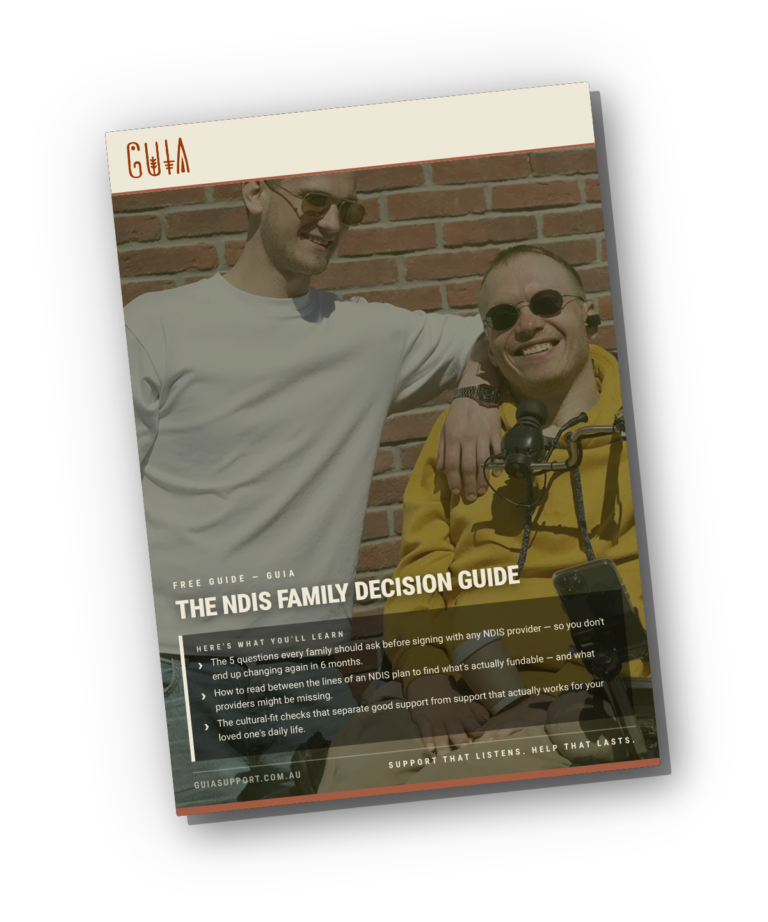
Here's What You'll Learn:
The 5 questions every family should ask before signing with any NDIS provider — so you don't end up changing again in 6 months.
How to read between the lines of an NDIS plan to find what's actually fundable — and what providers might be missing.
The cultural-fit checks that separate good support from support that actually works for your loved one's daily life.
NDIS support for vision impaired in South West Sydney
Vision impairment changes how you navigate daily life, but it doesn’t change who you are or what you’re capable of deciding. When you’re looking for NDIS support for vision impaired people in South West Sydney, you need workers who understand that distinction—people trained to describe what’s happening around you, not manage you through it. Too often, support feels like being talked about rather than talked to, which leaves you sidelined from your own decisions.
When support workers are trained in safe, descriptive communication, everything shifts. You stay in control of your choices. Your family sees consistency and reliability instead of worrying about whether you’re being treated as a capable adult. That’s the kind of partnership that actually builds independence over time, not dependence on someone else’s interpretation of what you need.
Read More - See what consistent support actually feels like
Good support for people with vision impairment means workers who understand how to describe their environment clearly, move safely alongside you, and respect your independence without stepping in unnecessarily. When you’re searching for NDIS — National Disability Insurance Scheme support across South West Sydney, you need providers who treat you as the expert on your own life — not as someone to be managed. Your family needs to know that the person supporting you has the training and mindset to build your confidence over time, not create dependency.
Here’s what that looks like in practice. A support worker trained in vision-impaired assistance doesn’t rush you through your day or make decisions for you. They describe what’s around you — “the kettle’s on your left, the bench is clear ahead” — so you can move with certainty. They learn your routines, your preferences, your pace. They show up reliably on the same day and time each week. For your family, this consistency means you can trust that someone qualified is there, and that they’re actively helping you build the skills and confidence to do more, not less.
Vision impairment affects how you navigate daily tasks, but it doesn’t define what you can do or decide. The support you need is specific: help with reading documents in formats you can access, assistance orienting to new spaces, confidence-building for community access. This isn’t about replacing your ability to choose — it’s about removing the barriers that make choosing harder. When support is designed this way, independence grows.
Guia’s team includes workers trained in safe, descriptive support tailored to how you navigate the world. We match you with someone who fits your communication style and goals, not just whoever is available. Your family gets regular check-ins on how the support is working, what’s shifting for you, and whether the arrangement still fits. We offer In-Home Daily Living & Personal Care Support and Community Access & Social Participation — both built around your pace and your decisions, not ours. Over time, NDIS — Home Modifications and NDIS — Daily Living Supports compound naturally alongside Vision impaired — together they build the daily rhythm and outward connections that make real independence stick.
What good support looks like for vision impaired people
Vision loss changes how you move through your home and your community. When you’re the person living with vision impairment, you need support workers who understand how to describe a room, guide you safely, and treat you as someone making your own choices—not someone being managed. When you’re the family member, you need to know the person supporting your loved one has real training in safe, dignified assistance tailored to vision loss.
The difference between daily living support and support designed for vision impairment is concrete: a worker trained to describe what’s ahead, to use consistent language about your home layout, to respect your independence while keeping you safe. That consistency builds your confidence and your family’s peace of mind. Here’s what that looks like in practice with Guia.
Read More - Come talk through what could work for you
Vision impairment shapes how you navigate daily life — from moving safely around your home to managing personal care, reading information, and staying connected to community. If you’re an adult with vision loss looking for support, or you’re a family member helping someone you care about, NDIS support for vision impaired people across South West Sydney can make a real difference. But good support isn’t about doing everything for you. It’s about understanding what you can do independently, what you need help with, and building your confidence over time. The NDIS — National Disability Insurance Scheme recognises vision impairment as a permanent condition affecting daily living, and funds support that helps you stay safe, independent, and connected to the people and places that matter.
What good support looks like in practice: a support worker who arrives on time, describes their actions clearly as they help, and learns your home layout so you can move around with confidence. They know that vision impairment doesn’t mean you can’t make decisions about your own life — it means you might need information presented differently, or a hand to steady you on unfamiliar stairs. A worker trained in this way doesn’t take over; they work alongside you. They notice when you’re ready to try something yourself, even if it takes longer. That shift — from being managed to being supported — changes how you feel about asking for help.
Many families tell us they’ve searched for providers who actually understand what their family member needs. The challenge isn’t finding someone willing to help. It’s finding someone who treats the participant as a capable adult, who communicates clearly with both of you, and who shows up consistently. Vision loss affects each person differently. One person might navigate their home independently but need support with shopping and transport. Another might need help with personal care and cooking. Neither is “high” or “low” support — they’re just different. Good providers take time to understand your specific situation before they start, and they adjust as things change.
Guia supports people with vision impairment through In-Home Daily Living and Personal Care Support, which covers personal care, household tasks, and safe movement around your home. We also offer Community Access and Social Participation, so you can get out to places that matter to you — whether that’s work, social groups, appointments, or just time in your community — with someone who knows you and your needs. Our support workers are trained, screened, and matched to you as a person, not assigned at random. We operate across South West Sydney, and our team speaks English, Arabic, and Spanish, so language doesn’t create a barrier to good communication. Over time, NDIS — Home Modifications and NDIS — Daily Living Supports compound naturally alongside Vision impaired — together they build the daily rhythm and outward connections that make real independence stick.
If you’re ready to explore what the right support could look like for you or your family member, there’s no pressure to have all the answers yet. We understand the NDIS can feel complicated, and choosing a provider is a big decision. When you’re ready to have a conversation — whether that’s about what’s possible, what we offer, or how we work — Enquire about support.
What happens without the right support coordinator
Vision impairment changes how you navigate daily life—but it doesn’t change who you are or what you’re capable of deciding. When you’re looking for NDIS support in South West Sydney, you need workers who describe the world to you clearly, who respect your independence, and who treat you as the expert on your own life. Your family needs to know those same workers show up reliably and understand what safe, dignified support actually looks like.
The right support means you stay in control of your choices while your family gains the confidence that consistency and training are built into every shift. That’s when real independence grows—not because someone does things for you, but because the support is steady enough that you can focus on what matters most to you.
Read More - See what consistent support actually feels like
Vision loss changes how you navigate daily life, but it doesn’t change your capacity to make decisions about your own support. Yet many NDIS provider websites talk about vision-impaired participants in the third person, as though the decision belongs to the family alone. That approach misses something very important: you’re the expert on what you need, and your family’s role is to ensure consistency and safety—not to gatekeep your choices. NDIS — National Disability Insurance Scheme funding exists to support both your independence and your family’s peace of mind at the same time.
Support workers trained in vision-impaired needs understand that descriptive language, consistent routines, and spatial awareness aren’t extras—they’re the foundation of safe, dignified help. When a support worker describes where things are in your home, or narrates what they’re doing before they do it, they’re not being overly cautious. They’re treating you as a capable adult who deserves to know what’s happening around you. That specificity builds trust, reduces anxiety for both you and your family, and means support feels like partnership, not management.
Accessible information in your preferred format—large print, audio, Braille, or digital—isn’t a courtesy. It’s the difference between understanding your NDIS plan and having to rely entirely on someone else to explain it to you. When information is truly accessible, you can make informed choices about your own support without needing constant interpretation from family or carers. That independence extends beyond daily tasks into the decisions that shape your life.
Here’s what that looks like in practice: a support worker arrives on time, knows your home layout, speaks clearly about what they’re doing, and respects your routines. They help with personal care, household tasks, or community outings—whatever your plan covers—without making you feel like you’re being done to. Over time, consistent support builds your confidence to try new things, whether that’s independent community access or employment. We support participants who are building toward greater independence, and we work alongside families to ensure that happens safely and reliably. In-home daily living support and community access are often the starting point for vision-impaired participants in South West Sydney. Over time, NDIS — Home Modifications and NDIS — Daily Living Supports compound naturally alongside Vision impaired — together they build the daily rhythm and outward connections that make real independence stick.
If you’re vision-impaired and searching for NDIS support that speaks to you directly while reassuring your family, or if you’re a family member wanting a provider who treats your loved one as a capable adult, the next step is straightforward. We’ve been supporting participants and families across South West Sydney since 2022—NDIS-registered, Code of Conduct compliant, and built on lived experience of disability and family caregiving. When you’re ready to explore what good support looks like, Enquire about support.
How NDIS support works for vision impaired people
Vision impairment changes how you move through daily life—but it doesn’t change or what you’re capable of deciding. When you’re looking for NDIS support for vision impaired people in South West Sydney, you need workers who see you as a person first, not a set of tasks to manage. Too often, support feels like it’s being done to you rather than with you, especially when family members are involved in the conversation.
The right support worker describes what’s happening around you clearly, respects the choices you make about your own life, and helps your family understand their role as backup—not gatekeeper. When that clicks into place, independence doesn’t disappear. It shifts. You move with more confidence, your family relaxes, and everyone knows exactly what to expect.
Read More -Send through a quick enquiry and let’s map out what works for you both
Send through a quick enquiry and let’s map out what works for you both
Vision loss changes how you navigate daily tasks, but it doesn’t change your capacity to direct your own life. When you’re searching for NDIS support for vision impaired people in South West Sydney, you’re looking for workers who understand this distinction. They should speak to you as a capable adult making decisions about your own support — not describe you in third person to your family. The NDIS — National Disability Insurance Scheme funds support that builds your independence, not maintains your dependence. That means training support workers to provide descriptive guidance, respect your preferred routes and routines, and step back as your confidence grows.
What this looks like in practice: a support worker who describes the layout of a new space rather than leading you by the arm, who learns your preferred communication style before the first visit, and who asks what you need instead of assuming. Your family member sees consistency — the same worker, reliable timing, and genuine knowledge of your preferences — which builds trust over time. When a worker shows up knowing your kitchen layout, your preferred shopping route, and how you like information presented, both you and your family feel the difference immediately.
Independence-building support doesn’t mean stepping back entirely. It means matching the level of guidance to what you actually need on any given day. Some days you need detailed verbal description; other days a light touch is enough. A worker trained in vision loss understands this shifts, and they adjust without making you feel like you’re failing. They also know that accessible information — large print, audio, or Auslan — isn’t a luxury add-on; it’s how you access the same information your support coordinator or family member receives in standard format.
Guia supports people with vision impairment across South West Sydney through In-Home Daily Living & Personal Care Support and Community Access & Social Participation. We match you with workers trained in safe, descriptive support techniques specific to vision loss. Our team includes Spanish-speaking and Auslan-trained workers, and we provide information in your preferred accessible format — because how you receive information about your own support matters as much as the support itself. We’ve been operating since 2022, we’re NDIS-registered, and every staff member is qualified and worker-screened. Over time, NDIS — Home Modifications and NDIS — Daily Living Supports compound naturally alongside Vision impaired — together they build the daily rhythm and outward connections that make real independence stick.
When you’re ready to explore what good support looks like, start a conversation with us. We listen to what you need and what your family needs, and we match you with someone who gets both.
How Guia supports vision impaired participants
Vision impairment shapes how you move through your day, navigate your home, and connect with people around you. When you’re looking for NDIS support for Vision impaired South West Sydney, you need workers who understand not just what you can’t see, but how to describe what’s happening so you stay safe, informed, and in control.
Your family member wants to know support is reliable and dignified—that the person helping them isn’t managing their independence but building it. When workers are trained to describe spaces, changes, and tasks clearly, both of you can trust the support is working toward real capability, not dependence.
Read More - When you're ready, we're here to listen and help you both move forward
When you’re vision impaired, the difference between good support and poor support often comes down to how a support worker describes the world around you. Poor support assumes you need everything done for you. Good support describes what’s there, waits for your instruction, and treats you as the decision-maker in your own home. That distinction matters because it shapes whether support builds your independence or deepens your reliance on others. The NDIS — National Disability Insurance Scheme funds support that’s meant to do exactly that — help you direct your life, not manage it for you. When families are researching support, they’re often looking for someone who understands this balance.
Here’s what that looks like in practice. A support worker trained in safe, descriptive support doesn’t say “I’ll get your breakfast ready. ” They say “There’s a kettle on the bench to your left, the cereal box is in the cupboard above, and I can help you locate things if you’d like. ” They describe the space. They wait. They only step in when you ask. Over weeks and months, you learn the layout of your own kitchen without losing the confidence that someone’s there if you need them. Your family sees you becoming more capable, not more dependent. That’s the shift that happens when workers understand vision impairment as a difference in how you navigate the world, not as a reason to take over.
Accessible information in your preferred format is another mechanism that changes everything. Some participants prefer large print, others Braille, others audio descriptions. Some families need written summaries they can review at their own pace. When a provider assumes one format fits everyone, information becomes a barrier instead of a bridge. We work with you to understand how you prefer to receive information — whether that’s about your support plan, your schedule, or changes to your routine — and we deliver it that way consistently. This isn’t a nice-to-have; it’s how you stay in control of your own plan and your own decisions. Families also benefit because they’re not the only translator between you and your support.
The practical mechanics of reliable support matter just as much as the philosophy behind it. When you arrange in-home daily living support or community access activities, you need to know that the same trained worker will show up at the same time, every time. Cancellations and last-minute changes aren’t minor inconveniences — they’re disruptions to the routines and independence you’ve built. Guia operates across South West Sydney with staff qualified in safe support practices and screened to work in your home. We also offer support coordination to help you navigate your NDIS plan and match you with workers who understand vision impairment specifically. That continuity and consistency is how support becomes reliable rather than stressful. Over time, NDIS — Home Modifications and NDIS — Daily Living Supports compound naturally alongside Vision impaired — together they build the daily rhythm and outward connections that make real independence stick.
How you'll know support is making a difference
When you’re managing vision impairment, the small details matter most; how a support worker describes the layout of your kitchen. Whether they remember you prefer the kettle on the left side of the bench. How they check in before moving something, rather than just doing it. These aren’t luxuries — they’re the difference between feeling capable and feeling managed.
The right NDIS support for vision impaired people in South West Sydney means workers trained to support your independence, not replace it. Your family gets consistency and reliability. You get dignity, choice, and the chance to direct your own day. That’s what happens when support is designed around how you actually live.
Read More - See how other families in South West Sydney got started here
Good support for vision-impaired participants means workers who understand how to describe what’s happening, not assume what you already know. When a support worker enters your home or joins you in the community, they’re not there to make decisions for you—they’re there to provide information and assistance in the way that works best for you. This is the foundation of NDIS — National Disability Insurance Scheme support that actually builds independence rather than replacing it. Guia’s team receives training in descriptive, safety-focused support that respects your autonomy as a capable adult making your own choices.
For families and carers, this shift matters deeply. When you’re supporting someone with vision impairment, you’re often the first point of contact for a new support worker. You want to hand over responsibility gradually—not all at once, and not never. A worker trained in vision-impaired support knows how to orient themselves in an unfamiliar space, describe obstacles clearly, and ask what help is actually needed rather than guessing. That consistency and reliability means you can step back with confidence, knowing the support is dignified and person-centred.
Information access is where many participants and families hit a wall. You’re searching for support, but the websites, forms, and provider materials aren’t available in the format you need—large print, audio, digital accessible formats, or your preferred language. Guia provides information in multiple formats and languages including English, Spanish, and Arabic, because access to clear information is the first step toward making your own decision about support. When you can read or hear the details, you’re not dependent on someone else to interpret them for you.
The practical side of in-home support matters just as much as the philosophy behind it. A two-hour Tuesday morning visit might include personal care, help with household tasks, or preparation for a community outing—whatever your NDIS plan funds and whatever you’ve decided you need that week. Guia’s workers show up on time, every time, and they’re trained to work with you on building skills and confidence over time, not just completing tasks. This kind of consistent, reliable support is registered under our NDIS registration (Reg # 4050144502) and guided by the NDIS Code of Conduct. Over time, NDIS — Home Modifications and NDIS — Daily Living Supports compound naturally alongside Vision impaired — together they build the daily rhythm and outward connections that make real independence stick.
When you’re ready to explore what NDIS support for vision-impaired participants looks like in practice, the next step is straightforward. You can speak with Guia about your situation—what daily support would help you build independence, what community access or employment support might open up, or how support coordination could help you navigate your plan with confidence. Both you and your family member can ask questions and understand exactly how the support works before committing to anything.
Building independence and confidence over time
Vision impairment changes how you navigate daily tasks, but it doesn’t change what you’re capable of deciding. You know what independence looks like for you. The challenge is finding support workers who understand that—who describe what’s happening around you clearly, who respect your choices, and who treat you as the person directing your own life, not as someone being managed.
When support for vision impaired people in South West Sydney gets this right, everything shifts. You move through your day with confidence because you trust the information you’re getting. Your family feels secure knowing trained workers are there—consistent, reliable, describing the world as you need it described. That’s the foundation for real independence.
Read More - Start the conversation about what consistent support could look like
Vision loss changes how you navigate daily life, but it doesn’t change your capacity to make decisions about your own support. When you’re looking for NDIS support for vision impaired adults in South West Sydney, you need providers who speak to you directly—not about you—and who understand that good support builds your independence, not deepens your reliance on others. The NDIS — National Disability Insurance Scheme funds this kind of practical help, and the right provider makes the difference between support that feels controlling and support that feels like a genuine partnership.
Here’s what that looks like in practice. A support worker trained in vision-impaired access doesn’t describe your home in vague terms—they name specific objects, locations, and hazards so you can build a clear mental map and move with confidence. They learn your preferred communication style: some people want detailed descriptions, others prefer minimal narration and tactile guidance. Your family member sees consistency in who arrives, when they arrive, and what they’re trained to do—no last-minute changes, no guesswork about whether this week’s worker knows how to support you safely.
Independence with vision loss is built on reliable information and safe routines. Many families tell us they’ve had support workers who meant well but didn’t understand that describing a room’s layout, a meal’s contents, or a task’s steps is not patronising—it’s essential. The mechanism is simple: when you have clear, consistent information delivered the same way each time, your confidence grows and your actual independence expands. You stop needing to ask “where is that? ” because you’ve learned the pattern. Over time, that’s what shifts—not your vision, but your sense of control over your own space and choices.
Guia’s approach centres on person-centred matching and worker training specific to vision loss. We provide support through In-Home Daily Living & Personal Care Support and Community Access & Social Participation—both built on the principle that you direct the support, not the other way around. Your family member has access to reliable, trained workers who show up consistently and understand the practical detail that makes real difference: how to guide safely, how to communicate clearly, how to respect your problem-solving capacity even while providing the physical or informational help you need. Over time, NDIS — Home Modifications and NDIS — Daily Living Supports compound naturally alongside Vision impaired — together they build the daily rhythm and outward connections that make real independence stick.
If this sounds like the kind of support you’re after—where you’re treated as the expert in your own life and your family has confidence in consistency and safety—here’s what happens next. We’re NDIS-registered, Code of Conduct compliant, and our team is trained and worker-screened. We’ve been supporting people across South West Sydney since 2022. When you’re ready to explore what good support actually looks like for your situation, Enquire about support.
How to get started with vision impaired support
Vision impairment changes how you navigate daily tasks, but it doesn’t change what you’re capable of deciding. You know what matters to you—whether that’s staying in your own home, getting to work, or spending time with people you care about. The right support means having someone who describes what’s happening around you clearly, respects your independence, and helps you move through your day with dignity.
Your family member sees the same thing: a person who deserves support that treats them as the adult making their own choices, not as someone being managed. When support workers are trained to communicate in ways that work for vision impairment—clear descriptions, consistent routines, time to ask questions—both of you feel the difference. That’s when independence actually grows, and when families can step back from being the constant go-between.
Read More - Start a conversation about what consistent support actually looks like
Vision impairment means navigating the world without the visual cues most sighted people rely on. You’re managing daily tasks, travel, and independence with a different toolkit. Your family is often researching support options while you’re deciding what kind of help actually fits your life. The right NDIS support works with both of you — treating you as the decision-maker while giving your family the confidence that consistency and safety are built in. Understanding how NDIS — National Disability Insurance Scheme funds support for vision impairment is the starting point.
Support workers trained in safe, descriptive assistance make a real difference. Instead of guessing or being over-helped, you get workers who describe their actions before they move, who explain the layout of a space, who let you lead the pace. Your family stops worrying about whether the support worker understands your specific needs — they see someone who communicates clearly and respects your independence. This isn’t just about dignity; it’s about building your confidence to do more, not less, over time.
Accessible information matters as much as the support itself. Letters in large print, documents read aloud, communication in your preferred format — these aren’t extras. They’re how you stay informed about your own plan and choices. When information comes to you in a way you can actually use, you’re not dependent on someone else to interpret it for you. That shift from relying on explanation to accessing information directly is how real independence grows.
The practical side involves matching you with workers who understand vision impairment and respect your routines. In-home support for daily living tasks, community access that gets you where you want to go, and help building skills for greater independence — these services work together. Your family sees a provider who shows up on time, communicates what’s happening, and treats you as a capable adult. Guia has been supporting people across South West Sydney since 2022, NDIS-registered and Code of Conduct compliant, with staff who are qualified and worker-screened. Over time, NDIS — Home Modifications and NDIS — Daily Living Supports compound naturally alongside Vision impaired — together they build the daily rhythm and outward connections that make real independence stick.
When you’re ready to explore what good support looks like for your situation, the next step is straightforward. You and your family can talk through what matters most — whether that’s rebuilding confidence in daily tasks, accessing the community more independently, or navigating your NDIS plan with clearer guidance. There’s no rush and no pressure.
Guia Is Trusted By NDIS Participants, Families And Support Coordinators
Imagine a life designed to empower you!




NDIS Participants South West Sydney Choose Guia
If you’re vision impaired navigating NDIS support in South West Sydney, you’re looking for a provider who understands what independence actually means to you—and who treats you as the expert on your own life. That’s where our specialist focus matters. We’ve built our approach around the real needs of vision impaired participants and families: reliable support workers matched to your preferences, practical help with daily living and community access, and coordinators who speak plain language about your plan. You make the decisions. We provide the consistency, the safeguards, and the local knowledge that makes those decisions work.
Person-Centred From the First Conversation
When you’re navigating daily life with vision impairment, consistency matters more than anything. We listen first—to what you need, how you prefer to move through your day, what independence looks like for you. Then we match you with the same support worker who learns your home, your routines, your goals. That reliability means you can focus on living, not managing constant change.
Reliable Consistency Every Single Visit
When you’re vision impaired, routine and trust matter deeply. The same support worker every visit means they know your home, your preferences, your pace. You plan your week around a schedule you can rely on—no last-minute changes, no strangers learning your layout. That consistency gives families peace of mind and participants the dignity of genuine continuity.
Culturally Diverse, Multilingual Team
When your support worker speaks your language and understands your culture, support feels personal, not just procedural. Our multilingual team—English, Spanish, Arabic—arrives ready to listen to what matters to you, not just what’s written in your plan. That means your routines, your faith, your background shape how we support you; you get dignity and practical help, together.
Six Years of South West Sydney Experience
Finding support workers who understand your community matters. We’ve been part of South West Sydney since 2022, so your support team knows local services, accessible transport routes, and community spaces where you’ll actually want to spend time. You’re not starting from scratch with someone unfamiliar—you’re building on existing local connections from day one.
NDIS Quality and Safeguards Commission Compliant
When you’re navigating support for vision impairment, you need providers you can trust completely. We’re NDIS Quality and Safeguards Commission registered and every support worker holds current screening clearance. That means consistent, accountable care from people qualified to work with you. No shortcuts, no surprises—just reliable support that respects your independence and keeps you safe.
Word-of-Mouth Referrals Build Trust
Most families who support us found us through other families. Word-of-mouth matters because it means real people have trusted us with someone they love. You’ll work with staff who are screened, qualified, and matched to you personally—not rotated through a system. That consistency builds the reliability you need when vision impairment means routine and familiarity matter most.
READY FOR A FREE PLAN MANAGEMENT REVIEW?
Find Unused Funding
Fix Budget Confusion
Plan Supports Better
FAQs For Vision impaired
What NDIS support is available for adults with vision impairment?
If you have vision impairment, NDIS support in South West Sydney can help you stay independent at home and connected to your community. We offer daily living support, community access, employment assistance, and home modifications tailored to your needs and goals.
Whether you’re directing your own plan or a family member is helping you navigate it, we match you with support workers who understand vision impairment and respect your choices. We’re here to build your confidence and independence over time, with reliability you can count on.
Enquire about support — find out how Guia can help with vision impairment.
Can NDIS fund a white cane, magnifier, or screen reader?
Yes, the NDIS can fund assistive technology like white canes, magnifiers, and screen readers. These are classified as mobility or communication equipment under your NDIS plan. Your support coordinator or planner can help you understand what’s available within your plan and how to access it.
Here’s what that looks like in practice: you’ll work with your support coordinator to identify which tools match your goals and daily routine. Once approved, we can help connect you with suppliers and trainers in South West Sydney. Your family stays informed at every step, and we make sure you’re confident using the equipment before support ends.
Enquire about support — find out how Guia can help with vision impaired support.
What mobility equipment and training does Guia offer for vision impaired participants?
Mobility training under the NDIS for vision impairment focuses on building confidence and independence in everyday spaces. Support workers trained in orientation and mobility techniques help you navigate your home, community, and local areas safely. This might include learning routes to shops, transport stops, or workplaces with consistent, patient guidance.
What we hear from families is that consistency matters most. A support worker who learns your preferences, your neighbourhood, and your pace builds trust over time. You direct the goals — whether that’s moving around home independently or accessing community activities. We match you with workers who understand vision impairment and show up reliably, so both you and your family know what to expect.
Enquire about support — find out how Guia can help with vision impairment.
What daily living skills can support workers help with?
A support worker can help with everyday tasks that vision impairment makes harder. This includes meal preparation, household management, personal care, and navigating your home safely. NDIS support for vision impaired in South West Sydney is tailored to what matters most to you.
Whether you’re directing your own support or a family member is helping you plan, the focus is on building your confidence and independence. A support worker might help with shopping, organising your space so it works for you, managing bills and correspondence, or getting out into the community. The goal is practical, dignified help that respects your choices and routines.
Enquire about support — find out how Guia can help with vision impaired.
Can NDIS support help me travel independently with vision impairment?
Yes. NDIS support can help you travel independently if you’re vision impaired. In South West Sydney, support coordinators and employment specialists work with you to build confidence and skills for getting around safely. This might include orientation and mobility training, travel planning, or a support worker to accompany you on trips you choose.
What we hear from families is that independence looks different for everyone. Some participants want to travel solo with mobility aids and route planning. Others prefer a trusted support worker alongside them. Either way, the goal is your confidence and control. We match you with staff who understand vision impairment and respect your decisions about where you go and how.
Enquire about support — find out how Guia can help with vision impaired travel and independence.
How do I find a support worker who understands vision impairment?
Finding a vision-impairment-trained support worker in South West Sydney starts with telling us what matters most. We match participants with support workers who understand vision loss and how it shapes daily life. NDIS support for vision impaired in South West Sydney works best when the match feels right.
Here’s what that looks like in practice: you tell us about your routines, your home, and what independence means to you. We listen to families too—we know you’re often the first to notice what works and what doesn’t. We then connect you with a worker trained in vision-aware support, reliable enough to show up on time every time, and matched to your communication style and needs.
Enquire about support — find out how Guia can help with vision impaired support.
Does NDIS fund orientation and mobility training for vision impaired participants?
Orientation and mobility training teaches people who are blind or have low vision how to move safely and independently through their home, workplace, and community. The NDIS can fund this training as part of your support plan if it’s listed in your approved goals.
Here’s what that looks like in practice: a trained orientation and mobility specialist works with you to build confidence navigating familiar routes, using canes or guide dogs, and managing stairs, crossings, and public transport. Your family can be part of planning how this fits your daily life. We match you with support workers who understand your pace and routines, so you’re building real independence—not just completing sessions.
How do I stay employed with vision impairment?
NDIS support can help you stay employed by providing workplace adjustments, assistive technology, and ongoing support tailored to your vision needs. Employment & Capacity Building services in South West Sydney include job coaching, skills training, and advocacy with your employer to make your role work for you.
Whether you’re directing your own plan or a family member is helping you navigate this, we match you with support workers who understand vision impairment and what you need to perform well at work. We focus on building your confidence and independence, not managing you. Your family can be part of planning how support fits around your work schedule and goals.
Enquire about support — find out how Guia can help with vision impairment.
Does NDIS fund accessible technology and home modifications?
Yes, the NDIS funds accessible technology and home modifications for vision impaired participants. This includes screen readers, magnification software, mobility equipment, and home changes that improve safety and independence. Your NDIS plan can cover these supports across South West Sydney.
If you’re vision impaired, you direct how these funds are used to suit your goals. If you’re supporting a family member, we help ensure the technology and modifications actually work for everyday life. We can discuss what equipment makes sense, how to fund it, and how to get training so it works for you. When you’re ready, we’ll help match you with support that respects your choices.
Enquire about support — find out how Guia can help with vision impaired support.
How do I choose a provider to support my vision care needs?
Starting an NDIS plan focused on vision impairment support begins with eligibility. You’ll need to apply to the NDIS and go through their assessment process. Once approved, your plan will include funding for supports tailored to your vision needs and goals.
If you’re a participant, you’ll direct how that funding is used and which providers support you. If you’re a family member or carer, you’re part of those conversations—your insights about daily routines, safety, and what works at home matter. Here in South West Sydney, we match you with support workers who understand vision impairment and show up reliably. We can help with daily living tasks, community access, and the practical adjustments that build your confidence and independence.
Enquire about support — find out how Guia can help with vision impaired support.
Reach out for a non-obligation NDIS Plan Management Assessment
ARE YOUR NDIS SUPPORTS WORKING FOR YOU?
GET A FREE NDIS PLAN MANAGEMENT REVIEW