


New NDIS plan: your first 30 days, in order
A new plan arrives and nothing tells you what to do first. Here is the order we work through with families in South West Sydney, and the two mistakes that cost the most.


NDIS group activities work best when the same support worker shows up reliably, week after week. Families tell us consistency matters more than variety—your family member learns to trust that person, builds a real relationship, and feels safe trying new things. The NDIS funds community access through your plan, but the quality of that experience hinges on whether the provider treats reliability as non-negotiable.
When a support worker becomes familiar, your family member relaxes. They stop spending energy on “who is this person” and start focusing on the activity itself. That’s when confidence builds. Community access isn’t just about getting out—it’s about building real connections to people and places. A consistent team member notices what your family member enjoys, remembers their preferences, and adapts without being asked.
Here’s what that looks like in practice: the same support worker arrives on the scheduled day and time, every time. They know your family member’s communication style, dietary needs, and sensory preferences. They’re trained and screened. If your family member speaks Arabic or Spanish at home, we match them with a support worker who speaks that language. That’s how support workers become part of your extended team, not just a service provider passing through.
NDIS group activities might sound simple on paper, but finding the right fit for your family member takes real thought. You’re probably wondering: will they actually enjoy it? Will the support worker show up consistently? Will they feel included, or just parked in a room with strangers?
What we hear from families is that consistency matters more than anything else. Your family member needs to know the same support worker will be there on Tuesday afternoon, or Thursday morning. They need to build real relationships, not start fresh each week with someone new. That’s how confidence grows.
NDIS group activities funded through Community Access & Social Participation are designed to do exactly that — build genuine connections and help your family member feel part of something. Whether it’s a weekly community outing, a skill-building group, or a social activity tailored to their interests, the goal is the same: real participation, not just attendance. Here’s what that looks like in practice: a Spanish-speaking support worker who knows your son’s sensory preferences and plans transport around his routine, or an Auslan-trained staff member who’s been supporting your daughter for six months and knows her mates by name.
The tricky part isn’t finding activities — it’s finding a provider who understands that consistency and person-centred matching are non-negotiable. Many families tell us they’ve tried providers who cancel last-minute, rotate staff constantly, or treat group activities like a logistics exercise rather than genuine community building.
At Guia, we’ve been supporting families across South West Sydney for two years; we’re NDIS-registered and we match support workers carefully — not randomly. We show up on time, every time. Your family member deserves that reliability, and so do you.
Here’s what that looks like in practice. Your adult son has NDIS funding for community access. On Tuesday afternoon at 2 pm, a support worker arrives at your home. They’re punctual—no last-minute cancellations or apologies. They know your son’s routine: he prefers a 10-minute wind-down before leaving the house, and he always checks the weather on his phone first.
The support worker helps him choose what to wear, then they head to a local community group—maybe a cooking class at the library, a sports and recreation programme, or a social group run by a disability organisation. It support worker isn’t hovering. They’re present but stepping back, letting your son lead the conversation and make choices about who to talk to and what activity to try. If he gets overwhelmed, they notice it early and know when to offer a quiet space or a break.
While they’re out, the support worker is also noticing things. Does he light up talking to one particular person? Does he prefer smaller groups or bigger ones? What did he enjoy most? They take mental notes—not to report back to you like a school teacher, but to help shape future outings around what actually works for him. Choice and control stay with him.
By 4 pm they’re home. The support worker helps him settle back into his routine. Before they leave, they might mention: “He really got into the basketball game today—might be worth trying the Thursday session next week if he’s keen. ” That’s it. No jargon, no formal report. Just honest observation that helps you and your son make the next decision together.
NDIS group activities work because they’re built around real people, real preferences, and real relationships—not a one-size-fits-all schedule. If that sounds like the kind of support you’re after, enquire about support and we’ll walk you through how it works for your family.
Many families think NDIS group activities mean sitting in a room with strangers doing crafts or watching a film. It sounds safe enough, but also a bit passive—like something that happens to your family member rather than something they choose and drive forward.
That’s not quite how it works. Community Access & Social Participation is about building real connections and confidence in settings your family member actually wants to be part of. It might be a cooking class, a sports group, a community garden, or a regular café catch-up. The activities matter less than the choice and control—your family member gets to say what they’re interested in, and the support worker helps them get there and join in.
Here’s what that looks like in practice. Instead of a one-size-fits-all programme, we listen to what your family member enjoys and what would build their confidence. If they’re an autistic adult who loves music, we might support them to join a local band or attend gigs. If they want to build friendships, we help them show up regularly to the same activity so real relationships have time to grow. The transport gets sorted. It support worker is there to help them settle in, not to hover or take over.
What we hear from families is that the biggest shift happens when participants realise they’re choosing their own path, not fitting into someone else’s schedule. That’s when confidence builds. That’s when they start to feel more in control of their own life.
The NDIS funds this as part of your family member’s plan under Community Participation and Social Connection. If you’re not sure whether your plan includes it or how much support is available, a conversation with the NDIS or your support coordinator can clarify what’s there to use. When you’re ready to explore what’s possible locally in South West Sydney, we’re here to talk through it.
Community Access & Social Participation is support that helps you or your family member get out, connect with others, and build confidence in everyday situations. It’s about real activities in real places — not therapy, not clinical treatment, and not something that happens in a clinic room.
This service includes group activities you choose — maybe a weekly community outing, a social group that meets fortnightly, or transport to a local interest-based activity. It also includes one-to-one support if your family member needs help managing sensory overwhelm, practising social skills in a real setting, or building confidence to try something new. A support worker might help with planning the activity, managing anxiety beforehand, or reflecting on how it went afterwards.
It’s worth knowing that Community Access & Social Participation is different from in-home support. You’re not paying for someone to help with personal care or household tasks at home — that’s a separate service. What you’re funding here is the worker’s time to help your family member participate in community life, build friendships, and develop skills through doing things that matter to them.
The activities themselves come from what your family member actually wants to do. That might be a sports group, a cooking class, visiting a local park, catching up with friends, or joining a community programme. Some participants need a support worker there the whole time. Others need help getting ready and getting there, then check in at the end. The level of support depends entirely on what your family member needs and what your NDIS plan includes.
When you’re ready to explore what Community Access & Social Participation could look like for your family member, we can walk through how it fits with your plan and what activities might work best. Enquire about support and let’s have a conversation about what matters most.
NDIS group activities sit within your support plan under what the NDIS calls “Community, Social and Civic Participation”. The way your funding is structured depends on what your plan includes and how your support coordinator has categorised your goals.
Most community access support comes through Core Supports — the flexible bucket of funding you control directly. You choose which provider delivers the activities, how often you attend, and what matters most. If your plan mentions “social and community participation” or “group activities”, that’s typically Core funding. You’re in charge of how it’s spent.
Some participants also have Capacity Building supports, which focus on building skills and independence over time. If your plan includes this, group activities might be funded here instead — especially if the goal is to help you develop confidence in new settings or learn new skills alongside peers. The difference matters because it shapes how the support worker approaches the activity and what they’re tracking progress on.
For participants in Supported Independent Living (SIL), community access is often built into the 24/7 support package. Your support worker helps you get out, stay connected, and build friendships as part of everyday life — not as a separate line item.
Here’s what matters most: you get to choose. Your plan tells you what’s available; you decide how to use it. A good provider matches your interests to real activities — not outings, but things that actually fit your life. If that sounds like the kind of support you’re after, we can walk you through how your plan works and what’s possible.
When you’re looking at NDIS group activities, cost varies based on who runs the programme, how often it meets, and what’s included. Understanding what you control—and what you don’t—helps you make decisions that fit your family’s needs and budget.
Here’s what’s genuinely your call to make:
These choices belong to you. A good provider listens to what matters and builds the support around it, not the other way around. That’s where reliability and genuine care show up—when a support worker shows up on time, remembers what your family member enjoys, and treats them like a capable adult deserving respect.
What sits outside this support:
The NDIS scheme funds the support; you and your family direct how it’s used. Your support coordinator can help clarify what’s in your plan and how group activities fit. If you’re ready to explore what NDIS group activities could look like for your family member, we’re here to talk through the practical details—no pressure, no jargon.
Enquire about support and let’s work out what works for you.
The clearest signal is when your family member wants to go out but needs someone to go with them. That might be a weekly shopping trip, a community group, or catching up with friends. If transport or confidence is the barrier, NDIS group activities or community access support can remove that friction. You’re not paying for a companion — you’re funding the practical help that makes participation possible.
Another common starting point is isolation. You notice they’re spending most days at home, or they’ve lost touch with people they used to see. Social connection matters for mental health and independence, but it takes planning and sometimes a bit of encouragement to rebuild. A support worker who shows up reliably can help them get out, try new things, and rebuild confidence in their own pace.
If your family member has specific interests — art, sport, music, cooking — but hasn’t found a group that fits, that’s worth exploring. NDIS group activities aren’t one-size-fits-all. They’re co-designed around what people actually want to do, not what providers think they should do. That means the support worker is there to help them access something real and meaningful, not just “activity for activity’s sake.
It’s also worth check-ing your current NDIS plan. Community Access & Social Participation may already be funded under your existing plan. If it’s, you don’t need to wait for a review — you can start using that funding now. A support coordinator can help you read what’s actually in your plan, but many families find they’ve had this option available all along.
If any of these situations sound familiar, the next step is straightforward. Enquire about support and tell us what your family member wants to do. We’ll talk through how community access support works in practice and whether it’s the right fit for your plan.
Marcus is an autistic adult in his mid-twenties who’d spent most afternoons at home. He wasn’t isolated by choice — his family simply couldn’t find NDIS group activities that felt right. Most programs either moved too fast or assumed he’d want to chat constantly. He needed something slower, with clear routines and people who got that sensory noise could be overwhelming.
When Guia matched him with a weekly community access group, the difference was immediate. The group met Tuesday afternoons at the same community centre, same time, same support workers. No surprises. The activities — cooking, art, a local library visit — were planned weeks ahead so Marcus could prepare mentally. It ratio was small: one support worker per three participants, which meant genuine one-on-one attention without feeling crowded.
What mattered most was consistency; the same two support workers showed up every Tuesday. They learned Marcus’s pace, knew when he needed a quiet ten minutes, and didn’t push conversation when he wasn’t ready. Over three months, he started suggesting activities. He asked to invite a friend from the group to a café. Small shifts, but they were his choices, not things done to him.
Marcus’s family noticed something shift too. They weren’t managing his social life — they were supporting it. The group gave him real friendships, not supervised outings. And because the support workers were reliable and trained, his parents could actually rest on Tuesday afternoons, knowing he was safe and genuinely enjoying himself.
If your family member has been waiting for NDIS group activities that feel tailored rather than , this is worth exploring. When you’re ready to talk about what matters most — routine, sensory needs, pacing, cultural fit — we can help match the right group and support worker. Enquire about support and we’ll walk through what’s available in your area.
NDIS group activities sit within your plan’s Core Supports or Capacity Building categories, depending on what the activity is designed to help you achieve. If it’s social connection and community participation, it’s typically Core. If it builds a specific skill—like confidence in group settings or independence in managing transport—it may be Capacity Building. Your support coordinator can clarify which category applies to your plan.
The NDIS uses a price guide to set funding amounts for different support types; group activities are priced by the hour and the number of participants, so costs vary. A smaller group outing with specialist transport might cost differently to a larger community programme. Your plan approval letter will show exactly what funding you have available for community access and social participation supports.
Here’s what that looks like in practice: when you choose a provider, they work within the price guide rates set by the NDIS. You don’t pay the difference if the actual cost is less—that’s how it’s meant to work. If a particular activity costs more than your allocated funding, your family or the provider might explore gap funding options, but that’s a conversation to have upfront, not a surprise later.
What we hear from families is that the funding side feels clearer once someone explains it plainly. Your support coordinator can walk you through your specific plan and show you what’s available for group activities in South West Sydney. When you’re ready to explore options, we can show you how our community programs fit within your plan and what a typical week or month might look like for your family member.
If that sounds like the kind of support you’re after, reach out and we’ll talk through your situation without pressure. We’re here to answer questions about how funding works and what’s actually possible.
Group size matters. Autistic adults and sensory-sensitive participants often thrive in smaller groups or one-to-one settings where they can control the pace, noise level, and social demand. Larger NDIS group activities can feel overwhelming—too many voices, unpredictable changes, sensory overload. The right match between group size and your family member’s comfort is what makes the difference between a support visit they look forward to and one that leaves them exhausted.
When you first call Guia, we ask about this upfront. A quick chat covers what your family member enjoys, what sensory or social situations work best, and whether they prefer smaller groups or one-to-one outings. We’re not check-ing boxes—we’re listening for the real picture. This conversation shapes everything that follows.
Next, you’ll meet someone from our team who knows the South West Sydney area and understands how to match support workers thoughtfully. They’ll walk through your family member’s NDIS plan, show you which activities sit within their funded hours, and talk through realistic options. No pressure. No hard sell. Just clarity about what’s possible and what it actually costs in time and energy.
Once you’ve decided to move forward, we match a specific support worker to your family member. This isn’t random. We consider personality fit, communication style, whether they speak Arabic, Spanish, or Auslan if that matters, and their experience with sensory needs. The first visit is short—maybe an hour—so both your family member and the support worker can get a feel for each other in a low-pressure way.
After that first visit, we check in. How did it go? What worked? What needs adjusting? Your family member’s comfort and confidence come first. If the group size or the person isn’t right, we listen and we change it. That’s what genuine choice and control looks like in practice.
Ready to start a conversation? Enquire about support and we’ll walk you through the next step at whatever pace suits your family.
Choosing the right NDIS group activities provider matters. You want someone reliable, someone who listens to what your family member actually enjoys, and someone who shows up consistently. Before you commit, it’s worth asking the right questions.
At Guia, we match support workers carefully and keep the same person on your family member’s visits where possible. We’re NDIS-registered, all staff are qualified and screened, and we speak English, Arabic, and Spanish. Ready to talk through your needs? Enquire about support today.
Not every NDIS group activities provider is right for your family member. Some providers talk a good game but struggle with consistency, communication, or genuine person-centred matching. Knowing what to watch for helps you spot a poor fit early.
Guia matches each participant with a reliable, consistent worker who shows up on time and genuinely knows your family member’s routines and preferences. We offer flexible bookings, multilingual support, and real activities your family member actually wants to do. When you’re ready to explore NDIS group activities that fit your needs, enquire about support.
When NDIS group activities are working well, you’ll notice it in the small things; the same support worker shows up on the same day, at the same time—week after week. Your family member knows what to expect. There’s no anxiety about cancellations or last-minute changes. That consistency builds trust, and trust is where real participation begins.
Communication flows naturally between you and the support team. You hear updates about what happened during the activity—not just “we went out”, but genuine detail. What did they enjoy? Who did they connect with? What’s next week? Regular check-ins mean your priorities stay front and centre, not buried under a provider’s standard programme. If something isn’t working, you can say so and see it change.
Your family member is making choices about what they do. They’re not just attending activities someone else planned—they’re steering toward things that matter to them. Maybe that’s a cooking group, a community garden, a sports club, or a shopping trip with a friend. The support worker is there to help them get there and participate fully, not to manage their behaviour or tick boxes on a form.
You’ll also spot real confidence growing; your family member talks about the people they’ve met. They remember names. They ask when they’re going back. They’re building friendships and routines that feel like theirs, not like “disability support”. That’s empowerment in action—when participation stops feeling like a service and starts feeling like their life.
If you’re seeing these signs, the support is working. If you’re not, that’s worth raising. Enquire about support with a provider who listens when families speak up and adjusts what they’re doing to match what actually matters.
Safety in NDIS group activities means more than just physical care. It means your family member feels respected, included, and genuinely safe to be themselves—whether that’s an autistic adult who needs consistent routines, someone with intellectual disability who relies on clear communication, or anyone else in your care.
If something doesn’t feel right—a support worker who cancels last minute, activities that don’t match what was promised, or your family member coming home upset—you have real options. Start with the provider directly. Tell them what happened, what you need to change, and when. Many issues get sorted at this step because good providers want to know when something’s not working.
If that conversation doesn’t lead anywhere, ask to speak with a manager. Be specific: “My son needs a Spanish-speaking support worker for the Tuesday outing” or “The activity schedule keeps changing without notice. ” Managers have more authority to make adjustments and can often reassign support workers or restructure how support is delivered.
You can also request a different support worker if the match isn’t right. This isn’t about blame—sometimes personalities don’t click, or a worker’s communication style doesn’t suit your family member. A good provider will listen and find someone who fits better.
If the provider isn’t responding or the issues persist, you have the right to switch providers. Your NDIS plan belongs to you. You choose who delivers your support, and you can change that choice whenever you need to.
For serious concerns—safety issues, mistreatment, or complaints that don’t get resolved—the NDIS Quality and Safeguards Commission investigates and enforces standards across all registered providers. You can lodge a formal complaint at any time.
Your family member’s safety and dignity aren’t negotiable. If you’re not confident in the support you’re getting, that’s a signal to act. When you’re ready to explore a provider who prioritises consistency and person-centred matching, we’re here to talk.
If you’re exploring NDIS group activities for your family member, you’ve probably noticed how much difference the right support can make. Not just the activity itself, but knowing someone reliable will show up, that they’ll respect your family member as a capable adult, and that they’ll actually listen to what matters most to your family.
That’s where a conversation with Guia can help. We’ve been supporting people across South West Sydney for two years, and we’ve learned what families really need: consistency, cultural and linguistic match where it matters, and support workers who feel like part of your extended team. We’re NDIS-registered and compliant with the NDIS Quality and Safeguards Commission, which means every staff member is qualified and worker-screened.
Here’s what that looks like in practice: If your family member speaks Arabic or Spanish at home, we can match them with a support worker who does too. If they’re autistic and routine matters, we build that into how we plan activities. If transport is the barrier keeping them home, we help with that. Community Access & Social Participation isn’t about ticking boxes—it’s about building real connections and confidence at a pace that works for your family.
You don’t need to have everything figured out before you reach out. Most families start with questions: What activities are possible? How does funding work? Will the same person show up each time? Those are exactly the conversations we have every week. Whenever you’re ready, enquire about support and we’ll walk through what’s available in your area and what might suit your family member best.
A new plan arrives and nothing tells you what to do first. Here is the order we work through with families in South West Sydney, and the two mistakes that cost the most.

Aged care at home South West Sydney from Guia. Reliable support workers who show up consistently and become part of your family’s everyday routine.

NDIS allied health support sydney from Guia. Reliable support workers who show up consistently and become part of your family’s circle. Peace of mind fo…
The Community Participation Playbook for NDIS Families
How to use NDIS Community Access funding to actually build connection, confidence, and independence — not just attendance.
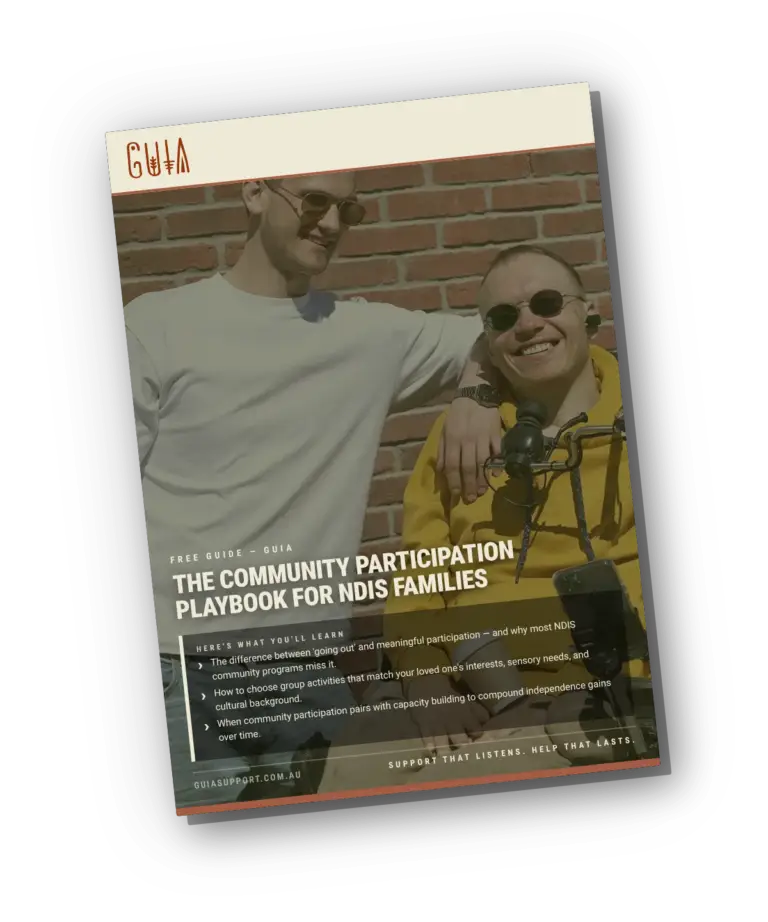
Here's What You'll Learn:
The difference between 'going out' and meaningful participation — and why most NDIS community programs miss it.
How to choose group activities that match your loved one's interests, sensory needs, and cultural background.
When community participation pairs with capacity building to compound independence gains over time.
ARE YOUR NDIS SUPPORTS WORKING FOR YOU?
GET A FREE NDIS PLAN MANAGEMENT REVIEW