


New NDIS plan: your first 30 days, in order
A new plan arrives and nothing tells you what to do first. Here is the order we work through with families in South West Sydney, and the two mistakes that cost the most.


NDIS community participation works best when a support worker shows up reliably and knows your family member well enough to notice what matters to them. Inconsistency breaks trust fast—cancelled visits, last-minute swaps, or workers who don’t return create real stress for families already managing complex schedules and relationships. The NDIS framework funds community access for a reason: isolation and disconnection are real barriers to wellbeing. A provider who treats reliability as non-negotiable removes that worry from your shoulders.
Community participation builds confidence through consistency and genuine connection. When the same support worker arrives on time, knows your family member’s preferences, and actively listens to what they want to do, something shifts—the participant stops bracing for disappointment and starts planning ahead. The mechanism is simple: trust creates space for choice. A worker who’s part of your extended team doesn’t just transport your family member to an activity; they notice what sparked genuine interest, remember it, and build on it next time.
Here’s what that looks like in practice. We match support workers thoughtfully—considering language, sensory needs, interests, and personality fit—because the first visit sets the tone. Our team across South West Sydney is trained and worker-screened, and we roster the same person where possible so your family member builds a real relationship. When you call to check in or adjust plans, you’re talking to someone who knows them, not reading from a file. That consistency is how families feel confident enough to say yes to new experiences.
NDIS community participation means getting out into your community, building real connections, and doing things that matter to you — but finding the right support to make that happen can feel overwhelming. You might be asking: how do we find activities that actually fit with what my family member enjoys? Will the support worker show up consistently? Can we find someone who speaks our language and understands our culture?
Here’s what that looks like in practice. Community access isn’t about filling time with activities. It’s about matching your family member with a support worker who gets them, then helping them access the things they genuinely want to do — whether that’s a regular outing to the shops, joining a community group, attending a local sports class, or just spending time with friends. The transport, the planning, the confidence-building — we handle all of that so your family member can focus on being part of their community.
What we hear from families is that consistency matters most. They worry about last-minute cancellations, workers who don’t show up, or support that feels impersonal. When someone is building confidence and routine, that unreliability breaks trust. We show up on time, every time, and we match support workers thoughtfully — so if your family member needs a Spanish-speaking worker, or someone trained in Auslan, or a support worker who understands sensory needs, that’s what happens.
The NDIS funds community participation through the NDIS scheme as part of your plan’s support categories. Your support coordinator can explain exactly what’s available to you, but our role is simple: we help your family member use that funding to build confidence, stay connected, and feel part of their community. That’s empowerment in action.
Centre-based programs run on a fixed schedule in a set location. You drop your family member off on Monday mornings, they spend three hours in a room with ten other participants doing structured activities, then you pick them up at noon. Community-based NDIS community participation works differently. A support worker comes to your home or meets your family member in the suburb where they actually live, and builds activities around what matters to them.
Here’s what that looks like in practice. On a Tuesday afternoon at 2pm, a support worker arrives at your house. Your adult son has autism and loves photography. Instead of a craft session, the support worker helps him plan a walk to the local park to photograph birds. They travel together by bus—your son navigates the journey, the support worker is there if he needs help. At the park, he takes photos for an hour. On the way home, they stop at the café he likes and he orders his own coffee. The support worker notices he’s more confident talking to the barista than he was six weeks ago and mentions it when they return.
That evening, you get a message: photos attached, café visit went well, he’s keen to go back next week. No surprises. No cancellations. You know exactly what happened and what to expect.
The difference matters for families. Centre-based programs can feel like respite—you get time away, but your family member is in a waiting room doing activities chosen by someone else. Community-based support builds real skills, real friendships, real confidence in the places where your family member actually spends their life. It’s also more flexible. If your son has a bad week, you’re not paying for a seat he won’t use. If he discovers a new interest, the support worker adapts.
If community-based NDIS community participation sounds like the kind of support you’re after, we can help you work out whether it fits your plan and what that actually looks like in your suburb. Enquire about support and let’s talk through your family member’s goals.
Many families think NDIS community participation means structured group outings run by the provider. You picture a minibus, a set schedule, activities chosen by staff. The reality is quite different—and much more flexible.
Community participation funding is about helping your family member do the things that matter to them. That might be a weekly coffee at the local café, joining a community sports group, attending a music class, or simply getting to a friend’s house on a Thursday afternoon. It’s not about filling a timetable with activities the provider thinks are “good for them”.
Here’s what that looks like in practice: A support worker helps with transport, builds confidence in the community space, and steps back as your family member becomes more comfortable. If your brother wants to try a pottery class in Fairfield but needs someone to come along the first few times, that’s community participation. If your daughter wants to volunteer at the local animal shelter one afternoon a week, that’s it too. The goal is real connection—to people, places, and activities your family member chooses.
The misconception often comes from mixing this up with day programs or centre-based activities. Those exist, but they’re different. NDIS community participation is about getting out into your actual neighbourhood and doing what brings you joy or builds your confidence. It’s personal, not programmed.
When you’re ready to explore what community participation could look like for your family member, we match them with a support worker who listens first. We ask what matters to them, what they’ve always wanted to try, where they feel safe. Then we build the support around that—not the other way around. If you’d like to talk through how this works in your situation, enquire about support and we’ll walk you through it.
Community Access & Social Participation is NDIS funding that helps you get out into your community, build real connections, and do the things that matter to you. It’s about choice and control—you decide where you want to go and what you want to do.
Here’s what that looks like in practice. This support includes group activities tailored to your interests, social outings to places you want to visit, and transport that gets you there safely. A participant might use it for a weekly community group, a monthly trip to the shops or a local café, or joining a sports or hobby club. It can also include support workers helping you build confidence in new social situations or learn skills that help you connect with others.
What it does NOT include is therapy or clinical treatment. Community Access & Social Participation is not allied health or counselling. It’s not about “fixing” anything—it’s about expanding your world and building the confidence and connections you choose.
To access this support, you’ll need NDIS funding allocated to your plan under a category like “Assistance with Social and Community Participation” or “Community Access”. Your support coordinator or the NDIA can tell you whether your plan includes this funding. If you’re not sure what’s in your plan, that’s a normal question—many families find the NDIS language confusing at first.
The key thing is that this support works best when the provider knows you, shows up consistently, and matches your cultural and communication needs. That’s where we come in. If you’d like to explore whether Community Access & Social Participation is right for your situation, or you want to talk through what’s already in your plan, we’re here to help.
Enquire about support with Guia today. No pressure—just a conversation about what matters to you.
NDIS community participation funding sits within your plan as either a Core Support or a Capacity Building Support, depending on what you’re trying to achieve. Core Supports cover the day-to-day help you need right now—transport to a community group, support during a social outing, or assistance getting to a local activity. Capacity Building Supports are about building skills and confidence over time, so you become more independent in accessing community on your own.
The NDIS funds community participation because isolation and loneliness are real barriers to wellbeing. Your plan recognises that getting out, making connections, and doing things that matter to you isn’t a luxury—it’s part of living a good life. How much funding you have depends on your individual circumstances and what your plan says you need.
Here’s what matters in practice: you get to choose what “community participation” means for you. For some people, that’s a weekly art class or a community sports group; for others, it’s transport to visit family, attend a local café, or join a hobby club. Your support worker’s job is to help you get there safely and confidently, then step back so you can enjoy it.
What we hear from families is that consistency matters most; if your son or daughter knows their support worker will show up on Tuesday at 2 p. m. every week, they can relax and actually enjoy the activity instead of worrying about reliability. That’s where Guia’s approach makes a real difference—we match participants with support workers thoughtfully and we keep those relationships stable.
If you’re unsure what community participation funding looks like in your plan, your support coordinator can walk you through it. When you’re ready to explore what’s possible in South West Sydney, we’re here to help you turn that funding into real connections and experiences.
When you’re thinking about NDIS community participation for your family member, it helps to know exactly what you’re choosing and what sits outside the support. Group activities are funded through your NDIS plan, but the shape they take is up to you and the support provider working together.
Here’s what’s your call — what you and your family decide:
Your support worker is there to help your family member join in, build confidence, and make real connections. They’re not there to lead therapy or deliver clinical services. That boundary matters because it keeps the focus on what your family member actually wants to do, not on what a professional thinks they should achieve.
Here’s what sits outside this support — what you won’t be deciding through community participation funding:
The real power here is that you’re not locked into a programme someone else designed. You’re building something that fits your family member’s life, interests, and pace. If you’d like to talk through how community participation could work for your situation, we’re here to help you think it through.
Enquire about support and we’ll walk you through what’s possible in South West Sydney.
The clearest signal is when your family member wants to do something in the community but needs reliable support to get there. That might be a weekly visit to the local shops, attending a sports group, or catching up with friends. If transport or confidence is the barrier, NDIS community participation support can be that bridge.
Another common starting point is when isolation is creeping in. You notice they’re spending most days at home, or they’ve stopped activities they used to enjoy. Sometimes it’s anxiety about being out alone. Sometimes it’s simply that the opportunity hasn’t come up. Community participation support rebuilds those connections at a pace that feels safe.
Check whether your current NDIS plan already includes a community participation category. Many plans do—it might be listed as “assistance with social and community participation” or similar. If it’s there but you’re not using it, that’s worth exploring with your support coordinator. You may not need to wait for a plan review to start.
You might also notice your family member has the interest but lacks the confidence to try new things alone. Group activities or outings with a trained support worker can help build that independence over time. The goal isn’t to create dependency—it’s to help them feel more in control of their own life and choices.
If any of these sound familiar, the next step is straightforward. Enquire about support and we can talk through what your plan includes and what might work best for your situation.
An Arabic-speaking autistic adult in Bankstown wanted to join a community group but worried about sensory overwhelm in crowded spaces and felt anxious about communicating with new people. His family had tried several support providers, but workers didn’t understand his need for quiet breaks or speak his preferred language during outings.
Guia matched him with a Spanish and Arabic-speaking support worker who had experience supporting autistic adults. Together, they visited the community centre during a quieter afternoon to scout the space. The worker helped identify a low-sensory corner, worked out a hand signal for when he needed a break, and stayed nearby during the first few sessions without hovering. Within four weeks, he was attending the group independently, knowing the routine and the other participants.
What made the difference wasn’t just the language match—though that mattered. It was that his support worker understood that NDIS community participation works best when it’s tailored to how that person’s mind and body actually work. She didn’t treat sensory needs as something to push through. She treated them as real information about what he needed to feel safe and included.
This is how we approach community access across South West Sydney. We listen to what families tell us about cultural fit, communication style, and sensory or routine needs. We match support workers thoughtfully. We show up consistently—the same person, the same time, week after week—because trust and reliability matter more than any single outing.
If you’re looking for NDIS community participation support that actually fits your family member’s life and values their dignity, that’s the conversation we want to have. When you’re ready, get in touch and we’ll talk through what real choice and control looks like for you.
NDIS community participation funding comes through your plan in two main ways. Most support sits under Core Supports, which covers day-to-day assistance with activities and community access. The NDIS uses a price guide to set reasonable rates for different support types, based on your location and the complexity of what you need.
When your plan is approved, the NDIS allocates a dollar amount for community access and social participation. That amount depends on your assessed goals, the support categories you’ve been approved for, and how often you’ll need help. Your support coordinator or planner will explain which categories apply to you during planning conversations.
Here’s what that looks like in practice. If you need transport to a community group twice a week, or support to join a local activity, the cost is calculated hourly. The rate includes the support worker’s time, travel, and any group activity fees. If you’re accessing group programs we run, costs may be bundled differently—your coordinator will walk you through the exact breakdown.
Some families find their plan covers most of what they need. Others discover gaps between what’s funded and what would genuinely help their family member participate more. That’s a real conversation to have with your support coordinator. They can help you prioritise, explore alternatives, or identify whether flexibility exists within your current plan.
The key is knowing your plan is yours to direct. You choose how to spend your community participation funding, and you choose the provider. If you’d like to talk through how your current plan might work for community access support, or if you’re still navigating what’s been approved, we’re here to help you understand your options.
The first step is simple: you call us or fill in an online enquiry. We’ll have a quick chat about what your family member enjoys, what they’ve struggled with in the past, and what community participation might look like for them. This conversation usually takes ten to fifteen minutes; we’re not filling out forms at this stage—we’re listening.
Once we understand the picture, we’ll talk through how NDIS community participation funding works and whether your support plan includes this category. If it does, we’ll explain what’s possible: group outings, one-to-one community access support, transport to activities they choose, or a mix of all three. We answer questions about costs, timing, and how it all fits together with other supports.
Next comes the match. We don’t just assign a support worker at random. We look at what matters to your family member—language, interests, routines, sensory needs, cultural background. If they need a Spanish-speaking support worker, or someone who understands autistic communication styles, or a worker who’s trained in Auslan, we make that happen. This takes a few days, but it’s worth the wait.
Then we arrange a meet-and-greet; the support worker visits your home or a place your family member feels comfortable. There’s no pressure to start activities straight away. It’s a chance for everyone to get to know each other, talk about what a typical visit might look like, and build a bit of trust before the first real outing.
Your first visit happens when everyone’s ready. It might be a trip to the local shops, a community group, a park, or something your family member has been wanting to try. The support worker is there to help them participate at their own pace, not to take over. And we’re in touch with you throughout—letting you know how it went, what worked, what we might adjust next time.
Ready to explore what’s possible? Enquire about support and we’ll walk you through the next step.
Choosing the right NDIS community participation provider means finding people who understand your family’s needs and show up consistently. Before you commit, it’s worth asking the provider some direct questions about how they work.
At Guia, consistency and respect are non-negotiable. We match support workers thoughtfully—including Arabic, Spanish, and Auslan speakers where needed. Our team is NDIS-registered, fully screened, and trained to treat participants as capable adults. When you enquire about support, we’ll answer every question openly and help you feel confident in your choice.
When NDIS community participation works well, it builds real friendships and genuine confidence over time. But not every provider approaches this the same way. Knowing what to watch for helps you spot a mismatch early.
At Guia, we build NDIS community participation differently. We match support workers with care for cultural fit and language. We show up on time, every time. We work with your family member to choose activities that matter to them, not what’s easiest for us. When you’re ready to explore what genuine community participation looks like, enquire about support.
When NDIS community participation support is working well, you’ll notice patterns that tell you your family member is genuinely benefiting. These signs matter because they show real change, not just activity happening.
The same support worker shows up consistently. You won’t see a different face every week or last-minute cancellations that leave your family member disappointed. Reliability builds trust, and trust is what lets someone relax enough to try new things. When your family member knows who’s arriving and when, they can prepare emotionally and practically for the outing ahead.
Your family member starts mentioning the same people or places unprompted; they talk about what happened last week or ask when they’re going back. This signals genuine connection, not just supervised activity. They’re thinking about it between visits, which means it matters to them. You might notice they’re getting ready earlier on support days or asking questions about what’s coming next.
Communication flows both ways with the support team. You receive regular updates about what went well, what your family member enjoyed, and what they’re interested in trying. The support worker listens when you mention preferences, routines, or sensory needs. This two-way exchange means the support stays personalised to your family member’s actual life, not a programme.
Your family member’s confidence grows in small, visible ways. They might try a café they’ve never been to, speak up about what activity they want, or show less anxiety about the outing itself. Empowerment looks like choice—they’re directing what happens, not just following along. These shifts happen gradually, but families notice them.
If you’re seeing these signs, the support is landing well. If you’re not yet, that’s worth raising directly with the support team. Enquire about support or have a conversation about what could shift.
The reality is this: not every community programme will be the right fit, and not every support worker will click with your family member. That’s not a failure. It’s a signal to pause and reassess what’s actually working.
Start with honest feedback to the support worker or programme coordinator. Many issues resolve with a simple conversation—timing that doesn’t suit, a transport preference, a sensory mismatch, or a personality clash. A good provider listens and adjusts. If the conversation doesn’t lead anywhere, ask to speak with a manager. That’s your right, and it’s how services improve.
If a particular support worker isn’t the right match, you can request someone else. Guia matches support workers based on your family member’s needs, communication style, cultural background, and language—but we know that sometimes the first pairing isn’t perfect. A change of worker is straightforward and happens regularly.
If the programme itself isn’t working—the activities don’t suit, the group dynamic feels wrong, or the transport is unreliable—you have options. You can pause that support and try something different; your NDIS plan belongs to your family member, and you get to decide how it’s spent. That’s Choice and Control in action.
If you’ve given it a genuine go and things still aren’t working, you can switch providers. The NDIS Quality and Safeguards Commission also handles formal complaints if you believe a provider hasn’t met their obligations. That pathway exists to protect you.
What matters is that your family member is building real connections, gaining confidence, and feeling respected. If they’re not, it’s time to try something else. When you’re ready to explore what Community Access & Social Participation could look like for your family, reach out. We’re here to listen and match you thoughtfully.
If you’re researching NDIS community participation support, you’ve probably noticed how much depends on finding the right match. Not just any support worker, but someone who shows up reliably, understands your family member’s needs, and helps build real confidence over time.
What we hear from families is that consistency matters most; when a support worker cancels last minute, it breaks trust and disrupts routines. When they show up every week at the same time, your family member knows what to expect. That predictability is the foundation for everything else—whether it’s a community outing, a new activity, or building friendships that actually stick.
Guia has been supporting participants across South West Sydney for two years. We’re NDIS-registered and Code of Conduct compliant, with all staff qualified and worker-screened. Our team speaks English, Spanish, and Arabic, which matters in our region where cultural and linguistic fit can make the difference between a support worker who feels like part of your extended team and one who doesn’t quite fit.
Here’s what that looks like in practice: we match support workers based on your family member’s interests, communication style, and what matters most to them—not just what’s available on the roster. If sensory needs, routine, or specific interests shape how your family member engages with community, we build that into how we plan.
When you’re ready to explore whether NDIS community participation support could work for your family, there’s no pressure to decide today. Enquire about support and we can have a conversation about what your family actually needs—no obligation, just honest talk about how we might help.
A new plan arrives and nothing tells you what to do first. Here is the order we work through with families in South West Sydney, and the two mistakes that cost the most.

Aged care at home South West Sydney from Guia. Reliable support workers who show up consistently and become part of your family’s everyday routine.

NDIS allied health support sydney from Guia. Reliable support workers who show up consistently and become part of your family’s circle. Peace of mind fo…
The Community Participation Playbook for NDIS Families
How to use NDIS Community Access funding to actually build connection, confidence, and independence — not just attendance.
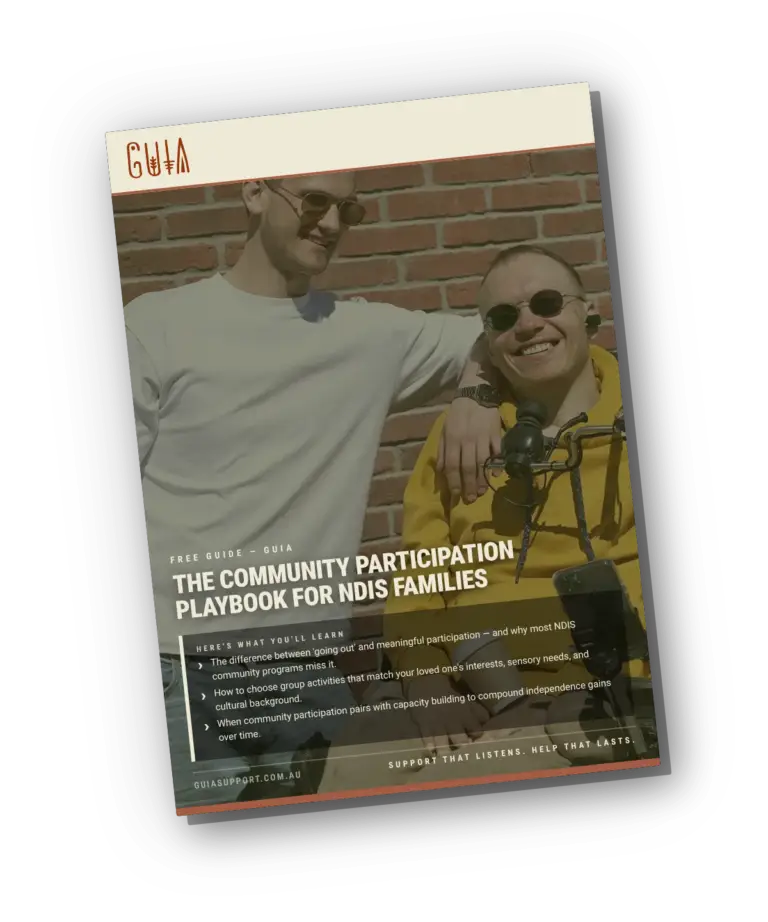
Here's What You'll Learn:
The difference between 'going out' and meaningful participation — and why most NDIS community programs miss it.
How to choose group activities that match your loved one's interests, sensory needs, and cultural background.
When community participation pairs with capacity building to compound independence gains over time.
ARE YOUR NDIS SUPPORTS WORKING FOR YOU?
GET A FREE NDIS PLAN MANAGEMENT REVIEW