


New NDIS plan: your first 30 days, in order
A new plan arrives and nothing tells you what to do first. Here is the order we work through with families in South West Sydney, and the two mistakes that cost the most.


NDIS social connection often stalls because families worry support workers won’t show up consistently or will let their family member down when it matters most. That fear is real. When a participant relies on a support worker for a Tuesday outing or a weekly community group, cancellations or no-shows don’t just disrupt plans—they erode trust and confidence. The NDIS funds these connections because isolation affects wellbeing, but funding alone doesn’t reliability.
Community Access & Social Participation works by matching participants with support workers who stay with them over time, building real familiarity and trust. Consistency is the mechanism: the same worker shows up on the same day, learns what matters to the participant, and becomes someone they actually want to spend time with. That reliability transforms a funded activity into a genuine connection—and when the support worker is culturally matched or speaks the participant’s language, the whole experience deepens.
Here’s what that looks like in practice. We assign support workers based on fit, not just availability, and we prioritise continuity—the same person, week after week. If your family member is autistic and needs routine, or speaks Spanish at home, or has specific sensory preferences, we match accordingly. You’re not starting from scratch each week explaining what works. The support worker becomes someone your family member trusts, and you can relax knowing someone reliable has their back.
NDIS social connection means your family member gets out into the world consistently—not as a one-off outing, but as a real part of their week. You’re probably wondering whether community access support actually happens reliably, or whether it’s another thing that gets cancelled when staff don’t show up.
Here’s what that looks like in practice. A participant might have a two-hour Thursday afternoon support visit to a local community group, a regular Saturday outing to somewhere they choose, or transport to an activity that matters to them. The support worker’s job is to help them get there, stay safe, and build confidence—not to manage them or fill time.
What we hear from families is that consistency matters more than anything else. If your brother knows his support worker arrives at 2 p. m. every Tuesday, he can plan his week. If your mum has the same person taking her to the local shops, she doesn’t have to explain herself each time. That reliability builds trust—and trust is what lets people relax enough to actually enjoy being out.
NDIS social connection also means the right match between participant and support worker. If your family member speaks Arabic or Spanish, or if they’re autistic and need someone who gets sensory needs without fussing, that’s not a nice extra—it’s essential. The same goes for age, interests, and personality. A good fit means the support feels natural, not forced.
The goal isn’t to fill their calendar. It’s to help them build real connections, try things they’re curious about, and feel more in control of how they spend their time. When you’re ready to explore what that could look like for your family member, we’re here to talk through it.
Here’s what genuine NDIS social connection looks like in practice. A Tuesday afternoon, 2 pm. Your adult son’s support worker, Maya, arrives at the front door—same time as last week, same time as next week. She knows he prefers a five-minute settle-in before heading out, so she sits with him in the lounge while he finishes his drink. No rushing.
Today they’re heading to the local community centre for a cooking group he’s been attending for three weeks. Maya checks: does he want to walk or take the car? He chooses the car. On the drive, she asks what he’s planning to cook today, and listens while he talks through the recipe he saw online. She’s not directing him—she’s genuinely interested in what he wants to do.
At the centre, Maya introduces herself to the group leader, then steps back. She’s there if he needs her, but the space belongs to him and the other participants. She notices he’s quieter today than last week, so she checks in during the break: is he okay? He says his sleep was rough. She doesn’t fuss—she just acknowledges it, and asks if he wants to stay or head home early. He stays. That matters. Choice stays with him.
On the drive home, he’s animated again, talking about what he cooked and who he sat next to. Maya asks if he’d like to do this again next week. He says yes. When she drops him home, she leaves a quick note for you: what they did, how he went, and that he’s already looking forward to next Tuesday. No surprises. No last-minute cancellations. Just steady, reliable presence that builds real connection over time.
That’s NDIS social connection done well. If that sounds like the kind of support you’re after, enquire about support with Guia today.
Many families think NDIS social connection support means signing their family member up to a group activity and hoping they’ll fit in. The reality is quite different, and it’s worth understanding what’s actually possible.
Community access support isn’t about ticking a box or getting someone “out of the house; ” It’s about building real connections that matter to that specific person. That might mean a weekly coffee catch with someone who shares the same interest, a structured group activity tailored to sensory needs, or transport to a community event they’ve chosen themselves. The difference is choice and control—your family member gets to decide what they do, not the other way around.
What we hear from families is that they’ve sometimes tried group programs elsewhere and felt their son or daughter was just one of many, without anyone really noticing what worked for them or what didn’t. A support worker who shows up without understanding sensory preferences, cultural background, or communication style can make an outing feel stressful rather than enjoyable. That’s not connection—that’s just activity.
Real NDIS social connection happens when a support worker knows your family member well enough to spot what brings them confidence and joy. It means reliable transport that actually arrives on time. It means a Spanish-speaking or Auslan-trained worker if that’s what your family needs. It means the same person showing up consistently, so trust builds over time.
When you’re ready to explore what genuine community access looks like for your family member, we’re here to talk through what matters most to you both. We’ve been supporting participants across South West Sydney for two years, and we know the difference between activity and real belonging.
Enquire about support and let’s work out what community connection could actually look like for your family.
Community Access & Social Participation is NDIS-funded support that helps participants build real connections, join activities they care about, and get to places that matter to them. It’s about choice and control — you decide what you want to do, and we help make it happen.
Here’s what that looks like in practice; it includes group outings to local parks, community events, or cafes. It covers one-to-one support to try something new — a swimming lesson, a pottery class, a local sports group. It includes transport to get you there and back safely. It means a support worker who shows up consistently, learns what you enjoy, and helps you build confidence in community spaces.
It does NOT include therapy or clinical treatment. It’s not about “fixing” anything or working towards therapy goals. It’s not medical support — that’s a different registration group. And it’s not about what the support worker thinks you should do. The choice stays with you.
What we hear from families is that consistency matters more than anything else; when the same support worker shows up week after week, participants relax. They stop explaining themselves. They start planning ahead because they know who’s coming. That trust builds real social connection — not forced activities, but genuine participation in community life.
In South West Sydney, where many families speak Arabic, Spanish, or use Auslan, having a support worker who shares your language or communication style makes a real difference. You don’t have to repeat yourself or worry about being misunderstood. That’s when NDIS social connection actually works.
If this sounds like the kind of support you’re after, we’re here to talk through what your plan includes and how we can match you with a reliable support worker. Enquire about support when you’re ready — no rush, no pressure.
NDIS funding for community access and social participation sits across three main categories, and understanding which one applies helps you and your family member make the most of what’s available. Core Supports cover regular activities like group outings, social programs, and transport to get there. Capacity Building Supports help build skills and confidence over time—think employment readiness or life skills that create independence. Supported Independent Living (SIL) includes community connection as part of 24/7 shared accommodation support. Your family member’s plan will specify which category their social participation funding sits in.
The key difference is choice and control. Unlike some support categories where funding is locked to specific providers, NDIS social connection funding gives your family member (or you, as their decision-maker) the power to choose activities and providers that actually match their interests and goals. That might be a weekly community group, monthly social outings, or transport to activities they’ve chosen themselves. It’s not about filling a quota or ticking boxes—it’s about building real connections that matter to them.
What we hear from families is that the real challenge isn’t the funding itself—it’s knowing what’s actually possible and finding support workers who’ll show up consistently and treat your family member with genuine respect. That’s where reliable, person-centred matching makes all the difference. At Guia, we work with participants and families to understand what community connection looks like for them, then match support workers who get it and deliver it reliably, every time.
If your family member’s plan includes community access funding but you’re not sure how to use it or who to trust with it, that’s exactly what we help with. When you’re ready to explore what’s possible, we’re here to answer your questions and help you move forward at your pace.
When you’re thinking about NDIS social connection for your family member, it helps to know exactly what you’re choosing and what sits outside the support itself. Here’s what that looks like in practice with community access and social participation.
What’s your call:
In South West Sydney, where cultural and linguistic diversity is the norm, we know that NDIS social connection works best when the support worker speaks your language and understands your community. That might mean Arabic, Spanish, English, or Auslan. It might mean knowing the local mosque, the community centre, or the footy club that matters to your family. We build that into the matching from the start.
What’s outside this support:
Community access is about building real connections and confidence in the world around you. You decide what matters, who shows up, and how it happens. We’re here to make it reliable and dignified.
If that sounds like the kind of support you’re after, enquire about support and let’s talk through what your family actually needs.
Community Access & Social Participation sits in a specific part of your NDIS plan. It’s about getting out into the community, building real connections, and doing things that matter to the participant. Here’s how to tell if it’s already part of your plan or worth discussing at your next review.
Look at your plan summary and search for “Community Participation” or “Social and Community Participation”. If it’s listed with an amount of funding (say, $3,000 per quarter), you likely have it already. Many families don’t realise the funding is there because the category name isn’t always obvious. If you’re unsure, your support coordinator can walk you through it in plain language.
The clearest signal is this: Does the participant want to do things outside the home but struggle to get there or feel confident going? That might be a Tuesday afternoon at a local community group, a shopping trip with someone alongside them, or attending a sports session they’re interested in. If transport, confidence, or having a familiar person there is what’s holding them back, NDIS social connection support is designed for exactly that.
Another sign is isolation or routine that’s become too narrow. When someone spends most of their time at home or in the same few places, and there’s no practical barrier stopping them from doing more—just a lack of support to make it happen—this service builds both the opportunity and the confidence to branch out.
It’s also worth considering if the participant has goals around friendships, belonging, or being part of their local community. These don’t have to be huge ambitions. A regular coffee catch, joining a group activity, or feeling part of something local all count. Support workers trained in community access help make those things real and sustainable.
If any of this resonates, enquire about how Guia can help. We’ll listen to what matters to your family and explain how the funding works.
Many autistic adults find that NDIS social connection happens best when the pace and environment feel right. Take an autistic adult in their late twenties who’d been at home most days, wanting to meet people but finding group settings overwhelming. Their family worried about isolation but wasn’t sure what would actually work.
The starting point wasn’t a big group activity. It was a weekly two-hour outing with a support worker who understood sensory needs and routines. They’d visit the same local café on Thursday afternoons, sit in a quiet corner, and the worker would help with conversation if needed—but mostly just be present. Predictability mattered more than activity.
After a few weeks, the autistic adult started recognising the café staff and chatting with them briefly. The support worker noticed this and suggested a pottery class at a community centre nearby—smaller, structured, less unpredictable than a big social group. The class had the same instructor every week and a consistent group of six people; no pressure to be social outside the activity itself.
Within three months, they’d made a genuine friendship with another person in the class. They now text each other about pottery between sessions. The support worker’s role shifted: less about facilitating, more about helping with logistics and being a familiar presence if anxiety spiked. It autistic adult felt more in control of their own social life and more confident about what they actually wanted.
This is what NDIS social connection can look like—not forced group activities, but patient, person-centred support that respects how someone’s brain works. If your family member is autistic and you’re wondering how to support genuine friendships without pushing them into situations that feel wrong, we can help. When you’re ready, enquire about support and we’ll talk through what might work for them.
Community Access & Social Participation is funded through your NDIS plan as either a Core Support or a Capacity Building support, depending on what you and your support coordinator agree you need. Core Supports cover ongoing assistance — the regular Tuesday afternoon outing, the weekly community group, the transport that gets you there. Capacity Building supports help you develop skills and confidence to do more independently over time.
The NDIS uses a price guide to set the hourly rate for community access and social participation support. This means the cost is set by the scheme, not negotiated between you and the provider. Your support coordinator will work with you to estimate how many hours you need each week or month, then add that to your plan. The funding is approved as part of your overall NDIS plan agreement with the National Disability Insurance Agency.
Here’s what that looks like in practice. If you need two hours of support each Thursday to attend a community group or go to the local shops, your coordinator calculates the cost using the NDIS price guide and includes it in your plan request. Once your plan is approved, that funding is yours to use with a registered provider like Guia. You’re in control of how you spend it — you choose the activities, the timing, and the support worker you work with.
Some families ask whether there’s a gap between what the NDIS funds and what support actually costs. In most cases, the price guide covers the service. If you need specialist support — say, a Spanish-speaking or Auslan-trained worker — that’s factored into the rate, not an extra cost to you. If you’re unsure whether your plan includes enough funding for the social connection you’re after, your support coordinator can help you review it and request a plan review if needed.
When you’re ready to explore what community access support could look like for you or your family member, we’re here to answer questions about how your funding works and what’s possible in South West Sydney. Enquire about support and we’ll walk you through it.
Not everyone finds connection in the same way; some people thrive in group outings and face-to-face activities. Others prefer smaller gatherings, or need time online to build confidence before meeting new people in person. NDIS social connection works best when it matches how each person actually wants to engage.
Digital participation—video calls with friends, online interest groups, gaming with peers, or social media communities—can be a genuine part of building real relationships. It’s not a substitute for in-person support, but it’s also not “less real. ” For many adults, especially autistic people and those managing social anxiety, online spaces offer a safe place to practise conversation and find people who share their interests.
At Guia, we help families think about both. A support worker might help your family member get to a weekly community group on Thursday afternoon, and also help them connect with an online hobby community on Tuesday evening. Some weeks, that balance shifts depending on energy, confidence, or what’s happening in their life. That’s choice and control in action.
The practical side matters too. A support worker can help with the logistics—setting up video calls, finding accessible online groups, troubleshooting technology—so the focus stays on connection, not frustration. They’re there to encourage participation, not to direct it; your family member stays in the driver’s seat.
If you’re thinking about how to build NDIS social connection for someone you support, the mix of digital and in-person often works better than either alone. When you’re ready to explore what that could look like, enquire about support and we’ll walk through the options together.
Choosing the right NDIS social connection provider matters. You’re trusting them with your family member’s time, safety, and confidence. Before you commit, it’s worth asking the right questions. A good provider will answer clearly and honestly.
At Guia, we answer every one of these questions the same way: with consistency, respect, and proof. Our support workers are matched carefully to each participant. We show up on time, every time. When you’re ready to talk through what NDIS social connection actually looks like for your family, enquire about support.
Finding the right NDIS social connection provider means knowing what to watch for. Not every support service will match your family member’s needs or your expectations for reliability and care. Here’s what signals a poor fit.
Guia works differently. Our team stays stable, matches workers to your family member’s communication style and cultural background, and plans outings that actually reflect what they want to do. We show up on time, every time, and build genuine friendships and confidence over months, not weeks. When you’re ready to explore what that looks like, enquire about support.
When NDIS social connection support is genuinely working, you’ll notice it in small, steady ways. The first sign is consistency—the same support worker shows up on the agreed day and time, week after week. Your family member knows what to expect. They’re not anxious about cancellations or last-minute changes. That reliability builds trust, and trust is where real connection starts.
You’ll also see your family member becoming more animated about their plans. They talk about next week’s outing or mention something funny that happened with their support worker. Their priorities are leading the choices—not a activity schedule imposed from above. When a support worker listens to what your family member actually wants to do, and then makes it happen, that’s when engagement shifts from compliance to genuine interest.
Regular communication with you matters too. A good provider checks in without being intrusive. You hear updates about how the outings went, what your family member enjoyed, what didn’t land. You’re not left wondering or having to chase for information. This kind of communication means you stay in the loop and can spot what’s working for your family member from your own perspective as well.
Finally, watch for growing independence and confidence. Your family member might try something new—speaking up about a preference, navigating a community space with less prompting, or building a friendship with someone they met through activities. These are signs the support is doing what it should: helping them feel more in control of their own life, not more dependent on the provider.
If these signs are present, the support is working. If you’re noticing the opposite—cancellations, activities, poor communication, or your family member withdrawing—it’s worth having a conversation about what needs to shift. Enquire about support with a provider who prioritises consistency and your family member’s voice.
If your family member has tried group activities through NDIS social connection support and it isn’t working, that’s important information. Not every setting suits every person; some autistic adults find group noise overwhelming. Others prefer one-to-one connection first. Some need a different support worker’s personality or communication style. These aren’t failures—they’re signals about what actually works for your family member.
The first step is usually a conversation with the support provider. Tell them what isn’t working: “The Tuesday group is too loud,” or “Your support worker cancels too often,” or “My son needs more time to warm up before joining a group. ” Good providers listen and adjust. That might mean a quieter activity, a different day, a new support worker, or a gradual transition plan that builds confidence at home first.
If feedback to the provider doesn’t shift things, you can escalate to their manager. Ask for a formal review of the support plan. Be specific about what you need to change. If that doesn’t help either, you have the right to request a different support worker or switch to another NDIS provider altogether. Your family member’s comfort and confidence matter more than loyalty to a provider.
For serious concerns—missed appointments, disrespect, safety issues—you can lodge a formal complaint with the NDIS Quality and Safeguards Commission. They investigate complaints about registered providers and can enforce change.
Choice and control means you’re not stuck. If Community Access & Social Participation support isn’t delivering dignity and genuine connection, you have options. When you’re ready to explore what might work better, we’re here to listen and help.
If you’re thinking about NDIS social connection support for your family member, you might be wondering where to start. There’s no rush. Many families spend time researching, talking to their support coordinator, or simply sitting with the idea before making a decision. That’s completely normal.
What matters is finding a provider who understands your family’s situation and shows up consistently. Someone who treats your family member as a capable adult, respects their preferences, and builds real relationships over time. Not a provider who cancels last minute or sends different support workers every week.
Here’s what that looks like in practice with Guia. We match support workers based on what matters to your family — whether that’s language (we work in English, Arabic, Spanish, and Auslan), personality fit, or shared interests. We show up on time, every time. And we listen to what your family member actually wants to do — whether that’s a weekly outing to the local community centre, transport to a hobby they love, or building friendships with other participants in a group activity we run.
We’re NDIS-registered and Code of Conduct compliant, which means you can trust that all our staff are qualified and worker-screened. But beyond the credentials, we’re founded on lived experience of disability and family caregiving. We get it because we’ve lived it.
When you’re ready — whether that’s today or in a few weeks — enquire about support and we’ll have a conversation with no pressure. We’ll listen to what your family needs, answer your questions in plain language, and help you work out if Guia is the right fit. Take your time. We’re here whenever you decide to take the next step.
A new plan arrives and nothing tells you what to do first. Here is the order we work through with families in South West Sydney, and the two mistakes that cost the most.

Aged care at home South West Sydney from Guia. Reliable support workers who show up consistently and become part of your family’s everyday routine.

NDIS allied health support sydney from Guia. Reliable support workers who show up consistently and become part of your family’s circle. Peace of mind fo…
The Community Participation Playbook for NDIS Families
How to use NDIS Community Access funding to actually build connection, confidence, and independence — not just attendance.
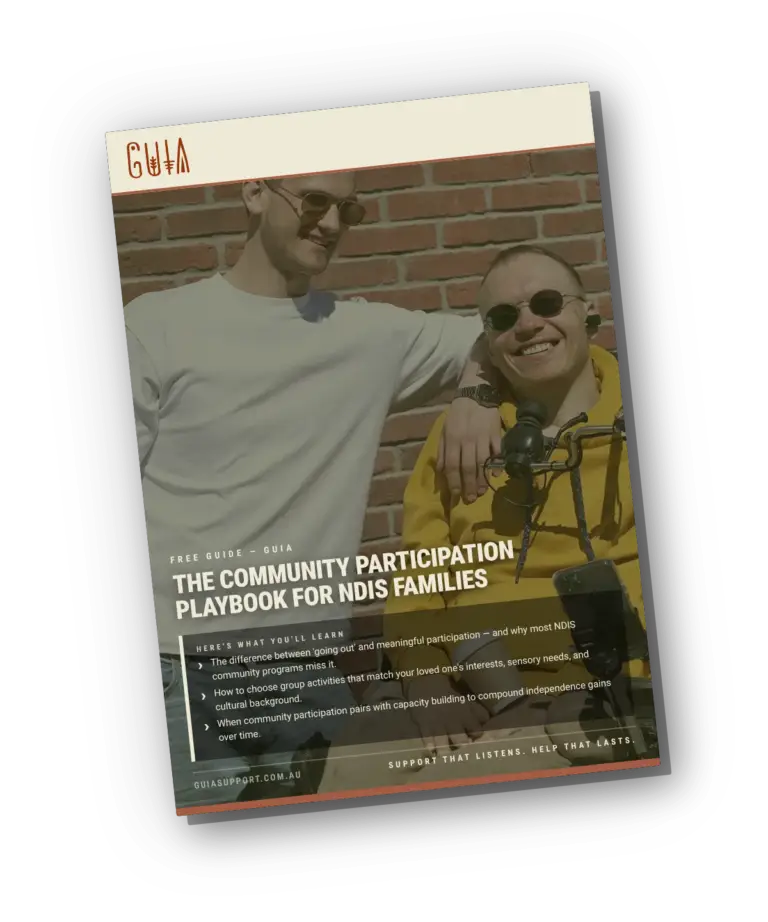
Here's What You'll Learn:
The difference between 'going out' and meaningful participation — and why most NDIS community programs miss it.
How to choose group activities that match your loved one's interests, sensory needs, and cultural background.
When community participation pairs with capacity building to compound independence gains over time.
ARE YOUR NDIS SUPPORTS WORKING FOR YOU?
GET A FREE NDIS PLAN MANAGEMENT REVIEW