


New NDIS plan: your first 30 days, in order
A new plan arrives and nothing tells you what to do first. Here is the order we work through with families in South West Sydney, and the two mistakes that cost the most.


NDIS support coordination sits at the centre of most families’ experience with the scheme — yet many carers worry their coordinator will vanish when things get complicated, or worse, miss a critical deadline that affects their family member’s plan. The reality is that finding someone who shows up consistently, understands your situation deeply, and treats your family member with genuine respect is harder than it should be. That worry is legitimate. A coordinator who cancels last-minute or doesn’t return calls leaves families scrambling to fill gaps their family member depends on.
Support coordination works by creating a single, stable point of contact who knows your plan inside out and advocates for you when decisions need to be made. A Level 2 or Level 3 specialist coordinator doesn’t just explain what the NDIS — National Disability Insurance Scheme offers — they actively match your family member to the right providers, track what’s working and what isn’t, and adjust your plan’s direction based on what actually matters to your family. This consistency means fewer miscommunications and fewer surprises when funding runs out or priorities shift.
Here’s what that looks like in practice: a coordinator who calls on the same day each week, who knows your family member’s name and routines, and who sits with you to work through provider options rather than handing you a list. At Guia, our coordinators are qualified, screened, and trained to match families with support workers who fit culturally and linguistically — Spanish-speaking, Arabic-speaking, or Auslan-trained where that matters. That consistency builds trust. Your family member stops being a file and becomes someone our team genuinely knows.
NDIS support coordination sounds straightforward until you’re actually in it. You’ve got a plan, funding allocated to “support coordination”, but what does that actually mean? Who helps you understand which services fit your budget? How do you know if a provider is the right fit for your family member’s needs?
What we hear from families is that the NDIS terminology alone creates confusion. “Level 2 coordinator”, “registration groups”, “plan goals” — it’s a lot to hold when you’re already managing day-to-day support for someone you care about. The real question underneath is simpler: “Can I trust someone to help us make sense of this, show up consistently, and actually listen to what we need?
NDIS support coordination is the service that bridges that gap. A good coordinator sits with you, explains your plan in plain language, helps match you to other providers who fit your family’s values, and checks in regularly to make sure things are working. It’s not about pushing you toward spending more or filling every dollar. It’s about helping you understand what’s possible and what actually matters for your family member’s life.
In South West Sydney, where families speak Arabic, Spanish, English, or use Auslan, language and cultural fit matter. A coordinator who understands your background and can communicate clearly makes all the difference. It’s the difference between feeling supported and feeling lost in the system.
The most common starting point is a phone call or conversation where you describe what’s happening right now — what’s working, what’s not, what you’re worried about. From there, a coordinator can help you see the shape of your plan and what’s actually available to you.
Here’s what that looks like in practice. Your support coordinator meets with you on a Tuesday afternoon at 2 pm—the time that suits your family’s routine. They bring your NDIS plan summary and a notebook, not a clipboard that feels formal.
Your coordinator sits down and asks what’s happened since last time. Maybe your son needs help understanding a new employment support option. Maybe your daughter’s funding ran out faster than expected and you’re worried about gaps. Maybe you’re simply unsure which registration group a service falls under, and the NDIS website left you more confused. Your coordinator listens first. They take notes on what matters to you, not what they think should matter.
Then they work through it together. If it’s about employment, they explain the difference between a support worker and a job coach in plain language. They show you where it sits in your plan. They talk through whether your current budget covers it, or whether you need to talk to the NDIS about adjusting allocations. They don’t make the decision for you—they give you the information and the confidence to choose.
Before they leave, they send you a summary email. Not jargon-heavy. Just the key points, the next steps, and their contact details. You know you can ring them Thursday morning if something doesn’t make sense. That’s the reliability families tell us matters most—someone who shows up, listens, and stays reachable.
At Guia, our NDIS support coordinators work at Level 2 and Level 3, meaning they can navigate complex plans and coordinate multiple providers on your behalf. We’re NDIS-registered and Code of Conduct compliant. When you’re ready to talk through what support coordination could look like for your family, enquire about support.
Many families think NDIS support coordination means someone will manage their loved one’s plan for them — make decisions, spend the money, and handle all the paperwork. That’s not quite how it works, and that’s actually good news.
Support coordination is about navigation and choice, not control. A support coordinator helps you understand what’s in the plan, what each dollar can be spent on, and which providers might be the right fit. They explain the NDIS jargon in plain language. They help you think through options. But the choices — and the authority — stay with you and your family member.
Here’s what that looks like in practice. If your adult son has funding for community access, a support coordinator won’t decide which activity he does. Instead, they’ll explain what’s possible, help you explore options, and support you to match him with a provider who fits. If your daughter needs a home modification, they’ll help you understand the process and timeline — but you decide what happens next. It’s your plan. You’re in charge.
This matters because many families worry they’ll lose control if they bring in a coordinator. The opposite is true. A good support coordinator gives you more control by making the system clearer. They reduce the confusion that stops families from using their funding well. They’re a steady guide who knows the rules, not a decision-maker who overrides yours.
At Guia, our Level 2 and Level 3 support coordinators work in plain language and respect your pace. We help you understand your options so you can make the choices that work best for your family. When you’re ready to talk through what support coordination could mean for your situation, enquire about support.
NDIS support coordination is a practical service that helps you navigate your NDIS plan and connect with the right providers. It’s not about managing your plan on your behalf — that’s your choice and your control. Instead, a support coordinator works alongside you to understand what you need, explain your options, and help you find providers who actually fit.
Here’s what that looks like in practice. A support coordinator will sit down with you and your family to talk through your plan. They’ll explain what funding you have, which support categories apply to you, and what providers can do under each one. They’ll answer questions about how the NDIS works — things like registration groups, what “assistance with daily personal activities” actually means, and why some providers can do certain things and others can’t.
Support coordination also includes helping you find and match with providers. Your coordinator knows local services across South West Sydney and can introduce you to options that suit your needs, your schedule, and your preferences — including providers who speak your language or have experience supporting people with your disability. They’ll help you understand what to expect from each provider and support you to make the decision that feels right.
What support coordination does NOT do: it doesn’t create or change your NDIS plan — that’s between you and the National Disability Insurance Agency. It doesn’t provide direct support like personal care or community outings; and it doesn’t make decisions for you. Your coordinator is there to give you information and confidence so you can choose what works best for your life.
The first 90 days are very important. A good support coordinator will check in regularly, make sure the providers you’ve chosen are delivering what you expected, and adjust if something isn’t working. If that sounds like the kind of support you’re after, enquire about support with Guia.
Support Coordination is funded through your NDIS plan as a Core Support. That means it sits alongside your personal care, community access, and employment supports—not competing with them for the same dollars. The NDIS recognises that navigating your plan, choosing the right providers, and staying on track takes time and expertise.
How much Support Coordination funding you receive depends on your plan and your circumstances. Some participants need Level 2 coordination—help understanding their plan, matching with providers, and sorting out what’s included in each support category. Others need Level 3—more intensive help if their needs are complex, their plan is larger, or they’re moving through a big life change like leaving school or moving into shared accommodation.
What matters here is choice and control. You decide whether you want a support coordinator at all. You choose which coordinator you work with. And you decide how often you meet and what you focus on—whether that’s understanding registration groups, troubleshooting a provider who isn’t showing up, or planning for what comes next in your life.
We hear from families that this clarity is what changes things. When you know exactly what your coordinator is there to do—and you trust they’ll follow through—the whole plan feels less overwhelming. You’re not trying to decode NDIS jargon alone or wondering if you’re spending your funding wisely. Your coordinator is there to translate the system into plain language and help you stay in control.
If you’re thinking about adding Support Coordination to your plan, or you’re already funded but want to talk through what’s possible in South West Sydney, that’s where we come in. Our coordinators work in English, Arabic, and Spanish, and we match you with someone who understands your situation and your goals.
Your NDIS plan isn’t fixed. If your circumstances change or you realise your current support coordination arrangement isn’t working, you have the right to ask for a change. Understanding what you can actually request—and what sits outside this service—helps you advocate clearly for yourself or your family member.
Here’s what that looks like in practice. You control the provider you work with, how often you meet with your coordinator, which support worker is matched to you, and when those sessions happen. You also set the scope of what you want help with—whether that’s understanding your plan, finding other NDIS providers, or working through a specific funding question. If a coordinator isn’t the right fit culturally or linguistically, or if the schedule doesn’t suit your routine, you can request a change. That choice stays with you.
What sits outside this support matters just as much to understand. NDIS support coordination doesn’t include clinical diagnosis, treatment advice, or therapy. Your coordinator won’t create or manage your NDIS plan—that’s the NDIA’s role. They also can’t make funding decisions or change what’s written in your plan. If you need a plan review or adjustment, that request goes to the NDIA, not your coordinator. They can help you prepare the case and navigate the process, but the decision isn’t theirs to make.
When you’re ready to explore NDIS support coordination that genuinely fits your needs, we’re here to help. Guia offers Level 2 and Level 3 specialist coordinators across South West Sydney, with multilingual support in English, Spanish, Arabic, and Auslan. Enquire about support and let’s talk about what works for you.
Support coordination isn’t just for people setting up their first NDIS plan. Many families find they need it later — when a plan isn’t working the way it should, or when life changes and the old setup no longer fits. Here’s what that looks like in practice.
You might benefit from NDIS support coordination if you’re spending hours each month trying to work out what’s actually in the plan, or which support categories cover what you need. If your family member’s plan sits unused because you’re not sure how to connect them with providers, or if you’ve chosen providers before and felt lost in the process, that’s a signal worth paying attention to.
Another common starting point is when a participant’s needs shift — they’ve moved house, started a new job, or their disability support needs have changed. The plan might still have money in the right categories, but nobody’s explained how to redirect it. Or a support coordinator from your previous provider has moved on, and the handover wasn’t smooth. These aren’t failures on your part. The NDIS is complex, and having someone explain it in plain language makes a real difference.
It’s also worth knowing that many plans already include support coordination funding; you might not need to wait for a plan review. If you’re unsure whether yours does, that’s exactly the kind of question a support coordinator can answer in a first conversation — no commitment needed.
If any of this sounds familiar, here’s what happens next. Get in touch and we’ll listen to where you’re at right now. We’ll explain what support coordination actually means for your family member’s situation, and whether it’s the right fit. Enquire about support and let’s talk through it together.
Maya is an autistic adult living in shared accommodation in Fairfield with two housemates. Her mum had been coordinating her NDIS plan for three years—juggling Maya’s support roster, tracking invoices, and fielding calls from providers. When her mum’s health declined, the family faced a real problem: who would step in?
They contacted Guia for NDIS support coordination. Within two weeks, our Level 2 coordinator had met with Maya, her mum, and the household to understand how things actually worked day-to-day. Maya’s support needs weren’t complicated on paper, but the real coordination—making sure the right support workers showed up on the right days, handling provider changes smoothly, and keeping Maya in the loop about her own plan—needed someone reliable and present.
Here’s what that looked like in practice. Our coordinator took over the admin: managing the roster, processing claims, and communicating with providers in plain language. More importantly, they visited the house every three weeks to check in with Maya directly. They noticed that one support worker’s schedule wasn’t working for Maya’s routine, so they worked with the provider to adjust it. They also helped Maya understand what her funding covered, so she could make real choices about how her support was arranged.
Fourteen days after the first meeting, Maya’s mum handed over the coordination entirely. She still stays involved—the coordinator keeps her updated—but the daily weight lifted. Maya now has a coordinator who knows her, knows her housemates, and shows up consistently. Her mum can focus on being her mum, not her administrator.
If your family is carrying the coordination load and you’re ready to hand it over to someone steady and reliable, we can help. Enquire about support and let’s talk about what NDIS support coordination could look like for your situation.
NDIS support coordination sits within your plan’s Core Supports budget. The NDIA approves a dollar amount based on your goals and complexity, then uses the NDIS price guide to calculate how many hours of coordinator time that covers. It’s not a fixed hourly rate — it depends on what you actually need.
Here’s what that looks like in practice. If you’re navigating your first plan or managing multiple providers, you might need Level 2 coordination (foundational support). If you’re coordinating complex health needs or managing a large team of workers, Level 3 coordination applies. The NDIA sets the price guide for each level, and your approved amount determines your coordinator’s available hours each year.
What we hear from families is that the real question isn’t “How much does it cost? ” but “Will my budget actually cover what we need? ” That’s fair. If your plan allocation runs short, some families explore gap funding through their own resources or community grants. We help you understand that trade-off clearly, so you can make the choice that works for your situation.
The NDIS also funds Psychosocial Recovery Coaching as part of Capacity Building supports. This sits separately from coordination but often works alongside it — helping you build confidence in managing your plan and making decisions about your support. Again, your approved amount determines what’s available.
When you’re ready to explore how your specific plan funding translates into support coordination hours, we can walk through the numbers together. No surprises, no pressure — just clarity about what’s approved and how we’d use it to help you navigate your plan with confidence.
When you call Guia about NDIS support coordination, a team member answers and listens to what you’re looking for. They’ll ask straightforward questions: what’s your family member’s main challenge right now, and what does good support look like to you? This first conversation usually takes 15–20 minutes. You don’t need to have everything figured out yet.
After that call, we’ll send you some information about how support coordination works and what to expect next. Within a few days, we’ll arrange a time to meet—either at your home or over the phone, whatever suits your family best. This meeting is where we get to know your family member properly. We’ll ask about their routines, their preferences, what matters most to them, and any cultural or language needs that matter for their support. This is also when you can ask us anything about the NDIS, how plans work, or what support coordination actually does.
Once we’ve had that conversation, we match a support coordinator to your family member. We pay real attention to fit here—whether someone needs a Spanish-speaking coordinator, whether they work better with a particular style of communication, whether they have sensory preferences that matter. This isn’t random assignment. We think about who your family member will actually feel comfortable with.
Your first visit with the matched coordinator usually happens within 7–10 days. They’ll come at a time that works for you, bring themselves as a real person (not just a form-filler), and start the work of understanding your family member’s plan and what needs to happen next. They’ll explain things clearly, answer your questions, and begin mapping out the practical steps together.
Ready to start? Enquire about support and let us know what matters most to your family.
Choosing the right support coordinator can feel overwhelming. You want someone who listens, shows up reliably, and helps your family member feel in control of their NDIS plan. Asking the right questions upfront helps you understand how a provider actually works.
At Guia, we believe consistency and genuine care matter most. Our support coordinators are qualified, screened, and trained to listen—not just to tick boxes. We match people thoughtfully, speak multiple languages including Arabic and Spanish, and stay connected to how support is actually landing for your family. When you’re ready to explore what that looks like, enquire about support.
When you’re choosing a support coordinator, it’s worth paying attention to how they actually work. Some providers talk a good game but show warning signs once you start working with them. Here’s what to watch for.
A good support coordinator shows up consistently, listens carefully to what you actually need, and explains things clearly. At Guia, our Level 2 and Level 3 Specialist coordinators prioritise reliability and cultural fit — we work in English, Spanish, Arabic, and Auslan. When you’re ready to explore support that treats your family’s needs with genuine care, enquire about support.
When NDIS support coordination is working well, you’ll notice it in small, steady ways. The same coordinator shows up for regular check-ins—not a different face each time. They remember what your family member told them last month. They follow through on what they said they’d do. That consistency builds trust and means your family member doesn’t have to re-explain their situation over and over.
Communication flows both directions. Your coordinator checks in with you between formal reviews, not just when something goes wrong. They listen to what matters to your family—whether that’s getting your son into a local footy club, helping your daughter move into her own place, or finding a support worker who speaks Arabic at home. They ask questions before suggesting solutions; they treat your family member’s goals as the starting point, not an afterthought.
You’ll see your family member having more say in their own life. A good coordinator explains options in plain language and waits for your family member to choose, rather than telling you what “should” happen. They respect routines that matter—like always having the same support worker on Tuesdays, or getting transport to the community centre on Friday afternoons. When your family member says no to something, the coordinator listens and finds another way.
Real outcomes show up over time. Your family member feels more confident about their NDIS plan. They’re connected to services that actually fit their life. You feel less like you’re managing everything alone. The coordinator has become someone you can ring with a question, not someone you have to chase. These aren’t dramatic changes—they’re the steady, reliable support that lets your family breathe a little easier.
If that sounds like the kind of support coordination you’re after, enquire about how Guia can help. We work with families across South West Sydney who want a coordinator that stays, listens, and puts their family member’s goals first.
You have real choice in NDIS support coordination. If the relationship isn’t working—whether the support worker doesn’t show up on time, doesn’t understand your family member’s needs, or the match just feels wrong—you have options.
Start with the provider directly. Tell your support coordinator what’s not working. Most good providers want to know. A simple conversation might lead to a different support worker, a change in how visits are structured, or a shift in approach. If that doesn’t resolve it, ask to speak with a manager. They can often step in quickly.
If the problem persists, you can request a different support worker altogether. You’re not locked in. A new person might be a better fit—someone who speaks your language, understands your routines, or just clicks better with your family member. That matters.
If you’ve tried these steps and support coordination still isn’t working, you can change providers. You’re entitled to shop around. Look for someone who listens, shows up reliably, and treats your family member with genuine respect. Word-of-mouth from other families in your area often helps here.
As a last step, if you believe a provider has breached the NDIS Quality and Safeguards Commission standards or treated your family member unfairly, you can lodge a formal complaint. The Commission investigates and can take action. This isn’t bureaucratic punishment—it’s accountability that protects everyone.
Choice and control belong with you and your family member. If support coordination isn’t delivering that, it’s time to move. When you’re ready to explore a different approach, we’re here to talk through what might work better.
If you’re reading this, you’ve probably spent time unpacking your NDIS plan already. You know what funding sits in each bucket. You’ve thought about which providers might fit. What you might not have done yet is talk to someone who can walk that complexity through with you in plain language—without pressure, without jargon, just clarity.
That’s where NDIS support coordination comes in. A good coordinator doesn’t tell you what to do. They help you see your options clearly, understand what each one actually means in practice, and make choices that feel right for your family’s situation. They’re the person who remembers what you said last month, who knows the providers in South West Sydney, and who shows up when they say they will.
At Guia, our Level 2 and Level 3 Specialist coordinators have been doing this for two years. We’re NDIS-registered and Code of Conduct compliant. Our team speaks English, Arabic, and Spanish—which matters in suburbs where language and cultural fit aren’t nice-to-haves, they’re essential. We’ve also built our approach on lived experience of disability and family caregiving, so we get what it feels like to be on your side of this conversation.
The most common starting point is a discovery conversation. No obligation. Just a chance to talk through where you are now, what’s confusing, and whether a support coordinator could actually help. We listen more than we pitch. We respect your pace. And we’re clear about what we can and can’t do—we navigate your plan and help you choose providers, but the decisions stay with you.
When you’re ready to explore whether NDIS support coordination could work for your family, enquire about support. There’s no rush. We’re here whenever you decide it’s time.
A new plan arrives and nothing tells you what to do first. Here is the order we work through with families in South West Sydney, and the two mistakes that cost the most.

Aged care at home South West Sydney from Guia. Reliable support workers who show up consistently and become part of your family’s everyday routine.

NDIS allied health support sydney from Guia. Reliable support workers who show up consistently and become part of your family’s circle. Peace of mind fo…
The NDIS Plan Navigation Guide
How to get the most out of your NDIS plan with Level 2 Support Coordination — without losing time to paperwork or pushy providers.
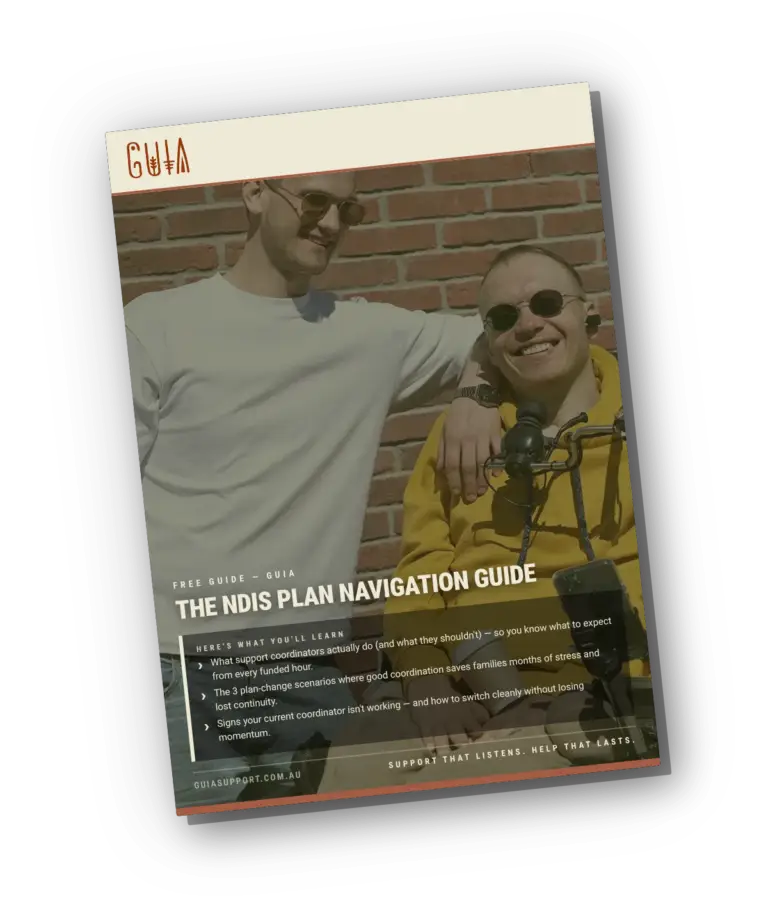
Here's What You'll Learn:
What support coordinators actually do (and what they shouldn't) — so you know what to expect from every funded hour.
The 3 plan-change scenarios where good coordination saves families months of stress and lost continuity.
Signs your current coordinator isn't working — and how to switch cleanly without losing momentum.
ARE YOUR NDIS SUPPORTS WORKING FOR YOU?
GET A FREE NDIS PLAN MANAGEMENT REVIEW