


New NDIS plan: your first 30 days, in order
A new plan arrives and nothing tells you what to do first. Here is the order we work through with families in South West Sydney, and the two mistakes that cost the most.


Shared living supports mean your family member lives with other participants in a home where trained support workers are present. The consistency worry you carry — that someone might cancel, show up late, or not understand your family member’s routines — stems from a real gap. Many providers treat shifts as interchangeable jobs rather than relationships. When support workers rotate unpredictably, your family member loses the trust and routine they depend on. The NDIS funds this support, but funding alone doesn’t the person showing up is the same person who knows how your family member takes their coffee.
Guia’s approach to shared living supports builds reliability into the matching process itself. We don’t assign workers by availability; we match them by fit — personality, communication style, cultural and language background, and understanding of each participant’s specific needs. This means the same support worker returns to the same house, learning routines and building genuine relationships. When a support worker knows your family member’s preferences and patterns, they anticipate needs rather than react to crises. Dignity and consistency become the foundation, not an add-on.
Here’s what that looks like in practice. You’ll meet the support workers who’ll be in your family member’s home before they start. If your family member speaks Spanish or Arabic, or uses Auslan, we match them with workers trained in that language. Our team shows up on time, every time — no last-minute cancellations. Over weeks and months, your family member builds confidence in the routine and in the people supporting them. That’s when real independence grows.
Shared living supports mean your family member lives with other people in a home where trained support workers help with daily tasks, personal care, and building independence. If you’re researching this option right now, you’re probably asking: Will my son or daughter be safe? Will the staff actually show up? Will they treat them with respect?
These aren’t small questions. When someone you care for moves into shared accommodation, you’re trusting another team with their dignity, their routine, their safety. That’s why consistency matters more than anything else. A support worker who cancels last minute or doesn’t know your family member’s preferences creates stress for everyone—especially the participant.
Here’s what families tell us they need most: staff who show up on time, every time. Support workers who learn what your family member actually likes for breakfast, how they wind down at night, what sensory environment helps them feel calm. Workers who speak their language—whether that’s English, Arabic, Spanish, or Auslan. And a provider who listens to what your family has learned over years, rather than starting from scratch.
Shared living can work really well when the right people are matched to the right household. Your family member gets the chance to live more independently, build friendships with housemates, and develop confidence in a supported environment. You get to know the team supporting them; everyone benefits from routine and reliability. Over time, NDIS — Social and Community Participation and NDIS — Finding and Keeping a Job compound naturally alongside In-Home Daily Living & Personal Care Support — together they build the daily rhythm and outward connections that make real independence stick.
The most common starting point is a conversation about what your family member needs day-to-day. What help do they need with personal care? Meals? Getting around the house? Managing their routine? Once you’re clear on that, the right support structure becomes obvious.
Here’s what that looks like in practice. On a Tuesday afternoon at 2 pm, your support worker arrives at the house. They’ve got the same person every week—consistency matters when you’re building trust. They know your family member takes time to transition between activities, so they sit down with a cup of tea first and chat about the weekend.
By 2:30 pm, they’re moving through the weekly tasks together. That might be preparing meals for the next few days, sorting through the laundry, or tackling the bathroom. The support worker doesn’t just do the work—they’re narrating what they’re doing and inviting your family member to help where they can. A cup gets washed together. A bed gets made with two sets of hands; small things that build capability and choice, not just get the job done.
Around 4 pm, they’ll notice something. Maybe the kitchen tap’s getting stiff, or the pantry’s running low on basics your family member likes. They’ll mention it to you, leave a note, or flag it for next week. They’re not just showing up—they’re noticing what matters to your family and your home.
By 4:30 pm, the visit wraps. The house feels lighter. It fridge is stocked. The laundry’s folded. But more than that, your family member’s had two hours of consistent, dignified support from someone who treats them as capable. That’s shared living supports done right—reliable, respectful, and built into the rhythm of your actual week. Over time, NDIS — Social and Community Participation and NDIS — Finding and Keeping a Job compound naturally alongside In-Home Daily Living & Personal Care Support — together they build the daily rhythm and outward connections that make real independence stick.
If that sounds like the kind of support you’re after, we’re here to help. Guia provides in-home daily living and personal care support across South West Sydney, with support workers who are trained, screened, and matched to your family’s needs. When you’re ready to explore what’s possible, enquire about support and we’ll walk you through how it works.
Many families think shared living supports mean their adult family member will live in a group home with strangers, lose privacy, or have little say in who supports them day-to-day. That’s understandable—the word “shared” can sound impersonal. But that’s not how it works in practice.
Shared living supports are about choice and control. Your family member lives in shared accommodation with housemates they’ve had a say in choosing. The support workers are matched to them based on personality fit, communication style, and cultural or linguistic needs—not just availability. If your brother needs a Spanish-speaking support worker, or your sister works better with someone who understands routine and sensory needs, that matters. It shapes the whole living arrangement.
Here’s what that looks like in practice: a participant might live in a two-bedroom house with one other person, with support workers coming in for personal care, meal prep, and help with household tasks. They’re not losing independence—they’re building it, with trained support beside them; they choose how their day runs. They decide when to go out, who visits, what meals they want. The support worker is there to help them make those choices happen safely and with dignity.
What we hear from families is that the best shared living arrangements feel like an extended team around their family member—not a service being done to them. That’s the difference between a provider who matches people thoughtfully and one who just fills a bed. When support workers show up consistently, know your family member’s preferences, and treat them as a capable adult, shared living becomes genuinely supportive rather than just convenient. Over time, NDIS — Social and Community Participation and NDIS — Finding and Keeping a Job compound naturally alongside In-Home Daily Living & Personal Care Support — together they build the daily rhythm and outward connections that make real independence stick.
If shared living supports sound like something worth exploring for your family member, we’re here to talk through what that could look like. Enquire about support and we’ll walk you through the options without pressure.
In-Home Daily Living & Personal Care Support is practical, everyday help that lets you or your family member stay living at home with the support they actually need. It covers personal care, household tasks, and shared living arrangements where participants live together in a home with trained support workers present.
Here’s what that looks like in practice. Personal care includes help with showering, dressing, toileting, and grooming—the intimate daily tasks that matter most. Daily living support covers meal preparation, cleaning, laundry, shopping, and managing the home. If your family member is part of a shared living arrangement, support workers help with all of this while they’re living with housemates, building independence and community at their own pace.
It’s worth knowing that this service does NOT include medical or nursing care, clinical therapy, or diagnosis. It’s not about “fixing” anything—it’s about enabling your family member to do the things they want to do, at home, with reliable people they can trust. The focus is on dignity, choice, and building capability over time.
In South West Sydney, where families often juggle work, caring, and managing NDIS funding, shared living supports can ease the load significantly. Instead of managing 24/7 care alone, your family member gets trained, screened support workers who show up consistently. Many families tell us the relief comes not just from the practical help, but from knowing someone reliable is there—and that their family member is building real independence and friendships in a shared home. Over time, NDIS — Social and Community Participation and NDIS — Finding and Keeping a Job compound naturally alongside In-Home Daily Living & Personal Care Support — together they build the daily rhythm and outward connections that make real independence stick.
The NDIS funds this through your family member’s plan under “Assistance with Daily Personal Activities” and “Assistance with Accommodation and Tenancy” if they’re in shared living. Every plan is different, so the hours and type of support depend on what’s been approved for them.
When you’re ready to explore whether shared living supports could work for your family, we’re here to walk you through it. Enquire about support and we’ll match you with someone who understands your situation.
Finding the right housemates is one of the biggest factors in whether shared living actually works. You’re not just looking for people who need support—you’re looking for people whose routines, interests, and communication styles fit together. That’s where shared living supports make the real difference.
When you’re setting up shared accommodation through your NDIS plan, your support coordinator and Guia’s team help you think through what compatibility actually means. Does your family member do best with a quiet household, or do they thrive with activity and conversation? Are there cultural or linguistic preferences that matter? Do they need someone who shares similar interests, or does the match just need to be respectful and stable? These aren’t small details—they shape whether the house feels like home or like you’re living with strangers.
Here’s what that looks like in practice. We work with you and your family member to understand their preferences, then help identify potential housemates through our network and local community connections. The goal isn’t just to fill a room—it’s to build a household where everyone feels they belong. That might mean finding another autistic adult who values routine and predictability, or matching someone who needs quiet evenings with housemates who respect that boundary.
Your NDIS plan can fund this matching process as part of your NDIS supports for accommodation and tenancy. The support coordinator explains what’s available in your plan, and then you choose how to use it. You’re in control of who lives with you—not the provider, not the scheme. We’re here to help you navigate the options and make sure the match actually works before anyone moves in. Over time, NDIS — Social and Community Participation and NDIS — Finding and Keeping a Job compound naturally alongside In-Home Daily Living & Personal Care Support — together they build the daily rhythm and outward connections that make real independence stick.
When you’re ready to explore shared living supports that fit your family member’s lifestyle, get in touch. We’ll walk through what’s possible in your plan and how to find housemates who genuinely complement each other.
When you choose shared living supports, you’re not handing over control—you’re gaining a partner who works within your choices. Here’s what actually sits in your hands.
What’s your call:
You set the direction. The support worker shows up to help you get there, not to decide where “there” should be.
What sits outside this support:
Shared living supports are about reliable, dignified help with the daily stuff. Your support worker isn’t a therapist or a case manager. They’re trained, screened, and there to help your family member live well in their home—on your terms.
That’s why clarity matters from the start. When you know what you control and what you don’t, you can focus energy on what actually improves day-to-day life. If you’d like to talk through what shared living supports could look like for your family, we’re here to listen. Over time, NDIS — Social and Community Participation and NDIS — Finding and Keeping a Job compound naturally alongside In-Home Daily Living & Personal Care Support — together they build the daily rhythm and outward connections that make real independence stick.
Shared living supports work best when your family member has a real say in who enters their space and when. If your son or daughter is sharing a home with housemates, they deserve support workers who respect their routines, their privacy, and their choices about daily life. That’s the foundation.
Here’s what that looks like in practice. You might notice your family member needs help with personal care or household tasks, but worries about strangers in the house. A reliable support worker who arrives on the same day each week—and actually shows up—builds trust over time. Consistency matters more in shared living than almost anywhere else.
Another signal: your family member is managing most things independently, but needs a hand with specific tasks—cooking certain meals, managing laundry, cleaning shared spaces. They want to stay in control of their day while getting practical help. In-Home Daily Living & Personal Care Support sits right there, supporting what they’re already doing rather than taking over.
Cultural and linguistic fit also shapes how comfortable someone feels at home. If your family member speaks Arabic, Spanish, or uses Auslan, having a support worker who shares that language means they’re not translating their own needs. They can just be themselves in their own space. Over time, NDIS — Social and Community Participation and NDIS — Finding and Keeping a Job compound naturally alongside In-Home Daily Living & Personal Care Support — together they build the daily rhythm and outward connections that make real independence stick.
It’s worth knowing that many NDIS plans already include funding for daily living support and personal care. You may not need to wait for a plan review—the support category might already be there. The question is whether the provider you choose understands shared living, respects independence, and shows up reliably.
If that sounds like the kind of support your family member needs, we’re here to help. Enquire about how shared living supports could work within your current plan.
An autistic adult in Bankstown moved into shared accommodation with two housemates last year. The transition felt big—new people, new routines, new spaces to navigate. His family worried about consistency and whether support workers would understand his need for quiet time and predictable schedules.
Guia matched him with a Spanish-speaking support worker who visited three mornings a week. She helped with breakfast routines, household tasks, and the small things that made the space feel manageable. She learned his preferences quickly—which cupboard he liked to stock, how he preferred to be asked about his day, when he needed space. No last-minute changes. She showed up on time, every time.
Six months in, he was managing more of the household tasks himself; not because anyone pushed him, but because he felt confident enough to try. His family noticed he talked differently about the house—less anxious, more like it was actually his home. The support worker became someone he looked forward to seeing, not someone he had to tolerate.
That’s what shared living supports can look like in practice. A reliable person who understands your needs, shows up consistently, and helps you build the confidence to do more. It’s not about doing everything for someone—it’s about creating the conditions where they can grow at their own pace. Over time, NDIS — Social and Community Participation and NDIS — Finding and Keeping a Job compound naturally alongside In-Home Daily Living & Personal Care Support — together they build the daily rhythm and outward connections that make real independence stick.
If your family member is thinking about shared living or is already settled in, and you’re looking for support workers who genuinely understand routine, consistency, and dignity, we’re here to help. When you’re ready to explore what that could look like, enquire about support and we’ll talk through your situation without pressure.
When your family member moves into shared living accommodation, the way support is funded changes. Understanding how this works helps you plan confidently and know what to expect from your NDIS plan.
In-Home Daily Living & Personal Care Support in shared accommodation is typically funded through your NDIS plan’s Core Supports category. The NDIS uses a price guide to set the hourly rate for personal care and daily living assistance. This rate applies whether support happens in a family home or shared house. Your plan approval letter shows the total budget allocated for this support type, not a fixed number of hours.
How many hours of support you receive depends on what your plan says you need. A support coordinator or planner works through your goals and day-to-day requirements to calculate this. For shared living, the assessment often considers: personal care tasks (showering, dressing, medication), meal preparation and eating, household tasks, and community participation. Each participant’s needs are different, so funding varies.
Here’s what that looks like in practice: if your plan allocates $15,000 annually for daily living support, and the price guide rate is $50 per hour, that covers roughly 300 hours of support across the year. Your support coordinator or the provider helps you schedule these hours around your routine and goals. Over time, NDIS — Social and Community Participation and NDIS — Finding and Keeping a Job compound naturally alongside In-Home Daily Living & Personal Care Support — together they build the daily rhythm and outward connections that make real independence stick.
Some families find the allocated funding doesn’t quite cover everything they’d hoped for. If that happens, you can discuss additional funding options with your planner, or explore whether other plan categories (like Capacity Building) might help bridge the gap. Guia can help you understand what’s realistic within your current plan and talk through your options honestly.
When you’re ready to explore shared living supports and how your funding might work in practice, get in touch. We’ll walk through your plan with you and help you build a support schedule that works.
When you call Guia, you’ll speak with someone who listens. That first conversation isn’t a sales pitch—it’s a chance for us to understand what your family member needs and what matters most to you both. We’ll ask about daily routines, any support gaps you’re facing, and what you’re hoping shared living supports might offer. Most calls take 15–20 minutes.
After that chat, we’ll send you some straightforward information about how shared living works within the NDIS, what’s included in our In-Home Daily Living & Personal Care Support, and what the next steps look like. No pressure. You can read it in your own time and come back to us with questions.
When you’re ready to move forward, we arrange a meet-the-team visit. This is where you’ll sit down with someone from our team who can walk through how we match support workers, what training and screening all our staff complete, and how we handle continuity—showing up on time, every time. We’ll also talk about language and cultural fit. If your family member speaks Spanish, Arabic, or needs Auslan support, we’ll make sure that’s part of the conversation from the start.
Next comes the worker match. We take time to find someone whose approach, availability, and communication style fit your family member’s personality and needs. You’ll meet them before the first support visit, so everyone feels comfortable and confident. Over time, NDIS — Social and Community Participation and NDIS — Finding and Keeping a Job compound naturally alongside In-Home Daily Living & Personal Care Support — together they build the daily rhythm and outward connections that make real independence stick.
Your first visit typically runs 1–2 hours. The support worker will get to know your family member, learn the routines that matter, and start building trust. We’ll check in with you after that first week to make sure everything’s working as it should.
Choosing the right shared living supports provider is one of the most important decisions you’ll make for your family member. You’re not just hiring a service — you’re inviting people into your loved one’s home and daily life. It’s worth taking time to ask the right questions before you commit.
A good provider will welcome your questions. They’ll answer clearly and honestly, without rushing you or using jargon. Here are the questions that matter most to families we work with across South West Sydney.
At Guia, we’re NDIS-registered and Code of Conduct compliant. We match support workers thoughtfully — considering personality, cultural background, and language. We have a multilingual team: English, Spanish, and Arabic speakers. Consistency matters to us. We aim for the same support worker each visit so your family member builds a real relationship with someone they trust.
When you’re ready to explore shared living supports that feel like a genuine fit, enquire about support. We’re here to answer your questions at your pace. Over time, NDIS — Social and Community Participation and NDIS — Finding and Keeping a Job compound naturally alongside In-Home Daily Living & Personal Care Support — together they build the daily rhythm and outward connections that make real independence stick.
When you’re looking for shared living supports, the right provider will show up reliably, communicate clearly, and treat your family member as a capable adult. Some providers fall short in ways that matter day-to-day. Here are the red flags that signal a poor fit.
You deserve a provider who listens, shows up on time, and treats your family member with genuine respect. At Guia, we’ve built our approach around reliability, cultural fit, and person-centred matching. If you’d like to talk through what good shared living supports actually look like, we’re here to help.
Shared living supports work well when the same support worker shows up consistently. Your family member knows what to expect. They’ve built a routine together. There’s trust there—and that matters more than you might think. When continuity happens, you’ll notice your family member relaxes. They’re not re-explaining their needs every visit. The support worker already knows how they take their coffee, what time they prefer to shower, which tasks they find harder on certain days.
Regular check-ins between you and the support team are another sign things are on track. You’re not chasing updates or wondering what’s actually happening during support hours. Instead, the team reaches out—maybe a quick text after a community outing, or a weekly call to talk through what’s working and what might need adjusting. This kind of communication means you’re genuinely in the loop, not an afterthought.
Your family member’s priorities are leading the support, not the other way around. If they want to learn to cook a specific meal, that becomes part of the plan. If they’re anxious about a particular task, the support worker works with them on it rather than rushing through. You’ll spot this when your family member is more engaged, more willing to participate, because the support feels like it’s actually about them.
Finally, look for small shifts in confidence or independence. Maybe they’re managing their own hygiene with less prompting. Perhaps they’re initiating social plans instead of waiting to be told what’s happening. These aren’t dramatic changes—they’re quiet wins. They show that shared living supports are doing what they’re meant to do: helping your family member feel more in control of their own life. Over time, NDIS — Social and Community Participation and NDIS — Finding and Keeping a Job compound naturally alongside In-Home Daily Living & Personal Care Support — together they build the daily rhythm and outward connections that make real independence stick.
If these signs aren’t there yet, that’s worth exploring. Enquire about support and talk through what’s not working. Sometimes it’s a worker match issue. Sometimes the plan needs tweaking. Either way, you deserve a provider who listens and adjusts.
You have choice and control over your support. If shared living supports or any in-home daily living support isn’t working the way you need it to, you have real options. This isn’t about being stuck with a provider who doesn’t fit your family’s needs or your family member’s routine.
The first step is usually direct feedback. If a support worker isn’t showing up on time, isn’t respecting your family member’s preferences, or isn’t doing the tasks you’ve agreed on, tell the provider. Most good providers want to know. A conversation with a manager can often solve things quickly—a different support worker, adjusted visit times, or clearer communication about what each shift looks like.
If feedback doesn’t lead to change, you can request a different support worker altogether. Personality and reliability matter enormously in shared living; a better match might be all that’s needed. If the provider itself isn’t meeting your expectations after genuine attempts to fix things, you can switch to another NDIS-registered provider. Your NDIS plan belongs to you, not to any single organisation.
For serious concerns—if you believe a support worker has breached your family member’s rights, safety, or dignity—the NDIS Quality and Safeguards Commission handles formal complaints. They investigate and can take action against providers who don’t meet the NDIS Code of Conduct. This is a real safeguard, not a last resort you should fear using. Over time, NDIS — Social and Community Participation and NDIS — Finding and Keeping a Job compound naturally alongside In-Home Daily Living & Personal Care Support — together they build the daily rhythm and outward connections that make real independence stick.
At Guia, we’re built on the belief that support should feel reliable and respectful. If it doesn’t, that’s worth addressing. When you’re ready to talk about what you’re looking for in shared living supports, we’re here to listen and match you thoughtfully.
Shared living supports give your family member a real home alongside people who understand them. It’s not just a roof—it’s a community, routines that work, and support workers who show up consistently. If your family member wants more independence but needs daily help, shared living can be that bridge.
Here’s what that looks like in practice. A participant might live in a house with one or two other people, each with their own room. Support workers are there for personal care, cooking, household tasks, and helping everyone stay connected to their community. The goal is building independent living skills over time—things like managing money, making choices about the day, or getting to appointments. It’s dignity and choice, not dependence.
What we hear from families is that the right shared living arrangement takes the pressure off. You’re not managing everything alone; your family member has peers and routines. Support workers become part of the extended team. That consistency matters. We match support workers carefully—considering language, interests, disability experience, and how they work with your family member’s needs. If your family speaks Arabic, Spanish, or needs Auslan, we find workers who do too.
The NDIS funds shared living supports through your family member’s plan, typically under Assistance with Accommodation and Tenancy. Your support coordinator can explain exactly what’s available in your plan and how it works. Over time, NDIS — Social and Community Participation and NDIS — Finding and Keeping a Job compound naturally alongside In-Home Daily Living & Personal Care Support — together they build the daily rhythm and outward connections that make real independence stick.
If shared living sounds like something worth exploring, enquire about support and we’ll walk through your options with no pressure. Whenever you’re ready, we’re here to answer questions and help you think it through.
A new plan arrives and nothing tells you what to do first. Here is the order we work through with families in South West Sydney, and the two mistakes that cost the most.

Aged care at home South West Sydney from Guia. Reliable support workers who show up consistently and become part of your family’s everyday routine.

NDIS allied health support sydney from Guia. Reliable support workers who show up consistently and become part of your family’s circle. Peace of mind fo…
The In-Home Daily Living Support Decision Guide
How to choose the right NDIS in-home support — for the routines, language, and worker continuity that actually fit your family's daily life.
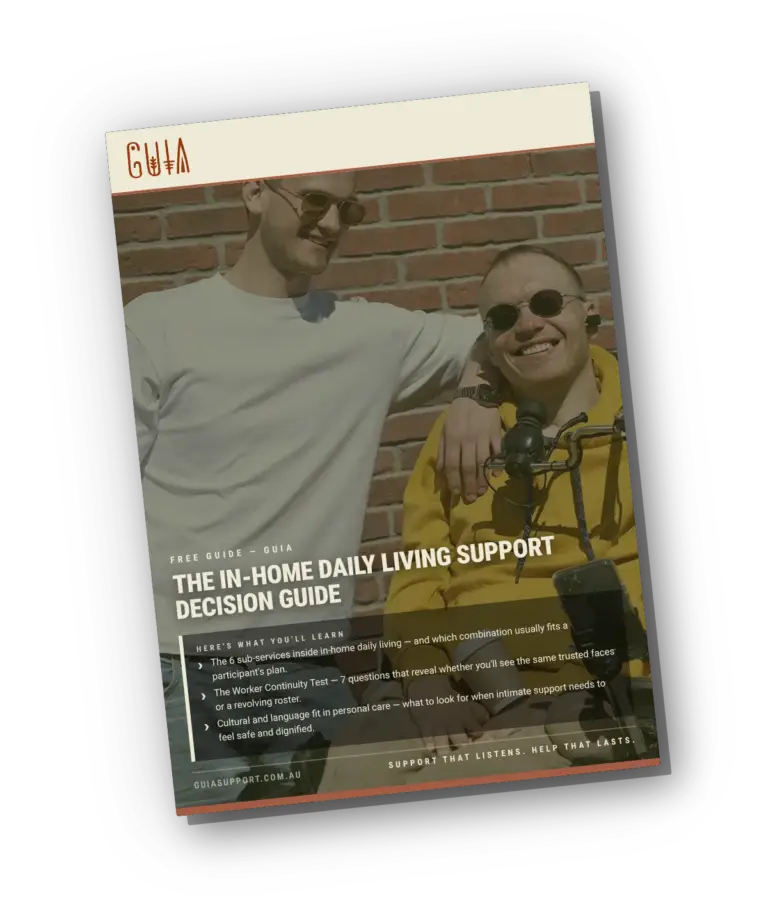
Here's What You'll Learn:
The 6 sub-services inside in-home daily living — and which combination usually fits a participant's plan.
The Worker Continuity Test — 7 questions that reveal whether you'll see the same trusted faces or a revolving roster.
Cultural and language fit in personal care — what to look for when intimate support needs to feel safe and dignified.
ARE YOUR NDIS SUPPORTS WORKING FOR YOU?
GET A FREE NDIS PLAN MANAGEMENT REVIEW