


New NDIS plan: your first 30 days, in order
A new plan arrives and nothing tells you what to do first. Here is the order we work through with families in South West Sydney, and the two mistakes that cost the most.


Household tasks support sounds straightforward until you’re the one managing it. Laundry piles up. Dishes accumulate. Floors need sweeping. When your family member needs help with these daily rhythms, reliability matters more than anything else. You need a provider who shows up on the day and time they’ve promised, every single time. That consistency is what turns support from a logistical headache into something that actually works.
In-Home Daily Living & Personal Care Support addresses this by matching your family member with trained support workers who become part of the household routine. A support worker who understands the rhythm of your home—how your family member prefers tasks done, what time works best, which sensory sensitivities matter—builds real continuity. The mechanism is simple: when the same person arrives regularly, they learn what matters. Tasks get done the way your family member needs them done, not in a checklist way.
Here’s what that looks like in practice. A Tuesday and Thursday afternoon support visit becomes a reliable anchor in the week. Your support worker knows the shopping list, the preferred cleaning products, the way your family member likes to tackle tasks. They’re not starting from scratch each time. That consistency builds trust—for your family member and for you. When you know someone reliable is handling the household, you can focus on being family instead of coordinator.
Household tasks support sounds simple until you’re the one managing it day to day. Laundry piles up. The kitchen needs cleaning. Groceries need buying. And if your family member has disability, these tasks might need more hands, more time, or a different approach than what you’re currently managing alone.
What we hear from families is that they’re often juggling these tasks themselves while also working, caring for others, or managing their own health. The exhaustion is real. And the guilt—wondering if you’re doing enough, or if there’s a better way—sits underneath it all.
Here’s what that looks like in practice: household tasks support through your NDIS plan means having a trained support worker come to your home and help with the everyday jobs that keep life running. Laundry, vacuuming, kitchen prep, shopping, tidying. The work itself isn’t complex. But having someone reliable show up, week after week, transforms what feels impossible into manageable.
It’s worth knowing that this kind of support isn’t about taking over completely. It’s about building capacity—helping your family member do more of what they can, learning new routines together, and creating space for you to breathe. For some families, it means one visit a week. For others, it’s two or three. It depends entirely on what your NDIS plan covers and what actually helps your situation. Over time, NDIS — Social and Community Participation and NDIS — Finding and Keeping a Job compound naturally alongside In-Home Daily Living & Personal Care Support — together they build the daily rhythm and outward connections that make real independence stick.
The hardest part isn’t finding support—it’s finding someone who shows up consistently, treats your family member with dignity, and feels like part of your team rather than just another service provider. That’s where the real difference happens.
Here’s what that looks like in practice. A participant might have household tasks support scheduled for Tuesday afternoons, 2 to 4 pm. The support worker arrives on time with a clear plan: today it’s the kitchen deep clean, fresh bedding on the bed, and sorting through the pantry together.
During that first hour, they work side by side. The support worker doesn’t just do the tasks—they talk through what they’re doing and why. “We’re wiping down inside the fridge because food stays fresher that way. ” The participant helps where they can, choosing the order of jobs or deciding which cleaning products to use. It’s their home, their choices, their say in how it happens.
By the second hour, the support worker notices something small: the participant moves slowly in the morning but has more energy now. They remember this for next week. They also leave a note on the fridge about where new supplies went, so the participant knows where to find things. That’s the kind of detail that matters when you’re supporting someone to stay independent in their own space.
Over weeks, this consistency builds trust. The same support worker learns how the participant likes things done. They know which tasks the participant enjoys and which ones drain them. They’re not just ticking boxes—they’re noticing what helps this person feel more in control of their home and their week. That’s household tasks support that actually works: reliable, respectful, and designed around what matters to your family member. Over time, NDIS — Social and Community Participation and NDIS — Finding and Keeping a Job compound naturally alongside In-Home Daily Living & Personal Care Support — together they build the daily rhythm and outward connections that make real independence stick.
If that sounds like the kind of support you’re after, we’re here to help. Guia has been supporting people across South West Sydney for two years, and we’re registered with the NDIS Quality and Safeguards Commission. When you’re ready to explore what this could look like in your home, reach out to us.
Many families think household tasks support means a support worker will come in and do everything—the dishes, the laundry, the vacuuming—while the participant sits back. That’s not quite how it works, and understanding the difference matters.
Household tasks support is about building capacity and maintaining dignity. A support worker might help someone learn to manage their laundry routine, work through a shopping list together, or break down meal prep into manageable steps. The goal is always to help the participant do what they can, at their own pace, with the support they actually need that day.
Some days that means hands-on help—rolling up sleeves and doing the task together. Other days it’s more about being there, offering a bit of direction or encouragement, or helping someone problem-solve when they get stuck. It depends entirely on what the participant needs and what their NDIS plan covers. The NDIS scheme funds support that builds independence and choice, not support that creates dependence.
What we hear from families is relief when they realise the difference. They’re not paying for someone to take over their loved one’s life. They’re paying for someone reliable to show up, understand what matters to that person, and help them stay in control of their own home and routines. That might mean consistent support twice a week, or it might mean flexible check-ins when things feel overwhelming. Over time, NDIS — Social and Community Participation and NDIS — Finding and Keeping a Job compound naturally alongside In-Home Daily Living & Personal Care Support — together they build the daily rhythm and outward connections that make real independence stick.
If that sounds like the kind of support you’re after—someone who treats your family member as capable and respects their choices—here’s what happens next. Get in touch and we’ll talk through what your situation actually looks like, and whether our approach is the right fit.
In-Home Daily Living & Personal Care Support is practical, hands-on help with the everyday tasks that keep your home running and your family member supported. It’s delivered by trained support workers who come to your home on a regular schedule you choose together.
The support includes personal care — help with showering, dressing, grooming, and toileting — and daily living tasks like meal preparation, laundry, cleaning, and shopping. It also covers help managing medications, paying bills, or organising appointments. The level of support depends entirely on what your family member needs and what’s included in their NDIS plan. Some participants need a few hours a week; others need daily visits. You’re in control of when support happens and what it focuses on.
It’s worth knowing that this service does NOT include clinical or therapeutic work. A support worker won’t diagnose health conditions or provide physiotherapy. If your family member needs that kind of care, it sits in a different part of the NDIS — allied health services. What household tasks support does is give your family member the practical help they need to manage daily life with dignity and independence, at their own pace.
Many families tell us the relief comes from knowing someone reliable will show up on Tuesday at 2pm, every week, without last-minute changes. For an autistic adult who values routine, or someone managing a chronic health condition, that consistency matters deeply. It also gives you breathing room — time to work, rest, or focus on other family needs knowing your loved one is supported at home. Over time, NDIS — Social and Community Participation and NDIS — Finding and Keeping a Job compound naturally alongside In-Home Daily Living & Personal Care Support — together they build the daily rhythm and outward connections that make real independence stick.
If that sounds like the kind of support your family needs, here’s what happens next. Enquire about support and we’ll talk through what your family member’s day-to-day looks like and how we might help.
Household tasks support is funded through your NDIS plan as part of Core Supports — the everyday assistance that helps you live at home. This covers things like laundry, meal prep, cleaning, shopping, and other daily tasks that keep your home running smoothly. The NDIS recognises that managing a household alone can be overwhelming, especially when disability makes certain tasks harder or impossible.
How much support you receive depends on your plan. Your NDIS planner works with you to work out what household tasks matter most to your life and goals. If you’re living independently, you might need regular weekly support; if you’re in shared accommodation, support might be more flexible. The key is that your plan reflects what you actually need, not a fixed amount everyone gets.
What we hear from families is that choosing the right provider matters more than the funding amount itself. You want someone reliable who shows up on time, treats your family member with dignity, and gradually builds their confidence to do more independently over time. That’s where person-centred matching comes in — we listen to what your household needs and connect you with a support worker who fits.
It’s worth knowing that household tasks support often works best alongside other supports in your plan. If you’re also building employment skills or working towards greater independence, household support gives you the stability at home to focus on those goals. Your support worker becomes part of your team, not just someone who cleans. Over time, NDIS — Social and Community Participation and NDIS — Finding and Keeping a Job compound naturally alongside In-Home Daily Living & Personal Care Support — together they build the daily rhythm and outward connections that make real independence stick.
When you’re ready to explore what household tasks support could look like for you, we’re here to walk through your plan and answer questions in plain language. No jargon, no pressure — just honest conversation about what your family actually needs.
When you’re setting up household tasks support, it helps to know exactly what you control and what sits outside the arrangement. This clarity means you can make decisions that fit your family’s actual life, not someone else’s .
Here’s what’s entirely your call:
You’re the expert on your family member’s needs and your household’s rhythm. A good provider listens to that and builds support around it, not the other way around.
What sits outside this support:
Household tasks support is practical, reliable help with the everyday stuff that keeps a home running. It’s not clinical, and it’s not about managing your NDIS plan — that’s your territory.
When you’re ready to explore what household tasks support could look like for your family, enquire about support. We’ll talk through what matters to you and how we’d work together. Over time, NDIS — Social and Community Participation and NDIS — Finding and Keeping a Job compound naturally alongside In-Home Daily Living & Personal Care Support — together they build the daily rhythm and outward connections that make real independence stick.
Household tasks support sits within the “Assistance with Daily Personal Activities” registration group. If your family member’s NDIS plan already lists this category, they may already have funding available — you don’t need to wait for a plan review to start.
The first signal is when daily tasks are piling up and your family member struggles to keep on top of them alone. That might look like laundry backing up, dishes stacking, or floors needing a regular clean. It’s not about perfection — it’s about whether they can manage the basics without stress or without you stepping in every time.
A second signal is when you’re doing these tasks yourself because it’s faster or easier than managing the process. If you’re regularly cleaning, doing laundry, or organising the kitchen because your family member finds it overwhelming, that’s a clear sign support could help them build confidence and take back some control over their own home.
A third signal is when routines matter — and they often do. Some people with disability need the same support worker at the same time each week, or they need tasks done in a particular way. Household tasks support that’s consistent and person-centred means your family member knows what to expect and feels genuinely supported, not just helped. Over time, NDIS — Social and Community Participation and NDIS — Finding and Keeping a Job compound naturally alongside In-Home Daily Living & Personal Care Support — together they build the daily rhythm and outward connections that make real independence stick.
The fourth signal is when cultural or language fit matters. If your family member would feel more comfortable with a Spanish-speaking or Arabic-speaking support worker, or someone who understands their routines and values, that’s not a luxury — it’s part of good support. We match support workers with care, which means your family member gets someone they can actually work with.
If any of these sound familiar, household tasks support could make a real difference. When you’re ready to explore what’s available in your plan, enquire about support and we’ll help you understand what’s already there and what might be next.
An autistic adult in Bankstown was managing most of his daily routine independently. What he struggled with was the weekly buildup of household tasks—laundry, kitchen organisation, bathroom cleaning—that would pile up and become overwhelming. He’d reach a point where the sensory chaos of the space would affect his mood and sleep.
His family tried various approaches. At first they handled it themselves, but that created a dependency neither he nor they wanted. He needed someone who understood that autistic people often work better with consistent routines and clear, predictable support. Someone who wouldn’t treat household tasks as “therapy” or try to teach independence through frustration.
Guia matched him with a support worker who came every Thursday afternoon for three hours. She learned his preferences: how he liked clothes folded, which cleaning products didn’t trigger sensory responses, and that he worked best when she explained the plan before starting. Over time, he started joining in on parts of the tasks he found manageable. The point wasn’t to make him do everything himself—it was to reduce the sensory and emotional weight of the space so he could focus on the things that mattered to him.
Within a few weeks, his family noticed the difference. He was sleeping better. He had energy for his community group on Fridays. The household tasks support wasn’t about independence in the traditional sense—it was about giving him control over his environment and his week. That’s what household tasks support actually means when it’s done well. Over time, NDIS — Social and Community Participation and NDIS — Finding and Keeping a Job compound naturally alongside In-Home Daily Living & Personal Care Support — together they build the daily rhythm and outward connections that make real independence stick.
If your family member is juggling similar pressures, we can help you explore how in-home daily living support might fit their situation. When you’re ready, enquire about support and we’ll have a conversation about what matters most.
Household tasks support sits within your NDIS plan as part of Core Supports — the funding category for everyday assistance. The NDIS uses a price guide to work out how much support costs, based on the type of task, how often you need it, and your location in South West Sydney.
Here’s what that looks like in practice. If you need help with laundry, vacuuming, or meal prep twice a week, your support coordinator works with you to estimate the hours needed. The NDIS then allocates funding at the published rate for that support category. You’re not locked into a fixed amount — your plan can be reviewed and adjusted if your needs change or if you find you need more or less support than expected.
What we hear from families is that the funding process feels clearer when someone explains it plainly. Your support coordinator can walk you through how much household tasks support typically costs, what’s included in your plan, and whether you might need to contribute any gap funding. It’s worth knowing that some families fund household support through Capacity Building (if the goal is building independence) or through Supported Independent Living if you’re in a shared home. Each option has different funding rules.
The key is that you’re in control. You choose which household tasks matter most to you — whether that’s keeping the kitchen clean, managing laundry, or having time to focus on work or study instead. Your support worker’s role is to help you manage those tasks in a way that builds your confidence and independence over time, not to do everything for you. Over time, NDIS — Social and Community Participation and NDIS — Finding and Keeping a Job compound naturally alongside In-Home Daily Living & Personal Care Support — together they build the daily rhythm and outward connections that make real independence stick.
If you’d like to understand how household tasks support funding works for your situation, we’re here to talk it through. Enquire about support and we’ll explain your options in plain language.
When you call Guia, you’ll speak with someone who listens. That first conversation is straightforward—we ask about your family member’s day-to-day needs, what household tasks feel overwhelming right now, and what your NDIS plan covers. No pressure. No lengthy forms on the phone. We’re gathering enough to know if we’re a fit.
Once we understand what you’re after, we’ll send through a simple overview of how household tasks support works in practice. This covers what a typical support visit looks like, how we match support workers, and what happens next. Most families hear back from us within two business days.
The next step is meeting the team. We’ll arrange a short chat—either by phone or in person—where you can ask questions and we can learn more about your family member’s routines, preferences, and any specific cultural or communication needs. If your family member uses Auslan, speaks Arabic or Spanish at home, or has sensory preferences around how tasks are approached, we note all of that. This shapes who we match.
Once we’ve matched a support worker, you’ll have a meet-and-greet before the first paid visit. This gives everyone a chance to connect without the pressure of the clock running. Your family member meets the person who’ll be supporting them. You can ask questions. The support worker understands the household layout and your family’s routines. By the time that first visit happens, it doesn’t feel like a stranger walking in. Over time, NDIS — Social and Community Participation and NDIS — Finding and Keeping a Job compound naturally alongside In-Home Daily Living & Personal Care Support — together they build the daily rhythm and outward connections that make real independence stick.
Most families are up and running within two to three weeks of that first call. We know consistency matters—the same support worker, the same day and time each week, showing up reliably. That’s how real trust builds.
Choosing the right household tasks support provider is one of the most important decisions you’ll make for your family member. You’re looking for someone reliable, respectful, and genuinely committed to helping your loved one stay independent and in control. Before you sign on with any provider, it’s worth asking some direct questions; here are the ones that matter most.
These questions aren’t about being difficult. They’re about making sure you’re working with someone who understands that household tasks support is about dignity, consistency, and real partnership. The answers you get will tell you a lot about how a provider actually operates.
At Guia, we’re NDIS-registered and worker-screened. We match support workers carefully, respect routines, and show up consistently. When you’re ready to explore what that looks like for your family, enquire about support and we’ll talk through your situation in plain language.
When you’re looking for household tasks support, it’s worth knowing what actually signals a provider who won’t show up for your family member. The NDIS scheme is built on choice and control—which means you get to pick a provider who fits, not settle for whoever has availability. Here are the red flags that tell you a provider might let you down.
The right provider will be clear about how they match workers, honest about their team’s stability, and genuinely interested in what your family member needs from day to day. When you’re ready to explore household tasks support that actually fits, we’re here to talk through what matters most to your family.
When household tasks support is working well, you’ll notice the small shifts first. Your family member stops mentioning the same worry twice. The dishes get done on Tuesday afternoon because the same support worker shows up on Tuesday afternoon, every week. That consistency matters more than most people realise — it builds trust, and trust makes the actual work easier.
Look for regular communication between you and the support worker. Not just a text saying “done” at the end of the visit, but genuine updates about what went well, what your family member asked for, and what they’re managing better than last month. A support worker who checks in with you about priorities is one who’s genuinely listening to what matters to your family, not just ticking tasks off a list.
You’ll also notice your family member having more say in how things happen. They’re choosing which household tasks to focus on this week. They’re suggesting a different way to organise the kitchen, and the support worker listens. That’s real empowerment — not someone doing things to them, but someone doing things with them. When your family member feels more in control, you’ll hear it in how they talk about support visits.
Finally, watch for the practical relief in your own routine. You’re not fielding last-minute cancellations or scrambling to cover gaps. The laundry pile isn’t growing because someone reliable is actually there. You have mental space to think about other things because this one part of your family member’s week is genuinely sorted. That breathing room is what good household tasks support creates. Over time, NDIS — Social and Community Participation and NDIS — Finding and Keeping a Job compound naturally alongside In-Home Daily Living & Personal Care Support — together they build the daily rhythm and outward connections that make real independence stick.
If these signs aren’t showing up, it’s worth having a conversation about what’s not working. Your family member’s experience matters, and so does yours. When you’re ready to explore support that’s built on consistency and genuine communication, enquire about support with Guia.
Your NDIS plan is yours to direct; if household tasks support isn’t working the way you need it, you have real options. You’re not locked in, and you don’t have to accept a poor fit.
Start with the provider directly. Tell your support worker or their manager exactly what’s not working. Maybe the timing doesn’t suit your family’s routine, or the support worker doesn’t speak your language, or tasks aren’t being done the way you’ve asked. Good providers want to know. Most issues get sorted with a straightforward conversation and a willingness to adjust.
If feedback doesn’t lead to change, ask for a different support worker. Guia matches participants and support workers with care — we know that personality, reliability, and cultural fit matter. A change in worker can make all the difference. Your support coordinator can help arrange this if you’re not sure how to ask.
If the provider itself isn’t meeting your needs, you can switch. You’re entitled to choose who delivers your support. Talk to your support coordinator about other registered providers in South West Sydney who offer household tasks support. There’s no penalty for moving on. Over time, NDIS — Social and Community Participation and NDIS — Finding and Keeping a Job compound naturally alongside In-Home Daily Living & Personal Care Support — together they build the daily rhythm and outward connections that make real independence stick.
If you’ve raised concerns and nothing shifts, formal complaints exist for that reason. The NDIS Quality and Safeguards Commission handles complaints about registered providers and investigates breaches of the NDIS Code of Conduct. It’s a real safety net, and it’s there because your experience matters.
You deserve support that feels reliable, respectful, and right for your family. If you’d like to talk through what good household tasks support looks like for you, we’re here to listen.
The right household tasks support starts with understanding what actually matters to your family member and what fits into their NDIS plan. Household tasks—laundry, meal prep, cleaning, shopping—aren’t luxuries. They’re the backbone of living with dignity and staying connected to your home and community.
When you’re thinking about household tasks support, it helps to be specific about what’s hardest right now. Is it the physical side—managing laundry or heavy cleaning; the planning side—knowing what groceries to buy and organising a shop? The routine side—keeping things consistent week to week? It clearer you are, the better the match between your family member and their support worker.
Here’s what that looks like in practice: a support worker might come for a two-hour Tuesday afternoon visit to help with meal prep and washing, or a Thursday morning to tackle the week’s laundry and tidy shared spaces. Some families prefer one consistent person; others value flexibility. Your NDIS plan will show what’s available to you, and your support coordinator can help translate that into real hours and activities.
We support participants across South West Sydney who need household tasks support that feels reliable and respectful. Our team includes Spanish-speaking and Arabic-speaking support workers, so if language or cultural fit matters to your family, we can usually match that from the start. Every support worker is qualified, screened, and trained to work with dignity—showing up on time, every time, and treating your family member as a capable adult. Over time, NDIS — Social and Community Participation and NDIS — Finding and Keeping a Job compound naturally alongside In-Home Daily Living & Personal Care Support — together they build the daily rhythm and outward connections that make real independence stick.
When you’re ready to explore what household tasks support could look like for your family, there’s no pressure to decide today. Enquire about support and we’ll have a conversation about what you need, answer your questions, and help you feel confident about the next step.
A new plan arrives and nothing tells you what to do first. Here is the order we work through with families in South West Sydney, and the two mistakes that cost the most.

Aged care at home South West Sydney from Guia. Reliable support workers who show up consistently and become part of your family’s everyday routine.

NDIS allied health support sydney from Guia. Reliable support workers who show up consistently and become part of your family’s circle. Peace of mind fo…
The In-Home Daily Living Support Decision Guide
How to choose the right NDIS in-home support — for the routines, language, and worker continuity that actually fit your family's daily life.
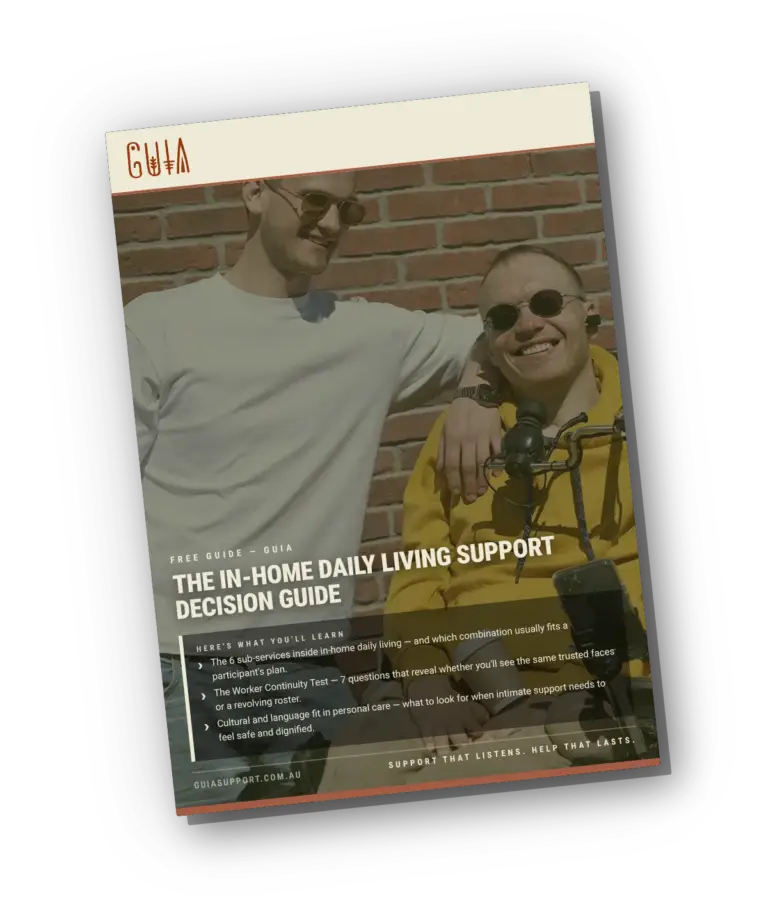
Here's What You'll Learn:
The 6 sub-services inside in-home daily living — and which combination usually fits a participant's plan.
The Worker Continuity Test — 7 questions that reveal whether you'll see the same trusted faces or a revolving roster.
Cultural and language fit in personal care — what to look for when intimate support needs to feel safe and dignified.
ARE YOUR NDIS SUPPORTS WORKING FOR YOU?
GET A FREE NDIS PLAN MANAGEMENT REVIEW