


New NDIS plan: your first 30 days, in order
A new plan arrives and nothing tells you what to do first. Here is the order we work through with families in South West Sydney, and the two mistakes that cost the most.


NDIS personal care support works best when the same trained support worker shows up consistently. Families worry most about cancellations, no-shows, or staff turnover that disrupts routines and breaks trust. The NDIS scheme funds this support because daily living tasks—showering, dressing, meal prep, household help—matter to independence. But funding alone doesn’t reliability. A provider’s actual commitment to showing up on time, every time, is what separates support that feels dependable from support that adds stress.
Consistency builds when a provider matches the right support worker to each participant and keeps that pairing stable. We invest time in understanding what matters to your family member—their routines, communication style, cultural background, preferred languages. That knowledge stays with one person across weeks and months, not rotating through different staff. When the same worker knows how your brother likes his coffee or what sensory needs matter to your daughter, support feels personal rather than transactional. That’s the mechanism: stability creates trust, and trust makes the work actually work.
In practice, this means your support worker becomes someone your family recognises and relies on. You know their name, their habits, their reliability. You’re not explaining the same preferences to a new face every fortnight. Our team is trained, screened, and matched thoughtfully—many speak Spanish or Arabic alongside English, and we work with Auslan users too. When you’re ready to explore how this kind of consistent, dignified support could fit your situation, get in touch and we’ll talk through what your family actually needs.
NDIS personal care support covers the everyday tasks that let your family member stay clean, dressed, and comfortable at home. Showering, dressing, grooming, toileting — these aren’t luxuries; they’re the foundation of dignity and independence.
What we hear from families is this: you’re not worried about the concept. You’re worried about consistency. Will the support worker actually show up on Tuesday at 9 am? Will they treat your mum or brother with respect, or will they rush through? Will they understand routines that matter — the way your family member needs things done?
Here’s what that looks like in practice. A support worker arrives on time, every time. They help with a shower at a pace that feels calm, not hurried. They know that your family member prefers their clothes laid out in a certain order, or that they need five minutes to settle after getting dressed. They’re trained, screened, and they treat personal care as the serious, dignified work it is.
It’s worth knowing that cultural and linguistic fit matters too. If your family speaks Arabic at home, having a Spanish-speaking or Arabic-speaking support worker isn’t a nice-to-have — it’s the difference between feeling understood and feeling like an outsider in your own routine. Guia works across South West Sydney with multilingual support workers who get that. Over time, NDIS — Social and Community Participation and NDIS — Finding and Keeping a Job compound naturally alongside In-Home Daily Living & Personal Care Support — together they build the daily rhythm and outward connections that make real independence stick.
Personal care support sits within your NDIS plan under Assistance with Daily Personal Activities. Your support coordinator or the NDIS official site can help you understand what’s funded for your situation. The real question isn’t whether you need it — it’s whether you’ve found a provider you can trust to show up with respect and reliability, every single week.
Here’s what that looks like in practice. Your family member has a Tuesday afternoon support visit, two hours, starting at 1 pm. The support worker arrives on time with a quiet knock. They know your mum takes a few minutes to transition between activities, so there’s no rushing.
Together they work through the week’s personal care and household tasks at a pace that feels manageable. Maybe it’s a shower day—the support worker has learned exactly how your mum likes the water temperature, which soap she prefers, and that she needs the grab rail on the left side. They’re not just efficient; they’re attentive. They notice when something’s changed, when she’s tired, when she’s ready to move on.
While support is happening, small things get done; clothes get folded and put away. The kitchen gets tidied. A meal prep happens for the next few days. Nothing feels rushed or transactional. The support worker checks in: “Does this work for you? ” “What do you need next week? ” Your mum stays in control of what happens in her own home.
When the visit ends at 3 pm, the house is calmer. Your mum feels cared for, not managed. You get a quick message—nothing intrusive, just a heads-up that everything went well. If there’s something you need to know, the support worker tells you. If there’s something your mum wants to try differently next time, that gets noted. Over time, NDIS — Social and Community Participation and NDIS — Finding and Keeping a Job compound naturally alongside In-Home Daily Living & Personal Care Support — together they build the daily rhythm and outward connections that make real independence stick.
That’s NDIS personal care support when it works well. Reliable. Respectful. Focused on what your family member actually needs, not on ticking boxes. When you’re ready to explore how this could work for your situation, enquire about support and we’ll talk through what matters most to you.
Many families think NDIS personal care support means hiring someone with minimal training to help around the house. That’s not what it is. When you choose a provider for daily living and personal care, you’re choosing someone qualified, screened, and trained to support your family member with dignity and safety.
Here’s why that distinction matters. Personal care—whether that’s help with showering, dressing, toileting, or managing health routines—requires real skill. It’s not just about showing up. It’s about understanding how to support someone safely, respecting their privacy and preferences, and noticing when something’s changed or needs adjusting. That takes training and experience.
At Guia, every support worker is qualified and worker-screened before they meet your family member. We match them carefully based on what your son, daughter, or family member actually needs—not just availability. If cultural or linguistic fit matters to your family (and for many in South West Sydney, it does), we can arrange that. We work in English, Spanish, Arabic, and Auslan. That’s not a bonus feature—it’s how we make sure communication is clear and support feels genuinely personal.
The NDIS Quality and Safeguards Commission registers and monitors providers to make sure standards are met consistently. We’re registered and Code of Conduct compliant. That’s your assurance that your family member is supported by someone who’s been properly vetted and trained. Over time, NDIS — Social and Community Participation and NDIS — Finding and Keeping a Job compound naturally alongside In-Home Daily Living & Personal Care Support — together they build the daily rhythm and outward connections that make real independence stick.
If you’ve been worried about whether the person coming into your home is truly qualified, that worry makes sense. It’s worth asking any provider directly: What training do your staff have? How do you match workers to participants? How do you handle continuity if someone’s unwell? Those are the questions that separate reliable support from a lucky guess.
For many families, having a support worker of the same gender during personal care is important for dignity, comfort, and trust. If that matters to you or your family member, it’s absolutely something you can request when you’re matched with a provider.
When you enquire about NDIS personal care support, let your support coordinator or provider know upfront. A good provider will listen to that preference and work to honour it. At Guia, we match support workers based on what each participant and family actually need—not just availability. Same-gender matching is one of those preferences we take seriously, and we’ll do our best to find the right fit for you.
It’s worth knowing that timing can affect how quickly a match happens. If you need support to start urgently, a same-gender worker might take a week or two longer to arrange. But if you can wait a little, we’ll find someone who fits what you’re looking for. That’s part of honouring your choice and control over who comes into your home.
Language and cultural background matter just as much. If you’d prefer a Spanish-speaking, Arabic-speaking, or Auslan-trained support worker alongside same-gender matching, we can work with that too. South West Sydney is home to families from many backgrounds, and your comfort during personal support is not negotiable. Over time, NDIS — Social and Community Participation and NDIS — Finding and Keeping a Job compound naturally alongside In-Home Daily Living & Personal Care Support — together they build the daily rhythm and outward connections that make real independence stick.
The conversation starts with a single conversation. Tell us what matters to you—whether that’s same-gender support, language, experience with a particular disability, or anything else. We’ll listen, and we’ll be honest about what we can arrange and what the timeline might look like. When you’re ready to explore what that could look like for your situation, get in touch.
NDIS personal care support is funded through your NDIS plan, but how that funding sits in your plan depends on what kind of support you need. Understanding the difference matters because it affects how you choose your provider and what flexibility you have month to month.
Most in-home daily living and personal care support sits in your plan as “Core Supports” — funding set aside specifically for assistance with daily personal activities like showering, dressing, meal preparation, and household tasks. Core Supports are flexible. You decide which provider delivers them, when support happens, and how often; if your circumstances change mid-year, you can adjust. The NDIS sets the rules, but you’re in control of how the funding gets used.
Some participants also have “Capacity Building” funding in their plan. This is support designed to help you build skills and independence over time — things like learning to manage medications independently or developing routines that work for your household. The goal is genuine progress toward greater control of your own life, not endless dependency.
If you’re looking at Supported Independent Living (SIL) — 24-hour support in shared accommodation — that’s typically a different funding stream. It’s designed for participants who need round-the-clock presence and want to live with housemates in a supported setting. Over time, NDIS — Social and Community Participation and NDIS — Finding and Keeping a Job compound naturally alongside In-Home Daily Living & Personal Care Support — together they build the daily rhythm and outward connections that make real independence stick.
What matters most is this: you get to choose your provider. You’re not locked in. If Guia isn’t the right fit, you can change. If a support worker isn’t working out, we listen and adjust the match. Your plan is yours to direct, and your provider should respect that choice every single day.
Evening routines set the tone for sleep and the next day. If your family member struggles with winding down, feels anxious at night, or needs help with personal care before bed, NDIS personal care support can make a real difference. Here’s what you actually control—and what sits outside this support’s scope.
What’s your call:
You also decide how much of the routine your family member does independently and where the support worker steps in. Some participants manage most tasks themselves but need help with one specific thing. Others need full support. That’s your choice, and a good provider matches their approach to what actually works for your household.
What’s outside this support:
If your family member has ongoing sleep issues or health concerns, those conversations belong with their GP or allied health provider, not their support worker. But a reliable support worker who shows up consistently, treats evening routines with dignity, and listens to what actually helps? That’s where real change happens.
When you’re ready to explore what evening support could look like for your family, enquire about support with Guia. We’ll talk through your routine, your goals, and what matters most. Over time, NDIS — Social and Community Participation and NDIS — Finding and Keeping a Job compound naturally alongside In-Home Daily Living & Personal Care Support — together they build the daily rhythm and outward connections that make real independence stick.
If your family member needs help with moving around at home—whether that’s getting in and out of bed, using the shower, or transferring to a wheelchair—NDIS personal care support can cover the cost of equipment and trained support workers to do this safely. This isn’t about doing things for them; it’s about doing things with them, at the pace that works.
A common starting point is when a participant or their family notices that transfers are becoming harder on everyone’s body. Maybe a parent’s back is strained from helping, or the participant themselves feels less secure. A hoist, slide sheet, or transfer board—combined with a support worker trained to use it properly—changes what’s possible. Your NDIS plan may already include funding for this under Assistance with Daily Personal Activities.
Here’s what that looks like in practice: a support worker arrives for a two-hour morning visit, helps your family member shower and dress using the right equipment, and leaves you feeling like the day has started well instead of stressfully. The worker knows the routine, knows the equipment, and knows your family member as a person—not just a task to tick off.
If you’re unsure whether your current plan covers equipment-assisted care or if you need a plan review to add it, a support coordinator can clarify what’s already there. Many families don’t realise they have funding available until someone explains it plainly. Cultural and linguistic match matters too—Guia’s team includes Arabic-speaking and Spanish-speaking support workers across South West Sydney, so the person helping your family member can communicate in the language that feels most comfortable. Over time, NDIS — Social and Community Participation and NDIS — Finding and Keeping a Job compound naturally alongside In-Home Daily Living & Personal Care Support — together they build the daily rhythm and outward connections that make real independence stick.
Maya is an autistic adult living in Bass Hill. She’d been managing daily routines alone for years, but as she got older, showering, meal prep, and keeping the house tidy became harder to coordinate around her sensory needs and preferred routines. Her mum worried constantly—not about Maya’s capability, but about whether she’d eat properly or whether the house would become unsafe.
When Maya’s NDIS plan included funding for in-home daily living support, her family wasn’t sure what that actually meant. Would a stranger disrupt her routines? Would they understand that she needed advance notice before any changes to her schedule?
Guia matched Maya with a support worker who speaks Spanish and understands routine-based living. The worker comes three mornings a week. They’ve built a rhythm together: a consistent time, consistent approach to tasks, and genuine respect for how Maya likes things done. The support worker doesn’t just tick boxes—they notice that Maya prefers to shower on specific days and that meal prep works better when ingredients are laid out in a particular order. Over time, Maya’s confidence grew. She started suggesting small changes to routines herself, knowing her preferences would be respected.
What matters most to her mum now? Reliability. The same worker, the same time, no last-minute changes. That consistency meant her mum could stop worrying about whether support would actually happen, and start noticing that Maya was more relaxed at home and more willing to try new things on her own terms. Over time, NDIS — Social and Community Participation and NDIS — Finding and Keeping a Job compound naturally alongside In-Home Daily Living & Personal Care Support — together they build the daily rhythm and outward connections that make real independence stick.
If your family member needs NDIS personal care support and you’re wondering what it looks like in reality, that’s exactly the kind of situation we help with every week. When you’re ready to explore what’s possible, enquire about support and we’ll walk you through how it works for your situation.
NDIS personal care support is funded through your plan as either a Core Support or, in some cases, a Capacity Building activity. The difference matters—it affects how your funding sits in your plan and what it can be used for. Core Supports cover ongoing assistance with daily personal activities like showering, dressing, and meal preparation. Capacity Building supports help you develop skills toward greater independence over time.
The NDIS uses a price guide to set the hourly rates for personal care and daily living support. Your support coordinator or the NDIS will have shared this with you when your plan was created. The actual cost depends on a few things: the number of hours you need each week, the time of day support happens (evening or weekend rates differ), and whether you need high-intensity support for complex health or mobility needs. Your plan approval letter will show exactly how much funding sits in each category.
Here’s what that looks like in practice. If your plan includes 10 hours of Core Support for daily personal activities at the standard rate, Guia’s support workers will deliver those hours across the week—perhaps two five-hour days, or shorter visits on multiple days. You choose the schedule that fits your life. The funding covers the support worker’s time and our coordination to match you with someone reliable and culturally suited to your needs.
Some families find their plan funding doesn’t quite cover everything they’d hoped for. If that’s your situation, we can talk through what’s realistic within your approved hours and how to make the most of them. We’re honest about what’s possible—and we’re experienced at helping families and participants make choices that feel right.
When you’re ready to understand your plan better or start arranging support, get in touch. We can walk through your funding with you in plain language and answer questions about how it all works.
When you call Guia, you’re talking to someone who listens. We ask about your family member’s daily routine, what matters most to them, and what support would actually help. That first conversation isn’t a sales pitch—it’s us getting to know you. We’ll explain what NDIS personal care support covers and answer questions about how it works in practice.
After that chat, we match a support worker to your family member. This isn’t random. We think about personality fit, language preferences, and whether they share cultural or faith values that matter to your family. If your family member speaks Arabic at home, we’ll find a Spanish-speaking or Arabic-speaking support worker when we can. If routine and predictability matter—and they often do—we’ll talk about that too.
Your first visit usually happens within one to two weeks. The support worker arrives on time. They spend the first hour getting to know your family member, learning their preferences, and understanding how they like things done. They’re not there to change routines or rush through tasks. They’re there to fit into your family’s life and earn trust.
Throughout this process, you stay in control; you choose whether the match feels right. You decide what support looks like week to week. We’re NDIS-registered and Code of Conduct compliant, which means we work within clear standards—but our real job is making sure your family member feels respected and supported at home. Over time, NDIS — Social and Community Participation and NDIS — Finding and Keeping a Job compound naturally alongside In-Home Daily Living & Personal Care Support — together they build the daily rhythm and outward connections that make real independence stick.
If that sounds like the kind of NDIS personal care support you’re after, reach out. We’re here to answer your questions and help you figure out what comes next.
Choosing the right NDIS personal care support provider is one of the most important decisions you’ll make for your family member. The provider you select will be in your home, supporting daily routines, and building trust over time. It’s worth asking direct questions upfront so you know exactly what to expect.
Here are the questions that matter most. Write them down, ask them in the same way to each provider you’re considering, and pay attention not just to the answer but to how they answer it. A good provider will be clear, honest, and ready to talk specifics.
A provider that answers these questions clearly and without hesitation is showing you they take accountability seriously. They’re also showing they respect your right to make an informed choice—which is exactly the kind of partner you want in your corner.
Sensory sensitivities are real and they matter. If your family member finds loud noises overwhelming, or needs routines to stay calm, the right support worker makes all the difference. The wrong one—even with good intentions—can leave your family member stressed and you doubting the whole arrangement.
Here’s what to watch for when you’re assessing whether a provider truly understands sensory needs. These red flags often show up early, sometimes in the first conversation or first visit.
At Guia, we match support workers to participants based on sensory needs and communication style, not just availability. We invest time in understanding what calm looks like for your family member, and we keep the same worker with you so trust can build. Our team is trained in sensory awareness and we’re NDIS-registered and Code of Conduct compliant.
If any of these red flags sound familiar, or if you’re not sure your current provider is the right fit, we’re here to talk through what would work better. When you’re ready, enquire about support and we’ll listen to what your family member actually needs. Over time, NDIS — Social and Community Participation and NDIS — Finding and Keeping a Job compound naturally alongside In-Home Daily Living & Personal Care Support — together they build the daily rhythm and outward connections that make real independence stick.
The best sign that NDIS personal care support is working well is consistency. Your family member’s support worker shows up on the same day and time, week after week. They know the routine—how your mum likes her morning tea, what time your brother prefers his shower, which tasks matter most that day. That reliability builds trust and lets your family member relax into the support.
Communication makes a real difference too; you hear from the support worker regularly—not just when something goes wrong. A quick message about how the week went, what your family member enjoyed, or a heads-up about something they’d like to try next. You’re not left guessing. You know what’s happening at home when you’re not there.
Watch for your family member’s priorities leading the support, not the other way around. If they want to spend Tuesday afternoon at the local shops instead of doing housework, that happens. If they’re learning to cook a favourite meal or practising a skill that matters to them, the support worker helps make that real. Your family member stays in control of their day, and the support adapts to fit their life—not the reverse.
Finally, notice the small shifts over time. Your family member might be more confident doing certain tasks. They might have a friendship that’s grown because the support worker helped them get to a community group. They might be sleeping better or seem calmer at home. These aren’t dramatic changes—they’re the quiet wins that add up to a better quality of life. Over time, NDIS — Social and Community Participation and NDIS — Finding and Keeping a Job compound naturally alongside In-Home Daily Living & Personal Care Support — together they build the daily rhythm and outward connections that make real independence stick.
If you’re seeing these signs, the support is working. If you’re not, it’s worth having a conversation about what needs to shift. When you’re ready to explore NDIS personal care support or discuss how to get better results from current support, enquire about support with Guia.
You have choice and control over your NDIS personal care support. If something isn’t working—whether it’s the support worker, the timing of visits, or the way support is being delivered—you’re not stuck with it.
The first step is usually a conversation with your support worker or their manager at Guia. Most issues get sorted quickly when they’re raised early. If you’d prefer a different support worker who’s a better fit culturally, linguistically, or just personally, that’s a reasonable request. We work to match you with someone you trust.
If feedback to the provider doesn’t resolve things, you can escalate formally within Guia’s complaints process. Your family or support coordinator can help you put concerns in writing if that feels easier. You deserve to feel heard and respected in how support is delivered.
You also have the right to switch providers entirely. Your NDIS plan belongs to you. If you decide Guia isn’t the right fit, you can choose another registered provider. Your support coordinator or the NDIS Quality and Safeguards Commission can explain how that works and what happens to your funding during a transition. Over time, NDIS — Social and Community Participation and NDIS — Finding and Keeping a Job compound naturally alongside In-Home Daily Living & Personal Care Support — together they build the daily rhythm and outward connections that make real independence stick.
If you believe a provider—any provider—has breached the NDIS Code of Conduct or failed to deliver what’s in your plan, you can lodge a formal complaint with the NDIS Quality and Safeguards Commission. They investigate independently and have the power to take action.
Choice and control aren’t just words in the NDIS. They’re your right. You get to decide who supports you, how, and when. If you’re thinking about your options or want to talk through what good support should look like, we’re here to listen.
When you’re ready to explore NDIS personal care support, the first step is a conversation with us. This isn’t a formal assessment or a commitment. It’s a chance to talk through what your family member needs day-to-day and how we might help.
During a free discovery call, we’ll ask about routines that matter most. Morning support getting ready for the day? Help with meals and household tasks? Personal care with dignity and consistency? We listen to what you’re actually managing right now, not what a checklist says you should need.
We’ll also talk about who your family member is. Their interests, communication style, cultural background, and what makes them feel safe and respected. That matters because the right support worker isn’t just qualified—they’re someone your family member connects with. If you speak Arabic, Spanish, or Auslan at home, we’ll match that too.
It’s worth knowing that we’re NDIS-registered and all our staff are qualified and worker-screened. We’ve been supporting people across South West Sydney for two years, and we’ve built our service on lived experience of disability and family caregiving. That means we get the small things that make support feel personal, not transactional. Over time, NDIS — Social and Community Participation and NDIS — Finding and Keeping a Job compound naturally alongside In-Home Daily Living & Personal Care Support — together they build the daily rhythm and outward connections that make real independence stick.
There’s no pressure to decide on the day. You’ll have time to think, ask questions, and check whether we’re the right fit for your family. If you’d like to have that conversation, enquire about support and let us know what works best for you—a phone call, email, or a visit to chat in person. Whenever you’re ready.
A new plan arrives and nothing tells you what to do first. Here is the order we work through with families in South West Sydney, and the two mistakes that cost the most.

Aged care at home South West Sydney from Guia. Reliable support workers who show up consistently and become part of your family’s everyday routine.

NDIS allied health support sydney from Guia. Reliable support workers who show up consistently and become part of your family’s circle. Peace of mind fo…
The In-Home Daily Living Support Decision Guide
How to choose the right NDIS in-home support — for the routines, language, and worker continuity that actually fit your family's daily life.
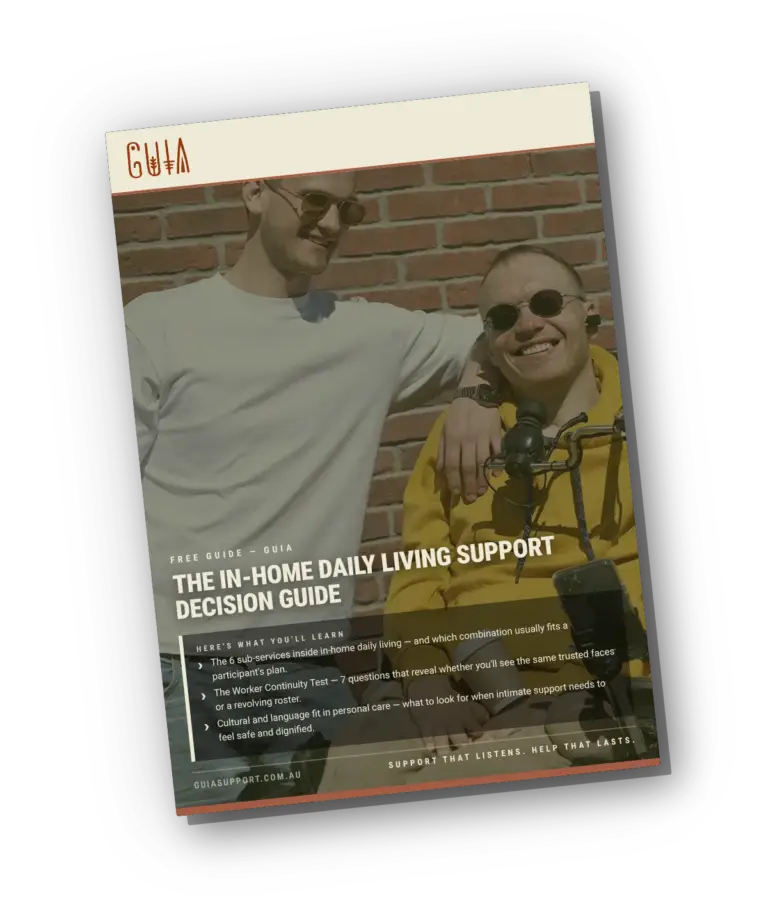
Here's What You'll Learn:
The 6 sub-services inside in-home daily living — and which combination usually fits a participant's plan.
The Worker Continuity Test — 7 questions that reveal whether you'll see the same trusted faces or a revolving roster.
Cultural and language fit in personal care — what to look for when intimate support needs to feel safe and dignified.
ARE YOUR NDIS SUPPORTS WORKING FOR YOU?
GET A FREE NDIS PLAN MANAGEMENT REVIEW