


New NDIS plan: your first 30 days, in order
A new plan arrives and nothing tells you what to do first. Here is the order we work through with families in South West Sydney, and the two mistakes that cost the most.


In-home daily living support means showing up on time, every time—because inconsistency erodes trust faster than anything else. When you’re managing a family member’s daily routine, a missed visit or a last-minute cancellation cascades through the whole day. You reorganise work, reschedule appointments, and your relative loses confidence in the plan itself. Under the NDIS, support providers register for specific assistance categories, and reliability is the foundation that everything else rests on.
Consistency works because it builds predictability into a participant’s week. When the same support worker arrives at the same time on the same days, your family member knows what to expect. They can plan their own activities around that anchor point. They build confidence in the relationship itself. A support worker who knows your mum’s routine, her preferences, and her communication style doesn’t need to start from scratch each visit. That familiarity translates into better support, faster problem-solving, and less stress for everyone.
Here’s what that looks like in practice. Guia matches support workers thoughtfully—considering language, cultural fit, and the specific dynamics your family needs. A Spanish-speaking support worker stays with the same participant across weeks. Scheduling happens in advance, not last-minute. If something changes, you hear about it directly, not through a message. That’s how a support worker becomes someone your family actually trusts, not just another provider ticking a box.
In-home daily living support means having a trained support worker come to your home regularly to help with the everyday tasks that matter most. That might be personal care, household help, meal preparation, or just having someone there you can rely on. It’s NDIS-funded support designed around what you or your family member actually needs, not a one-size-fits-all service.
What we hear from families is that the biggest worry isn’t understanding what the service is called — it’s whether the same person will show up on Tuesday afternoon, whether they’ll treat your mum or brother with dignity, and whether they’ll actually fit with your family’s routines and values. Those are the things that matter.
Under the NDIS, in-home daily living support sits in the “Assistance with Daily Personal Activities” registration group. That covers help with showering, dressing, toileting, and grooming — plus household tasks like laundry, cleaning, and meal prep if that’s part of your plan. The support is tailored to your participant’s goals and level of independence, not fixed into a standard package. If your family member speaks Arabic, Spanish, or uses Auslan, that matters too — the right match between worker and participant makes all the difference.
Here’s what that looks like in practice: instead of a “four hours per week,” you might have a Tuesday and Thursday afternoon visit from someone who knows your family’s routine, respects your son’s or daughter’s preferences, and helps build their confidence over time. The goal isn’t just to get tasks done — it’s to support people to feel more in control of their own life. Over time, NDIS — Social and Community Participation and NDIS — Finding and Keeping a Job compound naturally alongside In-Home Daily Living & Personal Care Support — together they build the daily rhythm and outward connections that make real independence stick.
If that sounds like the kind of support you’re after, we’re here to help you navigate it. Guia has been supporting people across South West Sydney for two years, and we’re NDIS-registered with all staff qualified and worker-screened. When you’re ready to talk through what your family actually needs, we’re a phone call away.
Here’s what that looks like in practice; your family member has a Tuesday afternoon support visit from 2 to 4 pm. The support worker arrives on time, every time. They help with a shower, choosing clothes that feel comfortable, and getting ready for the day ahead. Nothing rushed. Nothing assumed.
While they’re there, they might help with light household tasks—loading the dishwasher, wiping down the kitchen bench, tidying the lounge. But the real work is noticing. They see that your family member prefers their clothes folded a certain way; they remember that Tuesday is the day they like the curtains open. They leave a note about what went well, what your family member chose to do, and what might be worth planning for next week.
If your family member uses a wheelchair, they help with transfers in and out safely. If they need reminders about meals or taking medication, that’s built into the visit. If they’re autistic and find mornings stressful, the support worker learns their routine and sticks to it. If they speak Arabic at home, Guia can match them with a Spanish-speaking or Arabic-speaking support worker who gets the cultural context.
The goal isn’t to do everything for them. It’s to help them do what matters to them. Some people want to build confidence with cooking. Others want help managing their home so they can focus on hobbies or seeing friends. Some need high-intensity personal care because of complex health or mobility needs. In-home daily living support scales to what your family member actually needs—not a fixed package, but real choice and control over how their time and their home work. Over time, NDIS — Social and Community Participation and NDIS — Finding and Keeping a Job compound naturally alongside In-Home Daily Living & Personal Care Support — together they build the daily rhythm and outward connections that make real independence stick.
If that sounds like the kind of support you’re after, here’s what happens next. Enquire about support and we’ll talk through what a typical week might look like for your family member. No pressure. Just a conversation about what matters most.
Many families think in-home daily living support is only for people with very high support needs. The truth is simpler: if your NDIS plan includes funding for daily personal activities or assistance with daily living, you’re eligible to use it however makes sense for your situation.
The misconception often comes from seeing support workers help with complex personal care tasks. That’s real work we do. But in-home daily living support covers a much wider range of everyday tasks; it might be help with showering and dressing. It might be shopping, meal prep, or keeping the house liveable. It might be support getting to appointments or managing bills. The level and type of help depends entirely on what your plan funds and what you actually need.
Here’s what that looks like in practice: one participant might use three hours a week to learn cooking skills and build independence in the kitchen. Another might use the same hours for personal care and household tasks. A third might split it between both. There’s no single “right” way. Your NDIS plan is yours to direct, and the support you choose should fit your goals and daily reality.
What matters for eligibility is that your NDIS plan includes funding under the “Assistance with Daily Personal Activities” or “Assistance with Daily Living” support categories. If you’re not sure whether your plan includes this, your support coordinator can check, or you can ask us during an initial conversation. We work with participants and families across South West Sydney to match support that actually fits your life. When you’re ready to explore what’s possible, we’re here to walk you through it. Over time, NDIS — Social and Community Participation and NDIS — Finding and Keeping a Job compound naturally alongside In-Home Daily Living & Personal Care Support — together they build the daily rhythm and outward connections that make real independence stick.
In-home daily living support means a trained support worker comes to your home to help with tasks you need help with. This might be personal care—showering, dressing, toileting—or daily living tasks like meal prep, laundry, cleaning, or managing household routines. The support is tailored to what each person actually needs, not a one-size approach.
Here’s what that looks like in practice. If someone needs help getting ready in the morning, a support worker might come for two hours on Monday, Wednesday and Friday. If household tasks are the priority, support might focus on meal planning, shopping, or keeping the home safe and organised. The frequency and timing are built around the participant’s routine and goals, not the provider’s schedule.
What in-home daily living support does NOT include is medical care or clinical treatment. A support worker won’t administer medication or provide nursing—that’s a different service. It also doesn’t include allied health like physiotherapy or speech therapy. Those sit outside this category. What it does include is the everyday practical help that lets someone stay at home with dignity and independence, and builds their confidence over time.
NDIS funding for in-home support sits in a registration group called “Assistance with Daily Personal Activities”. When your NDIS plan is created, the planner will allocate funding for this support based on what you’ve told them you need. You then choose which provider delivers that support. That choice and control matters—you’re the one who decides if the support worker, the timing, and the approach actually fit your life. Over time, NDIS — Social and Community Participation and NDIS — Finding and Keeping a Job compound naturally alongside In-Home Daily Living & Personal Care Support — together they build the daily rhythm and outward connections that make real independence stick.
If you’re not sure whether in-home daily living support is the right fit for your situation, or you want to talk through what it might look like, we’re here to help. Enquire about support and we’ll walk through your needs in plain language, no pressure.
In-home daily living support sits within your NDIS plan’s Core Supports — funding that covers everyday help you choose and control. That might mean a support worker visiting twice a week for three hours, or five days a week for two hours. You decide what works for your life, and your plan funds it accordingly.
What does a support worker actually do? Here’s what that looks like in practice. They help with personal care — showering, dressing, grooming, toileting — at the pace and with the dignity that suits you. They help with household tasks: meal prep, laundry, cleaning, shopping. They support you to manage appointments, bills, or routines that keep your home running. If you’re learning to do more independently, they work alongside you, building your confidence step by step.
The NDIS funds this support because it’s essential to your daily life and wellbeing. Your support coordinator or planner will have worked with you to work out how many hours you need and what activities matter most. That’s your choice. You’re not spending down a pot of money — you’re using funding set aside specifically for daily living support.
What we hear from families is that consistency matters more than anything else. A support worker who knows your routines, respects your preferences, and shows up reliably becomes part of your week. At Guia, we match support workers carefully — considering language, experience, and how you work best together. We’re NDIS-registered and all our staff are qualified and worker-screened. When you’re ready to explore what in-home daily living support could look like for you, we’re here to talk through it. Over time, NDIS — Social and Community Participation and NDIS — Finding and Keeping a Job compound naturally alongside In-Home Daily Living & Personal Care Support — together they build the daily rhythm and outward connections that make real independence stick.
If that sounds like the kind of support you’re after, here’s what happens next. Get in touch and we’ll listen to what you need, answer your questions in plain language, and help you understand how your plan can fund it. No pressure, no jargon.
When you’re setting up in-home daily living support, it helps to be clear about what you control and what sits outside the scope. That clarity means fewer surprises and more confidence in how your support actually works week to week.
What’s your call:
You’re the expert on your family member’s needs and what matters most. At Guia, we match support workers with real attention to cultural and linguistic fit — so if an Arabic-speaking or Auslan-trained worker would make a difference, that’s something we work toward together. You set the rhythm; we show up consistently and treat every visit as part of building trust with your household.
What’s outside this support:
It’s worth knowing that in-home daily living support works best when it’s paired with clarity about what your NDIS plan actually funds. If you’re unsure what your plan covers or how much support you’re entitled to, a registered support coordinator can help you navigate that — that’s a separate service, but it often sits alongside daily living support.
When you’re ready to talk through what consistent, reliable support could look like for your household, we’re here. Enquire about support and let’s have a conversation about what matters most. Over time, NDIS — Social and Community Participation and NDIS — Finding and Keeping a Job compound naturally alongside In-Home Daily Living & Personal Care Support — together they build the daily rhythm and outward connections that make real independence stick.
In-home daily living support works best when it matches what your family member actually needs day-to-day. It’s not about waiting for a plan review—many NDIS plans already include this support category. The question is whether you’re using it, and whether it’s working.
A common starting point is when daily tasks feel overwhelming without help. That might be personal care—showering, dressing, grooming—or household tasks like meal prep, laundry, or cleaning. It might be both. If your family member can’t manage these safely or consistently alone, and you’re doing most of it yourself, in-home daily living support could ease that burden for everyone.
Another signal is routine and structure. Some people—autistic adults, for example, or those with intellectual disability—thrive when support is predictable. A support worker who arrives every Tuesday and Thursday afternoon, or every weekday morning, can provide the consistency that makes a real difference. Knowing what to expect helps build confidence and independence over time.
You might also notice that your family member needs someone they can trust but who isn’t you. A trained support worker can help with personal care or daily tasks in a way that gives both your family member and you some breathing room. That’s not about stepping back—it’s about sharing the load so everyone stays well. Over time, NDIS — Social and Community Participation and NDIS — Finding and Keeping a Job compound naturally alongside In-Home Daily Living & Personal Care Support — together they build the daily rhythm and outward connections that make real independence stick.
Cultural and linguistic fit matters too. If your family speaks Arabic, Spanish, or Auslan at home, having a support worker who shares that language or communication style makes a real difference. It’s not a nice extra—it’s part of genuine, respectful support.
If any of these sound familiar, it’s worth check-ing whether your current plan includes this support, and whether the provider you’re with now is reliable and responsive. When you’re ready to explore what’s possible, enquire about support and we can talk through what might work for your family.
Amira is an autistic adult living in Bankstown with her mum. She communicates best in Arabic and uses routine to manage sensory overwhelm. When Amira’s mum needed support with personal care and household tasks, finding a worker who understood both her communication style and her need for consistency felt urgent.
Guia matched Amira with Fatima, a Spanish and Arabic-speaking support worker trained in sensory awareness. Fatima visits three mornings a week for two hours. She helps with showering, getting dressed, and preparing breakfast — but she also respects Amira’s routine completely. Same days, same times, same approach; amira’s mum doesn’t have to repeat instructions or worry about last-minute changes.
What changed for Amira’s family was simple but real. Her mum could attend her own medical appointments without stress. Amira had a support worker she could communicate with directly in her own language. And because Fatima was trained to recognise sensory sensitivities, she adjusted the environment — softer lighting, quieter mornings — without being asked. Amira felt more in control of her day.
Across South West Sydney, cultural and linguistic matching isn’t optional — it’s essential. Our multilingual team speaks English, Arabic, and Spanish. We also provide Auslan-trained workers for Deaf and hard of hearing participants. More importantly, we match participants to workers thoughtfully, not by availability alone. We listen to what matters: communication style, cultural background, routine preferences, sensory needs. Over time, NDIS — Social and Community Participation and NDIS — Finding and Keeping a Job compound naturally alongside In-Home Daily Living & Personal Care Support — together they build the daily rhythm and outward connections that make real independence stick.
If your family member needs in-home daily living support and language or cultural fit matters to you, that’s not a complication — it’s exactly what we’re designed for. When you’re ready to explore what support could look like, we’re here to listen to your situation and find the right match.
In-home daily living support is funded through your NDIS plan as a Core Support. The NDIA sets a price guide for different support categories — personal care, daily living assistance, household tasks — and your plan allocates funding based on your assessed needs and goals. Here’s what that means in practice for your family.
When you and your support coordinator agree on the level of support you need, that funding sits in your plan ready to use. If your plan includes two four-hour visits per week for personal care and daily living help, those hours are yours to direct toward a provider you choose. Guia charges within the NDIS price guide, so your funding goes directly toward the support your family member receives — no hidden gaps.
Some families find their plan funding covers most of what they need. Others discover a small gap between what’s funded and what they’d like to add — perhaps an extra visit on a difficult day, or support in a category the NDIA didn’t fully fund. That’s a real conversation to have with your support coordinator, and it’s worth knowing upfront so you can plan together.
The NDIS price guide adjusts annually, and your plan is reviewed each year. If your family member’s needs change — they’re moving house, starting a new routine, managing a health change — that’s the time to talk with your coordinator about whether your current support level still fits. Guia works with you and your coordinator to match the support you’re funding to the life you’re actually living, not the other way around. Over time, NDIS — Social and Community Participation and NDIS — Finding and Keeping a Job compound naturally alongside In-Home Daily Living & Personal Care Support — together they build the daily rhythm and outward connections that make real independence stick.
When you’re ready to explore how in-home daily living support could work for your family, we’re here to answer your questions about funding, matching, and what a typical week looks like. Enquire about support and we’ll walk you through it.
When you call Guia, you’ll speak to someone who knows the NDIS and knows South West Sydney. That first conversation isn’t a sales pitch—it’s a chance for us to listen. We’ll ask about your family member’s daily routine, what’s working, what’s hard, and what kind of support would actually help. Most calls take 15 to 20 minutes.
After that chat, we’ll send you simple information about how in-home daily living support works, what it costs under the NDIS, and what we’d do differently. If it feels like a fit, we’ll arrange a quick meet-the-team call. You’ll talk to the coordinator who’d manage your family member’s support. They’ll answer questions about timing, worker matching, and how we handle changes to routines or preferences.
Here’s what that looks like in practice: once you’re ready to move forward, we match a support worker based on what matters to your family—language, personality fit, experience, and availability. We don’t rush this. A good match means the support worker feels like part of your team, not a stranger in your home. If you speak Arabic, Spanish, or need Auslan support, we make sure that’s part of the match from day one.
Your first visit is a meet-and-greet. The support worker arrives on time—we’re reliable about that—and spends time getting to know your family member and understanding the routines that matter. They’ll talk through what a typical support visit looks like: personal care, household tasks, meal prep, whatever’s in the plan. Nothing surprises anyone on day one. Over time, NDIS — Social and Community Participation and NDIS — Finding and Keeping a Job compound naturally alongside In-Home Daily Living & Personal Care Support — together they build the daily rhythm and outward connections that make real independence stick.
From first call to first visit usually takes one to two weeks. We keep you informed at every step. When you’re ready to start, enquire about support and we’ll take it from there.
Choosing the right in-home daily living support provider means asking the right questions upfront. You’re not just looking for someone to show up—you’re looking for someone reliable, respectful, and genuinely matched to your family member’s needs. Here are the questions that matter most.
The answers tell you a lot. A provider who can name your support worker by next week, who has a clear backup plan, and who asks about cultural and language needs is showing you they think about consistency and respect. A provider who rushes through these questions or gives vague answers might be cutting corners elsewhere.
At Guia, we’ve been supporting people across South West Sydney for two years. We’re NDIS-registered, all our staff are qualified and worker-screened, and we match support workers thoughtfully—not randomly. When you’re ready to explore in-home daily living support that treats your family member as a capable adult, enquire about support and let’s talk about what your situation actually needs.
Good in-home daily living support should feel reliable, respectful, and responsive to your family member’s actual needs. Not every provider gets this right. Here are the clearest signs that your current support isn’t working—and that it’s time to look for a better fit.
If any of these sound familiar, it’s worth exploring other options. The right provider shows up consistently, listens to what your family member actually needs, and treats every support visit as an opportunity to build trust and independence. When you’re ready to talk about in-home daily living support that works differently, enquire about support with Guia.
In-home daily living support works best when you start to notice small, consistent changes in your family member’s day-to-day life. These signs tell you the support is actually landing — not just happening around them, but genuinely helping them.
The first sign is consistency. It same support worker shows up on the same day at the same time, week after week; your family member knows what to expect. They’ve built a real relationship with that person. There’s no anxiety about a stranger arriving, no time wasted on explanations. When support workers stay in role, participants feel safer and more in control of their own routine.
The second sign is communication that flows both ways. You hear from the support worker about what went well, what your family member enjoyed, what they’re working towards. You’re not left guessing. At the same time, your family member’s own priorities — what matters to them, not just what’s on a checklist — are actually shaping the support. If they want to learn to cook a particular meal, or spend more time in the garden, or get to the shops on a specific day, that’s what the support focuses on.
The third sign is growing confidence. You notice your family member doing things more independently, or asking for help differently, or trying something new. They’re not just receiving support — they’re building skills and feeling more capable. That’s empowerment in action. Over time, NDIS — Social and Community Participation and NDIS — Finding and Keeping a Job compound naturally alongside In-Home Daily Living & Personal Care Support — together they build the daily rhythm and outward connections that make real independence stick.
The fourth sign is peace of mind for you. You know your family member is safe, respected, and genuinely supported. You can step back a little because you trust the arrangement. That matters as much as anything else.
If these signs resonate with what you’re hoping for, Guia can help. We match support workers carefully and stay committed to continuity and genuine communication. When you’re ready to explore in-home daily living support that actually works this way, enquire about support and we’ll talk through what your family member needs.
In-home daily living support works best when it fits your family’s actual life. Sometimes that means the support you set up initially needs to shift — because routines change, needs evolve, or the match between your family member and their support worker simply isn’t right. The good news is that you have real options, and you’re not locked into any arrangement that isn’t working.
The first step is usually a conversation with your provider. If a support worker isn’t showing up on time, or the way they help with personal care doesn’t feel respectful, or they’re not a cultural or linguistic match your family needs, tell them directly. Most good providers — including Guia — want to know when something isn’t working so they can fix it. That might mean adjusting the support plan, changing the times of visits, or matching your family member with a different support worker who’s a better fit.
If feedback to the provider doesn’t lead to change, you can escalate to their manager or request a formal review of your support arrangement. You’re also entitled to switch providers entirely. Your NDIS plan belongs to you — you choose who delivers it, and you can change that choice if the current provider isn’t meeting your family’s needs.
If you feel your concerns haven’t been heard or resolved fairly, the NDIS Quality and Safeguards Commission handles complaints about registered providers and can investigate if support falls below the standards you’re entitled to expect. This isn’t a last resort — it’s a real safeguard built into the scheme. Over time, NDIS — Social and Community Participation and NDIS — Finding and Keeping a Job compound naturally alongside In-Home Daily Living & Personal Care Support — together they build the daily rhythm and outward connections that make real independence stick.
Choice and control are at the heart of the NDIS. You’re the decision-maker, and that includes deciding whether your current support is working. When you’re ready to explore options or talk through what adjusting your support might look like, we’re here to listen.
The first step is often the simplest: a conversation. You don’t need to have your NDIS plan sorted or know exactly what support looks like yet. Many families start by talking through what a typical day looks like for their family member — what takes the most time, what feels hardest, where an extra set of hands would make the biggest difference.
When you’re ready, enquire about support and we’ll listen to what matters most. We’ll ask about routines, preferences, any cultural or language needs, and how your family member likes to be supported. This isn’t a sales call — it’s us getting to know you so we can match the right support worker to your family.
Here’s what that looks like in practice. If your family member speaks Arabic at home, we’ll prioritise an Arabic-speaking support worker. If mornings are chaotic and evenings are calm, we’ll work around that rhythm. If your family member has sensory sensitivities or needs routines to stay grounded, we build support that respects that. We’re NDIS-registered and Code of Conduct compliant, and all our staff are qualified and worker-screened.
Once you’ve had that first chat, we’ll talk through how in-home daily living support fits into your NDIS plan — what it covers, how many hours might suit your situation, and what the actual support visits look like week to week. We can answer questions about how the scheme works and what your options are. Over time, NDIS — Social and Community Participation and NDIS — Finding and Keeping a Job compound naturally alongside In-Home Daily Living & Personal Care Support — together they build the daily rhythm and outward connections that make real independence stick.
There’s no pressure to decide straight away. Some families take time to think it over, chat with their support coordinator, or see how their family member feels about meeting a potential support worker. That’s completely normal, and we’re here whenever you’re ready to move forward.
A new plan arrives and nothing tells you what to do first. Here is the order we work through with families in South West Sydney, and the two mistakes that cost the most.

Aged care at home South West Sydney from Guia. Reliable support workers who show up consistently and become part of your family’s everyday routine.

NDIS allied health support sydney from Guia. Reliable support workers who show up consistently and become part of your family’s circle. Peace of mind fo…
The In-Home Daily Living Support Decision Guide
How to choose the right NDIS in-home support — for the routines, language, and worker continuity that actually fit your family's daily life.
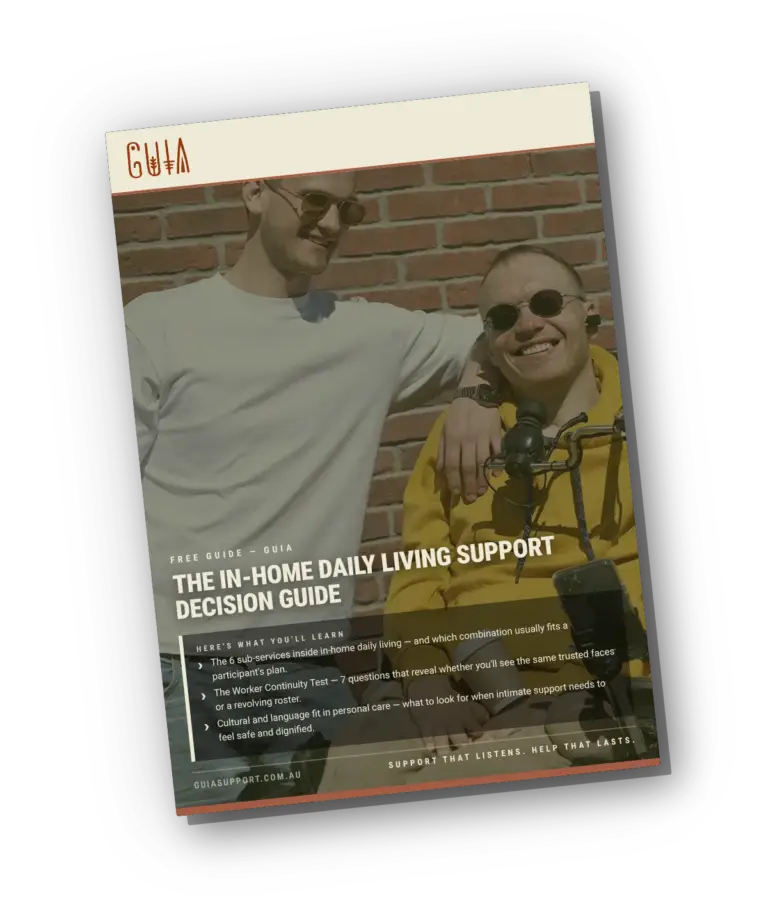
Here's What You'll Learn:
The 6 sub-services inside in-home daily living — and which combination usually fits a participant's plan.
The Worker Continuity Test — 7 questions that reveal whether you'll see the same trusted faces or a revolving roster.
Cultural and language fit in personal care — what to look for when intimate support needs to feel safe and dignified.
ARE YOUR NDIS SUPPORTS WORKING FOR YOU?
GET A FREE NDIS PLAN MANAGEMENT REVIEW