


New NDIS plan: your first 30 days, in order
A new plan arrives and nothing tells you what to do first. Here is the order we work through with families in South West Sydney, and the two mistakes that cost the most.


What support coordinator does is bridge the gap between your family member’s NDIS plan and the actual providers who deliver support. A support coordinator reads the plan document, understands what funding sits in each category, and matches your family member with providers who can deliver exactly what’s needed—on time, every time. Within the NDIS — National Disability Insurance Scheme, this role exists because plans are complex and most families need someone who speaks both the plan language and the real-world language of getting support to show up reliably.
The mechanism is straightforward: a support coordinator sits between your family member’s goals and the providers doing the work. They listen to what matters most—whether that’s consistency, cultural fit, or specific expertise—then actively match participants to providers who fit those needs. They don’t just hand you a list and wish you luck. They follow up, check that the relationship is working, and adjust if something isn’t landing right. This means your family member gets support that actually fits, not just support that technically fills a funding category.
In practice, here’s what that looks like: a support coordinator meets with you and your family member, learns what reliability and respect mean in your household, then introduces you to providers who understand those values. If a support worker doesn’t show up on time, or if the cultural or language match isn’t right, the coordinator knows about it early and helps find someone better. Over time, you stop worrying about whether support will land—it does, consistently—and the support worker starts to feel like someone you can actually trust with your family member’s care.
What support coordinator does is help you navigate your NDIS plan and choose the right providers to match what you actually need. If you’re sitting with a plan document that feels overwhelming, or you’re wondering how to turn funding into real support, a support coordinator is the person who helps you get there.
Most families tell us the same thing: the NDIS itself isn’t simple. There are registration groups, support categories, budget codes, and decisions that affect what your family member can access month to month. A support coordinator translates all of that into plain language and helps you match providers to the life you’re trying to build—not the other way around.
Here’s what that looks like in practice. A support coordinator listens to what matters most to your family member. Do they want to learn work skills? Build friendships? Get reliable help at home? The coordinator then finds providers who can actually deliver that, explains what each one offers, and helps you make the choice that feels right. They also stay involved after you’ve chosen—check-ing in, making sure things are working, and adjusting when life changes.
It’s worth knowing that not all coordinators work the same way. Some rush through the matching process. Others take time to understand your family’s routines, preferences, and what “good support” actually means to you. The best ones treat the participant as the decision-maker and the family as part of that decision, not an obstacle to it.
If that sounds like the kind of support you’re after, Guia’s Level 2 and Level 3 Specialist coordinators work across South West Sydney. We listen first, explain the NDIS in plain language, and help you build a plan that works for your family. When you’re ready to explore what support coordination could look like for you, enquire about support.
A support coordinator does what support coordinators do: they listen to what matters to you, then find and connect you with the right providers and services. Here’s what that looks like in practice across a typical week in South West Sydney.
Monday morning, your coordinator rings to check in. Your adult son has been struggling with the transition back to his day programme after the school holidays. She’s already thinking about whether his current provider is still the right fit, or whether a different approach might build his confidence faster. She takes notes. She doesn’t rush.
By Wednesday, she’s spoken to three other providers in the area. She’s asked specific questions: Can they work with autistic adults who need routine consistency? Do they have Arabic-speaking staff, or can they respect your family’s cultural preferences? What does their actual Tuesday afternoon look like; she’s gathering real detail, not just ticking boxes.
Thursday afternoon, she visits your home. She sits down with you and your son. She explains what each option actually means—not in NDIS jargon, but in words that make sense. She asks what you’re worried about. She listens more than she talks. By the end, you feel like someone genuinely understands what your family needs, not just what the plan says you’re entitled to.
The next week, she makes the introduction to the new provider; she stays involved during the first few visits. If something isn’t working, she notices it and acts. She’s not hands-off; she’s steady and present. That’s what support coordination actually is: someone who knows the system, respects your choices, and makes sure the pieces fit together the way you need them to.
If that sounds like the kind of support you’re after, enquire about support with Guia. We’re NDIS-registered and based right here in South West Sydney.
Many families think a support coordinator’s job is to manage their loved one’s NDIS plan or make decisions about funding on their behalf. It’s an understandable mix-up—the title sounds administrative, and coordinators do work closely with plans. But that’s not what support coordinators actually do.
The NDIS itself creates and manages your plan. A support coordinator’s role is different: they help you understand what’s in your plan, explore what support options exist, and match you with providers who fit your needs. They’re navigators and matchmakers, not plan managers or decision-makers.
Here’s what that looks like in practice. A support coordinator might explain which registration groups offer the services you’re after, help you think through what “good fit” means for your family, or connect you with providers in South West Sydney who offer the specific support you need. They work with you to build confidence in your choices—not to choose for you.
What we hear from families is that this distinction matters more than it sounds. When you know a coordinator is there to clarify your options and support your thinking—rather than push you toward particular providers—you feel more in control. You’re making the call. They’re holding the map.
If you’re looking for support coordination that respects your family’s pace and priorities, Guia offers Level 2 and Level 3 Specialist coordinators who work in plain language and take time to understand what matters to you. When you’re ready to explore what support coordination could look like for your situation, we’re here to talk it through.
Support coordination is what support coordinator does: it helps you understand your NDIS plan, find the right providers, and make sure your funding is spent on things that actually matter to you. It’s about having someone in your corner who knows the system and can translate it into plain English.
Here’s what that looks like in practice. A support coordinator works with you and your family to map out what you need—whether that’s daily personal care, community access, employment support, or home modifications. They help you choose providers who are a good fit, not just available. They check in regularly to make sure the support is working and adjust things if it isn’t. They also help you understand what your plan covers and what it doesn’t, so there are no surprises down the track.
It’s worth knowing that support coordination does NOT include managing your NDIS plan itself—that’s the NDIA’s job. A support coordinator doesn’t create your plan or decide how much funding you get. What they do is help you spend that funding wisely and find providers who will show up reliably and treat you with respect. They’re also not therapists or clinical advisors. If you need allied health support, they’ll help you find an exercise physiologist or other specialist, but they won’t deliver that care themselves.
At Guia, our Level 2 and Level 3 Specialist coordinators work in plain language and take time to understand what matters to you. We’re NDIS-registered and Code of Conduct compliant, and our team includes Arabic, Spanish, and Auslan-trained coordinators across South West Sydney. We’ve been supporting families for two years, and we know that good coordination means you stay in control of your choices.
If you’d like to talk through what support coordination could look like for you or your family member, we’re here to help.
Support Coordination sits within your NDIS plan as a Core Support — meaning it’s funded to help you navigate the scheme itself, not to deliver direct disability support. It’s distinct from the hands-on help you might receive from personal care workers or community participation staff. A support coordinator’s job is to help you understand what’s in your plan, find the right providers, and make sure everything runs smoothly.
The NDIS funds support coordination at different levels depending on what you need. Level 2 coordinators work with participants who have straightforward plans and clear goals. Level 3 specialists step in when your situation is more complex — multiple providers, changing circumstances, or coordination between health and disability supports. Guia offers both, plus Psychosocial Recovery Coaching for participants managing mental health alongside their NDIS plan.
Here’s what that looks like in practice. Your coordinator helps you read your plan letter, explains what each funding line means, and talks through which providers might be the right fit for you. They don’t make the choice for you — they give you the information and the confidence to decide. If your circumstances change — you move house, your goals shift, a provider isn’t working out — your coordinator helps you adjust your plan and find new support.
Funding for Support Coordination comes from your plan’s Core Supports budget. How much you receive depends on your individual circumstances and what the NDIA approved when your plan was agreed. Your coordinator can’t create or change your plan — that’s the NDIA’s role — but they can help you understand it and use it well.
What we hear from families is that having a coordinator who knows your situation, speaks your language, and shows up consistently makes the whole NDIS experience feel less overwhelming. When you’re ready to explore Support Coordination with Guia, get in touch.
When things go wrong—a support worker cancels last-minute, a service doesn’t show up as planned, or your family member’s needs change suddenly—it’s natural to feel uncertain about what happens next. A good support coordinator helps you navigate these moments by being clear about what you control and what sits outside the support relationship.
Here’s what’s your call to make:
Your support coordinator works within these boundaries because they’re yours to direct. You’re not a passenger in your own plan—you’re making the decisions about who supports you and how. If a provider isn’t showing up reliably or a support worker isn’t the right fit, that’s something you and your coordinator address together. That’s agency. That’s choice.
Here’s what sits outside this support:
A support coordinator isn’t there to fix everything or promise outcomes they can’t control. They’re there to help you understand what’s possible within your plan, connect you to the right providers, and step in when communication breaks down. If your family member’s situation changes—a new diagnosis, a move, a change in what they need—your coordinator helps you think through what that means for your support, then works with you to adjust.
When you’re ready to talk about what support coordination could look like for your family, we’re here to listen and explain how we work. Enquire about support with Guia.
Support Coordination sits in your NDIS plan under a category called “Assistance with Plan Management”. It’s not something every participant needs, but it’s worth check-ing whether it’s already there and whether it’s doing what your family actually requires right now.
A practical signal you might benefit from Support Coordination is if you’re spending more than an hour each week working out which providers fit which parts of your plan. If your family member has multiple support needs—say, personal care, community access, and employment support—and you’re juggling three or four different providers, a coordinator can translate your plan into plain language and match the right person to each task. That clarity saves time and worry.
Another common starting point is when your family member’s needs have shifted. Maybe they’ve left school, moved into a new living arrangement, or their health has changed. A support coordinator helps you understand what your current plan actually covers and whether a plan review makes sense. They’re not there to push you toward spending more—they’re there to help you see what’s already available and make sure it’s working.
You might also find Support Coordination valuable if English isn’t your first language at home. Guia’s coordinators speak English, Spanish, and Arabic, which means complex NDIS terminology gets explained in a way that feels natural to your family. That matters when you’re making decisions about your family member’s support.
Check your NDIS plan letter to see if “Support Coordination” or “Plan Management” is already listed. If it’s, you may not need to wait for a plan review. If it’s not there and any of these situations sound familiar, that’s worth exploring. When you’re ready to talk through whether it fits, we’re here to help.
An autistic adult in Bass Hill was managing on a part-time support arrangement that had worked for two years. When their mum’s health changed, the household needed more help with meal planning and shopping. The participant and their family weren’t sure if their NDIS plan had room for this, or how to ask.
Their support coordinator helped them gather the right evidence — notes from the mum about what was hardest week to week, a simple diary of tasks that took longest. The coordinator explained which parts of their plan could stretch to cover shopping support, and which bits needed a formal plan change request. No jargon, just clear steps.
The coordinator then wrote the request on their behalf, keeping the language plain and specific. Instead of “needs more support”, it said: “Shopping trips twice weekly, 90 minutes each, because meal planning and choosing foods are sensory-heavy and take longer. ” The NDIA approved the change within four weeks.
Here’s what that looked like in practice: the participant now has a Spanish-speaking support worker who comes Tuesday and Friday mornings. They’ve built routines around the shops the participant prefers, and they talk through meal ideas together. The participant feels more in control, and the mum has breathing room.
This is what a good support coordinator does — they translate your everyday reality into NDIS language, gather the proof, and handle the paperwork so you don’t have to. If your family member’s needs have shifted and you’re not sure how to ask, that’s exactly what we’re here for. When you’re ready, enquire about support and we’ll walk through it together.
Your NDIS plan includes funding for support coordination under two main categories: Core Supports and Capacity Building Supports. The NDIS price guide sets the hourly rates that providers can charge, but the amount you receive depends on what your plan approves and your individual circumstances.
Core support funding covers the day-to-day coordination help you need to navigate your plan and connect with providers. This might include explaining what different support categories mean, helping you choose providers that match your needs, or working through changes to your plan. The NDIS calculates this based on your assessed support needs, not on how much money is in your plan overall.
Capacity Building supports are designed to help you develop skills and independence over time. If support coordination is listed here, it means the NDIS recognises that learning to manage your own plan—or having someone help you do that—builds your confidence and control. This funding sits separately from your Core allocation.
Here’s what that looks like in practice: You’ll have an approved dollar amount for support coordination in your plan. When you engage a provider, they’ll work within that budget. If you need more hours than your plan allows, you and your family can discuss whether additional funding is possible at your next plan review, or whether other supports in your plan could be adjusted.
What we hear from families is that the funding conversation feels clearer when someone explains it plainly. At Guia, our Level 2 and Level 3 Specialist coordinators walk you through exactly how your allocation works and what it covers. When you’re ready to explore what support coordination could look like for you, we’re here to help.
When you’re ready to explore what support coordination looks like with Guia, here’s what actually happens. The process is straightforward, and we’ll walk you through each step so there are no surprises.
Your first call is a quick chat—nothing formal. We’ll listen to what your family member needs, what’s confusing about their NDIS plan, and what you’re hoping to sort out. We’ll answer questions about how we work and what support coordination covers. You’ll get a real sense of whether Guia feels like the right fit. Most calls take fifteen to twenty minutes.
If you’d like to move forward, we’ll arrange a time to meet. This might be a phone or video chat, or we can visit you at home—whatever works best for your family. We’ll go through your NDIS plan together in plain language, talk through which support services might help, and explain how our coordinators match you with the right providers. This is where you ask all the questions that came up after the first call.
Once you’re ready, we’ll match you with a support coordinator who fits your family’s needs. If language or cultural background matters to your family, we’ll prioritise that. Our team includes Spanish-speaking, Arabic-speaking, and Auslan-trained coordinators. We’ll introduce you properly before the first official visit, so there’s no awkwardness on the day.
Your first coordination visit usually takes an hour. Your coordinator will sit down with you and your family member, review the plan in detail, and start building a picture of what good support looks like for them. They’ll talk through next steps, answer questions, and set up a schedule that works around your routine. You’ll leave knowing exactly what happens next and when to expect contact.
If that sounds like the kind of support you’re after, enquire about support with Guia and we’ll take it from there.
Choosing the right support coordinator makes a real difference to how smoothly your NDIS plan works. A good coordinator understands your family’s needs, explains things clearly, and stays reliable. Before you commit, it’s worth asking some direct questions about how they actually work.
At Guia, we believe consistency and respect matter most. Our Level 2 and Level 3 specialist coordinators work with families across South West Sydney in English, Arabic, Spanish, and Auslan. We match people carefully, show up reliably, and help you navigate your plan without pressure. When you’re ready to talk through what support coordination could look like for your family, enquire about support.
When you’re choosing a support coordinator, it helps to know what doesn’t work. Some providers create more confusion than clarity. Watch for these warning signs that a coordinator isn’t the right fit for you and your family member.
A good support coordinator shows up consistently, listens to what matters to your family, and explains the NDIS in plain language. At Guia, our Level 2 and Level 3 specialist coordinators work at your pace, respect your choices, and match you with providers who fit your needs. When you’re ready to explore support coordination that feels like a genuine partnership, enquire about support.
When support coordination is working well, you’ll notice it in the everyday rhythms of your family member’s life. The same coordinator shows up consistently—not a rotating roster of unfamiliar faces. This continuity matters because they learn your family’s routines, your son’s or daughter’s preferences, and what actually works in practice. Trust builds over time, not in a single meeting.
You’ll also see regular, genuine communication flowing both ways. Your coordinator checks in between formal plan reviews—a quick call to ask how a new activity went, or a message to flag something they’ve noticed. They listen when you raise a concern and respond with concrete next steps, not empty reassurance. They treat your observations as valuable information, because they are.
Perhaps most importantly, your family member’s priorities lead the conversation. The coordinator asks what matters to them, then helps find services and supports that fit those goals—not the other way around. If your son wants to build work skills, the plan reflects that; if your daughter values time with friends, the coordinator helps make that happen. You’ll see their choices shaping their support, not the support shaping their choices.
Finally, you’ll notice small outcomes that matter to your family. Maybe your family member is more confident speaking up in appointments. Perhaps they’re trying something new they wouldn’t have attempted before. Or simply, there’s less stress in your home because someone reliable is helping with the practical stuff. These aren’t dramatic transformations—they’re the quiet, real changes that make daily life feel more manageable and hopeful.
If this is the kind of support coordination you’re looking for, we’re here to help. Guia’s Level 2 and Level 3 Specialist coordinators work to build that same steady, respectful partnership with your family. When you’re ready to explore what support coordination could look like for your family member, enquire about support.
You have real choices if support coordination isn’t meeting your family member’s needs; your support coordinator works for you, not the other way around. If something isn’t working, you have options.
Start with your support coordinator directly; let them know what’s not working and what you need instead. Many issues get sorted quickly with a straightforward conversation. If that doesn’t help, ask to speak with their manager. A good provider listens when families raise concerns and makes changes.
You can also request a different support coordinator from the same provider. Sometimes it’s a personality fit or a communication style that isn’t clicking. A change of person often makes all the difference without needing to switch providers entirely.
If you want to move to a different provider altogether, that’s your right. You direct your NDIS plan. You choose who supports you. Talk to your support coordinator about what you’re looking for in a new provider, and they can help you find someone who’s a better match for your family’s needs and values.
If you’ve tried these steps and nothing changes, you can lodge a formal complaint with the NDIS Quality and Safeguards Commission. They investigate concerns about provider conduct and can take action if standards aren’t being met. It’s a safety net, not a first step—but it’s there when you need it.
Choice and control sit at the heart of the NDIS. You’re not locked in. If Guia’s support coordination isn’t right for you, that’s okay. And if you’d like to explore what our Level 2 and Level 3 coordinators can offer your family, we’re here to listen. Enquire about support whenever you’re ready.
If you’re still working out whether support coordination is right for your family member, that’s completely normal. The NDIS can feel overwhelming, and it’s worth taking time to understand what actually happens in practice before you commit to anything.
What we hear from families is that the biggest relief comes when someone else knows the system inside out. When a support coordinator understands your family member’s goals and can translate NDIS language into plain English, suddenly the plan stops feeling like a puzzle. You’re no longer second-guessing whether you’ve chosen the right providers or whether funding is being used well.
Here’s what that looks like in practice: A support coordinator sits down with you and your family member, listens to what matters most, then helps match them with providers who actually fit. They handle the ongoing check-ins, provider changes, and plan adjustments. They show up consistently — no last-minute cancellations or broken promises. If something isn’t working, they fix it. That’s the kind of reliability that lets families breathe.
At Guia, our Level 2 and Level 3 Specialist coordinators work across South West Sydney. We’ve been supporting families for two years, and we’re NDIS-registered and Code of Conduct compliant. Our team speaks English, Arabic, and Spanish, so language or cultural fit isn’t a barrier — it’s something we plan for from the start.
Whenever you’re ready, there’s no pressure. If you’d like to talk through what support coordination could look like for your family, enquire about support and we’ll have a conversation at your pace.
A new plan arrives and nothing tells you what to do first. Here is the order we work through with families in South West Sydney, and the two mistakes that cost the most.

Aged care at home South West Sydney from Guia. Reliable support workers who show up consistently and become part of your family’s everyday routine.

NDIS allied health support sydney from Guia. Reliable support workers who show up consistently and become part of your family’s circle. Peace of mind fo…
The NDIS Plan Navigation Guide
How to get the most out of your NDIS plan with Level 2 Support Coordination — without losing time to paperwork or pushy providers.
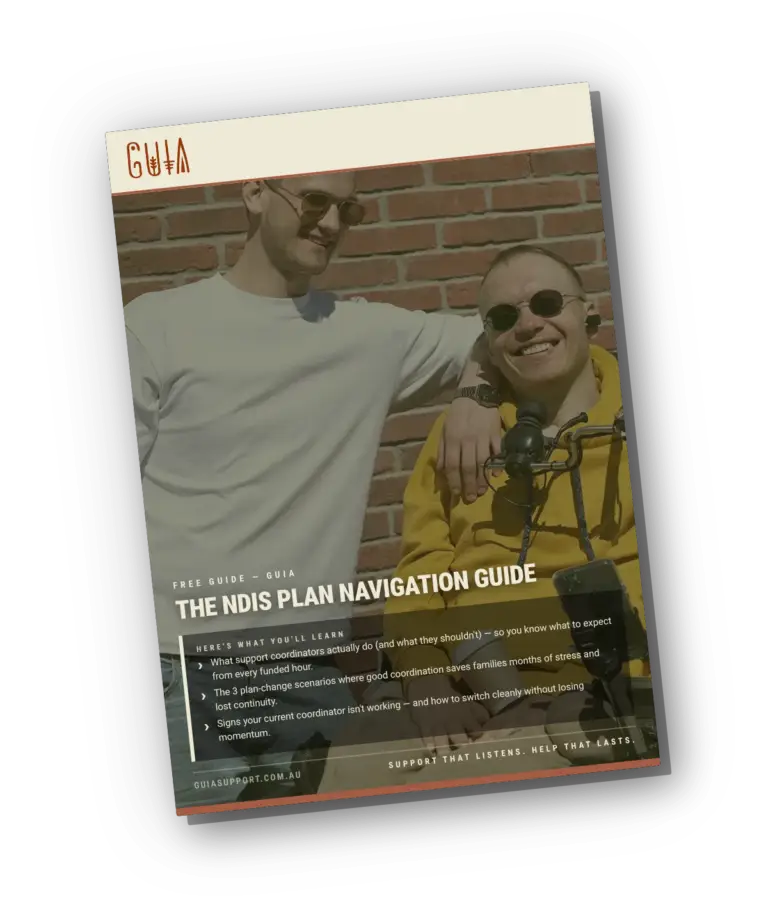
Here's What You'll Learn:
What support coordinators actually do (and what they shouldn't) — so you know what to expect from every funded hour.
The 3 plan-change scenarios where good coordination saves families months of stress and lost continuity.
Signs your current coordinator isn't working — and how to switch cleanly without losing momentum.
ARE YOUR NDIS SUPPORTS WORKING FOR YOU?
GET A FREE NDIS PLAN MANAGEMENT REVIEW