


New NDIS plan: your first 30 days, in order
A new plan arrives and nothing tells you what to do first. Here is the order we work through with families in South West Sydney, and the two mistakes that cost the most.


School leaver NDIS employment support works best when it starts before the final school bell rings. Most families we work with worry that a provider will commit to supporting their young person through this transition, then pull back when the reality gets complex. That inconsistency breaks trust and stalls momentum. The NDIS recognises life stage transitions as a core support category precisely because this window matters. Your son or daughter needs someone who shows up the same way, every time.
Employment and capacity building during school leaving works through a specific mechanism: building real skills in real settings, with consistent people alongside. Rather than job-readiness training in isolation, we match your young person with a support worker who understands their pace, their sensory needs, their goals. That worker helps them practise actual workplace routines, navigate social moments, and build confidence through repetition. The consistency matters because confidence grows through familiarity, not through one-off sessions with rotating faces.
Here’s what that looks like in practice. A support worker meets your young person every Tuesday and Thursday afternoon during their final year at school. They might visit a local employer together, shadow a shift, or practise the commute. The same person is there for the first week of actual employment too. That continuity—the same face, the same voice, the same understanding of what works for your family—builds the kind of trust that feels like part of your extended team, not an external service ticking boxes.
School leaver NDIS employment support is about helping your young person move from the classroom into work or further training—and feeling confident doing it. If you’re sitting with questions like “Will they actually get a job? ” or “How do we know if they’re ready? “—you’re asking the right things.
Here’s what families tell us they’re really worried about. They want someone who shows up consistently, knows their kid, and doesn’t disappear when things get tricky. They need clarity on what NDIS funding actually covers. And they want support workers who speak their language—literally and culturally—so there’s no gap between home and work.
Employment and capacity building isn’t about pushing your young person into any job. It’s about building the specific skills, confidence, and routines they’ll need for the work they actually want. That might be paid employment, volunteer work, or a mix of both. It might take weeks or months. The pace is theirs, not ours.
What we hear from families in South West Sydney is that the transition from school feels like stepping off a cliff. One day there’s structure, timetables, and staff who know them. The next day—nothing. That’s where employment support makes a real difference. A support worker who understands their strengths, shows up on time every time, and helps them practise the skills they’ll actually use at work.
The most common starting point is working out what kind of work feels right—and what support they’ll need to get there. That might be job coaching, help with communication on the job, or building routines around getting ready and getting to work. Every person’s path looks different, and that’s exactly how it should be.
Here’s what that looks like in practice; your son finishes Year 12 on a Friday. Monday morning feels different—no timetable, no classroom structure, no automatic peer group. By Tuesday afternoon, a Guia employment support worker arrives at 2 pm with a notepad and genuine curiosity about what comes next.
That first session isn’t about job applications or résumés. It’s about understanding what your son actually wants to do, what he’s good at, and what support he’ll need to get there. The worker asks specific questions: Does he prefer working with people or alone? Morning shifts or afternoons? What did he enjoy most at school; they listen to the answers—really listen—and write them down. They notice what matters to him, not what a checklist says should matter.
Over the next few weeks, the support looks different depending on what emerges. If retail interests him, you might visit a local South West Sydney shopping centre together on a Wednesday morning. The worker walks the aisles with him, talks to managers, helps him picture himself stacking shelves or working a register. If he’s anxious about eye contact or sensory overload in busy spaces, the worker notices and adjusts—maybe they visit at quieter times, or practise a greeting script beforehand. If he needs help with transport, they work out the bus route together, rehearse it, then travel with him until he’s confident going alone.
The worker also stays in touch with you. They send a quick message after each session—what went well, what felt hard, what to practise at home. They treat you as part of the team, not an outsider. When something clicks—your son nails a job interview, or manages a full shift without shutting down—they celebrate it with him and tell you straight away.
This is employment support built on choice and control, not. If this kind of steady, person-centred approach fits what your family needs, enquire about how Guia supports school leavers into work.
Many families think school leaver NDIS employment support means pushing their young adult into a job as quickly as possible. They worry it’s all about meeting targets or filling shifts, with little regard for what their son or daughter actually wants or can manage.
That’s not how it works. Employment and capacity building for school leavers is about discovering what’s possible—not forcing what’s convenient. It starts with listening to the young person: what interests them, what environments suit their sensory or social needs, what kind of routine feels sustainable.
Here’s what that looks like in practice. A support worker might spend weeks exploring different settings with a young autistic adult—a community garden, a local café, a small business—before anything formal happens. The goal is building genuine confidence and real skills, not just getting them through a door. If employment is the right path, it comes from that foundation. If something else—volunteering, skill-building in the community, or a mix of activities—serves them better, that’s equally valid.
What we hear from families is relief when they realise there’s no pressure to choose “work or nothing. ” Your young person’s NDIS plan can fund exploration, skill-building, social connection, and employment support all together. The focus stays on their choice and control over what happens next, not on meeting someone else’s timeline.
If that sounds like the kind of support you’re after, we’re here to talk through what might work for your family. Guia has supported school leavers across South West Sydney for two years, and we’re NDIS-registered with staff trained in life stage transition. When you’re ready, get in touch to explore what’s possible.
Employment & Capacity Building is practical, one-on-one support that helps young adults develop job-ready skills and find work that suits them. It’s not about pushing anyone into a job quickly. It’s about building confidence, understanding what kind of work fits, and developing the skills to do it well.
Here’s what that looks like in practice. A support worker might help your family member practise interview techniques, work through a job application, or spend time at a potential workplace learning the routine before they start. They’ll also help develop everyday skills like getting to work on time, managing a lunch break, or asking for help when needed. Some participants benefit from ongoing workplace support once they’ve started—someone check-ing in regularly to make sure things are working.
It’s worth knowing that Employment & Capacity Building also includes life skills that sit alongside work readiness. That might be learning to manage money, understanding transport options to get to a job, or building confidence in social situations. For some young adults, the focus starts here before moving toward employment. For others, it’s all happening at the same time.
What Employment & Capacity Building does NOT do: it’s not job placement alone, it’s not clinical assessment or diagnosis, and it doesn’t replace your family member’s own choices about whether or when they want to work. The goal is always to build their independence and control over their own direction—not to meet targets or spend plan budgets.
If your son or daughter is thinking about work after school, or if they’re already looking but need support to get there, this is where school leaver NDIS employment support starts. The right fit matters more than speed. When you’re ready to explore what this could look like for your family member, we’re here to talk it through.
When your young person leaves school, their NDIS plan may include funding for employment and capacity building support. Understanding how that funding actually works helps you make confident decisions about what’s possible and what fits your family’s situation.
The NDIS divides support into different categories. Core Supports cover day-to-day assistance—personal care, daily living help, community access. Capacity Building Supports are designed to help participants build skills, confidence, and independence over time. Employment assistance and life skills training sit here. Your young person’s plan will specify which supports are funded and at what level, based on their goals and needs.
Your support worker and you control how that funding is used. If your plan includes employment assistance, you decide whether to use it for job-readiness training, workplace support, or help with interview skills. If it includes life skills support, you might focus on budgeting, travel training, or building routines. The funding is there to support your young person’s actual goals—not to tick boxes or spend to a limit.
Here’s what that looks like in practice. A school leaver NDIS employment support plan might include a worker who helps your young person explore job options, practise interview techniques, or settle into a new workplace. That same worker might also help build confidence around independent travel or managing a weekly routine. The support is flexible because your young person’s needs change as they settle into adult life.
It’s worth knowing that good employment support isn’t rushed; building real skills and confidence takes time. Your support worker should check in regularly about what’s working, what’s not, and what matters most to your young person right now. That’s how support stays matched to life, not just to paperwork.
When your young person is ready for school leaver NDIS employment support, it helps to know exactly what you’re choosing and what stays in your hands. That clarity means you can plan with confidence and hold the provider accountable for what they’ve promised.
Here’s what’s genuinely your call:
At Guia, we match you with a support worker who understands your young person’s communication style and your family’s values. We show up on time, every time. We build relationships that feel like part of your extended team, not a transaction. That consistency matters more than you might think when trust is being built.
Here’s what sits outside this support and stays with you or other services:
Employment and capacity building support works best when families know what they’re in control of. You’re not waiting for permission or hoping the provider will make decisions for you. You’re choosing a partner who respects your expertise about your young person and shows up reliably to do the work you’ve both agreed on.
When you’re ready to explore what school leaver NDIS employment support could look like for your family, enquire about support with Guia. We’ll listen to what matters to you and explain how we work in plain language.
Employment & Capacity Building sits in your NDIS plan under “Assistance with Life Stage Transition” or “Assistance with Daily Personal Activities”. It’s worth check-ing whether your current plan already includes funding for this — many school leavers do have it allocated, even if you haven’t used it yet.
Here’s what signals that this support would fit your young person right now. They’ve finished school and you’re both unsure what comes next — whether that’s paid work, volunteering, further study, or building independence at home. There’s no rush, and no single “right” answer. Employment & Capacity Building helps you explore what matters to them, at their pace.
Your young person struggles with the practical steps of job-hunting — writing a resume, talking about their strengths in an interview, understanding workplace routines. They might have the interest but not the confidence or the know-how yet. A support worker can sit alongside them through those early conversations, helping them build both skills and belief in themselves.
They need someone who understands their communication style and cultural background. If your family speaks Spanish or Arabic at home, or if your young person is Deaf or hard of hearing, having a support worker who matches that matters. It means less explaining, more genuine connection, and faster progress.
You’re worried about consistency — that a support provider will cancel at the last minute or not show up when your young person is counting on them. That’s a real concern, and it’s worth asking any provider directly how they handle reliability and continuity. We’ve been operating for two years and we’re NDIS-registered. Our team is multilingual and trained in person-centred matching — meaning we work to connect your young person with someone they can actually trust.
If any of these situations sound familiar, Employment & Capacity Building might be the right fit. When you’re ready to explore what that looks like, enquire about support and we’ll talk through your young person’s goals and your family’s needs.
Many autistic school leavers find the sensory demands of a first workplace overwhelming before they even start the actual job. Fluorescent lights, background noise, unfamiliar routines, and unexpected changes can make concentration impossible — even if the work itself suits them perfectly.
An autistic young adult we supported had strong digital skills and wanted to work in data entry. His family worried that the open-plan office environment would shut him down. We worked with him and his employer to map the sensory landscape: which hours were quietest, where he could take short breaks, what noise-cancelling headphones looked like on the job. We didn’t ask the workplace to change everything — we built his confidence and strategies to manage what was actually there.
Our Employment & Capacity Building support included several visits to the workplace before his first official day. He practiced his route, met his supervisor in a quieter moment, and identified a safe space to decompress if sensory load got too high. His support worker stayed nearby for the first two weeks, then gradually stepped back as his confidence grew.
What mattered most wasn’t removing every sensory challenge. It was giving him genuine choice and control over how he’d manage them. He knew his limits, had a plan, and trusted that his support worker would listen if something needed adjusting. That confidence changed everything.
If your young person is heading into school leaver NDIS employment and sensory needs feel like a barrier, that’s exactly what Employment & Capacity Building is designed for. We work at the pace that suits them — no rush, no pressure. Enquire about support and we’ll talk through what their first workplace could actually look like.
Employment & Capacity Building support for school leavers sits within your NDIS plan as either a Core Support or a Capacity Building line item. The way it’s funded depends on what your plan says you need and which support category your provider is registered under.
Core Supports cover day-to-day help — like job coaching during your first weeks at work, or weekly check-ins to build confidence in a new role. These are funded at the NDIS price guide rates, which means your plan sets aside a dollar amount per hour or per session. Your support worker’s time is charged against that budget. If you’re autistic or have intellectual disability, this is often where school-leaver employment support sits.
Capacity Building supports help you develop skills and independence over time — like life skills training, interview preparation, or learning how to manage a workplace routine. These are also priced according to the NDIS price guide, but they’re designed to build your capability so you need less support later on. It’s worth knowing that Capacity Building has a different funding logic than Core — it’s about investment in your growth, not just day-to-day assistance.
Your support coordinator or the NDIA will have worked out which registration groups match what you need. Guia is registered to provide Assistance with Life Stage Transition, which covers the school-to-work shift specifically. Your plan approval letter will show exactly what’s allocated and what it covers.
If your plan doesn’t include employment support and you think it should, that’s a conversation for your support coordinator or the NDIA — not something your provider can change. What we can do is help you use what’s in your plan as effectively as possible, and be honest about what sits outside it.
When you’re ready to explore how school leaver NDIS employment support could work for your son or daughter, we’re here to walk through it together. Enquire about support and we’ll explain your options in plain language.
The first three years after school are about building real skills and confidence. That’s where school leaver NDIS employment support starts—not with a job hunt, but with understanding what your young adult actually wants to do and what support they’ll need to get there.
Here’s what that looks like in practice. You’ll have an initial conversation with our team about your son or daughter’s interests, routines, and what matters most to them. We listen to what you’re hoping for too—because families know the everyday picture better than anyone. That chat takes about 20 minutes and helps us understand the fit.
Next, we’ll match a support worker whose experience and personality align with your family’s needs. If cultural or language fit matters—Spanish-speaking support, for example, or someone who understands sensory routines—we make that happen. This isn’t random assignment. We take time to get the match right because consistency builds trust.
Your first visit happens in your home or somewhere your young adult feels comfortable. The support worker meets them properly, learns their routines, and starts building the relationship that’ll carry the work forward. We’re not there to test or assess. We’re there to listen and to show up reliably, week after week.
From there, we work together on the goals that matter—whether that’s learning to manage money, building workplace skills, exploring part-time work, or growing independence in daily routines. Progress isn’t about ticking boxes. It’s about your young adult feeling more confident and in control of their own choices.
If you’d like to talk through what employment and capacity building support could look like for your family, we’re here to help. No pressure, no jargon—just a conversation about what comes next.
Enquire about support and we’ll get back to you within one business day.
Finding the right Employment & Capacity Building provider for your young adult matters. You’re looking for someone who’ll show up consistently, understand what your family needs, and treat your son or daughter as a capable person deserving respect. Ask these questions before you commit.
At Guia, we match support workers based on what matters to your family—not just availability. We’re NDIS-registered, all staff are qualified and worker-screened, and our team speaks English, Spanish, and Arabic. Consistency and dignity are non-negotiable for us; when you’re ready to explore what that looks like in practice, enquire about support.
When things don’t go to plan, it’s natural to wonder if the provider is the right fit; some warning signs are easier to spot than others. Knowing what to watch for helps you decide whether to stay, adjust, or move on.
At Guia, we match support workers with care for consistency and fit. Our team stays trained, shows up reliably, and listens to what your young person actually needs. If setbacks feel like a pattern rather than a bump, that’s worth exploring; Enquire about support and let’s talk about what a better fit looks like.
When school leaver NDIS employment support is working well, you’ll notice it in small, steady ways. The same support worker shows up on the agreed day and time, week after week. Your young adult mentions them by name. There’s a real relationship building, not a transactional service.
You’ll hear regular updates about what’s happening. Not a formal report, but a genuine conversation—a text, a quick call, or a chat when they’re picked up. The support worker tells you what your son or daughter is learning, what they’re finding hard, and what they want to try next. You feel included, not kept at arm’s length.
Most importantly, your young adult’s priorities lead the work. If they want to explore retail work, the support isn’t pushing them toward admin roles instead. If they need extra time to build confidence before a workplace visit, that happens without pressure. You see them becoming more willing to try new things because they’re choosing the direction, not being steered.
Practical skills start showing up at home too. They’re managing their own lunch, remembering their work clothes, asking questions about the job instead of waiting to be told. Independence grows quietly—not overnight, but noticeably. You’re doing less prompting and more supporting them to do things themselves.
If you’re seeing these signs—consistency, real communication, your young adult’s voice at the centre, and growing confidence—that’s employment support doing its job. If you’re not seeing them, it’s worth having a conversation with your support provider about what needs to shift. When school leaver NDIS employment support fits well, everyone feels it.
Ready to explore what good support looks like for your family? Enquire about support with Guia and let’s talk about what matters most to you.
School leaver NDIS employment support should feel like a genuine partnership. If the support you’re receiving isn’t working—whether the timing doesn’t suit your son or daughter, the approach feels mismatched, or the relationship with the support worker isn’t right—you have real options. You’re not locked in.
The most straightforward starting point is honest feedback to the provider; tell them what’s not working and what you need instead. A good provider listens and adjusts. That might mean changing the day or time of support, shifting the focus of sessions, or requesting a different support worker who’s a better fit culturally or personally.
If feedback doesn’t lead to change, ask to speak with a manager. Escalation within the provider is a normal part of how support gets better. You’re not being difficult—you’re being clear about what your family member needs.
If the provider isn’t responding to your concerns, you can switch providers entirely. Your NDIS plan belongs to you. You choose who delivers your support, and you can change that choice whenever it makes sense. Your support coordinator can help you explore other options in South West Sydney if you need guidance.
For formal concerns about how a provider is operating, the NDIS Quality and Safeguards Commission handles complaints and investigates breaches of the NDIS Code of Conduct. That’s a step you’d take if you believe something serious has gone wrong—not for minor mismatches, but for real safeguarding concerns.
At Guia, we believe choice and control matter. If employment and capacity building support isn’t delivering what your family needs, you deserve better. When you’re ready to explore what a different approach might look like, we’re here to talk through it.
School leaver NDIS employment support isn’t about pushing your son or daughter into a job they’re not ready for. It’s about building confidence, learning what works, and moving at a pace that feels right. Many families in South West Sydney find that the transition from school to work (or to greater independence) needs someone who understands both the participant and the NDIS system.
What we hear from families is that consistency matters most. You need a support worker who shows up on time, remembers what was discussed last week, and treats your young adult as a capable person—not a project. That’s where school leaver NDIS employment support becomes real. It’s job-readiness coaching, workplace visits, life skills practice, and someone in your corner when things feel uncertain.
Here’s what that looks like in practice: a support worker might help your young adult practise a job interview, visit a potential workplace to check the routines and sensory environment, or work through the steps of getting ready for a shift. If your family member is autistic or has another disability that affects how they process change, that kind of steady, person-centred support can be the difference between a placement that sticks and one that falls apart.
At Guia, we’ve been supporting school leavers and their families for two years. Our team includes Spanish-speaking and Arabic-speaking support workers, so cultural and linguistic fit isn’t an afterthought—it’s part of how we match you with the right person. We’re NDIS-registered and all our staff are qualified and worker-screened.
If you’d like to talk through what school leaver NDIS employment support could look like for your family, enquire about support. No pressure, no jargon—just a conversation about what your young adult needs and how we might help. Whenever you’re ready.
A new plan arrives and nothing tells you what to do first. Here is the order we work through with families in South West Sydney, and the two mistakes that cost the most.

Aged care at home South West Sydney from Guia. Reliable support workers who show up consistently and become part of your family’s everyday routine.

NDIS allied health support sydney from Guia. Reliable support workers who show up consistently and become part of your family’s circle. Peace of mind fo…
The Capacity Building and Employment Pathway Guide
How NDIS Capacity Building and Employment Support work together to build real job-ready skills — for adults with disability who want to work.
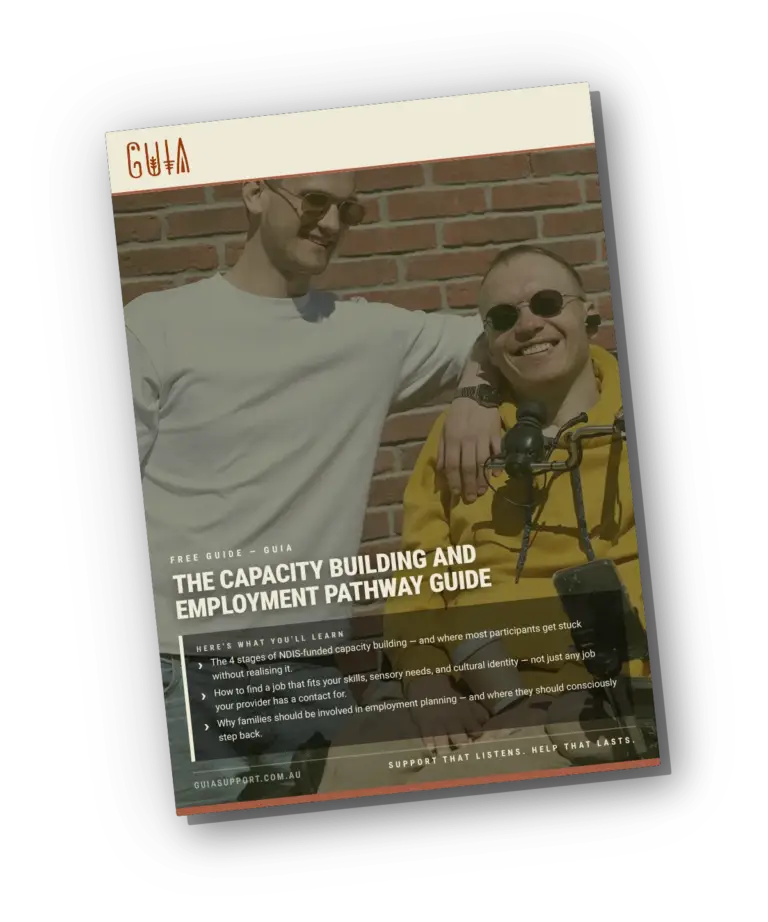
Here's What You'll Learn:
The 4 stages of NDIS-funded capacity building — and where most participants get stuck without realising it.
How to find a job that fits your skills, sensory needs, and cultural identity — not just any job your provider has a contact for.
Why families should be involved in employment planning — and where they should consciously step back.
ARE YOUR NDIS SUPPORTS WORKING FOR YOU?
GET A FREE NDIS PLAN MANAGEMENT REVIEW