


New NDIS plan: your first 30 days, in order
A new plan arrives and nothing tells you what to do first. Here is the order we work through with families in South West Sydney, and the two mistakes that cost the most.


NDIS workplace modifications often sit in a grey zone for families. You know your family member has the capacity to work, but the employer hasn’t made the adjustment yet. The NDIS funds support that bridges the gap between current ability and workplace readiness. Without it, families watch opportunities slip because the timing never quite aligns with what the employer can provide.
Employment and Capacity Building works by building the specific skills and confidence your family member needs before they step into that modified role. A support worker doesn’t just show up on day one. They work alongside your family member in the weeks before, practising the commute, learning the tasks, building the routine. When the workplace adjustment lands, your family member is already steady. The modification works because the person using it is ready.
Here’s what that looks like in practice. You’ll have a consistent support worker—someone your family member knows and trusts—meeting them twice a week for eight weeks before employment starts. That worker shows up on time, every time. They’re trained and screened. If your family member needs support in Arabic or Spanish, we match them with someone who speaks it. When your family member walks into that job, they’re not alone. The support worker becomes part of their extended team.
NDIS workplace modifications can sound like jargon, but what you’re really asking is: how do we help your family member actually do the job, without struggling with the physical space or the routine of getting there? That’s the real question sitting underneath.
Most families we work with in South West Sydney come to us because their son, daughter, or family member wants to work—or wants to try—but something about the workplace itself feels like the barrier. Maybe it’s sensory overload on a busy shop floor. Maybe it’s difficulty with the commute. Maybe the desk setup causes pain, or the routine of the day feels unpredictable. The person is capable. The job is real. The fit just needs adjusting.
Here’s what that looks like in practice. NDIS workplace modifications aren’t just about ramps or equipment. They’re about understanding what your family member needs to show up, stay focused, and do the work well. That might be a quieter workspace corner. It might be a structured checklist for task handover. It might be transport support to get there reliably. It might be a gradual transition into the role, with someone alongside them building confidence week by week.
The tricky part isn’t the modification itself—it’s knowing what to ask for, how to phrase it in your NDIS plan, and finding a provider who actually follows through. Families tell us they worry about consistency. Will the support worker show up? Will they understand what matters to your family member? Will they treat them as capable, not as someone to manage?
That’s where we come in. We match support workers thoughtfully, we show up on time every time, and we work alongside you to build the practical changes that make work possible. If that sounds like what you need, let’s talk about what employment support could look like for your family member.
Here’s what that looks like in practice. Your adult son or daughter has an NDIS plan that includes employment support. A Guia employment specialist arranges a Tuesday afternoon visit at 2 pm—the time that works best for your family. They arrive on time, every time. No last-minute cancellations.
During that first session, they sit down with your family member and listen. They ask about what kind of work appeals to them, what they’re already good at, and what makes them anxious or overwhelmed in a workplace. They notice the small things—whether your family member prefers written instructions or spoken ones, whether they need breaks every hour, whether sensory noise is a real barrier. They take notes.
Over the next few weeks, the specialist works with your family member on job-readiness skills. This might mean practising how to introduce themselves to a new manager, or working through what to do if a task feels confusing. They might help your family member build a simple checklist for their first week, or practise using the staff kitchen so the workplace lunchroom feels less overwhelming. The support is tailored to what your family member actually needs, not a one-size-fits-all .
When NDIS workplace modifications come into focus—maybe your family member needs a quieter desk, or a visual timetable, or time to settle in before the team arrives—the specialist helps you and your family member understand what’s possible. They liaise with the employer. They build the confidence your family member needs to ask for what helps them work well. They’re not making promises about outcomes. They’re building real capacity and choice.
When you’re ready to explore employment support that fits your family member’s pace and strengths, enquire about support with Guia. We’ll listen first and match you with a specialist who gets your family’s situation.
Many families think NDIS workplace modifications are only for people heading into competitive employment. The assumption is straightforward: if your family member isn’t job-ready yet, workplace support doesn’t apply. That’s the misconception we need to clear up.
Employment & Capacity Building covers far more than job placement. It includes the skills, confidence, and practical adjustments that lead toward work—or toward greater independence in any setting. NDIS workplace modifications can mean adjusting a home office setup for someone building work-from-home skills. They might involve sensory-friendly workspace design for an autistic adult preparing for their first role. Or they could mean transport support to a training programme, or a support worker helping someone practise job interview routines at their own pace.
Here’s what that looks like in practice: a family member might use their NDIS plan to fund modifications to a community training space, assistive technology that makes tasks easier, or one-on-one coaching on workplace routines and communication. The goal isn’t always employment—it’s building the capacity, confidence, and practical setup that makes work possible when the time is right. Some participants use this support to explore whether work suits them at all. Others use it to prepare over months before stepping into a role.
The real shift is this: workplace modifications aren’t a final destination. They’re part of the journey toward whatever independence and choice matter most to your family member. Whether that’s paid work, volunteering, skills development, or simply feeling more in control of their day.
If you’re wondering whether Employment & Capacity Building fits your family member’s goals, we can talk through what’s possible. When you’re ready, enquire about support and we’ll explore what might work for you.
NDIS workplace modifications are practical changes to your work environment that help you do your job safely and independently. These might be adjustments to your desk, equipment, software, or the way tasks are structured. They’re funded through your NDIS plan if your support coordinator agrees they’re necessary for employment or capacity building.
Here’s what that looks like in practice. An autistic adult might need noise-cancelling headphones and a quieter workspace corner. Someone with a mobility disability might need an adjustable desk or a modified chair. Another participant might benefit from screen-reading software, task-management apps, or written instructions instead of verbal ones. These aren’t one-size solutions—they’re matched to what actually helps you work better.
Assistive technology covers the software and devices that make work possible. Ergonomic equipment means chairs, desks, footrests, or keyboard trays that reduce strain and injury. Software modifications are changes to how programs work—larger text, voice commands, or simplified interfaces. All three can be funded through your NDIS plan as part of Employment & Capacity Building support.
What workplace modifications do NOT include: they’re not therapy or clinical treatment, and they’re not ongoing wages or employment itself. They’re the tools and adjustments that sit alongside your job, not the job itself. Your support coordinator and employer work together to identify what you actually need, then Guia helps you access and use those tools confidently.
At Guia, we work with you and your employer to understand your workspace, identify barriers, and arrange modifications that respect your routines and preferences. We’re NDIS-registered and experienced in matching participants with practical solutions that stick. When you’re ready to explore what workplace modifications might help, enquire about support and we’ll talk through your situation without pressure.
NDIS funding for Employment & Capacity Building sits in two main buckets: Core Supports and Capacity Building Supports. Understanding the difference helps you and your family member make the most of what’s available in their plan.
Core Supports cover day-to-day assistance with work-related tasks — things like help getting to a job interview, support during the first weeks at a new workplace, or assistance with workplace routines once employment starts. These are practical, immediate needs. Capacity Building Supports fund longer-term skill development — job-readiness training, resume writing, interview coaching, or learning the soft skills that build confidence over time. The NDIS allows participants to use both, depending on what’s written into their plan.
Your family member (or you, if you’re the participant) has genuine choice in how these funds are used. You’re not locked into one approach. Some people need intensive support finding work first, then lighter ongoing assistance once they’re settled. Others benefit from skill-building now so they’re ready when the right opportunity comes along.
What matters is that the support matches what your family member actually wants to do. If they’re keen on retail work but anxious about customer interaction, that’s where support focuses. If they’re ready to try part-time hours but need help with transport and routine, that’s what gets funded. It’s not about ticking boxes — it’s about real, practical steps toward the independence they’re after.
When you’re ready to explore how NDIS workplace modifications and employment support could work for your family member, we’re here to talk through it plainly. No jargon, no pressure — just a conversation about what’s possible and what the next step looks like.
When you’re building employment support for your family member through the NDIS, it helps to know exactly what you’re directing and what sits outside the support. Here’s the clarity you need.
What’s your call
Employment and capacity building support is about building real skills and confidence. Your family member stays in control of their choices, and you and they together decide what success looks like.
What’s outside this support
Many families ask about NDIS workplace modifications — things like ramps, handrails, or equipment adjustments at work. If your family member needs physical modifications to their workplace, that’s funded through a different part of the NDIS. Employment support focuses on the person’s skills, confidence, and readiness to work safely and successfully.
The key is clarity: you direct the support, the provider delivers it, and your family member builds capacity at their own pace. When you’re ready to explore what employment and capacity building could look like for your family member, we’re here to talk it through.
Enquire about support and we’ll answer your specific questions about how this works in your situation.
Employment & Capacity Building sits in your NDIS plan under “Assistance with Life Stage Transition” or “Assistance with Daily Personal Activities”. It’s worth check-ing your current plan documents to see if funding is already allocated here.
You might recognise the need for this support if your family member is approaching or in their first job, apprenticeship, or volunteer role. They may have the skills to do the work but need someone to help them settle into the workplace routine—understanding unwritten rules, managing sensory or social demands, or building confidence in a new environment. NDIS workplace modifications cover practical adjustments that make the workplace work better for them.
Another signal is when your family member wants to work but isn’t sure where to start. They might have left school or been out of work for a while. They need help exploring what kinds of work suit them, building job-readiness skills like resume writing or interview practice, and then ongoing support once they’re in the role. This is exactly what Employment & Capacity Building addresses.
You might also notice they’re struggling with specific workplace tasks—managing sensory sensitivities on a noisy shop floor, understanding workplace communication, or handling changes to their shift. These aren’t things a standard employer can always solve alone. NDIS workplace modifications and capacity-building support help bridge that gap, so your family member can stay in work and feel secure doing it.
If any of these sound familiar, your NDIS plan may already include this category. If you’re unsure what’s in your plan or whether you need a review, that’s completely normal. Enquire about support and we can help you understand what’s available and what might help next.
An autistic adult in South West Sydney wanted to return to part-time retail work after a two-year break. The sensory environment—fluorescent lights, customer noise, till sounds—had been overwhelming before. His family worried about whether he’d manage the same role, and whether an employer would even consider him.
His support coordinator referred him to Guia’s Employment & Capacity Building service. Over six weeks, a support worker met with him and his employer to map out specific NDIS workplace modifications. These weren’t expensive changes—they were practical adjustments; a quieter staff room for breaks. Permission to wear noise-cancelling headphones during stock rotation. A written checklist for his till tasks, reducing reliance on memory under pressure. A weekly check-in call with his support worker during his first month back.
The real shift came when the support worker helped him practise asking for what he needed. Not in a formal way—just conversation about how to say “I need a five-minute break” without feeling like he was letting people down. How to explain his sensory needs to a new team member. How to recognise when he was getting tired and ask for support before things became difficult.
Six months in, he’s working two days a week. His employer has kept the modifications in place because they work. His family stopped worrying about whether he’d manage. He stopped worrying too. What changed wasn’t the job—it was his confidence that he could shape his workplace to suit him, and that asking for help was a strength, not a failure.
If your family member is thinking about work or returning to work, NDIS workplace modifications and employment support can make the difference between struggling alone and building something sustainable. When you’re ready, enquire about our Employment & Capacity Building support.
Employment & Capacity Building support is funded through your NDIS plan as either Core Support or Capacity Building, depending on what you’re working toward. If your family member is building toward employment or greater independence, their support coordinator will have discussed which category fits best during plan planning.
The NDIS uses a price guide to fund employment support. This means the scheme sets a maximum price for different types of support—job-readiness coaching, workplace modifications, ongoing employment assistance. Your plan approval letter will show exactly what’s been allocated and for how long. The funding isn’t a lump sum you spend however you like; it’s attached to specific support categories and hourly rates.
Here’s what that looks like in practice: if your family member needs NDIS workplace modifications—like adjustments to their workstation, communication supports at a new job, or confidence-building before starting—those costs are covered under the price guide. A support worker trained in employment assistance might cost $60–80 per hour depending on their qualifications and the complexity of the work. Your plan approval tells you exactly how many hours you have available.
What we hear from families is that the price guide feels confusing at first. You’re not paying out of pocket for registered NDIS providers—the scheme pays them directly. But it’s worth knowing that some families choose to add their own funds if they want additional hours beyond what’s approved. That’s a choice you make, not something we’d ever push.
If you’re unsure whether your current plan includes enough employment support, or you want to understand how workplace modifications fit into your family member’s funding, that’s exactly what we help clarify. When you’re ready to talk through the detail, get in touch.
When you’re ready to explore NDIS workplace modifications with Guia, here’s what actually happens. The process is straightforward, and we build in time at each step so you and your family member feel confident about the match.
Your first call is a quick chat—usually 10 to 15 minutes. We ask about your family member’s work goals, what sensory or routine needs matter most at work, and what’s already working well in their life. We listen more than we talk. If NDIS workplace modifications and employment support fit what you’re after, we explain how our Employment & Capacity Building service works and answer any questions about how support is funded under your NDIS plan.
Next, we arrange a time to meet in person or over video—whatever suits your family best. You’ll meet one of our team, usually the person who’ll be matching a support worker to your family member. This visit is about building trust. We talk through routines, sensory preferences, communication style, and what dignity and respect look like in your home and your family’s life. If your family member speaks Arabic or Spanish, or uses Auslan, we make sure language matching happens from this conversation onward.
Once we’ve understood what matters, we match a support worker who fits—someone whose reliability, communication style, and experience align with your family member’s needs. We don’t rush this step. The right match means your family member feels comfortable, respected, and genuinely supported at work and beyond.
Your first visit with the matched support worker happens within two weeks. They arrive on time, introduce themselves clearly, and start building the relationship that’ll help your family member feel confident and in control. From there, you shape the support together—what works, what needs adjusting, what comes next. When you’re ready to take the next step, enquire about support and we’ll walk you through it at your pace.
Before you commit to an Employment & Capacity Building provider, it’s worth asking the right questions. A good provider will answer clearly and honestly. These questions help you understand how they work and whether they’re the right fit for your family member.
At Guia, we answer these questions because consistency, respect, and genuine partnership matter. We’re NDIS-registered, all staff are qualified and worker-screened, and our team speaks English, Spanish, and Arabic. When you’re ready to explore what Employment & Capacity Building support could look like for your family member, enquire about support.
When you’re looking for an Employment & Capacity Building provider to support NDIS workplace modifications, it helps to know what doesn’t work. Poor fit shows up in predictable ways. Watch for these warning signs before you commit.
Guia does the opposite. We match you with reliable, trained support workers who show up on time. We respect confidentiality and work with you to navigate workplace adjustments at your pace. Our team speaks English, Spanish, and Arabic, and we can arrange Auslan support when needed. If this sounds like the kind of provider you’re after, enquire about support.
The best sign that Employment & Capacity Building support is working is consistency. You’ll notice the same support worker shows up on the agreed days and times, week after week. They know your family member’s routines, preferences, and what matters to them. That familiarity builds trust and means less time spent explaining context and more time spent actually building skills and confidence.
Regular communication with you is another marker. A good support provider checks in about how things are going, what’s working, and what might need adjusting. They’re not waiting for you to chase them down. You hear from them about small wins—a successful interview practice, a new task your family member managed independently, a workplace adjustment that’s made the day easier. These updates help you stay connected to the journey.
Watch for your family member’s growing agency in the process. Are they starting to lead conversations about what they want to work towards? Are they making choices about how support happens, rather than just receiving it? Real Employment & Capacity Building support puts their priorities and preferences at the centre. You’ll notice them becoming more confident in conversations about their own goals, even if those goals shift over time.
Practical changes matter too. If your family member is accessing NDIS workplace modifications—like adjustments to their workstation, communication tools, or a modified schedule—a strong support provider will help implement these smoothly and check they’re actually making a difference. You’ll see your family member less stressed on work days, more engaged in their role, or managing tasks that previously felt overwhelming.
When support is working well, you feel less alone in the process. The provider becomes someone you trust, and that matters. If you’d like to explore what good Employment & Capacity Building support could look like for your family, enquire about support and we can talk through your situation.
Your son or daughter’s role might change. A promotion might mean new tasks. A workplace layout might shift. Or the support you’ve arranged simply isn’t fitting the way you’d hoped. That’s not failure—it’s part of how real work looks.
The first step is always a conversation. If NDIS workplace modifications or employment support aren’t working the way you need, talk directly with the support worker or their team leader. Many issues sort themselves with a simple chat about what’s changed and what needs to shift. Be specific: “The Tuesday afternoon timing isn’t working anymore” beats vague feedback. Clear expectations help everyone.
If that conversation doesn’t move things, ask to speak with the provider’s manager. They can often adjust the support plan, match your family member with a different support worker, or reshape how sessions run. You’re not being difficult—you’re being clear about what your family needs; that’s your right under the NDIS.
You also have the option to change providers. Your NDIS plan belongs to you. If a provider isn’t delivering the reliability, cultural fit, or skill your family member needs, you can move to someone else. There’s no penalty for switching. Many families find their best match through conversations with other families in your area or through support coordinators who know the local landscape.
If you’ve tried these steps and remain concerned about how you’ve been treated, the NDIS Quality and Safeguards Commission handles formal complaints about provider conduct. They’re there to make sure registered providers meet their obligations.
Choice and control sit at the heart of the NDIS. You get to decide who supports your family member and how. If something isn’t working, you have options. When you’re ready to explore what better support might look like, we’re here to talk it through.
You’ve probably already thought about what your family member needs to feel confident and safe at work. Maybe it’s a quieter workspace, adjusted break times, or clear written instructions instead of verbal ones. These aren’t extras—they’re the foundation of real workplace participation. NDIS workplace modifications can cover exactly these kinds of adjustments, and they’re designed to help your family member do their job well while staying well.
The tricky part is knowing what’s actually fundable, how to ask for it, and how to make sure the workplace actually implements the changes. That’s where support with employment and capacity building makes a real difference. A good support worker helps you and your family member figure out what modifications will actually work, then advocates with the employer to put them in place. They’re there to troubleshoot when something isn’t working and to build your family member’s confidence in speaking up for themselves over time.
Here’s what that looks like in practice: if your family member is autistic and sensory-sensitive, modifications might include noise-cancelling headphones, a designated break space, or a flexible start time. If they have a physical disability, it could be adjustments to workstation height, accessible parking, or modified shift patterns. The point is that modifications are personal—they’re built around your family member’s actual needs, not a checklist.
What we hear from families is that the hardest part isn’t the funding—it’s knowing where to start and having someone who’ll follow through consistently. Our employment support coordinators work with you and your family member to map out what modifications would help, then stay involved to make sure they stick. We’re NDIS-registered and our team includes workers who speak English, Spanish, and Arabic, so language or cultural fit won’t be a barrier.
If you’d like to explore what NDIS workplace modifications could look like for your family member, enquire about support whenever you’re ready. A conversation costs nothing, and you can take your time deciding what comes next.
A new plan arrives and nothing tells you what to do first. Here is the order we work through with families in South West Sydney, and the two mistakes that cost the most.

Aged care at home South West Sydney from Guia. Reliable support workers who show up consistently and become part of your family’s everyday routine.

NDIS allied health support sydney from Guia. Reliable support workers who show up consistently and become part of your family’s circle. Peace of mind fo…
The Capacity Building and Employment Pathway Guide
How NDIS Capacity Building and Employment Support work together to build real job-ready skills — for adults with disability who want to work.
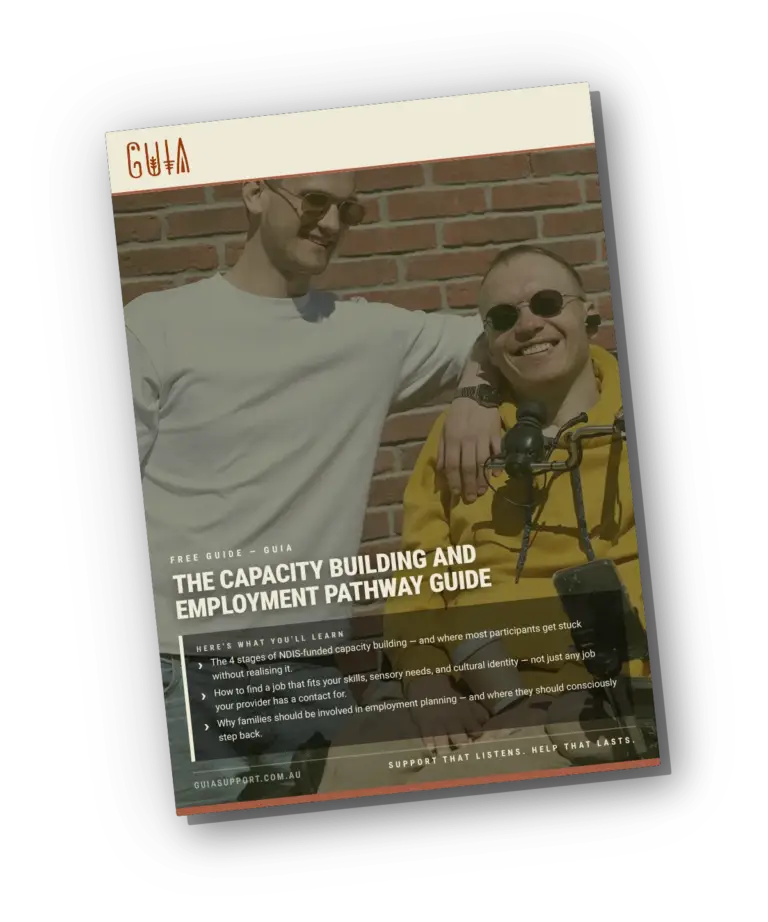
Here's What You'll Learn:
The 4 stages of NDIS-funded capacity building — and where most participants get stuck without realising it.
How to find a job that fits your skills, sensory needs, and cultural identity — not just any job your provider has a contact for.
Why families should be involved in employment planning — and where they should consciously step back.
ARE YOUR NDIS SUPPORTS WORKING FOR YOU?
GET A FREE NDIS PLAN MANAGEMENT REVIEW