


New NDIS plan: your first 30 days, in order
A new plan arrives and nothing tells you what to do first. Here is the order we work through with families in South West Sydney, and the two mistakes that cost the most.


NDIS capacity building south west sydney works because it addresses a specific gap most families face: the worry that support will be inconsistent, or worse, that a provider will let you down when you need them most. This isn’t just about finding someone who shows up—it’s about building genuine skills and confidence over time with someone you can trust. When a support worker becomes part of your extended team, the real learning happens between sessions, not just during them.
Employment and capacity building on the NDIS works through consistent, person-centred support that builds skills step by step. A support worker helps you identify what matters—whether that’s job readiness, independent living skills, or confidence in social settings—then shows up regularly to practice those skills in real contexts. Reliability is the mechanism: the same worker, the same day each week, means your family member learns faster because they’re not starting over with someone new.
Here’s what that looks like in practice: a Spanish-speaking support worker meets with your family member every Tuesday afternoon for two hours, helping them prepare for a workplace trial or practise budgeting for a share house. They know your family member’s routines, what motivates them, and what sensory or communication adjustments matter. That consistency builds trust—and trust is where real capacity grows. When you’re ready to explore how this works for your situation, we’re here to discuss what support actually fits.
When you’re thinking about NDIS capacity building south west sydney for your adult child, the real question often isn’t “Will they get a job? ” It’s “Will they be ready? Will someone actually show up? Will this person treat them with respect?
You’ve probably watched your child navigate school, watched them leave it, and now you’re wondering what comes next. Work might be part of that picture—maybe part-time, maybe supported, maybe something else entirely. But before any of that happens, your child needs to build the skills and confidence to get there. That’s where capacity building comes in.
Here’s what that actually means: It’s not about forcing your child into a job they don’t want. It’s about working together to figure out what they’re good at, what they enjoy, and what skills they need to build to move toward greater independence—whether that’s paid work, volunteer roles, or just feeling more confident in everyday situations.
What we hear from families is that the hardest part isn’t finding the opportunity. It’s finding someone who’ll stick with the process. Someone who shows up on time, who listens to what your child actually wants, and who treats them like a capable adult, not a project. Someone who understands that building confidence takes time, and that setbacks are part of learning.
The NDIS recognises this through support categories like Employment Support and Life Stage Transition Support, both of which sit within your child’s plan if they’ve been approved for them. It right support coordinator or employment specialist can help you work out what’s realistic and what your plan actually covers.
If that sounds like the kind of support you’re after, we’re here to help. Guia has been supporting people across South West Sydney for two years, and we specialise in helping participants and families navigate exactly this conversation. When you’re ready, let’s talk about what your child needs and what comes next.
Here’s what that looks like in practice. Your adult son or daughter has NDIS capacity building funding. A support worker arrives on a Tuesday afternoon at 2pm — the same time, every week. They’re reliable. They know your family’s routines and what matters to your son or daughter.
That Tuesday might focus on job-readiness skills. The support worker helps with a mock job interview, practising answers to common questions. They notice your son gets anxious about eye contact and work together on what feels manageable. They take notes on what went well. They leave a simple one-page summary so you know exactly what happened and what to focus on next.
The week after, the focus shifts. Maybe it’s life skills — learning to use public transport to get to a part-time placement, or practising how to ask for help at work without feeling embarrassed. The support worker travels with your son on the bus, steps back when he’s confident, steps in when he needs it. They’re not doing it for him. They’re building his confidence to do it himself.
Over weeks and months, capacity grows quietly. Your son starts remembering the bus route without prompting. He speaks up in a team meeting at his placement. He tells you about his day without being asked. These aren’t dramatic moments. They’re the small shifts that matter most to families — the ones that mean your son is more independent, more confident, more in control of his own life.
NDIS capacity building in South West Sydney works best when the support worker shows up consistently, knows your family, and treats your son or daughter as capable. That’s what we do. If you’d like to talk about what capacity building could look like for your family, enquire about support.
Many families think NDIS capacity building means helping their family member hunt for jobs on job boards or sit through interview prep with a employment agency. That’s only half the picture — and it misses what actually matters.
Job boards and mainstream agencies work well for people who can navigate their own applications, handle rejection, manage transport to interviews, and self-advocate in a workplace. For many NDIS participants, the real barrier isn’t finding a job posting. It’s building the everyday skills, routines, and confidence that make work possible in the first place.
Here’s what that looks like in practice: an autistic adult might need support learning how to manage sensory overwhelm on public transport before they can get to a workplace. A participant recovering from a mental health crisis might need help rebuilding daily structure and sleep routines. Someone stepping out of school might need weeks of practice with workplace communication, handling mistakes, or asking for help — skills that don’t fit neatly into a job application form.
Capacity building is the foundation. It’s about working with your family member at their pace to build the skills, confidence, and independence they need — whether that leads to paid work, volunteering, further study, or simply more control over their own day. It’s not about rushing to an outcome. It’s about treating them as capable of growth, and giving them the time and person-centred support to get there.
When you’re ready to talk about what capacity building could look like for your family member, we’re here to listen. Enquire about support and let’s work out what actually matters.
Employment and Capacity Building is support that helps you or your family member build skills, confidence, and pathways toward work or greater independence. It’s about practical, real-world learning—not classroom theory. The support is tailored to what matters to your family, at a pace that works.
This includes employment assistance—help preparing for work, finding roles that fit, and ongoing support once you’re in a job. It covers life skills training too: budgeting, managing appointments, using public transport, cooking, or whatever builds toward independence in daily life. Transition support is part of it as well—practical help through major life changes like leaving school, moving out, or stepping into new routines.
What it does NOT include: clinical therapy, diagnosis, or medical treatment. Capacity Building is not about “fixing” anyone. It’s about discovering what your family member can do, and building confidence and real-world skills from there. It’s not job placement alone—it’s the ongoing support and coaching that makes work sustainable.
Here’s what that looks like in practice: A young autistic adult might work with a support worker on interview skills, workplace communication, and sensory strategies for their specific role. An adult with intellectual disability might build budgeting skills and learn to use community transport independently. Someone transitioning out of school might explore different work options and develop routines that work for their body and mind.
The support is person-centred, which means it starts with what your family member actually wants to do—not what you think they should do. A Spanish-speaking or Auslan-trained support worker can be matched to your family if that matters. And reliability matters: the same support worker shows up consistently, so trust builds and learning sticks.
If this sounds like the kind of support your family is after, we’re here to talk through what’s possible. Enquire about support and we’ll help you understand how Employment and Capacity Building fits into your NDIS plan.
Employment and capacity building support sits within your NDIS plan as part of what the NDIS calls “Capacity Building” supports. This is different from daily personal care or accommodation support. It’s about building skills, confidence, and independence over time—whether that leads to paid work, volunteer roles, or greater self-direction in everyday life.
Your NDIS plan will outline how much funding is available for capacity building in your specific situation. This might include employment assistance, life skills training, or transition support through major changes like leaving school or moving into shared living. The key difference from other support types is the focus: we’re working toward increased independence, not just meeting immediate daily needs.
What matters most is that you—or your family member—stay in control of how that funding is used. You choose which provider delivers the support, what skills to focus on, and the pace of progress. Some participants work toward open employment in the community. Others build confidence in managing their home, connecting with community, or developing routines that give them more choice about their day. There’s no single “right” outcome.
Here’s what that looks like in practice: a support worker might help you prepare for a job interview, travel independently to a workplace, or learn budgeting skills for renting. They might work with you one-on-one or in small groups. The support is tailored to what you actually need—not a programme everyone goes through.
If you’re not sure whether employment and capacity building is the right fit, or how much funding sits in that part of your plan, your support coordinator or the NDIS can clarify. When you’re ready to explore what’s possible, we’re here to help you match the right support to your goals.
When you’re building capacity with NDIS support in South West Sydney, it helps to know exactly where your choice and control sit. You’re not passive in this process—you’re steering it. Here’s what that looks like in practice.
What’s your call:
What sits outside this support:
What we do is walk alongside you. We help you build skills, try new things, and feel more confident in your choices. We show up consistently—no last-minute cancellations. We listen to what matters to you and your family, and we match you with a support worker who gets it.
The empowerment comes from you staying in the driver’s seat. Your capacity building plan exists because you want to move forward in some way. We’re here to make that happen reliably and with genuine care.
When you’re ready to explore what NDIS capacity building south west sydney could look like for your family member, enquire about support. We’ll answer your questions in plain language and help you figure out next steps at your pace.
Your family member might already have Employment & Capacity Building in their NDIS plan — or it might be worth discussing at the next plan review. Here’s what to look for.
If they’re about to leave school or transition into adult life, capacity building support often makes sense. This might look like learning how to get to a local café on the bus, understanding workplace routines before starting a part-time role, or building confidence in new social situations. The goal isn’t to rush into work; it’s to build the skills and independence that make work feel possible later on.
You might also notice they’re keen to try something new — a hobby, a volunteer role, or even paid employment — but aren’t sure how to start or what support they’d need. That’s exactly what Employment & Capacity Building covers. A support worker can help them explore options, practise the skills needed, and stay with them as they settle in. It’s not about pushing them faster than they’re ready; it’s about having someone steady beside them who believes they can do it.
Another signal is if they’re doing the same activities every week and seem ready for something more challenging. Building confidence and independence takes time, and the right support can help them take that next step at their own pace — whether that’s a new community group, a work placement, or managing more of their daily routine independently.
If any of these situations sound familiar, it’s worth check-ing your current plan or having a conversation with your support coordinator. Employment & Capacity Building is part of how the NDIS supports participants to build real independence and community connection. When you’re ready to explore what this might look like for your family member, we’re here to help.
An autistic adult in his mid-twenties was finishing school and facing the question every family dreads: what happens next? His parents had always supported him at home, but they knew he needed to build skills and confidence in a real workplace setting. His NDIS plan included funding for employment support, but he’d never had a job before and the whole idea felt overwhelming.
Guia matched him with a support worker who understood autistic adults and how routines matter. They started small—two afternoons a week at a local supermarket, learning shelf-stacking with consistent support. The same worker showed up every Tuesday and Thursday, no cancellations. That reliability meant he could focus on the task instead of worrying about who’d be there.
Within three months, he’d moved to three days a week; his manager noticed he was reliable and detail-focused. By month six, the support worker was gradually stepping back—still present, but giving him more room to problem-solve on his own. That’s capacity building in practice: not doing things for him, but helping him do them himself.
What his family noticed was the shift in confidence. He started talking about his shifts like they mattered. He had money in his pocket from his wages. He wasn’t just staying home—he was part of a workplace team. His parents could see him building the skills and independence they’d always hoped for, at his own pace, with someone who showed up consistently and treated him with respect.
If your family member is at a similar crossroads—leaving school, ready to try work, or wanting to build skills toward greater independence—that’s where NDIS capacity building can make a real difference. Enquire about support and we’ll talk through what that could look like for them.
Employment and capacity building support sits within your NDIS plan’s Core Supports category. This means funding is available for assistance that helps you build work-readiness skills, confidence, and pathways toward employment or greater independence—whether that’s your first job, returning to work, or developing everyday life skills that matter to you.
The NDIS uses a price guide to set the cost of support hours. Your support coordinator will work with you to map out how many hours of employment assistance, life skills coaching, or transition support fit your goals and your plan. The funding is calculated based on the type and intensity of support you need, not on outcomes or how quickly you progress.
Here’s what that looks like in practice: if you’re working toward a job in South West Sydney and need help with interview skills, workplace communication, or learning how to manage a new routine, those hours come from your plan. If you’re an autistic adult building independent living skills before moving out, or a young person transitioning from school, that support is funded the same way. The hours are yours to use with a provider you choose and trust.
It’s worth knowing that some families find their plan doesn’t quite stretch as far as they’d hoped. If that happens, your support coordinator can help you talk through priorities and what’s realistic within your funding. Some participants also explore community resources or other funding streams alongside their NDIS plan—your coordinator can point you toward those conversations too.
When you’re ready to explore how employment and capacity building support could work for your situation, we’re here to answer questions and help you understand your options. Get in touch with us to discuss what you’re aiming for and how we might help.
When you call Guia about NDIS capacity building support, the first conversation is straightforward. A team member listens to what your family member needs — whether that’s help preparing for work, building daily living skills, or gaining confidence in a new life stage. You’ll talk about their goals, what’s already working, and where they need real support; this call usually takes 15 to 20 minutes. There’s no pressure to decide anything that day.
Once we understand the picture, we’ll explain how capacity building fits into your NDIS plan and which support category covers it. If you’re unsure about plan details, we can walk through that together in plain language — no jargon required. We’ll also ask about language and cultural preferences, because the right support worker makes all the difference. Within a few days, we’ll send you a simple summary of what we’ve discussed.
Next comes the match. We introduce your family member to the support worker who’ll be working with them. This isn’t a formal interview — it’s a chance to meet face-to-face, ask questions, and see if the fit feels right. We listen to what matters: Does the support worker speak Arabic or Spanish? Do they understand autism or psychosocial disability? Are they reliable and calm? This step takes time because we get it right or we don’t start.
Your first visit is planned together. You’ll agree on a day, time, and what happens during that session — whether that’s practising interview skills, working through a job application, or breaking down a household task into manageable steps. The support worker arrives on time, every time. They bring clarity about what comes next and how often you’ll meet. You’re always in control of the pace.
Ready to start? Enquire about support with Guia and we’ll take it from there.
Choosing the right employment support provider matters. Your family member deserves someone who listens, shows up consistently, and genuinely understands what they’re working toward. Before you commit to any provider, it’s worth asking the questions that matter most to you.
At Guia, we prioritise consistency, cultural fit, and genuine partnership with families. We’ve been supporting people across South West Sydney for two years, and we’re NDIS-registered with all staff qualified and worker-screened. When you’re ready to explore employment and capacity building support that actually listens, enquire about support.
When you’re looking for an Employment & Capacity Building provider in South West Sydney, reliability and genuine person-centred practice matter more than slick marketing. Watch for these concrete warning signs that a provider may not be the right fit for your family member.
Good Employment & Capacity Building support is built on consistency, respect, and genuine understanding of what your family member actually needs. Guia has been supporting people across Cumberland and Canterbury for two years, with all staff qualified and worker-screened. We match workers based on language, communication style, and the specific goals that matter to each participant. When you’re ready to explore support that feels like a genuine partnership, enquire about support.
When NDIS capacity building support is working well, you’ll notice it first in consistency. The same support worker shows up on the agreed day and time, week after week. They know your family member’s routines, what matters to them, and what they’re working towards. That continuity builds trust fast — and trust is where real progress begins.
Regular check-ins are another clear sign. The support worker talks with you and your family member about what’s landing and what isn’t. They ask questions like “Is this goal still what you want? ” rather than pushing ahead with a plan that’s stopped fitting. When your priorities lead the conversation, you know the support is genuinely person-centred.
You’ll also spot it in small shifts in confidence and independence. Your family member might start managing a task they used to need help with — ordering their own coffee, catching the bus alone, preparing a simple meal. These aren’t dramatic overnight changes. They’re quiet, steady wins that add up over weeks and months. The goal of capacity building is exactly this: helping people do more of what matters to them, at their own pace.
Finally, watch for honest conversations about what’s working and what needs to adjust. A support worker who says “This approach isn’t landing — let’s try something different” is doing their job properly. They’re treating your family member as someone who can learn and grow, not as a fixed problem to manage. That respect for their agency — their ability to make choices about their own life — is the foundation of real empowerment.
If you’re seeing these signs, the support is on track. If you’re not, that’s worth raising directly with the provider. Enquire about support with Guia if you’d like to explore what good capacity building looks like in practice.
If Employment & Capacity Building support isn’t working the way you hoped, you have real options. Your family member deserves a provider and support worker who fit their goals and personality. Choice and control sit at the heart of the NDIS — and that includes the right to change direction if something isn’t right.
Start with the simplest step: talk directly to the support worker or their manager at Guia. Most mismatches happen because expectations weren’t clear from the start, or circumstances have shifted. A conversation often fixes it. If you’d like a different support worker who might be a better personality fit, or who speaks your home language, ask. That’s a normal request and a good provider responds to it.
If feedback to the provider doesn’t lead anywhere, you can escalate formally. Request a meeting with the provider’s management team to discuss what’s not working and what you need instead. Be specific: “The Tuesday afternoon sessions aren’t happening reliably” or “We need a Spanish-speaking support worker” or “The focus has drifted from job readiness into general chat. ” Clear feedback helps.
You also have the right to switch providers. Your support coordinator can help you explore other NDIS-registered organisations in South West Sydney. There’s no penalty for changing — your plan funding moves with you. If you believe a provider has breached the NDIS Code of Conduct or treated your family member unfairly, you can lodge a formal complaint with the NDIS Quality and Safeguards Commission. They investigate independently and take safeguarding seriously.
You’re not locked in. If Guia’s Employment & Capacity Building support is working well, we’re grateful. If it’s not, we want you to find what does. Your family member’s progress and confidence matter more than provider loyalty.
Finding a provider who actually understands what you need—and delivers on it—takes time. You’re looking for someone reliable, someone who shows up when they say they will, and someone who treats your family member as a capable adult, not a project.
The right employment and capacity building support should feel like a natural fit. That means a support worker who speaks your language (literally—we have Arabic, Spanish, and Auslan-trained staff across South West Sydney). It means someone who listens to what your family member wants to build towards, whether that’s paid work, volunteer roles, or greater independence in daily life. It means consistency: the same person, week after week, so trust can actually develop.
When you’re comparing providers, ask about their matching process. Do they just send whoever’s available, or do they take time to understand your family member’s personality, communication style, and goals? Will they work with you and your family member together, or do they treat you as background noise? How do they handle changes to the support plan if something isn’t working?
It’s also worth check-ing whether they’re registered with the NDIS Quality and Safeguards Commission and what their staff qualifications actually are. Not all providers are equal, and your family member deserves someone trained and screened properly.
If you’d like to talk through what NDIS capacity building support could look like for your situation—no pressure, no sales pitch—enquire about support and we can have a conversation about what matters to your family. Whenever you’re ready.
A new plan arrives and nothing tells you what to do first. Here is the order we work through with families in South West Sydney, and the two mistakes that cost the most.

Aged care at home South West Sydney from Guia. Reliable support workers who show up consistently and become part of your family’s everyday routine.

NDIS allied health support sydney from Guia. Reliable support workers who show up consistently and become part of your family’s circle. Peace of mind fo…
The Capacity Building and Employment Pathway Guide
How NDIS Capacity Building and Employment Support work together to build real job-ready skills — for adults with disability who want to work.
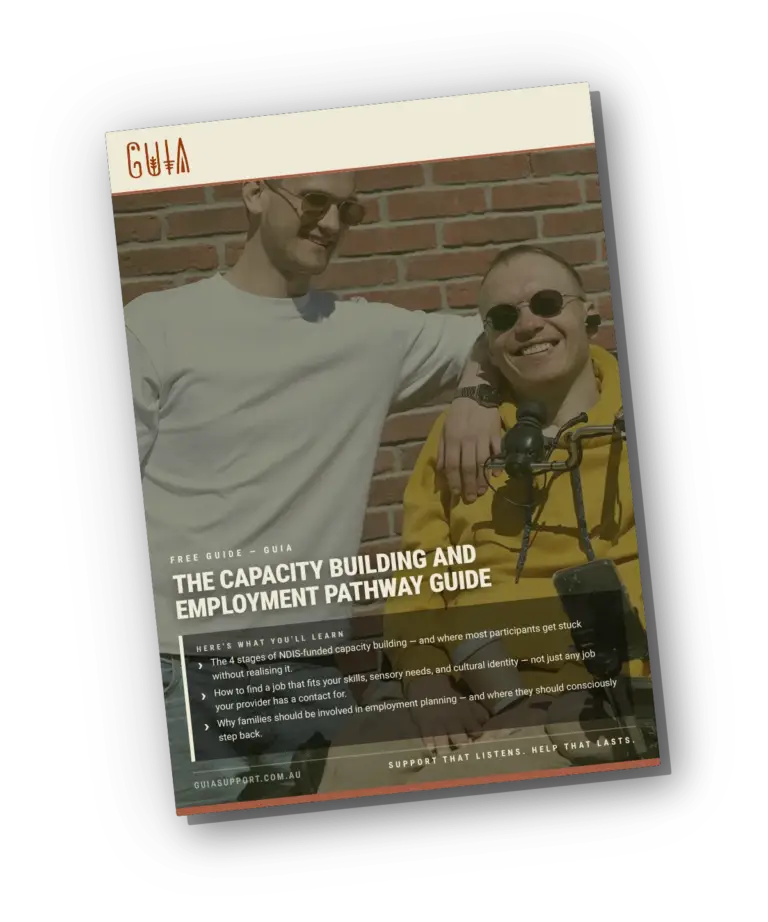
Here's What You'll Learn:
The 4 stages of NDIS-funded capacity building — and where most participants get stuck without realising it.
How to find a job that fits your skills, sensory needs, and cultural identity — not just any job your provider has a contact for.
Why families should be involved in employment planning — and where they should consciously step back.
ARE YOUR NDIS SUPPORTS WORKING FOR YOU?
GET A FREE NDIS PLAN MANAGEMENT REVIEW