


New NDIS plan: your first 30 days, in order
A new plan arrives and nothing tells you what to do first. Here is the order we work through with families in South West Sydney, and the two mistakes that cost the most.


My Aged Care home support works best when the same support workers show up reliably, week after week. Most families worry less about what support looks like on paper and more about whether someone will actually be there on Tuesday morning when they promise. That consistency matters because your older family member builds trust with their support worker over time. They learn each other’s routines, preferences, and the small things that make the day run smoothly. When providers cancel shifts or rotate staff constantly, that foundation cracks. Under the NDIS — National Disability Insurance Scheme, My Aged Care home support is designed to be predictable and person-centred, not transactional.
Reliability in home support works through two mechanisms: first, matching the right support worker to your family member from the start, and second, keeping that worker stable in the role. When a provider takes time to understand your relative’s needs—their language, their cultural background, their daily rhythm—the support worker can anticipate what’s needed rather than always asking. This reduces friction, builds dignity, and means fewer disruptions. A Spanish-speaking support worker, for example, doesn’t just communicate better; they understand context and nuance that matters. That consistency compounds over weeks and months. Your family member feels less like a task and more like someone the support worker actually knows.
Here’s what that looks like in practice: when you enquire about My Aged Care home support, we ask detailed questions about your relative’s routines, preferences, and any cultural or language needs. We then match a specific support worker to that profile and keep them in the role. If your mum prefers a Tuesday and Thursday afternoon visit at 2pm, the same person arrives at 2pm on those days. No last-minute changes. No rotation through five different faces. That predictability is how your family member—and you—start to feel that the support worker is genuinely part of your extended team, not just another provider.
My Aged Care home support and NDIS support sound similar on the surface, but they’re actually two separate systems with different rules, funding sources, and eligibility pathways. If you’re looking after an older family member, understanding the difference matters—it shapes what support is available and how you access it.
The key thing to know: My Aged Care is for older Australians (generally 65 and over, or 50 and over for Aboriginal and Torres Strait Islander people). It’s funded by the Australian Government and covers personal care, domestic help, and companionship at home. The NDIS, by contrast, is for working-age people with permanent disability. If your family member is over the age threshold and doesn’t have a disability covered by the NDIS, My Aged Care is where you’ll find support.
What we hear from families is confusion about which system applies—especially when someone has both age and disability. Here’s what that looks like in practice: your mum might be 68 with arthritis and mobility challenges. She’d access My Aged Care for personal care and home help. But if she also has a diagnosed disability like Parkinson’s disease that meets NDIS criteria, she might be eligible for both schemes, each covering different parts of her support needs.
The funding and approval process is different too. My Aged Care assessments happen through Aged Care Assessment Teams; NDIS plans go through the National Disability Insurance Agency. The support workers are different. It paperwork is different. It’s worth knowing that before you start researching providers, so you’re looking in the right place and asking the right questions.
When you’re ready to find the right support for your family member, we can help you navigate what applies to their situation—and connect you with the right provider, whether that’s through My Aged Care or another pathway. Enquire about support with us, and we’ll help clarify what’s available.
Picture a Tuesday afternoon at 2 p. m. Your mum’s support worker, Sarah, arrives with her bag of cleaning supplies and a cup of tea already made. She’s been coming for six weeks now, and your mum knows her routine; they chat about the garden while Sarah helps her into comfortable clothes for the day.
By 2:30, they’re tackling the bathroom together. Sarah washes the tiles while your mum sits safely on a shower stool. It’s not rushed. Sarah notices your mum’s right shoulder seems stiffer than last week and mentions it gently. She leaves a note on the kitchen pad so you see it when you visit Sunday. That kind of attention matters.
At 3 p. m., they move to the kitchen. Your mum wants to bake biscuits—something she’s done for forty years. Sarah doesn’t take over. Instead, she stands nearby, fetches ingredients, steadies the mixing bowl when your mum’s hands shake. Your mum directs. Sarah supports. By 3:45, there are warm biscuits cooling on the bench and your mum has spent the afternoon doing something that feels like hers, not something being done to her.
Before Sarah leaves at 4 p. m., the kitchen is tidy, the washing is folded, and your mum has a meal prepped for tomorrow. But more than that: your mum has had two hours where she felt capable, where someone listened, where her home stayed her own. That’s what My Aged Care home support looks like in practice—not a checklist ticked off, but a person supported to live the way she wants to live.
If that sounds like the kind of support you’re after, here’s what happens next; Enquire about support and we’ll talk through what your parent needs and how we can help.
Many families think My Aged Care home support means a few hours of cleaning or meal prep each week. The truth is wider and more flexible than that. Support at Home (Aged Care) covers personal care, domestic help, companionship, and wellbeing activities—all tailored to what your older family member actually needs right now.
The misconception often comes from outdated ideas about aged care. People assume it’s one-size-fits-all or that you’re locked into a fixed schedule. In reality, My Aged Care home support works around your family member’s routines and preferences. If they need help with showering and medication reminders on Mondays and Thursdays, that’s what gets arranged. If they’d value a support worker to chat with over a cup of tea on Wednesday afternoons, that matters too.
Here’s what that looks like in practice. A support worker might help your mum with personal care in the morning, then stay for an hour to chat, help with light housework, or go for a walk together. Another family might need evening support so their dad can stay safely at home after his wife goes to bed. The support is built around dignity and choice—not around what fits neatly into a provider’s roster.
The other common myth is that you need to know exactly what you want before you contact a provider. You don’t. Your job is to describe what’s hard right now and what matters to your family member. A good provider listens, asks questions, and helps you work out what support actually fits. That’s how you end up with reliable, consistent help that feels less like a service and more like someone who genuinely knows your family.
If you’re wondering whether My Aged Care home support could help your situation, there’s only one way to find out. Enquire about support and talk through what your family needs. No pressure, no jargon—just a conversation with people who’ve been doing this for two years.
My Aged Care home support is practical, everyday help that lets older Australians stay at home safely and independently for longer. It’s funded through My Aged Care—the Australian government’s entry point for aged care services—and covers personal care, domestic help, and companionship tailored to what each person actually needs.
Here’s what that looks like in practice. Personal care means assistance with showering, dressing, toileting, and medication reminders. Domestic assistance covers meal preparation, laundry, cleaning, and grocery shopping. Companionship and social support help reduce isolation—a support worker might sit with your mum over a cup of tea, help her stay connected to her community, or accompany her to appointments. All of this happens in her own home, at times that suit her routine.
It’s worth knowing that My Aged Care home support does NOT include nursing care, wound dressing, or complex medical tasks—those sit with aged care nurses or your GP. It also doesn’t cover home modifications or equipment like grab rails or mobility aids, though your aged care coordinator can point you toward those services separately.
The key difference from NDIS support is eligibility. My Aged Care is for Australians aged 65 and over (or 50+ for Aboriginal and Torres Strait Islander people), regardless of disability type. You access it by contacting My Aged Care directly or through your GP. Your aged care coordinator then works with you to match you with a provider—someone reliable, respectful, and a genuine fit for your mum, your dad, or yourself.
At Guia, we’ve been supporting older Australians across South West Sydney for two years. Our team is NDIS-registered and trained in aged care support, and we match each person with a support worker who understands their routines, their preferences, and their need for dignity. When you’re ready to explore what My Aged Care home support could look like for your family, enquire about support—no pressure, just a conversation.
My Aged Care home support works differently from NDIS funding, so it’s worth understanding the distinction. If your older family member receives support through My Aged Care, they’re funded by the Australian Government’s aged care programme, not the NDIS. The rules, eligibility, and how support is arranged follow a separate pathway.
To access My Aged Care home support, your family member typically needs to be assessed by an aged care assessor. They’ll look at what daily tasks your relative finds difficult—things like showering, dressing, meal preparation, or household cleaning. Based on that assessment, they’ll recommend a support level. You then choose a provider, like Guia, to deliver that care at home.
The support itself covers personal care, domestic assistance, and companionship—practical help that keeps your older family member living at home safely and with dignity. Unlike NDIS plans, My Aged Care funding isn’t a fixed annual budget you manage yourself. Instead, the government pays providers directly for the hours of support your family member receives. You may contribute a fee based on your income, but the scheme is designed to be affordable.
What matters most is choice and control; you’re not locked into one provider. If the support isn’t working—if workers don’t show up reliably, or if there’s a poor cultural or language fit—you can change providers. That’s why finding someone you trust from the start matters. The NDIS and aged care are separate systems, but both centre on your family member’s right to choose who supports them and how.
If you’re unsure whether My Aged Care is the right fit for your older family member, or you want to know how Guia’s approach to home support works in practice, we’re here to talk it through. When you’re ready, get in touch.
When you’re arranging My Aged Care home support, it helps to know exactly what sits in your hands and what doesn’t. This clarity means you stay in control of the decisions that matter most to your mum, dad, or older family member.
What’s your call:
You decide these things. A good provider listens to what your family needs and works around your schedule, not the other way around. At Guia, we match support workers thoughtfully — considering language, cultural fit, and personality alongside practical skills. If a particular worker isn’t working out, we adjust. That’s how it should work.
What’s outside this support:
Your support worker is there to help with daily living — the things that keep your family member comfortable, safe, and connected at home. They’re not there to diagnose, treat, or promise health improvements. If something medical comes up during a visit, a good provider flags it and suggests you speak to your doctor.
The boundary matters because it keeps everyone safe and clear about what support actually does. When you know what you’re choosing and what you’re not, you can plan with confidence. If you’d like to talk through what My Aged Care home support could look like for your situation, enquire about support and we’ll walk you through it in plain language.
My Aged Care home support is designed to help you stay at home safely and independently. If your older family member needs help with daily tasks, personal care, or keeping the house running, this support category might already be part of their plan—or it could be added during a review.
The clearest signal is when your family member struggles with personal care tasks they’d rather manage alone. That might look like bathing, dressing, toileting, or grooming. A support worker visiting twice a week for two hours can make the difference between staying home and needing residential care. You don’t need to wait for a crisis to ask for this help.
Domestic assistance is another practical fit. If your mum or dad finds housework exhausting—vacuuming, laundry, meal prep, shopping—a support worker handling these tasks frees them to do things that matter more. This isn’t about luxury; it’s about energy. When someone’s energy is limited, every hour counts.
Companionship and wellbeing support matter too. Isolation is real for older Australians, especially in South West Sydney where families are often spread across suburbs. A regular support worker who arrives on the same day each week, knows your family member’s routines, and builds genuine connection can reduce loneliness and catch early warning signs of health changes.
Here’s what that looks like in practice: your family member knows their support worker is coming Tuesday at 10 am. That consistency builds trust. The worker knows how they like their tea, which topics matter to them, and when something feels off. That’s dignity and reliability working together.
If any of these situations sound familiar, your family member’s plan may already include Support at Home funding. If you’re unsure what’s in their current plan or whether they’d benefit from more hours, enquire about support and we can help you work through it together.
Margaret is a 74-year-old widow living alone in Bass Hill. She’s managing her arthritis well enough, but the housework—vacuuming, mopping, changing sheets—has become harder. Her daughter noticed the kitchen wasn’t being cleaned the way Margaret liked, and Margaret herself admitted she was skipping tasks because bending down hurt. That’s when they looked into My Aged Care home support.
Margaret’s support coordinator helped her understand what My Aged Care could fund. She arranged two three-hour visits each week with a support worker who could help with domestic tasks and personal care. What mattered to Margaret wasn’t just the help—it was having someone reliable show up on the same days at the same time. She needed to know the support worker would be there on Tuesday and Friday mornings, no cancellations.
Guia matched Margaret with a support worker who speaks Arabic and English. Margaret’s neighbours are mostly Arabic-speaking, and she felt more comfortable communicating in her first language. The support worker helped with vacuuming, mopping, laundry, and preparing simple meals. Over a few months, Margaret noticed she had more energy for the things she actually wanted to do—gardening on her balcony, calling her grandchildren, attending her community centre.
The consistency mattered most. Margaret knew exactly when her support worker was coming. No last-minute changes. No surprises. She could plan her week around it. Her daughter felt reassured knowing her mum wasn’t managing everything alone, and Margaret felt more in control of her home and her time.
If you’re looking at My Aged Care home support for an older family member, this kind of practical, reliable help is exactly what we provide across South West Sydney. When you’re ready to explore what’s possible, we’re here to talk through your situation.
My Aged Care home support is funded differently from NDIS, so it’s worth understanding how the money flows and what your older family member can actually access. Under My Aged Care, the Australian Government sets a price guide for support services. Your family member’s approved support plan outlines what’s covered.
The funding model works like this: My Aged Care approves a support package based on your family member’s assessed needs. It approved provider — that’s us — delivers the support within that package. You’re not paying directly for hours; you’re paying a contribution based on your family member’s income and assets. The Government covers the rest through My Aged Care funding.
Here’s what that looks like in practice: if your mum needs personal care three times a week and help with household tasks, My Aged Care will approve a package that covers those specific supports. The price guide sets what providers can charge for each service type. Your mum’s contribution is means-tested, meaning it depends on her financial situation, not on how many hours she uses.
What we hear from families is that the approval process can feel unclear; that’s why we help walk you through it. We’re NDIS-registered and experienced in navigating My Aged Care funding rules. We explain what’s included, what your family member’s contribution looks like, and how often support can happen without surprises later.
If gap funding becomes necessary — that is, costs beyond the Government contribution — we discuss that openly with you upfront. No hidden fees. Your family member stays in control of the decision about whether to proceed. When you’re ready to talk through how My Aged Care funding works for your situation, enquire about support and we’ll explain your options in plain language.
When you call Guia about My Aged Care home support, the first conversation is a quick chat—nothing formal. We’ll ask what’s happening at home right now and what kind of help would make the biggest difference. Most calls take ten to fifteen minutes. You don’t need to have everything figured out yet. We’re here to listen and answer questions about how support actually works.
After that first call, we’ll send you some information in plain language about what’s included in Support at Home under My Aged Care. We’ll also explain how the matching process works—because getting the right support worker matters more than getting one fast. If you’d like to move forward, we’ll set up a time for you to meet the team. This isn’t a formal interview. It’s a chance to ask questions and get a real sense of how we work.
Once you’re ready, we match you with a support worker who fits what you and your family actually need. That might mean finding someone who speaks Arabic or Spanish if that’s important to you. It might mean someone with experience in the specific kind of support you’re after—personal care, domestic help, companionship, or a mix of all three. We take time to get this right because consistency and trust matter more than speed.
Your first visit is straightforward. The support worker will come at the time you’ve agreed on. They’ll spend time getting to know your home, your routines, and what matters most to you. They’ll talk through what support looks like week to week. If something doesn’t feel right, we’ll adjust. You’re in control of how the support works and what happens next.
Ready to get started? Enquire about support and we’ll take it from there at whatever pace suits you.
Choosing the right My Aged Care home support provider matters. The person or team you select will become part of your family’s routine, so it’s worth asking the right questions upfront. Here’s what to clarify before you commit.
At Guia, we know consistency and trust are everything. We match support workers with care to your family’s needs, and we show up on time, every time. Our team speaks English, Arabic, and Spanish, so language isn’t a barrier to quality care. When you’re ready to explore My Aged Care home support that feels right, enquire about support.
Finding the right My Aged Care home support provider means knowing what to watch for. Some providers look good on paper but fall short when it matters most — consistency, respect, and genuine fit with your family member’s needs.
At Guia, we do the opposite. We match support workers thoughtfully, show up reliably, and respect your family member as a capable adult. Our team speaks English, Arabic, and Spanish — and we’re NDIS-registered and Code of Conduct compliant. When you’re ready to explore a better fit, enquire about support.
When My Aged Care home support is working well, you’ll notice it in small, steady ways. The same support worker arrives on Tuesday and Thursday mornings at 9 am, knows your mum’s routine, and doesn’t need to ask where she keeps her medications or how she takes her tea. Consistency matters more than people realise. It builds trust, reduces confusion, and means your family member doesn’t spend energy re-explaining their needs week after week.
You’ll also spot regular communication from the support team. A quick call or message to let you know how the week went, if anything’s changed, or if they’ve noticed something worth discussing. Not intrusive check-ins, but genuine updates that show someone’s paying attention. This keeps you in the loop without creating anxiety, and it gives you confidence that your older family member is being looked after with real care.
A third sign is that your family member’s priorities are actually shaping the support, not the other way around. If they want help with cooking their favourite meals rather than meal prep, that happens. If they prefer a morning shower instead of afternoon, that’s what the plan reflects. When older Australians have genuine say in how their support works, they’re more engaged and the whole arrangement feels less like care is being done to them and more like it’s being done with them.
Finally, you’ll notice a reduction in your own stress. You’re not fielding crisis calls about missed visits or last-minute changes. You’re not worried about whether the support worker will show up. Instead, you can focus on being family rather than crisis manager. That shift—from worry to confidence—is how you know the support is genuinely working.
If you’re looking for that kind of reliability and person-centred approach to My Aged Care home support, Guia works across South West Sydney with older Australians and their families. When you’re ready to explore what good support looks like for your situation, enquire about support.
You’re in control of your My Aged Care home support arrangement. If something isn’t working — whether it’s a mismatch with your support worker, scheduling problems, or the way support is being delivered — you have clear options to make a change.
Start with your provider directly. A conversation with your support worker or their manager often sorts things quickly. Be specific about what isn’t working. “I’d prefer a support worker who speaks Arabic at home visits” or “The Tuesday timing no longer suits our routine” gives them something concrete to act on. Most providers, including Guia, want to get the match right.
If feedback to the provider doesn’t shift things, you can request a different support worker. You’re not locked into one person. A fresh pairing sometimes makes all the difference — different personalities, different schedules, different communication styles all matter when someone’s in your home regularly.
If the provider itself isn’t meeting your needs, you can switch. Your My Aged Care coordinator can help you explore other registered providers in South West Sydney. There’s no penalty for moving to someone who’s a better fit for your situation and your family’s expectations.
For formal concerns about quality or compliance, the NDIS Quality and Safeguards Commission handles complaints about registered providers. This isn’t a step you need to rush to — it’s there if informal conversations haven’t resolved things — but it’s a real safeguard that backs up your choice.
You deserve support that feels reliable, respectful, and genuinely matched to what you and your family need. If that’s not what you’re getting, change it. When you’re ready to explore a provider who prioritises consistency and person-centred matching, enquire about support with Guia.
If you’re exploring My Aged Care home support options in South West Sydney, the next step is straightforward. We listen first, answer questions second, and only suggest a match when it feels right for your family member’s needs.
Here’s what that looks like in practice. You’ll speak with someone who knows both the My Aged Care system and what actually works day-to-day at home. They’ll ask about your mum or dad’s routine, what matters most to them, and where support would make the biggest difference. No pressure to decide on the spot.
We’re NDIS-registered and NDIS Code of Conduct compliant, which means all our support workers are qualified, screened, and trained in dignity and person-centred care. Our team speaks English, Arabic, and Spanish, so if language or cultural fit is important to your family, we can usually match that from the start.
The most common starting point is a conversation about what’s actually needed; does your family member need help with personal care on certain days? Domestic assistance? Companionship and social connection? Once we understand that, we can talk about how support might fit into your current My Aged Care arrangement and what the practical next steps look like.
We’ve been supporting older Australians and people with disability across South West Sydney for two years. Families often find us through word-of-mouth, or sometimes their support coordinator recommends us. Whenever you’re ready to explore options, enquire about support and we’ll take it from there at your pace.
A new plan arrives and nothing tells you what to do first. Here is the order we work through with families in South West Sydney, and the two mistakes that cost the most.

Aged care at home South West Sydney from Guia. Reliable support workers who show up consistently and become part of your family’s everyday routine.

NDIS allied health support sydney from Guia. Reliable support workers who show up consistently and become part of your family’s circle. Peace of mind fo…
The My Aged Care Home Support Guide
How to access Australian Government funded home care for an older family member — without losing months to waitlists or guessing at packages.
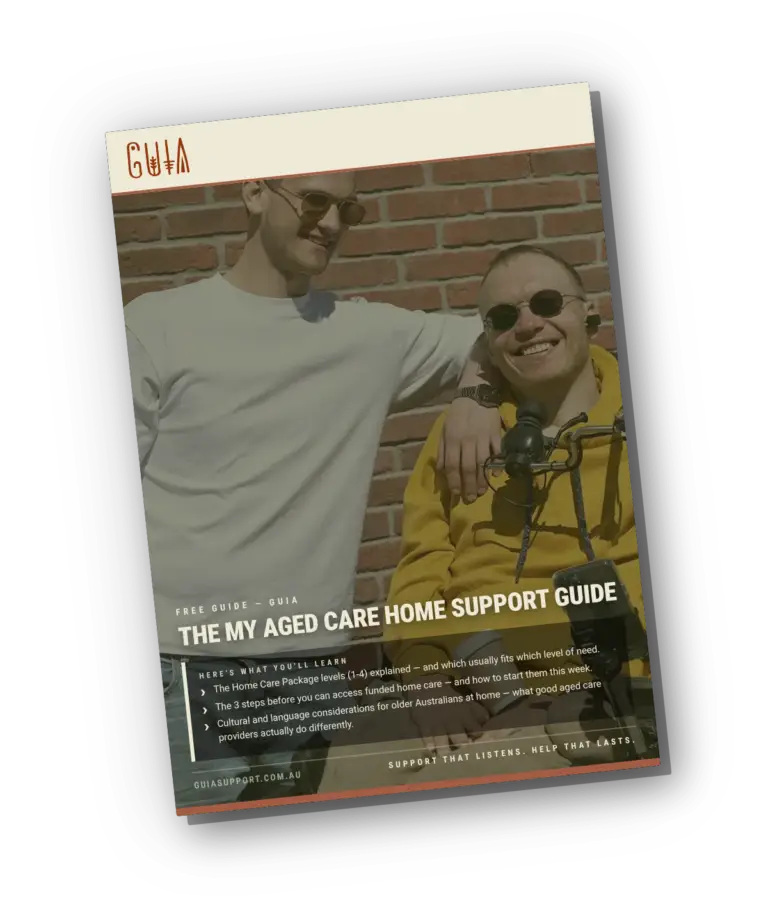
Here's What You'll Learn:
The Home Care Package levels (1-4) explained — and which usually fits which level of need.
The 3 steps before you can access funded home care — and how to start them this week.
Cultural and language considerations for older Australians at home — what good aged care providers actually do differently.
ARE YOUR NDIS SUPPORTS WORKING FOR YOU?
GET A FREE NDIS PLAN MANAGEMENT REVIEW