


New NDIS plan: your first 30 days, in order
A new plan arrives and nothing tells you what to do first. Here is the order we work through with families in South West Sydney, and the two mistakes that cost the most.


When you’re arranging in-home daily living support south west sydney, the biggest worry isn’t whether support exists—it’s whether the same person will actually show up on Tuesday afternoon, week after week. Most families tell us that inconsistency breaks trust faster than anything else. The NDIS scheme funds support hours, but funding alone doesn’t reliability. What matters is a provider who treats your family member’s routine as sacred and builds their roster around keeping promises, not around filling shifts cheaply.
Consistency works because it builds what researchers call procedural trust—your family member learns what to expect, the support worker learns their preferences without retraining, and you stop spending mental energy worrying about cancellations. When the same support worker arrives on schedule, they notice the small things: that your mum prefers her tea made a certain way, that your brother settles better after a familiar face helps him shower. That knowledge compounds over time. It turns a support arrangement into a real working relationship where dignity and routine are protected.
Here’s what that looks like in practice. Guia matches participants with support workers based on fit—not just availability—and we roster the same team member to the same shifts whenever possible. If a worker can’t make a shift, we notify families early and send a trained replacement who’s already familiar with the household. We’ve been operating for two years and we’re NDIS-registered, with all staff qualified and worker-screened. When you’re ready to explore whether this approach works for your situation, contact us to discuss your family’s specific needs.
In-home daily living support south west sydney means finding someone who shows up on time, treats your family member with dignity, and becomes part of your support routine—not a stranger who cancels last minute or leaves you scrambling. The real question most families ask isn’t “what is personal care support,” but “will this person actually be reliable, and will my family member feel comfortable with them?
That worry is completely valid. When someone comes into your home regularly, they’re not just helping with showering, meals, or household tasks. They’re part of your family’s rhythm. A support worker who understands your son’s morning routine, respects your mum’s preferences, or knows which sensory sensitivities matter—that’s the difference between support that feels like help and support that feels like an extra thing to manage.
Here’s what that looks like in practice: A Spanish-speaking support worker who can chat with your parent in their first language. A worker trained to recognise when an autistic adult needs quiet time before a transition. Someone who notices the small things—that your family member prefers tea in a certain mug, or needs five minutes’ notice before leaving the house. These details aren’t luxuries. They’re what make support feel respectful and actually work.
The challenge is that finding someone reliable in south west sydney takes time. You need a provider who takes matching seriously—who listens to what your family actually needs, not just who’s available. You need staff who are qualified, screened, and trained. And you need to know that if something isn’t working, there’s someone listening and ready to adjust.
That’s where we come in. When you’re ready to explore what in-home daily living support could look like for your family, we can walk you through what matters most and help you find the right fit.
Here’s what that looks like in practice. A Tuesday afternoon, 2 pm. Your support worker arrives on time—they always do. They’ve worked with your family member for six weeks now, so they know the routine: keys on the hook, shoes off, kettle on. Small things that matter.
The first hour focuses on personal care and getting ready for the week ahead. Your support worker helps with showering, choosing clothes, and sorting out medications into the weekly organiser. They chat while they work—not rushing through tasks, but noticing what your family member wants to talk about. If there’s anxiety about an upcoming appointment, they listen. If there’s a preference for a particular brand of shampoo, they remember it next time.
By 3 pm, the focus shifts to daily living tasks. That might mean preparing a simple meal together, tidying the kitchen, or sorting through the laundry. Your support worker doesn’t just do these things—they work alongside your family member, explaining each step and asking what help is needed. If your family member is autistic and routine matters, the support worker respects that. If they speak Arabic or Spanish at home, your support worker can communicate in that language too.
Before they leave at 4 pm, your support worker makes a note of what’s been done and what’s coming up. They leave the house ready for the week: groceries put away, clothes folded, a meal prepped. But more than that, they leave your family member feeling capable and heard—not managed, but supported.
That consistency and dignity is what in-home daily living support should feel like. If you’d like to talk about what this could look like for your family, enquire about support with Guia.
Many families think in-home daily living support means a single support worker showing up each week. They expect consistency, routine, and someone who knows their family member well. Then reality hits: different workers arrive without notice, each one learning the same tasks from scratch.
Here’s what that inconsistency actually costs; your family member loses the trust they’ve built. A support worker who knows that your mum needs her tea at 2:30pm, or that your son gets anxious during transitions, doesn’t show up. A replacement arrives who doesn’t know these things. Tasks take longer. Anxiety rises. Your family member feels less in control of their own day.
The misconception is that this is just “how NDIS support works”—that staff turnover and roster changes are unavoidable. They’re not. Reliability isn’t a luxury; it’s the foundation of dignified support. When a support worker becomes part of your family’s rhythm, they notice things. They anticipate needs. They build the kind of relationship where your family member actually looks forward to their visit.
At Guia, we’ve built our in-home daily living support around consistent, matched support workers. We invest in person-centred matching—making sure the worker fits your family member’s communication style, cultural background, and daily routines. Our team includes Spanish-speaking and Arabic-speaking support workers, because language and cultural fit matter in South West Sydney. We show up on time, every time. No last-minute cancellations. No rotating roster of strangers.
If you’re tired of the inconsistency and want support workers who actually know your family member, we’re here to help. When you’re ready to explore what reliable in-home daily living support south west sydney can look like, reach out to us. We’ll listen to what matters most to your family, then match you with someone you can genuinely trust.
Enquire about support today.
In-home daily living support is practical help with the everyday tasks that make up your day at home. It’s not nursing care or therapy. It’s the kind of support that helps a participant with personal care, household tasks, meal preparation, and the routines that matter to them. A support worker might help with showering and dressing, preparing lunch, doing laundry, or tidying shared spaces. The goal is to help the participant stay safe, healthy, and connected to their home and community.
What this support includes depends entirely on what’s in the participant’s NDIS plan. The NDIS (National Disability Insurance Scheme) funds support under a registration group called “Assistance with Daily Personal Activities”. If this is listed in the plan, the participant can use those funds to employ a support worker. Here’s what that looks like in practice: a support worker might visit twice a week for two-hour sessions, or daily, depending on what the plan allows and what the participant needs.
What it does NOT include: medical care, wound dressing, medication administration, or therapy that requires a clinical qualification. Those services come from different NDIS providers or health services. In-home daily living support is about dignity, reliability, and helping the participant stay in control of their own home and routines. It’s about showing up on time, every time, and treating the participant as the expert on their own life.
The support worker becomes part of the household rhythm. They learn what matters to the participant—whether that’s a specific routine, cultural preferences, language, or sensory needs. Guia matches support workers with care and attention to fit. We work across South West Sydney with staff who speak English, Arabic, and Spanish, and we’re trained in Auslan. When you’re ready to explore whether in-home daily living support fits your situation, we’re here to talk through what that could look like.
Enquire about support and let’s have a conversation about your family’s needs.
When you’re navigating NDIS funding for in-home daily living support south west sydney, it helps to understand what’s actually available to you. The scheme sorts support into different categories, and knowing which one fits your situation makes planning clearer.
Core Supports are the day-to-day assistance most families think of first. These cover personal care, household tasks, meal preparation, and help with daily routines at home. Your NDIS plan allocates funding specifically for these activities, and you choose which provider delivers them. A support worker might help with showering and dressing on Monday and Wednesday mornings, or assist with grocery shopping and meal prep on Friday afternoons—whatever matches your or your family member’s actual routine.
Capacity Building Supports work differently. Instead of ongoing weekly visits, these fund time-limited help to build skills or independence. That might mean a support worker teaching someone how to manage their own medications, or practising budgeting and shopping skills over a set period. Once the skill develops, you may need less frequent support—or none at all for that task.
Supported Independent Living (SIL) is for participants who want to live in shared accommodation with 24/7 support on-site. It’s a different model entirely, but worth knowing about if your family member is exploring moving out or living more independently.
The NDIS funds these supports based on your plan, and you control how the money is spent and which provider you work with. That’s the power of choice and control—you’re not locked into one approach. If in-home daily living support south west sydney is what your family needs right now, we can help you understand what’s available in your plan and match you with support workers who fit your household and your values. When you’re ready to explore what’s possible, get in touch.
When you’re choosing in-home daily living support south west sydney, it helps to know exactly what you control and what sits outside the support itself. This clarity stops confusion later and keeps you in the driver’s seat.
Here’s what’s genuinely your call:
These choices matter because support works best when it reflects how your family actually lives. A support worker who arrives at the same time each Tuesday, knows your mum’s morning routine, and speaks Spanish or Arabic if that’s what your family needs — that consistency builds trust and real independence over time.
Here’s what sits outside in-home daily living support:
A good provider — like Guia — will be clear about these boundaries from day one. We focus on what we do: showing up reliably, treating your family member with dignity, and helping build confidence and independence through everyday routines. If your family needs allied health, plan advice, or clinical support, we’ll help you connect with the right people.
When you’re ready to explore what in-home daily living support could look like for your situation, enquire about support. We’ll listen to what matters most to your family and explain exactly how we’d work together.
Moving from one-on-one home support to shared living is a big step. It’s worth knowing that many NDIS plans already include funding for in-home daily living support within shared accommodation. You may not need to wait for a plan review to explore this option.
Here’s what that looks like in practice. If your family member is currently receiving support with personal care, meals, or household tasks at home, and they’re expressing interest in living with housemates or in a supported shared home, that same support can continue in a different setting. The tasks stay the same — showering, meal prep, laundry, community outings. It environment changes. Shared living often brings new friendships and a sense of routine that single-person home support can’t quite offer.
A concrete signal is when your family member says they’re ready for more independence but still needs help with daily tasks. Or when they’re spending a lot of time at home alone and you’re worried about isolation. Shared living with on-site or regular visiting support workers addresses both. Another signal is when managing home support logistics — coordinating multiple visits each week, managing cancellations, finding workers who speak your family member’s language — is becoming stressful for you. A shared home often means a more stable, predictable support roster.
It’s also worth considering if your family member has expressed preference for living with peers. Many autistic adults, adults with intellectual disability, and those with psychosocial support needs thrive when surrounded by people their own age navigating similar daily routines. That peer connection, combined with trained support workers who understand their needs, builds confidence and genuine independence over time.
If any of these situations sound familiar, the next step is straightforward. Get in touch and let us know what your family member’s current support looks like. We can help you understand whether shared living funding already sits in their plan, and what the transition might look like in practice.
An autistic adult in Bankstown needed support with morning routines and household tasks. Getting ready for the day felt chaotic—choosing clothes, managing sensory sensitivities, keeping track of time. His family worried about consistency and whether a support worker would respect his need for predictable routines.
Guia matched him with a Spanish-speaking support worker who visited three mornings a week. They built a visual schedule together and kept the same arrival time. Small things mattered: the worker learned he needed five minutes of quiet before talking, and that certain textures made getting dressed harder. Over weeks, mornings became calmer.
The household tasks piece came next. His mum had been managing laundry, dishes, and general tidying alone. With support two afternoons weekly, those tasks got shared. His mum could step back from the daily grind and actually be his mum again, not just the person managing everything. He built real skills too—he now sorts his own laundry and knows the weekly rhythm.
What made the difference wasn’t just the hours. It was that the support worker showed up the same day, same time, every week. No last-minute changes. No surprises. For an autistic adult who thrives on routine, that reliability meant he could trust the arrangement and actually build on it.
If your family member needs in-home daily living support in South West Sydney, the starting point is a conversation about what actually matters to them—not what fits. When you’re ready to explore how this could look for your situation, reach out to Guia. We’ll listen to what you need and match support that fits.
In-home daily living support is funded through your NDIS plan as part of Core Supports. This means the NDIA allocates money specifically for help with daily personal activities—things like personal care, meal preparation, household tasks, and daily routines. The funding sits in your plan from the day it’s approved.
How much you receive depends on your assessed support needs and goals. The NDIA uses the NDIS price guide to set hourly rates for different support categories. Your support coordinator or planner will work through what level of help you actually need—whether that’s a few hours a week or more intensive daily support. The funding is then allocated as a dollar amount, not a set number of hours.
When you choose a provider like Guia, we work within those approved rates. We don’t charge above the price guide, and we’re transparent about how your funding is used. If your support needs change—say you need more help during winter, or you’re working toward greater independence—your plan can be reviewed. That’s where choice and control matter: you decide how to spend your allocation, and we help make that work in practice.
Here’s what that looks like in practice: if your plan includes $8,000 per year for in-home daily living support, we help you use that money in a way that actually fits your life. Some families use it for consistent weekly visits. Others use it flexibly—more support when they need it, less when they don’t. The key is that the money is yours to direct.
If you’re unsure what’s in your current plan or how much funding you have for daily living support, that’s a perfect starting point for a conversation with us. When you’re ready, enquire about support and we’ll walk through what’s possible.
When you call Guia, you’ll speak with someone who knows the area and understands what in-home daily living support south west sydney families actually need. That first conversation is straightforward—we ask about your situation, what support would help most, and whether your NDIS plan covers the services you’re after. No pressure, no lengthy forms before we’ve even met.
From there, we move to a quick chat about matching. We listen to what matters to your family member—their routines, any cultural or language preferences, whether they work better with consistency or flexibility. If a Spanish-speaking support worker or someone trained in Auslan would make a real difference, we note that. We’re not assigning a random person; we’re thinking about fit from the start.
Once we’ve got a clear picture, we introduce you to the support worker who’ll be coming into your home. You’ll meet them, talk through how they’ll approach personal care, daily living tasks, or household support—whatever’s in your plan. This isn’t a formal interview; it’s a chance for your family member to get a sense of the person who’ll be supporting them, and for them to ask questions or raise concerns before the first visit happens.
Your first actual support visit follows the same rhythm. The support worker arrives on time, settles in, and starts building the routines that work for your household. They’re trained, screened, and they understand that reliability matters—we show up, we follow through, and we’re here to help your family member feel more in control of their day.
If that sounds like the kind of support you’re after, here’s what happens next. Reach out to us with a bit of detail about what you’re looking for, and we’ll take it from there at a pace that suits you.
Choosing the right in-home daily living support provider is one of the most important decisions you’ll make for your family member. The provider you select will be in your home, supporting your loved one through daily routines. It’s worth asking the right questions upfront to make sure they’re the right fit.
At Guia, we answer these questions with consistency and respect. We match support workers carefully, prioritise continuity, and train all staff to dignity and person-centred practice. We’re NDIS-registered and multilingual—English, Spanish, and Arabic. When you’re ready to explore in-home daily living support in South West Sydney, enquire about support and we’ll walk you through how we work.
When you’re looking for in-home daily living support in South West Sydney, knowing what to watch for helps you avoid providers who won’t show up for your family member the way they deserve.
Guia works differently. We match support workers based on language, cultural fit, and your family member’s actual needs — not just availability. Our team stays trained, screened, and accountable to the NDIS Quality and Safeguards Commission. When you’re ready to explore support that treats your family member with genuine dignity and reliability, enquire about support with us.
Good in-home daily living support shows itself in small, steady ways. The same support worker arrives on Tuesday and Thursday afternoons at 2pm, and they’re there. No last-minute cancellations. No different person each week. Your family member knows who’s coming and what to expect; that consistency builds trust and makes the routine work.
You’ll notice the support worker listens to what matters to your family member, not just what’s on a checklist. If your brother prefers to do his own cooking but needs help with shopping and meal planning, that’s what happens. If your mum wants to stay in her own home and manage her own routines, the support adapts around that. The participant’s priorities lead, not the provider’s schedule.
Communication flows both ways without you chasing answers. The support worker checks in about how things are going — what worked, what didn’t, what your family member wants to try next. You hear from them regularly, not just when there’s a problem. If something changes, you know about it early. That kind of openness means you can actually relax a bit.
Over time, you see real changes. Your family member feels more confident managing daily tasks. They’re doing things independently that they needed help with before. They’re less anxious about the routine because they know what’s happening and when. These aren’t dramatic transformations — they’re the quiet wins that actually matter to families living with disability day to day.
If that sounds like the kind of support you’re after, we’d like to talk. Guia has been supporting people across South West Sydney for two years. We’re NDIS-registered, our team speaks English, Arabic, and Spanish, and we match support workers carefully so the fit feels right. When you’re ready to explore what in-home daily living support could look like for your family, enquire about support.
If your current in-home daily living support isn’t working the way you need it to, you have real options. Support should feel reliable, respectful, and matched to your family member’s needs. If it doesn’t, that’s a signal to act.
Start by giving feedback directly to your provider. Many issues can be sorted quickly—a support worker who arrives late, tasks that aren’t being done the way you’ve asked, or personality mismatches. A conversation with the provider’s manager often leads to practical changes: a different support worker, adjusted visit times, or clearer communication about what matters most to your family.
If direct feedback doesn’t shift things, you can request a different support worker from the same provider. You’re not being difficult—this is part of how person-centred support works. A good provider will listen and find someone who’s a better fit. If the provider can’t or won’t make changes, you have the right to switch.
Changing providers is straightforward. Talk to your support coordinator (if you have one) about what you’re looking for in a new provider. They can help match you to someone who understands your family’s priorities. If you don’t have a support coordinator, contact your NDIS planner or search the NDIS provider finder for registered providers in your area offering in-home daily living support across South West Sydney.
For serious concerns—safety issues, breaches of respect, or unresolved complaints—you can lodge a formal complaint with the NDIS Quality and Safeguards Commission. They investigate and hold providers accountable. When you’re ready to explore a different provider, we’re here. Enquire about support and let’s talk about what your family actually needs.
Finding the right support worker matters more than you might think. It’s not just about someone showing up to help with daily tasks—it’s about a person who listens, respects your family member’s choices, and becomes someone you can genuinely trust. The fit between support worker and participant shapes whether support feels like a real partnership or just a service being delivered.
Start by being clear about what your family member actually needs day-to-day. Does morning routine take two hours because of mobility needs, sensory preferences, or both? Does your family member prefer a consistent worker, or do they adapt well to different people? Do they need someone who speaks Arabic, Spanish, or Auslan? These specifics aren’t luxuries—they’re the foundation of support that actually works.
It’s worth knowing that NDIS-registered providers match support workers based on your family member’s preferences and needs, not just availability. A good provider listens first and assigns second. They understand that cultural and linguistic fit matters, and that routines matter. They know reliability isn’t negotiable—cancellations undermine trust and disrupt your family’s week.
When you’re ready to explore options, a discovery conversation is a low-pressure way to test whether a provider gets your family’s situation. You can ask about their matching process, their support worker screening, and how they handle continuity if a regular worker is unavailable. Guia has supported families across South West Sydney for two years, and we’re NDIS-registered with all staff qualified and worker-screened. We match support workers based on your family member’s choices and needs—not just the roster.
If you’d like to talk through what in-home daily living support south west sydney might look like for your family, enquire about support. There’s no pressure to decide today. Whenever you’re ready, we’re here.
A new plan arrives and nothing tells you what to do first. Here is the order we work through with families in South West Sydney, and the two mistakes that cost the most.

Aged care at home South West Sydney from Guia. Reliable support workers who show up consistently and become part of your family’s everyday routine.

NDIS allied health support sydney from Guia. Reliable support workers who show up consistently and become part of your family’s circle. Peace of mind fo…
The In-Home Daily Living Support Decision Guide
How to choose the right NDIS in-home support — for the routines, language, and worker continuity that actually fit your family's daily life.
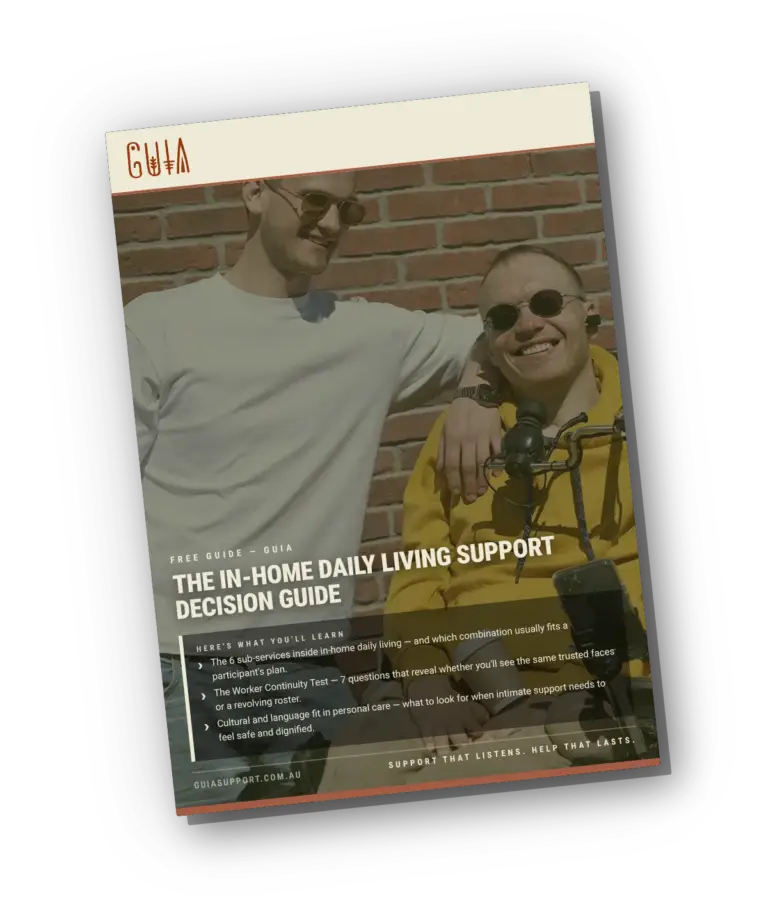
Here's What You'll Learn:
The 6 sub-services inside in-home daily living — and which combination usually fits a participant's plan.
The Worker Continuity Test — 7 questions that reveal whether you'll see the same trusted faces or a revolving roster.
Cultural and language fit in personal care — what to look for when intimate support needs to feel safe and dignified.
ARE YOUR NDIS SUPPORTS WORKING FOR YOU?
GET A FREE NDIS PLAN MANAGEMENT REVIEW