


New NDIS plan: your first 30 days, in order
A new plan arrives and nothing tells you what to do first. Here is the order we work through with families in South West Sydney, and the two mistakes that cost the most.


When you’re arranging NDIS community access support Sydney, the biggest worry isn’t finding options—it’s finding someone who actually shows up. Consistency matters more than you’d think. Your family member builds confidence around a person, a time, a routine. Then cancellations happen. Workers don’t return calls. The whole thing collapses, and you’re back to square one. That’s not just inconvenient; it breaks trust. The NDIS funds community participation specifically because connection and routine are how people grow. But only if the support is reliable.
Community access support works by pairing a consistent support worker with your family member over time. That worker learns what matters—the coffee shop they prefer, the sensory needs, the communication style, the things that build confidence. They’re not rotating through a roster; they’re the same person, week after week. This consistency lets your family member relax into the relationship. The worker becomes someone they trust, not a stranger managing tasks. Confidence builds because routine builds. Independence grows because someone steady is there to notice and encourage it.
Here’s what that looks like in practice. You book a two-hour community access visit on a Tuesday afternoon. The same support worker arrives on time, every time. They know your family member’s routine, their communication needs, maybe they speak Spanish or Arabic if that matters. Over weeks, they’re part of the extended team—not a contractor cycling through. That reliability means you can plan your own week knowing support is solid. You’re not managing cancellations or chasing callbacks. You can breathe.
When you’re researching NDIS community access support Sydney, you might notice your family member spends most days at home. Not because they don’t want to go out—but because getting there feels complicated, unreliable, or just too hard to arrange. That’s the gap NDIS community access support is meant to fill.
Here’s what we hear from families: the barriers aren’t always obvious. It’s not just transport. It’s the worry that a support worker won’t show up on time. It’s uncertainty about whether the activity will actually suit them. It’s the frustration of explaining their needs over and over to different people. And if English isn’t your first language, or your family member is autistic and needs consistency, those barriers get bigger.
NDIS community access and social participation funding exists specifically to help people get out into their community—to do the things that matter to them. That might be a regular outing to the local shops, joining a group activity, attending a sports class, or visiting friends. It might be building confidence to try something new. The goal is always the same: more connection, more choice, more control over how they spend their time.
But funding alone doesn’t solve it; you need a support provider who actually shows up when they say they will. Someone who listens to what your family member wants to do, not what’s easiest to arrange. Someone who treats them as a capable adult, not as a task to tick off. And if your family speaks Arabic, Spanish, or Auslan, you need a provider who can match that—so communication is real, not strained.
That’s where reliable, person-centred NDIS community access support makes the difference. When it works well, it opens doors.
Here’s what that looks like in practice. Your family member has funding for community access in their NDIS plan. A support worker, matched to their interests and communication style, arrives on a Tuesday afternoon at 2 pm. They’re on time. Every time.
That first hour might be a trip to the local library in Bass Hill. The support worker knows your family member prefers a quieter time, so they go mid-week when foot traffic is light. They help choose a book, chat with the librarian, and grab a coffee at the café next door. Small things. Things that matter because they’re chosen, not imposed.
The second hour shifts. Maybe it’s a community group that meets nearby — a sports club, an art class, a cooking session run by the local council. The support worker introduces them, stays close enough to help if needed, then steps back. They’re watching for what builds confidence. What makes your family member smile. What they might want to do again next week.
Before they leave, the support worker writes a quick note. Not clinical. Just honest. “Really enjoyed the library visit. Asked the librarian about the book club — might be interested. Will ask next week. ” You read it and know exactly what happened. You know your family member is being seen as a person, not a task.
That’s NDIS community access support. Not vague “social outings”. Real outings, real connections, real choice about where to go and who to spend time with. The support worker is reliable, trained, and matched to your family member’s needs and communication style. If cultural or language fit matters — Arabic, Spanish, or Auslan — we make sure that happens too.
When you’re ready to explore this for your family member, enquire about support with Guia. We’ll listen to what matters most and help you understand how community access funding can work in your plan.
Many families think NDIS community access support is just about getting someone out of the house. A few outings a month, maybe a shopping trip. But isolation isn’t solved by occasional activities. It’s the gap between Thursday and next Thursday that matters—the days when your family member stays home because transport is hard or connections feel too risky to build.
What we hear from families is that the real cost of isolation isn’t boredom. It’s the slow loss of confidence, the shrinking of what feels possible, and the weight on you as the everyday support person. When someone doesn’t get regular chances to be around others, to try things, to belong somewhere, the whole family feels it.
NDIS community access support isn’t a box to tick. It’s consistent, reliable transport and a support worker who shows up the same day each week—someone who helps your family member build real connections over time, not just attend events. Here’s what that looks like in practice: a Wednesday afternoon at a community group, a Friday outing to somewhere your family member chooses, a support worker who knows the staff there and checks in regularly. Small, steady, predictable. The kind of support that lets someone build friendships and routines instead of starting from scratch each time.
The shift happens when community access becomes part of the weekly rhythm. Confidence grows. Your family member has something to look forward to. You get breathing room. And isolation stops being the default.
If that sounds like the kind of support you’re after, we can help. Guia has been supporting participants across South West Sydney for two years, with NDIS-registered workers who match closely with each person and show up consistently. When you’re ready to explore what community access could look like for your family member, enquire about support.
Community Access & Social Participation is NDIS support that helps you or your family member get out into the community, build real connections, and do the things that matter to you. It’s about choice and control — you decide where you want to go and what you want to do.
This support includes group activities tailored to your interests, social outings to places you choose, and transport to get you there. It might be a weekly outing to the local library, a community sports group, volunteering, attending cultural events, or simply spending time with friends. A support worker travels with you, offering practical help and companionship so you can participate with confidence.
It also covers the skills-building that happens naturally through participation. When you’re out in the community regularly, you build friendships, learn how to navigate public spaces, and grow more confident in social situations. That confidence often flows into other areas of life — work, study, or independent living.
What it does NOT include: Community Access & Social Participation is not therapy or clinical treatment. It’s not designed to “fix” or “overcome” anything. It’s simply support that removes the barriers between you and the community you want to be part of. If you need allied health services like exercise physiology or psychology, those are separate NDIS supports funded differently.
Here’s what that looks like in practice: A Spanish-speaking or Auslan-trained support worker might help you attend a local community centre programme on Tuesday afternoons, or support you to volunteer at an organisation you care about. The focus is on what you want to do, not what a service thinks you should do.
If that sounds like the kind of support you’re after, enquire about support and we can talk through what community participation might look like for you or your family member.
Community Access & Social Participation is funded through your NDIS plan as a Core Support — money set aside specifically to help you or your family member get out into the community, build connections, and do things that matter to them. Unlike some supports that focus on daily tasks at home, this funding is about choice and control: what activities interest your family member, where they want to go, and who they want to spend time with.
Here’s what that looks like in practice. Your family member might use this funding for a weekly group activity — a cooking class, a sports group, or a community centre programme. Or they might use it for one-on-one outings with a support worker: a trip to the shops, a visit to the library, or meeting friends at a café. The support worker’s role is to help them get there safely, build confidence, and stay connected to what matters. Transport is included if it’s part of getting to the activity.
The NDIS funds this because research shows that isolation and loneliness affect people with disability at higher rates than the general population. Community participation builds confidence, reduces anxiety, and helps people feel part of their neighbourhood. For families, it also means regular respite — knowing your family member is doing something they enjoy, with trained support, while you have time for yourself.
What matters most is that the choice stays with your family member. They decide what activity appeals to them, how often they want to go, and whether they’d prefer group or one-on-one support. A good Community Access provider listens to those preferences and matches them with a support worker who gets it — someone reliable, culturally matched if that matters to your family, and genuinely interested in helping your family member build real friendships and confidence.
If you’re not sure whether your current plan includes Community Access funding, or you’d like to explore what’s possible in your area, we’re here to help. Get in touch and we’ll walk through your plan together.
When you’re choosing NDIS community access support, it helps to know exactly what you control and what sits outside the support itself. That clarity means you can make real decisions about what matters to your family member.
What’s your call
These decisions stay with you and your family member. A good provider listens to what matters and builds the support around your actual life. At Guia, we match support workers based on personality fit, language needs, and what your family member enjoys — not just availability.
What’s outside this support
It’s worth knowing that community access support is about real participation — getting out, doing things your family member enjoys, building friendships and confidence. It’s not therapy disguised as an outing. If clinical support is part of your plan, that’s a separate service with a different provider.
When you’re ready to explore what community access could look like for your family member, we’re here to answer your questions. Enquire about support and we’ll walk you through how it works in practice.
Community Access & Social Participation sits in your NDIS plan under “Assistance with Social and Community Participation”. It’s worth check-ing your plan documents now to see if this category is already there and what funding sits against it.
Here’s what that looks like in practice. If your family member is spending most days at home and has said they’d like to get out more — to a local café, a community group, a sports activity, or just somewhere they feel comfortable — that’s a signal this support could help. The goal isn’t to fill every hour; it’s to build real connections at a pace that works for them.
Another common starting point is when a participant wants to try something new but needs someone alongside them the first few times. That might be attending a disability sports group, joining a community art class, or volunteering at a local charity. A support worker who knows them well can help them settle in, build confidence, and gradually step back as they feel ready.
You might also notice your family member has interests or hobbies they can’t access alone — whether that’s transport, sensory support, communication help, or just a trusted person nearby. An autistic adult might need someone who understands their sensory needs; a participant who uses Auslan might need transport to a Deaf community event. A Spanish-speaking family might want activities where their language is spoken. These aren’t extras. They’re part of real community participation.
If your NDIS plan already includes Community Access funding, you can start exploring this with a support coordinator or provider now. If it’s not there yet, a plan review can add it. Either way, the first step is a conversation about what your family member actually wants to do and what would make that possible.
Enquire about support and we can help you work out whether this fits your current plan and what the next step looks like.
An autistic adult in Canterbury was spending most days at home. His mum worried he wasn’t building friendships or learning to navigate local spaces. His NDIS plan included funding for community access, but he needed someone who understood his sensory needs—loud shopping centres overwhelmed him, and sudden changes to routine made him anxious.
Guia matched him with a support worker who specialised in community participation for autistic adults. They started small: a quiet Tuesday morning at the local library, then a coffee at a nearby café during off-peak hours. The support worker learned his preferences, checked in about what felt manageable, and never pushed. After six weeks, he was confident enough to attend a community art class with the same worker present but stepping back.
What changed wasn’t dramatic, but it mattered. He now has two regular community activities each week. He knows the café staff by name. His mum sees him more confident talking about his week. He’s building real connections, not just ticking boxes on a support plan. The consistency—the same worker, the same times, the same spaces—meant he could focus on enjoying himself rather than managing uncertainty.
This is what community access support looks like in practice; it’s not about filling your calendar with activities. It’s about finding what genuinely interests you, matching you with someone reliable who respects your pace, and showing up every week so you can build confidence and real community ties.
If your family member needs this kind of steady, person-centred community participation support, enquire about support with Guia. We’ll listen to what matters to you both.
Community Access & Social Participation support is funded through your NDIS plan as either Core Support or Capacity Building, depending on what you and your support coordinator agree you need. Core Support covers ongoing activities like regular group outings or weekly community access visits. Capacity Building funds support that helps you build skills, confidence, or independence over time.
The NDIS uses a price guide to set fair rates for different support types. Community access support is priced by the hour, and the rate depends on factors like whether transport is included, the size of the group, and the qualifications of your support worker. Your support coordinator will work through these details with you when your plan is being discussed.
It’s worth knowing that funding approval isn’t automatic. Your NDIS plan needs to show a clear link between the support you’re asking for and the goals in your plan. For example, if one of your goals is to build friendships or get out into your local community, community access support is a natural fit. If you’re working toward employment, group activities that build confidence or social skills might be approved as Capacity Building instead.
Families often ask whether there’s a gap between what the NDIS funds and what support actually costs. That depends on your local area and the specific support you choose. Your support coordinator can explain what’s covered and what isn’t before you commit to anything.
The key is having a clear conversation early: what do you want to do, what’s realistic with your plan, and how much support do you actually need to get there? That’s where choice and control matter most. When you’re ready to talk through your options, we’re here to help.
When you first ring Guia, you’ll speak with someone who understands NDIS support. We’ll ask about your family member — what they enjoy, where they’d like to go, what matters most to them. This chat takes about 15 minutes. We’re not filling a form; we’re listening.
After that first call, we’ll send you information about how NDIS community access support works and what Guia offers. We’ll explain your family member’s options clearly, in plain language. If you have questions about your NDIS plan, funding, or what’s included, we answer those too. No pressure to decide straight away.
Once you’re ready to move forward, we’ll arrange a time to meet. This might be a visit to your home or a chat over the phone — whatever suits your family. You’ll meet a member of our team who can answer questions about how support would actually work week to week. They’ll talk through transport, activity preferences, and how we match support workers to participants.
The matching process is personal. We listen to what your family member needs — whether that’s a Spanish-speaking support worker, someone with experience supporting autistic adults, or a particular personality fit. We don’t just assign whoever’s available. This step usually takes a week or two, depending on availability.
Your first visit with your matched support worker is a getting-to-know-you session. You’ll meet them, talk through routines, and plan that first outing or activity together. We keep that first visit shorter so everyone feels comfortable. From there, your family member and support worker build the relationship week by week.
If you’d like to start this process, ring us or enquire about support online. We’ll walk you through each step at your pace.
Finding the right NDIS community access support provider in South West Sydney means asking the questions that matter most to your family. A good provider should be able to answer these clearly and honestly, showing they understand what reliable, person-centred support actually looks like.
At Guia, consistency and choice are how we build trust. We match support workers thoughtfully, show up reliably, and treat every participant as someone deserving dignity and respect. Our team speaks English, Arabic, and Spanish—and we work with your support coordinator every step of the way. When you’re ready to explore what that looks like for your family, enquire about support.
When you’re looking for NDIS community access support in Sydney, not every provider will be the right fit. Some warning signs are easy to spot if you know what to look for. These red flags often show up early and can save you time, frustration, and changes down the track.
Guia operates differently. We match support workers based on what your family member actually needs — language, communication style, interests, and routine. Staff stay because we invest in them. We show up on time, every time. When you’re ready to explore NDIS community access support that respects your family’s choices, enquire about support.
Good community access support shows up in small, steady ways. The first sign is consistency. You’ll notice the same support worker arriving each week, learning your family member’s preferences and routines, and building real trust over time. That continuity matters—it means fewer explanations, fewer awkward moments, and genuine care rather than surface-level assistance.
The second sign is regular communication. You hear back promptly when you ask questions. The support worker shares what happened during outings—not just logistics, but how your family member felt, what they enjoyed, what they’d like to try next time. That two-way conversation helps you stay connected to their life outside home.
The third sign is your family member’s priorities leading the way. Community access support works best when the activities and outings match what the participant actually wants to do—not what fits the schedule or what the provider thinks is “good for them. ” If your family member is choosing the café, the park, the community group, or the shopping trip, that’s choice and control in action. You’ll see confidence growing because they’re doing things that matter to them.
The fourth sign is visible growth in independence and connection. This might look like your family member remembering the bus route, chatting more easily with people they meet regularly, or wanting to go out more often. It might mean they’re building friendships or trying activities they were hesitant about before. These shifts take time—but they’re real signs that support is building their confidence, not just filling their hours.
If you’re seeing these signs consistently, the support is working. If you’re not, it’s worth a conversation with your support worker or coordinator about what might need to shift. Enquire about support with Guia to discuss what good community access looks like for your family member.
If Community Access & Social Participation support isn’t working the way you hoped, you have real options. The choice and control you have over your NDIS plan extends to how that plan gets delivered and who delivers it.
Start with your support provider directly. A quiet conversation with your support worker or their manager often sorts things out quickly. Maybe the timing doesn’t suit, or the activities don’t match what you actually want to do. Good providers listen and adjust. If that doesn’t shift things, ask for a different support worker. You’re not locked in.
If the issue runs deeper—reliability problems, poor communication, or a mismatch in how support feels—you can request a formal review with the provider’s management team. Be specific about what’s not working. Most providers want to know when something’s off so they can fix it.
You also have the right to change providers altogether. Your NDIS plan belongs to you. If Guia or any other provider isn’t the right fit, you can move your funding to someone else. Your support coordinator can help you explore other options in South West Sydney if you want to.
For serious concerns—safeguarding issues, breaches of the NDIS Code of Conduct, or complaints that don’t get resolved—the NDIS Quality and Safeguards Commission handles formal complaints and investigates provider conduct. This is a real safety net, not a last resort you should fear using.
You’re in charge. If you want to talk through what’s happening or explore what better support might look like, we’re here to listen. Enquire about support whenever you’re ready.
Choosing an NDIS community access provider is a practical decision, not a leap of faith. You’re looking for someone who shows up reliably, matches your family member’s interests and communication style, and treats them as a capable adult—not a project. That clarity matters more than glossy marketing.
Start by asking potential providers direct questions. What does a typical outing actually look like? How do they match support workers to participants? What happens if your regular worker is sick? Do they have staff who speak Arabic, Spanish, or Auslan if that matters for your family? A provider worth their salt will answer these plainly and honestly.
It’s worth knowing that NDIS providers must be registered and compliant with the Quality and Safeguards Commission. Check their registration number before you commit. Ask whether they’ve worked with participants who share your family member’s disability type or communication needs. Someone with lived experience of disability or family caregiving often brings a steadier understanding of what actually helps day-to-day.
Many families find their provider through word-of-mouth—a support coordinator’s recommendation or another family’s honest feedback. That’s valuable. But you don’t have to decide today. A good provider will offer a no-pressure conversation to explore whether they’re the right fit. You might ask about a trial visit or a short initial booking to see how the relationship feels before committing further.
When you’re ready to explore options, enquire about support and describe what matters most to your family. We’ll listen first and explain how we work—then you decide if it’s right for you.
A new plan arrives and nothing tells you what to do first. Here is the order we work through with families in South West Sydney, and the two mistakes that cost the most.

Aged care at home South West Sydney from Guia. Reliable support workers who show up consistently and become part of your family’s everyday routine.

NDIS allied health support sydney from Guia. Reliable support workers who show up consistently and become part of your family’s circle. Peace of mind fo…
The Community Participation Playbook for NDIS Families
How to use NDIS Community Access funding to actually build connection, confidence, and independence — not just attendance.
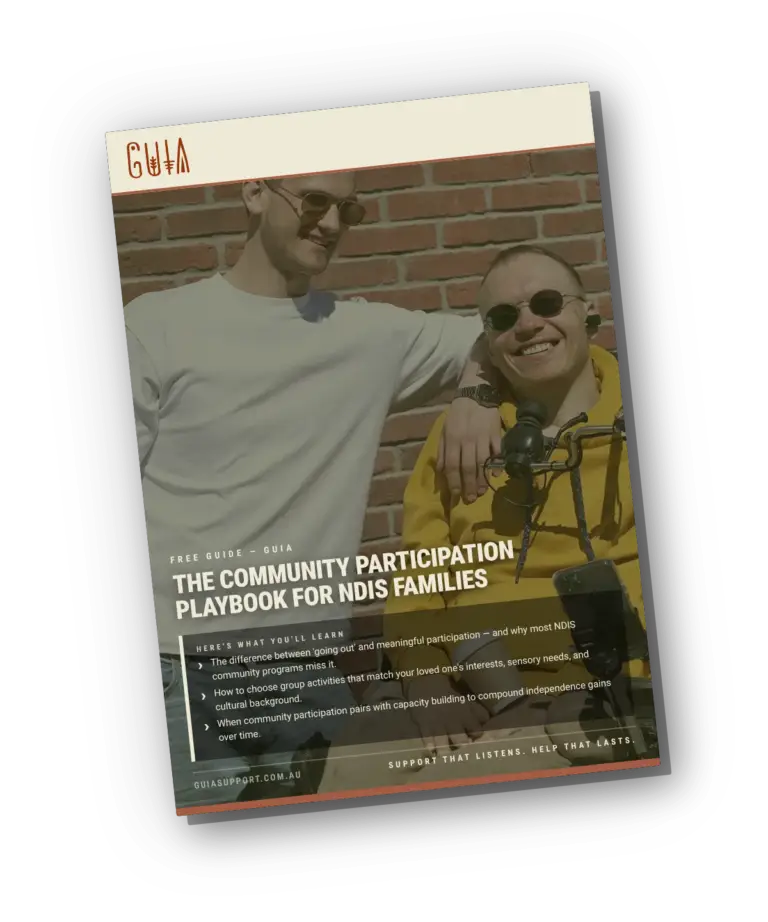
Here's What You'll Learn:
The difference between 'going out' and meaningful participation — and why most NDIS community programs miss it.
How to choose group activities that match your loved one's interests, sensory needs, and cultural background.
When community participation pairs with capacity building to compound independence gains over time.
ARE YOUR NDIS SUPPORTS WORKING FOR YOU?
GET A FREE NDIS PLAN MANAGEMENT REVIEW