


New NDIS plan: your first 30 days, in order
A new plan arrives and nothing tells you what to do first. Here is the order we work through with families in South West Sydney, and the two mistakes that cost the most.


NDIS capacity building funding sits in your plan under “Assistance with Life Stage Transition” — but many families don’t realise it covers far more than school-to-work moves. It funds the skills, confidence, and pathways your family member needs to step toward work or greater independence, whether that’s their first job, a return to employment, or building the routines that make daily life feel more in their control. The worry isn’t whether the funding exists — it’s whether the support worker showing up will actually understand what your family member needs and stick with them through the messy middle part, when progress feels invisible.
Employment and capacity building works by pairing consistent, qualified support with real-world practice. A support worker doesn’t just talk about job readiness — they practise interview answers on a Tuesday afternoon, then travel with your family member to the workplace on Thursday to see how the routine actually feels. That repetition and presence builds confidence in a way no single session can. The mechanism is simple: show up reliably, practise the specific skill, adjust based on what you learn, show up again.
Here’s what that looks like in practice. You meet with the same support worker across multiple weeks — not a different face each time. They learn your family member’s pace, their sensory needs, whether they prefer a quiet moment before a shift or a walk to settle their thoughts. They become someone your family member recognises and trusts, and that trust becomes the foundation for every new skill. When the provider is reliable and the match is right, the support worker feels less like a contractor and more like the person who genuinely knows how to help.
NDIS capacity building funding is designed to help participants build skills, confidence, and independence—but families often ask: what does that actually mean, and how does it fit my son or daughter’s real life right now?
The truth is, capacity building isn’t one-size-fits-all. For some participants, it means learning to use public transport independently. For others, it’s job-readiness skills, managing money, or building the confidence to join a community group. For an autistic adult, it might mean developing routines that make work feel less overwhelming. The funding exists to support whatever helps your family member move toward greater independence and choice in their own life.
What we hear from families is this: you’re not looking for promises. You’re looking for someone who shows up consistently, listens to what your family member actually needs, and builds support around their strengths—not their limits. You want a provider who treats your son or daughter as a capable adult, even when progress feels slow or uncertain.
Here’s what that looks like in practice. NDIS capacity building funding covers employment assistance, life skills training, and support through major transitions—like leaving school, moving toward work, or gaining independence in daily tasks. It’s not therapy. It’s practical, real-world support delivered by someone who knows your family member and understands what matters to them.
The right support worker becomes part of your extended team. They’re reliable, they’re trained, and they respect your family member’s pace. They help build skills over time, not rush outcomes. If you’re wondering whether capacity building support could help your family member take their next step, that’s worth exploring.
Here’s what that looks like in practice. Your adult son, who’s autistic, has NDIS capacity building funding allocated for employment support. On a Tuesday afternoon at 2pm, a Guia support worker arrives at your home. They’ve worked with your son for three months now—they know his routine, his sensory preferences, and that he needs ten minutes to settle before starting anything new.
Today’s focus is job applications. The support worker sits beside him at the kitchen table with a laptop and a printed list of three local roles that match his interests and skills. They don’t take over. Instead, they talk through each job description together, asking questions like “Does this one feel right to you? ” and “What part of the work appeals to you? ” Your son answers. He’s in control. The support worker takes notes on what matters to him—the hours, the environment, whether there’s a mentor on site.
By 3:15pm, they’ve drafted two applications together. Your son wrote most of the cover letter himself; the support worker helped him structure his thoughts and checked spelling. Before they finish, the support worker reviews what they’ve done and leaves you a brief handwritten note about next week’s plan. It’s not a clinical report—it’s a neighbour’s update: “We’re ready to submit these two. He’s keen on the café role. Next week we’ll talk about interview prep.
That’s NDIS capacity building funding at work. It’s not about filling hours or ticking boxes. It’s about building your son’s confidence and independence at a pace that suits him, with someone who shows up reliably and treats him as capable. If that sounds like the kind of support your family needs, we’re here to help you explore what’s possible.
Enquire about support and we’ll talk through how employment and capacity building can work for your situation.
Many families think NDIS capacity building funding is only for people who want to work in paid employment. The assumption makes sense—the name includes “employment”—but it’s actually much broader than that.
Capacity building covers any support that helps a participant build skills, confidence, and independence in daily life. That might mean job-readiness training for someone aiming for part-time work. It might also mean learning how to manage money, use public transport, cook a meal, or navigate social situations with less anxiety. It’s about growing capability in whatever area matters most to that person and their family.
Here’s what that looks like in practice. One participant might work with a support worker on interview skills and workplace communication. Another might focus on budgeting and tenancy skills as they move toward independent or shared living. A third might build confidence in community access—learning routes, managing sensory environments, building friendships. All three are using capacity building funding. All three are building real independence and choice over time.
The key is that the goal belongs to the participant and family, not to the provider. When you access NDIS capacity building funding, you’re choosing what skills matter, what independence looks like for your situation, and what pace feels right. A good support worker listens to that, shows up consistently, and helps you practice until the skill feels solid enough to use on your own.
If you’re wondering whether capacity building might fit your family member’s plan—whether the goal is employment, daily living, transition to a new living arrangement, or something else entirely—that’s worth exploring. When you’re ready to talk through what capacity building could look like, we’re here to help.
Employment & Capacity Building is NDIS funding that helps adults with disability build skills, confidence, and pathways toward work or greater independence. It’s not about finding you a job overnight. It’s about working at your pace to develop the capabilities you need to do what matters to you.
This support includes employment assistance—job-readiness training, workplace support, and ongoing advocacy once you’re in a role. It also covers life skills training, like managing money, using public transport, or building routines that help you live more independently. Transition supports are part of it too—practical help through major life changes like school leaving, moving out, or changes in your circumstances.
What it does NOT include: clinical therapy, medical diagnosis, or treatment. Employment & Capacity Building is about building your capabilities, not treating a condition. The support is tailored to you. If you’re autistic and need routine-based planning to manage a new job, that’s what we work with. If you’re deaf and need an Auslan-trained support worker, that’s what we organise. The NDIS funds support that matches how you actually work and what you actually need.
Here’s what that looks like in practice: a support worker might help you write a resume, practise interview skills, then support you in your first weeks at work. Or they might help you learn to use online banking, plan a weekly budget, or build confidence catching the bus to a community activity you’ve chosen. The focus is always on what builds your independence and choice over time.
NDIS capacity building funding sits in your plan under “Assistance with Life Stage Transition” or similar categories. Your support coordinator can show you exactly what’s allocated and how it’s meant to be used. If you’re not sure whether you have this funding or how much, that’s a good first question to ask them—or to bring to us when you’re ready to explore what’s possible.
NDIS capacity building funding works differently from day-to-day support. Where Core Supports cover immediate needs like personal care or community access, Capacity Building funding is designed to help participants develop new skills, confidence, and independence over time. The NDIS allocates this funding based on what your family member wants to achieve, not on a fixed hourly rate or service menu.
Your family member (or you, if you’re their representative) decides how to use Capacity Building funding. That might mean employment assistance to help them find and keep work. It could be life skills training—learning to manage money, cook meals, or use public transport independently. It might be transition support through major life changes, like moving out or starting a new phase of education. The choice stays with your family member and your family.
What matters is that the support is time-limited and goal-focused. Rather than ongoing weekly visits, Capacity Building typically funds a specific plan to build a particular skill or achieve a concrete outcome. For example, a 12-week employment readiness programme, or support to move toward independent living over six months. Progress is reviewed regularly so funding stays aligned with what’s actually working.
In South West Sydney, many families find that combining Capacity Building with other support categories works best. Someone might use Core Supports for daily personal care, Capacity Building for employment coaching, and Community Participation funding to build social connections alongside their work goals. Your support coordinator can help map out how these fit together in your family member’s plan.
The key is that you’re not spending funding on something—you’re investing it in building real skills and independence. If that sounds like the kind of support your family member needs, we can walk you through how it works in practice and help you think through what Capacity Building might look like for them.
NDIS capacity building funding gives you real control over how support happens. You decide the shape of it—not the NDIS, not the provider. Here’s what sits squarely in your hands.
What’s your call:
You’re not locked into a set package. If fortnightly sessions aren’t working, you can adjust; if a support worker isn’t the right fit, you can request someone else. If the focus needs to shift from employment prep to independent living skills, that’s your choice to make.
What’s outside this support:
What we do is support the goals you’ve already set. We help your family member build confidence, learn new skills, and move toward the independence they’re after. We show up consistently, we listen, and we treat them with the respect they deserve.
If you’re ready to explore what NDIS capacity building funding could look like for your family, enquire about support with Guia. We’ll walk through your situation without pressure, answer the questions that matter, and help you understand what comes next.
If your family member is thinking about work, study, or building confidence in daily routines, NDIS capacity building funding might already be part of their plan. Here’s how to tell if Employment & Capacity Building support could help right now.
The clearest signal is when your family member says they want to try a job or apprenticeship but doesn’t know where to start. That might mean help with a resume, practising interview skills, or support on the first few weeks at a workplace. It could also be someone who’s been out of work for a while and needs to rebuild confidence before applying. Capacity building funding covers exactly this kind of practical, step-by-step help.
Another common situation is when daily routines feel overwhelming. Your family member might struggle with budgeting, cooking, using public transport, or managing their time. Rather than waiting for a plan review, check your current plan documents — many include capacity building as a registered support category. If it’s there, you can start exploring support now without waiting for the NDIA.
Life changes also trigger this need. A young autistic adult leaving school, someone moving out of home for the first time, or an adult returning to work after a health setback — these are moments when building skills and confidence matters most. The NDIS website lists what’s typically funded under capacity building, though your plan may include more or less depending on your family member’s goals.
The honest truth is that capacity building only works if the support worker shows up reliably and actually listens to what your family member wants to achieve. That’s where the fit between provider and participant really counts.
If any of these situations sound familiar, it’s worth exploring what support could look like. When you’re ready, reach out and we can talk through what your family member needs and how your current plan might cover it.
An autistic adult in their mid-twenties came to us with a clear goal: steady part-time work that fitted his routine and sensory needs. His family had tried a few employment agencies, but the support felt and didn’t account for his need for consistency and predictable tasks.
His NDIS capacity building funding was split across two approaches. We started with structured workplace coaching—a support worker attended his first three weeks on the job, helping him learn the routine and build confidence with his manager. After that, we shifted to fortnightly check-ins rather than daily visits. This flexible arrangement meant he could call if something changed, but he wasn’t dependent on constant support.
At the same time, we worked on life skills that mattered to him: managing his lunch break independently, asking for help when he needed it, and tracking his own shifts on a calendar he’d chosen. These weren’t formal lessons—they were built into real moments during his support visits and at home with his family.
What made the difference wasn’t the intensity of support. It was the match between what he needed and what his plan could actually fund. His NDIS capacity building funding covered both the workplace coaching and the ongoing skill-building, but we didn’t pretend he needed the same level of support every week. Some weeks he needed more; others, he was fine on his own.
His family saw the shift pretty quickly: he started talking about his shifts unprompted, and the anxiety around changes to his routine dropped noticeably. That’s what person-centred support looks like in practice—flexible enough to fit his actual life, not rigid around a fixed schedule.
If your family member is ready to explore employment or build capacity toward greater independence, enquire about support and we’ll talk through what your plan can cover and how we’d approach it together.
NDIS capacity building funding sits within your support plan as either a Core Support or a Capacity Building line item. The difference matters, because it shapes how much you can spend and what it covers. Core Supports are flexible—you can use them for employment assistance, life skills coaching, or transition support. Capacity Building is more targeted and typically sits alongside other supports to help you build independence over time.
The NDIS uses a price guide to set the hourly rate for employment and capacity building support. Your support coordinator or planner will work from this guide when they draft your plan. The amount approved depends on what you and your family identify as a priority—whether that’s job readiness, workplace confidence, or moving toward greater independence in daily life. It’s not about how much you can spend; it’s about what you actually need to move forward.
Once your plan is approved, you choose the provider. That’s where control sits—with you and your family. You’re not locked in, and you’re not obliged to spend every dollar. If you find a support worker through Guia who understands your goals and shows up consistently, you build on that. If something isn’t working, you can change providers or adjust your support plan at review.
What we hear from families is that the funding piece feels clearer once someone explains it plainly. The NDIS website has a price guide you can check, and your support coordinator can walk you through what your specific plan includes. If you’d like to talk through how employment and capacity building support might fit your situation, we’re here to help.
Enquire about support and we’ll explain your options in plain language—no jargon, no pressure.
NDIS capacity building funding works best when it’s matched to what your family member actually needs right now. That’s why we start with a conversation, not a form. When you call us, you’ll speak to someone who listens — not someone reading from a script. We ask about your situation, what’s been tricky, and what you’re hoping to change. That first chat usually takes 15 to 20 minutes.
Once we’ve got a sense of what you’re after, we’ll explain how NDIS capacity building funding can support different areas — job readiness, life skills, moving towards independence, managing routines, or building confidence in new situations. We’ll be clear about what we can do and what sits outside our scope; there’s no pressure to decide on the spot.
If it feels like a fit, we’ll arrange a meet-and-greet. This is where your family member gets to meet the actual support worker who’d be working with them — not just hear about the service in theory. We believe in person-centred matching, which means we’re listening to whether the personality, communication style, and availability feel right for your household. If it doesn’t click, we’ll keep looking.
Your first support visit is structured but relaxed. The support worker will arrive on time — reliability matters to us — and spend time understanding your family member’s goals and routines. They’ll work with you both to set out what a typical week looks like and where capacity building fits in. Whether that’s job-readiness coaching, help with independent living skills, or support through a big life transition, the focus stays on building confidence and real skills over time.
Ready to have that first conversation? Enquire about support and let’s talk through what capacity building could look like for your family member.
Choosing the right Employment & Capacity Building provider matters. Your family member deserves someone reliable, respectful, and genuinely invested in their goals. Before you commit, it’s worth asking any potential provider these questions to understand how they work and whether they’re the right fit.
At Guia, we answer these questions honestly. We’re NDIS-registered, all staff are qualified and worker-screened, and we match support workers thoughtfully—including Spanish-speaking and Auslan-trained team members across South West Sydney. We show up reliably, treat every participant with dignity, and focus on real skill-building and independence. When you’re ready to explore what genuine Employment & Capacity Building support looks like, Enquire about support.
When you’re looking at NDIS capacity building funding options, it helps to know what to watch for. Not every provider matches every family’s needs or values. Here are the observable signs that an Employment & Capacity Building provider may not be the right fit.
At Guia, we do things differently. We match support workers based on your family member’s actual needs, not just availability. Our team stays consistent — reliability matters when you’re building trust and momentum. We’re NDIS-registered and Code of Conduct compliant, with staff who speak English, Spanish, and Arabic. When you’re ready to explore Employment & Capacity Building support that feels right, enquire about support.
When Employment & Capacity Building support is working well, you’ll notice it in small, steady ways. The same support worker shows up on the agreed day and time—no last-minute changes or cancellations that throw your family member’s routine off track. That consistency builds trust and lets real progress happen.
You’ll hear your family member talk about what they’re actually working towards, not what a provider thinks they should do. Their priorities—whether that’s gaining confidence for a specific job, learning to manage money, or building skills for independent living—stay at the centre of every session. The support worker checks in regularly about what’s working and what needs adjusting, and listens when your family member says something isn’t right.
Communication flows both ways. The support worker keeps you in the loop without overstepping—sharing progress in a way that respects your family member’s privacy and growing independence. You might get a quick message that they’ve had a win, or a heads-up if something needs tweaking. You’re never left wondering what’s actually happening in those sessions.
Perhaps most importantly, you’ll see your family member becoming more confident in their own choices. They might speak up about what they want to try next, ask better questions, or show less anxiety about the steps ahead. That’s empowerment in action—not someone else deciding their future, but your family member gradually taking the wheel.
If you’re seeing these signs, the support is landing well. If you’re not—if the worker keeps changing, communication is one-way, or your family member’s voice isn’t being heard—that’s worth raising. Enquire about support with a provider who puts consistency, communication, and genuine choice at the heart of NDIS capacity building funding.
If Employment & Capacity Building support isn’t meeting your family member’s needs, you have real options. Your NDIS plan belongs to your family member, and they deserve support that works for them. Here’s what you can do.
Start with the provider directly. A conversation with your support worker or their manager often solves things quickly. Maybe the timing of visits needs adjusting, or the focus of sessions isn’t matching what was planned. Good providers listen and change course when feedback comes in. If that doesn’t shift things, ask for a different support worker from the same team. A fresh match sometimes makes all the difference.
If the provider isn’t responding or you’re not confident they’ll improve, you can switch. Your family member can choose a different NDIS provider at any time. There’s no penalty for moving on. Talk to your support coordinator about options in South West Sydney, or search the NDIS website for registered providers in your area. You’re not locked in.
For serious concerns—missed appointments, disrespect, or safety issues—the NDIS Quality and Safeguards Commission handles formal complaints and investigates breaches of the NDIS Code of Conduct. It’s there to protect participants and families. You don’t need a lawyer to lodge a complaint, and the process is designed to be straightforward.
Choice and control are at the heart of the NDIS; your family member gets to decide who supports them and whether that support is working. If you’d like to talk through your options or explore what Guia’s Employment & Capacity Building support looks like, we’re here to help. Enquire about support whenever you’re ready.
If you’re exploring NDIS capacity building funding for your family member, the next step doesn’t have to feel rushed. Many families in South West Sydney start by asking questions—about what’s actually included, how support workers are matched, and whether a provider will show up consistently.
That’s exactly what a discovery conversation is for. We listen to what matters most to your family: whether your son or daughter needs help building job-ready skills, managing routines independently, or navigating a major life change like leaving school or moving into their own place. We ask about your concerns—cultural fit, language needs, reliability—because those details shape whether support actually works.
During a free chat, we’ll walk you through how NDIS capacity building funding works in plain language, what Guia can offer, and what the first few weeks might look like. No pressure to decide on the spot. No sales pitch. Just honest information so you can make the choice that fits your family.
We’re NDIS-registered and our team has lived experience of disability and family caregiving. We match support workers carefully—Spanish-speaking, Arabic-speaking, or Auslan-trained workers are available—because the right person makes all the difference. We show up on time, every time, and treat your family member with the dignity and respect they deserve.
Whenever you’re ready, enquire about support and we’ll arrange a time that suits you. No obligation. Just a conversation.
A new plan arrives and nothing tells you what to do first. Here is the order we work through with families in South West Sydney, and the two mistakes that cost the most.

Aged care at home South West Sydney from Guia. Reliable support workers who show up consistently and become part of your family’s everyday routine.

NDIS allied health support sydney from Guia. Reliable support workers who show up consistently and become part of your family’s circle. Peace of mind fo…
The Capacity Building and Employment Pathway Guide
How NDIS Capacity Building and Employment Support work together to build real job-ready skills — for adults with disability who want to work.
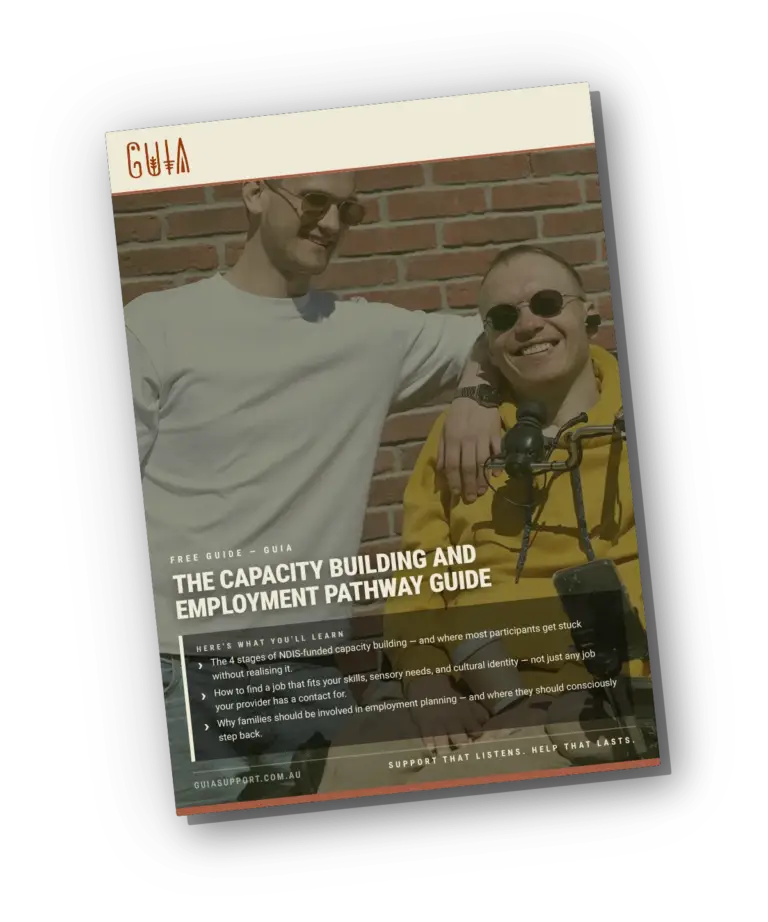
Here's What You'll Learn:
The 4 stages of NDIS-funded capacity building — and where most participants get stuck without realising it.
How to find a job that fits your skills, sensory needs, and cultural identity — not just any job your provider has a contact for.
Why families should be involved in employment planning — and where they should consciously step back.
ARE YOUR NDIS SUPPORTS WORKING FOR YOU?
GET A FREE NDIS PLAN MANAGEMENT REVIEW