


New NDIS plan: your first 30 days, in order
A new plan arrives and nothing tells you what to do first. Here is the order we work through with families in South West Sydney, and the two mistakes that cost the most.


NDIS plan review preparation often catches families off guard because the review itself isn’t just a tick-box admin task — it’s your chance to reshape what support actually looks like for the year ahead. Many families worry a support coordinator won’t show up when promised or will leave gaps in the plan that nobody catches until it’s too late. The truth is that without someone steady in your corner before the review meeting, you’re walking in under-prepared, which means the NDIA shapes the conversation instead of you doing it.
Support Coordination works by placing a Level 2 or Level 3 Specialist coordinator alongside you weeks before the review date. They translate your real-world needs into plan language the NDIA understands. They identify gaps in your current plan, gather evidence of what’s working and what isn’t, and build a case for the supports you actually need. This mechanism matters because it shifts control back to you — you’re not reacting to what the NDIA proposes, you’re leading with what you’ve documented and planned.
Here’s what that looks like in practice. A coordinator meets with you and your family member, listens to a typical week, and notes where support is missing or misaligned. They prepare a one-page summary for the review meeting so you’re not scrambling to explain everything in real time. They show up to the meeting itself or brief you beforehand so you feel confident and heard. That consistency — the same person, every step — is what builds trust and makes sure nothing slips through.
NDIS plan review preparation can feel overwhelming when you’re not sure what to expect or what questions to ask. You might be wondering: Will the review actually change anything? How do I know if my family member is getting the right support? What if the funding doesn’t stretch far enough? These are the questions families in South West Sydney ask us every week.
Here’s what matters: a plan review isn’t just a paperwork exercise. It’s your chance to step back and ask whether the supports your family member is using are actually working. Are they building confidence and independence? Are they getting to community activities that matter to them? Is the support worker reliable and respectful? If something isn’t working, a review gives you the space to change it.
Most families we work with tell us they feel clearer after talking through their plan before the review happens. Not because anyone tells them what to do, but because they’ve had time to think through what’s actually working and what isn’t. That might mean noticing that your brother needs more help with employment support, or that your mum’s support worker isn’t showing up on time, or that nobody’s explained what funding is left and where it can go.
The NDIS review process itself is managed by the NDIS scheme, but how you prepare for it and what you do with the outcome—that’s where support coordination makes a real difference. A good support coordinator listens to what you’re actually worried about, helps you put it into plain language, and makes sure your voice is heard when decisions get made.
If you’re coming up to a plan review and want to feel more confident about what’s ahead, that’s exactly what we help families with.
It’s a Tuesday afternoon at 2 pm. Your support coordinator arrives with a folder and a notebook. They’ve blocked out two hours—not to rush through paperwork, but to sit down properly and talk through what’s actually working in your family member’s life right now.
They start by asking questions; what did the allied health exercise physiologist say last month? Has the personal care worker been showing up on time? Are there gaps in the current plan that nobody’s mentioned yet? They’re not ticking boxes. They’re listening for the real picture—the things that matter day-to-day.
Your coordinator pulls out the progress notes from the past three months; they read them carefully, making notes about what’s changed. They ask your family member directly: “What’s been helpful? What’s felt stuck? ” They notice things—how your family member communicates, what they care about, what routines matter most. That matters for the next plan review conversation with the NDIA.
Before they leave, they’ve drafted a simple summary. It lists what’s working, what needs adjusting, and what questions to raise at your plan review meeting. They leave you with a copy. They explain it in plain language. No NDIS jargon that leaves you confused. They answer your questions—the ones you’ve been holding onto for weeks.
That’s what NDIS plan review preparation looks like in practice. It’s not a box-ticking exercise. It’s someone who knows the system, who listens carefully, and who helps your family feel ready and confident when the plan review happens.
If that sounds like the kind of support you’re after, enquire about support with Guia. We work across South West Sydney, and our coordinators are trained to help families prepare for plan reviews with clarity and calm.
Many families think a support coordinator is someone who fills out paperwork and manages their NDIS plan for them. That’s understandable — the title sounds administrative. But that’s not what support coordination actually does, and it’s worth clearing up before your plan review.
A support coordinator doesn’t create or manage your NDIS plan. That’s the NDIA’s job. What a coordinator does is help you understand what’s in your plan, explore what support options exist to meet your goals, and then match you with providers who can actually deliver. They’re the bridge between your plan and the real support that happens in your life.
Here’s what that looks like in practice. Before your plan review, a support coordinator sits down with you and your family to talk about what’s working and what isn’t. They listen to the everyday stuff — the school run that’s hard, the isolation on weekends, the gaps in your current support. Then they help you think through what kinds of support might help, explain how different services fit into your plan, and introduce you to providers who match what you actually need.
During the review itself, they’re there to help you communicate with the NDIA planner. They translate NDIS language into plain English. They make sure your goals are written down clearly so your plan actually reflects what you want to work towards. And after the review, they help you find the right providers and get support started without months of confusion.
The key difference: a support coordinator empowers you to make informed choices about your own support. They don’t decide for you. They give you the information and confidence to decide for yourself. That’s the whole point.
Support Coordination is someone who helps you understand your NDIS plan and find the right providers to deliver it. Think of them as a guide who speaks NDIS fluently and translates it into plain English for you.
Here’s what that looks like in practice. A Support Coordinator will sit with you and your family to talk through what your plan actually says. They’ll explain which services you’re funded for, how much money you have to spend, and which registration groups the providers you’re considering belong to. They’ll help you match your goals to the right support—whether that’s daily living help at home, community access, employment support, or something else entirely.
Support Coordination does NOT include creating your plan or negotiating with the NDIA; that’s plan management—a different role. What a Support Coordinator does do is help you make sense of the plan you’ve been given and choose providers who’ll actually deliver what you need.
It’s worth knowing that Support Coordinators come in two levels; level 2 coordinators handle straightforward plan navigation. Level 3 Specialist coordinators work with more complex needs—multiple providers, behaviour support planning, or coordination across health and disability services. Some coordinators also offer Psychosocial Recovery Coaching if mental health and independence building are part of your goals.
When you’re preparing for a plan review, a good Support Coordinator helps you gather evidence about what’s working and what isn’t. They listen to what you’ve learned over the past year and help you shape goals that actually matter to you—not goals that sound good on paper. That’s where real change starts: when your plan reflects what you actually want to achieve, not what someone else thinks you should want.
If that sounds like the kind of support you’re after, we’re here to help. Enquire about support and we’ll talk through how we can guide you through your next review.
Support Coordination funding sits within your NDIS plan as part of your Core Supports. This means the money is set aside specifically to help you navigate your plan, understand your options, and connect with other providers who’ll deliver the actual support you need.
Here’s what that looks like in practice. Your support coordinator works with you to understand what’s in your plan, which funding categories apply to your goals, and how much you have available across different support types. They help translate NDIS language into plain terms. They match you with providers — whether that’s personal care, community access, employment support, or allied health — based on what matters to you, not on what’s easiest for them to deliver.
The NDIS allows you to choose your support coordinator, just as you choose every other provider. That choice is real. If a coordinator isn’t listening to you, isn’t showing up on time, or doesn’t understand your family’s cultural or language needs, you can change them. Many families in South West Sydney work with coordinators who speak Arabic, Spanish, or Auslan alongside English — because that match matters.
Support Coordination doesn’t cover the actual daily support itself — that comes from other funding categories in your plan, like Assistance with Daily Personal Activities or Community Participation. What coordination does is make sure those connections happen smoothly, and that you stay in control of how your money is spent.
When your NDIS plan review comes around, a good support coordinator helps you prepare; they gather information about what’s worked, what hasn’t, and what you want to change. They help you articulate your goals clearly to the NDIA. They’re there to make sure your voice is heard, not to decide for you.
If you’d like to talk through how support coordination could work for your family, we’re here to help. Enquire about support and let’s have a conversation about what you actually need.
Your voice matters in NDIS plan review preparation. You know your family member best — their routines, what works at home, what frustrates them, and what they’re hoping for. A good support coordinator listens hard to what you’re telling them, then helps translate that into the practical language the NDIS uses.
Here’s what’s genuinely your call to make:
At Guia, we match you with a Level 2 or Level 3 Specialist coordinator who listens to what matters to your family. We’ve worked with families across South West Sydney who speak Arabic, Spanish, English, and Auslan. That cultural fit isn’t a bonus — it’s how real understanding happens.
What sits outside this support — and it’s important you know this — includes clinical decisions, NDIA plan creation, and funding approvals. Those belong to your participant’s treating team and the NDIA itself. What a support coordinator does is help you navigate the system, ask the right questions, and make sure your voice is heard in the process.
The timing of your input matters too. It best NDIS plan review preparation starts weeks before your actual review meeting, not days before. That gives your coordinator time to gather information, check what’s working and what isn’t, and help you think through what you actually need.
If you’re ready to talk through what support coordination could look like for your family, we’re here to listen. Enquire about support and we’ll walk you through the options without pressure.
Support Coordination sits in your NDIS plan as a separate budget line. It’s not the same as having a support worker visit your home. It’s about having someone who understands your plan, helps you choose providers, and steps in when things need adjusting between annual reviews.
Here’s what that looks like in practice. You might notice your current support worker is reliable but doesn’t match your family member’s cultural background or language needs. A Support Coordinator can help you find someone who does—whether that’s a Spanish-speaking, Arabic-speaking, or Auslan-trained worker. That choice and control matters more than most people realise.
Another signal: your plan review is coming up in the next three months, and you’re unsure what to ask for or how to explain what’s actually working and what isn’t. A Level 2 or Level 3 Specialist Coordinator can help you gather that information, translate it into NDIS language, and present it clearly to the NDIA. Families tell us this reduces the stress of the review conversation significantly.
You might also find yourself juggling multiple providers—one for daily living support, another for community access, maybe a third for employment help. If coordinating between them feels like a second job, that’s a sign Support Coordination would ease the load. A coordinator keeps everyone on the same page and handles provider handovers.
It’s worth knowing that many plans already include Support Coordination funding; you may not need to wait for a review to access it. If you’re unsure whether your plan covers it, or you’d like to explore how it might help your family member feel more in control of their supports, we’re here to walk you through it in plain language.
Enquire about support and let’s talk about what would make the biggest difference for your family right now.
An autistic adult in their mid-twenties came to us just before their plan review. They’d been using the same support worker for two years, but their needs had shifted—they’d started volunteering at a local community garden and wanted help with transport and confidence building in new social settings. Their family wasn’t sure if their current plan still matched what they actually needed.
Our Level 2 Support Coordinator met with them and their mum over two visits. The coordinator listened to what the volunteering meant to them, what barriers they faced on transport days, and what kind of support felt respectful rather than hovering. Then they mapped it against the existing plan—what was working, what gaps had opened up, and where a funding request made sense.
The coordinator drafted a clear, specific request to the NDIS. Not “more support hours”—but “six hours fortnightly transport and community access support to enable participation in weekly volunteering, with a focus on building independence and peer connection. ” They included concrete examples: the volunteer coordinator’s feedback, the specific transport route, and what success would look like in three months. They also flagged that the existing personal care budget was still right, so the family didn’t lose funding in one area to gain it in another.
The request was approved. What mattered most to the family wasn’t just the funding—it was having someone who’d actually listened, asked the right questions, and made the case in language the NDIS understood. The autistic adult felt heard. The family felt supported, not left to figure it out alone.
That’s what NDIS plan review preparation looks like in practice. If you’d like to explore how support coordination could help before your next review, we’re here to talk it through.
Support Coordination sits within the NDIS as a support category, which means funding is allocated to your plan based on your goals and assessed need. The NDIS uses a price guide to work out how much support coordination costs, and this is approved at plan review time by the National Disability Insurance Agency. Your coordinator’s hourly rate depends on their qualification level—Level 2 or Level 3 Specialist coordinators, for example, have different price points.
When you’re preparing for your plan review, it helps to know that support coordination funding can come from three budget categories: Core Supports, Capacity Building, or Supported Independent Living (if that’s part of your plan). Core Supports typically cover ongoing coordination you need every month. Capacity Building supports might fund coordination linked to a specific goal—like preparing to move into your own place or starting a job. If you live in shared supported accommodation, SIL funding can include coordination as part of your 24/7 support.
Here’s what that looks like in practice: if you need help preparing for your plan review—gathering documents, understanding your current support, working out what you actually need for the next 12 months—that preparation work is often funded as part of your coordination support. Your coordinator helps you get ready, then attends the review meeting with you.
It’s worth knowing that the NDIS doesn’t cover everything every family needs. If your plan doesn’t include enough coordination funding for the level of support you’d like, some families choose to pay for additional hours themselves. This is a real conversation to have with your coordinator or support planner before the review.
When you’re ready to explore what support coordination might look like for your family, we’re here to help. Enquire about support with Guia, and we’ll walk you through how it works in your situation.
When you call Guia about NDIS plan review preparation, the first conversation is straightforward. We’ll ask what’s happening in your family member’s life right now — what’s working, what isn’t, and what you’re hoping to change in the next plan. This call usually takes 15–20 minutes. No pressure, no forms yet. Just listening.
After that initial chat, we’ll send you a simple overview of how support coordination works and what we’d do together. We’ll also confirm the best way to stay in touch — phone, email, or a quick message; if you speak Arabic or Spanish at home, we’ll match you with someone who does. That matters, especially when you’re discussing something as important as your family member’s plan.
The next step is meeting the team. Depending on what you need, you might speak with one of our Level 2 or Level 3 Specialist coordinators. They’ll walk through your NDIS plan line by line — what funding sits where, which services you’re already using, and where there might be gaps. They’ll explain registration groups and support categories in plain language, not NDIS jargon. Most families find this conversation clears up months of confusion.
Then comes the match. We don’t just assign a support worker — we listen to who your family member gets on with. Do they prefer someone quieter or more outgoing? Do routines matter? Are there cultural or language preferences? We take time to get this right. The first visit with your matched coordinator happens within a week or two, depending on your diary. They’ll come to your home, meet everyone, and start planning the review conversation together.
It’s a process that respects your pace and your family’s needs. When you’re ready to explore how Guia can help with your NDIS plan review, enquire about support and we’ll take it from there.
Before you commit to a Support Coordination provider, it’s worth asking some direct questions. These aren’t trick questions—they’re the practical things that matter to families day to day. A good provider will answer them clearly and honestly.
At Guia, we believe consistency and respect matter. Our support workers are qualified, screened, and matched carefully to each participant. We’re NDIS-registered and Code of Conduct compliant. When you’re ready to explore what support coordination looks like for your family, enquire about support.
When you’re preparing for an NDIS plan review, the support coordinator you choose shapes how smoothly the process goes. Some providers make it harder than it needs to be. Knowing what to watch for helps you spot a poor fit early.
At Guia, we prioritise consistency, clear communication, and person-centred matching. Our Level 2 and Level 3 Specialist coordinators work at your pace in English, Arabic, Spanish, or Auslan. We’ve been NDIS-registered for two years and built our practice on genuine care and reliability. When you’re ready to explore support coordination that feels like a genuine partnership, enquire about support.
Good support coordination shows itself in small, steady ways. The most telling sign is consistency—the same coordinator showing up, knowing your family member’s situation without needing to start from scratch each time. They remember what matters to your family and what didn’t work last time. That continuity builds trust and means less time spent re-explaining.
Regular check-ins between reviews are another marker. A coordinator who reaches out every few weeks—not to sell you something, but to ask how things are actually going—signals they’re paying attention. They’ll ask specific questions about the supports your family member is using, whether the workers are reliable, and if anything’s shifted in what your family needs. That kind of listening matters.
Your family member’s own priorities should be leading the conversation. If the coordinator is asking what your family member wants to do or learn next, rather than telling you what’s available, that’s a good sign. Real support coordination respects choice and control—it puts your family member’s goals at the centre, not the provider’s service menu. You’ll notice this when decisions feel like they’re genuinely yours to make.
Finally, watch for practical outcomes that matter to your family. Maybe your family member is more confident going out because the coordinator helped arrange transport. Maybe the support workers feel like part of your extended team because the coordinator matched them carefully. Maybe your NDIS plan review felt less overwhelming because someone walked you through it step by step in language that made sense. These aren’t flashy wins—they’re the quiet, everyday changes that make life feel more manageable.
If you’re spotting these signs, your support coordination is working; if something feels off, that’s worth raising. Enquire about support with Guia to explore what better coordination might look like for your family.
If your support coordinator isn’t the right fit, you have options. This isn’t about accepting what doesn’t work — it’s about making sure the support you’re getting actually serves your family member’s needs.
The first step is often a quiet conversation. Tell your current provider what’s not working. Be specific: “We need someone who speaks Arabic during the review meeting” or “The timing of visits doesn’t suit our routine. ” Good providers listen and adapt. Sometimes a simple adjustment fixes everything.
If that doesn’t shift things, ask to speak with a manager. Explain the mismatch clearly. Many providers can match you with a different support worker who’s a better cultural or linguistic fit. That might be all you need.
You can also switch providers entirely. Your NDIS plan belongs to you. If Guia’s support coordination isn’t meeting your family’s needs, you’re entitled to choose someone else. There’s no penalty for changing. What matters is that whoever supports you — whether that’s us or another provider — shows up reliably and understands your family’s values and communication needs.
If you’ve raised concerns and nothing changes, you can lodge a formal complaint with the NDIS Quality and Safeguards Commission. They investigate provider conduct and can take action if standards aren’t met. It’s a safety net, not a first step — but it exists to protect you.
At Guia, we’re built on the idea that support should feel like a genuine partnership. If you’re thinking about support coordination and want to talk through what would actually work for your family, we’re here to listen. No pressure, no sales pitch — just a conversation about what you need.
If you’re thinking about NDIS plan review preparation, you don’t have to figure it out alone. A lot of families tell us they feel more confident when they have someone in their corner who knows the system and knows their family’s situation.
Here’s what that looks like in practice. Before your plan review meeting with the NDIA, a support coordinator can help you gather the right information, clarify what’s working in your current plan, and identify where you might need changes. They’ll explain the funding categories in plain language so you understand exactly what you’re talking about when you sit down with the NDIA. That takes the guesswork out of the conversation.
A good support coordinator also listens to what matters most to your family member. They ask questions about daily routines, what’s hard, what brings confidence, and what you’re hoping to build towards. Then they help you translate that into language the NDIA understands. It’s not about pushing for more money—it’s about making sure the plan actually reflects what your family member needs to live the life they want.
At Guia, our Level 2 and Level 3 Specialist coordinators have worked through this process with families across South West Sydney. We’re NDIS-registered, all staff are qualified and worker-screened, and we speak English, Arabic, and Spanish. We match you with a coordinator who fits your family’s needs, and we show up consistently—no last-minute changes.
When you’re ready to explore what support coordination might look like for your family, enquire about support and we can have a conversation about your plan review and what you’re hoping to achieve. There’s no pressure to decide anything today.
A new plan arrives and nothing tells you what to do first. Here is the order we work through with families in South West Sydney, and the two mistakes that cost the most.

Aged care at home South West Sydney from Guia. Reliable support workers who show up consistently and become part of your family’s everyday routine.

NDIS allied health support sydney from Guia. Reliable support workers who show up consistently and become part of your family’s circle. Peace of mind fo…
The NDIS Plan Navigation Guide
How to get the most out of your NDIS plan with Level 2 Support Coordination — without losing time to paperwork or pushy providers.
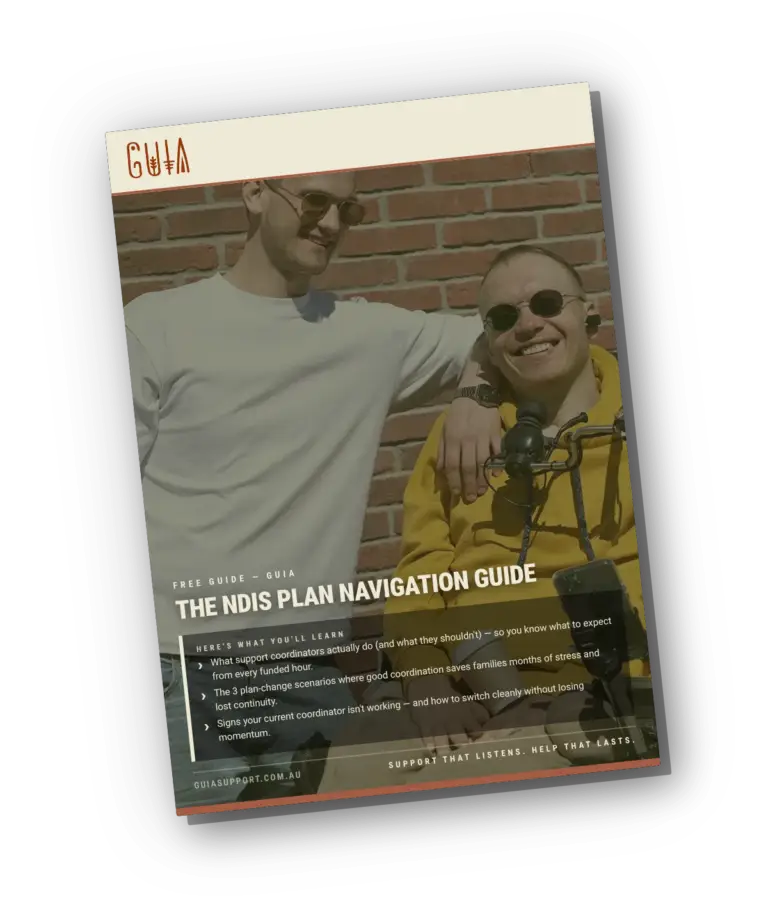
Here's What You'll Learn:
What support coordinators actually do (and what they shouldn't) — so you know what to expect from every funded hour.
The 3 plan-change scenarios where good coordination saves families months of stress and lost continuity.
Signs your current coordinator isn't working — and how to switch cleanly without losing momentum.
ARE YOUR NDIS SUPPORTS WORKING FOR YOU?
GET A FREE NDIS PLAN MANAGEMENT REVIEW