


New NDIS plan: your first 30 days, in order
A new plan arrives and nothing tells you what to do first. Here is the order we work through with families in South West Sydney, and the two mistakes that cost the most.

ARE YOUR NDIS SUPPORTS WORKING FOR YOU?
GET A FREE NDIS PLAN MANAGEMENT REVIEW
Allied health is the therapy part of your plan — occupational therapy, speech pathology, physiotherapy, psychology, dietetics, exercise physiology. It is the money you spend to change something rather than to maintain it, and in Bass Hill it is the budget most often spent on reports that nobody acts on.
There is a practical thing worth knowing before you choose anyone, and almost nobody local has written it down. Since 1 July 2025, therapy providers can only claim half of their price limit for time spent travelling, capped at 30 minutes each way in metropolitan areas — and Bass Hill is metropolitan. The NDIS gives the example of a physiotherapist on a $183.99 hourly limit claiming up to $92.00 an hour for travel. That single change is why fewer therapists will come to your house than would have a year ago, and why some families here have quietly lost a therapist without ever being told why.
The second thing worth knowing is what a registered provider is not allowed to do. The NDIS states plainly that registered providers must not add any other charge to the cost of supports — no gap fees, no credit card surcharges, no additional fees. If someone has asked you for a top-up on top of your plan, that is worth a question.
We are a registered NDIS provider working across South West Sydney. Two thirds of Bass Hill speaks a language other than English at home, and therapy is the support where that matters most, because therapy is almost entirely talking. Our team works across English, Arabic, Vietnamese, Spanish and Auslan, and we bring in accredited interpreters where we do not hold the language.
Allied health is the therapy part of your plan — occupational therapy, speech pathology, physiotherapy, psychology, dietetics, exercise physiology. It is the money you spend to change something rather than to maintain it, and in Bass Hill it is the budget most often spent on reports that nobody acts on.
There is a practical thing worth knowing before you choose anyone, and almost nobody local has written it down. Since 1 July 2025, therapy providers can only claim half of their price limit for time spent travelling, capped at 30 minutes each way in metropolitan areas — and Bass Hill is metropolitan. The NDIS gives the example of a physiotherapist on a $183.99 hourly limit claiming up to $92.00 an hour for travel. That single change is why fewer therapists will come to your house than would have a year ago, and why some families here have quietly lost a therapist without ever being told why.
The second thing worth knowing is what a registered provider is not allowed to do. The NDIS states plainly that registered providers must not add any other charge to the cost of supports — no gap fees, no credit card surcharges, no additional fees. If someone has asked you for a top-up on top of your plan, that is worth a question.
We are a registered NDIS provider working across South West Sydney. Two thirds of Bass Hill speaks a language other than English at home, and therapy is the support where that matters most, because therapy is almost entirely talking. Our team works across English, Arabic, Vietnamese, Spanish and Auslan, and we bring in accredited interpreters where we do not hold the language.
Guia Is Trusted By NDIS Participants, Families And Support Coordinators
Imagine a life designed to empower you!




If it has become harder to find a therapist willing to visit you at home in the last year, you are not imagining it and it is not about you. The rules changed.
From 1 July 2025, therapy providers can claim only half of the relevant price limit for time spent travelling, up to the usual caps. In metropolitan areas — which includes Bass Hill — that cap is 30 minutes each way. The NDIS’s own example is a physiotherapist with a $183.99 hourly price limit who can claim up to $92.00 an hour for travel time. The change applies to therapy providers specifically, not to support workers.
Work through what that means for a suburb like this one. A therapist coming from the inner west or the northern suburbs is now paid half rate for an hour of driving they cannot fully claim anyway. The economics of that visit changed overnight. Nobody sent participants a letter about it. What families experienced instead was a therapist who stopped offering home visits, or a waitlist that got longer, or a service that started insisting on clinic appointments.
There are only three honest responses to this and it is worth knowing which one you are being offered. The first is clinic-based therapy, which is cheaper in travel terms and worse for anyone whose whole point is being assessed in their actual home. The second is telehealth, which is genuinely good for some things — coaching a parent, reviewing progress, most psychology — and useless for others. The third is a therapist who is actually local, where the travel is fifteen minutes rather than fifty and the arithmetic still works.
We are honest about which of those we are offering for any given goal. Where the right answer is a home visit and we cannot make it work, we say so rather than selling you a clinic appointment and calling it the same thing.
This one is short, and it is the single most useful paragraph on this page for anyone who has been asked for extra money.
The NDIS states that registered providers must not add any other charge to the cost of the supports they provide — it names gap fees, credit card surcharges, and any additional fees. If a registered provider has asked you to pay something on top of what comes out of your plan, that is not a grey area.
This matters more in allied health than anywhere else, because therapy is the support where families are most likely to be told that the NDIS rate does not cover the “real” cost and a top-up is normal. It is not normal and for a registered provider it is not permitted.
Two honest caveats, because the picture is not as simple as a slogan. Not every therapist is a registered NDIS provider — plan-managed and self-managed participants can use unregistered ones, and the rules for those are different. And travel is a legitimate charge when it is claimed properly against the plan, at the rates above, and agreed in your service agreement in writing before it appears on an invoice. The thing to look out for is not a travel line. It is a charge to you personally, on top of the plan.
If you are not sure which category something falls into, bring us the invoice. We will tell you what we think even if the provider is not us, and we will tell you when we think the answer is that it is fine.
There is a lot of fear about the NDIS changes starting 1 October 2026, and most of it is aimed at the wrong budget. Here is where allied health actually sits.
From 1 October 2026 the Government is reducing budget allocations for social, civic and community participation supports by 50 per cent, and capacity building daily activity allocations by 10 per cent. It applies as plans are reassessed or renewed, progressively across twelve months. Budgets for critical supports — in-home assistance, home modifications, mobility equipment, specialist disability accommodation — are not being reset. That is the Department of Health, Disability and Ageing’s own wording.
Allied health is capacity building. Therapy aimed at daily living sits in the daily activity category, which is the one being reduced by ten per cent rather than half. That is a meaningfully different picture from community access, and it is worth knowing before you panic or before somebody sells you a panic.
Ten per cent is still ten per cent, and on a therapy budget it is roughly the difference between finishing a block of sessions and stopping two short. The practical response is not to stockpile. It is to make sure each block has a defined end and a written result, so that at reassessment you are arguing from “this achieved that” rather than “we would like to continue”. Open-ended therapy with no stated endpoint is the first thing a delegate reduces, and honestly they are not wrong to.
What we do not know is how the reduction is applied to a plan where therapy is the only capacity building line, or where a block is mid-way. That has not been published. When the operational guidance appears we will read it and tell participants what it says.
Speech pathology in a second language is not speech pathology. Psychology through a relative is not psychology. Occupational therapy where the participant nods because they did not follow the question produces a report that is confidently wrong, and that report then drives a year of funding. This is the single biggest quality problem in allied health in this part of Sydney and it is rarely named.
Our team works across English, Arabic, Vietnamese, Spanish and Auslan. Where we do not hold a language in-house we bring in an accredited interpreter rather than making do. We do not use a family member as the interpreter for a therapy conversation, and we do not use children at all. In therapy that rule is stricter than elsewhere for an obvious reason: the questions are about capability, mood, pain, continence and independence, and those are exactly the answers a relative will soften.
There is a real limitation we will not pretend around. Some standardised assessments are normed on English speakers and administering them through an interpreter changes what the score means. A good therapist says that in the report. A bad one produces a number and lets everyone treat it as fact. If you are handed an assessment with no note about language, that is worth asking about.
Practically, we would rather book a session three weeks later with the right language than a session next Tuesday without it. That is occasionally unpopular and it is still correct.
At the 2021 Census, 33.6 per cent of Bass Hill households spoke English at home, Arabic 30.5 per cent and Vietnamese 10.1 per cent. Allied health is the support where that matters most, because therapy is almost entirely talking.
Speech pathology in a second language is not speech pathology. Psychology through a relative is not psychology. Occupational therapy where the participant nods because they did not follow the question produces a report that is confidently wrong, and that report then drives a year of funding. This is the single biggest quality problem in allied health in this part of Sydney and it is rarely named.
Our team works across English, Arabic, Vietnamese, Spanish and Auslan. Where we do not hold a language in-house we bring in an accredited interpreter rather than making do. We do not use a family member as the interpreter for a therapy conversation, and we do not use children at all. In therapy that rule is stricter than elsewhere for an obvious reason: the questions are about capability, mood, pain, continence and independence, and those are exactly the answers a relative will soften.
There is a real limitation we will not pretend around. Some standardised assessments are normed on English speakers and administering them through an interpreter changes what the score means. A good therapist says that in the report. A bad one produces a number and lets everyone treat it as fact. If you are handed an assessment with no note about language, that is worth asking about.
Practically, we would rather book a session three weeks later with the right language than a session next Tuesday without it. That is occasionally unpopular and it is still correct.
Most Bass Hill families we meet have at least one assessment report they paid for out of their plan and have never used for anything.
A report is not the outcome. It is either the thing that unlocks something — equipment, a home modification, a school adjustment, a stronger case at reassessment — or it is several hundred dollars of your budget spent on a PDF. The difference is almost never the quality of the writing. It is whether anyone was clear at the start about what the report was for.
So we ask before we book. What decision is this report supposed to inform? Who is going to read it? What will they do differently once they have? If nobody can answer, the honest recommendation is usually to spend the money on something else and come back when there is a decision to make.
The reports that earn their place tend to be the boring ones: a functional capacity assessment written specifically for a reassessment; an OT report written to support a specific modification rather than to describe a person in general; a speech report that tells a school exactly what to do on Monday. The ones that do not are the comprehensive overviews commissioned because it seemed like the responsible thing to do.
The same logic applies to therapy itself. A block of sessions with a stated goal and an end date produces something you can point at. Ongoing therapy with no endpoint produces invoices. With capacity building daily activity allocations reducing by ten per cent from October, the second kind is going to be the first thing cut, and it will be cut whether or not it was actually working.
Bass Hill has no railway station. Combine that with therapists travelling less since July 2025 and you get the practical problem that defines allied health here: somebody has to move, and both directions have become harder.
The bus network is the network. Metro Route M91 runs the Parramatta to Hurstville corridor and services this area, and Transport for NSW has been upgrading stops along it, including on Hector Street at Bass Hill. Clinics that sit on that corridor are genuinely reachable. Clinics that need two changes are, realistically, appointments somebody will start missing by the third month.
This is worth deciding deliberately rather than by accident. If a clinic is hard to reach, the options are a closer clinic, telehealth for the parts that suit it, or paying for travel out of core supports rather than losing the therapy. The wrong answer is booking the far clinic anyway and treating the missed appointments as a motivation problem.
Telehealth deserves a straight assessment rather than either enthusiasm or snobbery. It works well for parent coaching, review sessions, most psychology, and anything where the therapist needs to watch rather than touch. It works badly for a first assessment, for anything involving equipment or physical handling, and for anyone who finds video calls hard — which includes a lot of the people it gets recommended to. We will tell you which category your goal falls into.
Where the barrier is genuinely transport rather than therapy, the fix belongs in a different budget. Getting to the appointment is community participation, out of core supports. Keeping those separate on paper is what stops one running dry while the other sits untouched.
Therapy is the support where a year disappears most easily, because sessions happening feels like progress happening.
Four questions. First: what will be different in six months, and how will we know? A therapist who cannot answer that concretely at the start is a therapist who will produce a review in six months describing engagement rather than change. Second: are you registered, and if not, what does that mean for me? Unregistered therapists are legitimate for plan-managed and self-managed participants, but the protections differ and you should be told which situation you are in.
Third: how is travel handled? Since July 2025 therapy travel is claimable at half the price limit within 30 minutes each way in metro areas. That belongs in your service agreement in writing before the first session, not on an invoice afterwards. Fourth: will you tell me when to stop? The good answer is a defined block with an endpoint. The bad answer is enthusiasm about a long journey together.
You should also know that the escalation path is not internal. We are a registered NDIS provider, every worker holds an NDIS Worker Screening Check, and complaints run to the NDIS Quality and Safeguards Commission, not just to us. A provider who presents their own complaints process as the only option is not describing the system accurately.
On price, we will not put figures on this page. Allied health is subject to the NDIS Pricing Arrangements and Price Limits, those limits are revised, and a number here would eventually be wrong and read as a quote. And remember: a registered provider cannot charge you a gap fee on top of the plan.
No comprehensive assessment before anybody knows what it is for. The first conversation is about what you want to be different.
We start with a conversation, in your language, wherever suits — at home, on the phone, or with an interpreter on the line. What we want is one thing you want changed and an honest account of what has been tried. Often what emerges is that the goal is not really a therapy goal at all: it is equipment, or a modification, or a change to how mornings are organised. When that is the case we say so, and we do not bill a therapy block to find it out slowly.
Where therapy is the right answer, it goes in as a block with a stated goal, a number of sessions and an end date. At the end we write down what changed, in specifics, including if the answer is not much. That record is what a reassessment rests on, and it is also what tells us honestly whether to run a second block or stop.
We are straight about what we can and cannot do locally. If the right therapist for your goal is not one of ours, we will say so. If a home visit is what the goal needs and the travel arithmetic does not work for anyone we can find, we will tell you that rather than quietly substituting a clinic appointment.
After the first block it depends on you. Some people want one focused piece of work and nothing more. Some want a slow build over two years. Both are legitimate, and needing less of us is the point rather than a failure of engagement.
What allied health in Bass Hill is actually for.
Support Coordination
The person who turns a plan into working services. Where therapy reports need to reach the right people in time for a reassessment, coordination is usually what makes that happen.
Community Access
Getting to appointments is community participation out of core supports, not therapy budget. Keeping them separate is what stops one running dry while the other sits untouched.
In-Home Daily Living
Help at home with the ordinary parts of the day. Often what a therapy goal actually needs is a change to how mornings are organised rather than another block of sessions.
Employment Support
Finding and keeping work. Where the same physical or communication barrier keeps ending placements, allied health is what moves it rather than working around it forever.
Home Modifications
Changes to the house so it works for you. Usually the thing an occupational therapy report is written to unlock, and on the Government’s list of supports not being reset in October.
Aged Care
For people over 65 and families managing both systems. The rules differ from the NDIS and the wrong assumption costs months.
What allied health in Bass Hill is actually for.
A stated goal, a set number of sessions and a written result. Blocks that finish, not journeys that continue.
We ask what decision the report informs before we book it. If nobody can answer, we say spend the money elsewhere.
English, Arabic, Vietnamese, Spanish and Auslan, with accredited interpreters and a note in the report when it matters.
Why home visits got harder in July 2025, and which of clinic, telehealth or local is honestly being offered.
Registered providers cannot charge on top of your plan. Bring us an invoice you are unsure about, even if it is not ours.
Therapy is capacity building. Getting to the clinic is core supports. Blurring them is how one runs dry in April.
Six reasons Bass Hill families use us for therapy, none of which are awards.
Since July 2025 therapy travel is claimable at half rate, capped at 30 minutes each way in metro. That is why home visits got scarce here, and almost nobody local has told families so.
Therapy is almost entirely talking. We work across English, Arabic, Vietnamese, Spanish and Auslan, and never use a family member — or a child — as the interpreter.
Registered providers must not add gap fees, surcharges or extra charges on top of your plan. Bring us an invoice you are unsure about, even if it is not ours.
A stated goal, a number of sessions, an end date and a written result. Open-ended therapy is the first thing cut at reassessment, and usually fairly.
We are a registered NDIS provider. Every worker holds an NDIS Worker Screening Check and complaints run to the NDIS Quality and Safeguards Commission, not just to us.
Sometimes the goal needs equipment, a modification or a different routine rather than another block. Recommending what we do not bill for costs us hours and saves you a year.
The NDIS Family Decision Guide
What to ask before you commit a therapy budget in Bass Hill.
Here's What You'll Learn:
What a therapist can and cannot charge you
Why home visits got harder in July 2025
How to tell progress from a very tidy report
Finance Manager
Operations Manager
Community Outreach Coordinator
Because the travel rules changed. From 1 July 2025 therapy providers can claim only half the relevant price limit for travel time, capped at 30 minutes each way in metropolitan areas, and Bass Hill is metropolitan. The NDIS example is a physiotherapist on a $183.99 hourly limit claiming up to $92.00 an hour for travel. For a therapist driving from further away the economics of a home visit changed overnight. It is not about you, and nobody wrote to tell participants.
Not if they are a registered NDIS provider. The NDIS states that registered providers must not add any other charge to the cost of supports, and it names gap fees, credit card surcharges and additional fees. Travel claimed properly against your plan and agreed in writing beforehand is different from a charge to you personally on top of the plan. Unregistered providers, which plan-managed and self-managed participants can use, operate under different rules — so the first question is which you are dealing with. Bring us the invoice and we will tell you what we think, even if the provider is not us.
Reduced, not halved. The published changes reduce social, civic and community participation allocations by 50 per cent and capacity building daily activity allocations by 10 per cent, applied as plans are reassessed over twelve months. Allied health is capacity building, so therapy aimed at daily living sits in the ten per cent category rather than the fifty. What has not been published is how the reduction lands on a plan where therapy is the only capacity building line, or where a block is mid-way. We will read the operational guidance when it appears and tell participants what it says.
Our team works across English, Arabic, Vietnamese, Spanish and Auslan, and where we do not hold a language in-house we bring in an accredited interpreter. In therapy we are stricter than elsewhere: we do not use a family member as the interpreter and we never use children, because the questions are about capability, mood, pain, continence and independence — exactly the answers a relative will soften. One honest limitation: some standardised assessments are normed on English speakers, and administering them through an interpreter changes what the score means. A good report says so. If you are handed an assessment with no note about language, ask about it.
We will not put a figure on this page. Allied health is subject to the NDIS Pricing Arrangements and Price Limits, those limits are revised, and a number written here would eventually be wrong and read as a quote. We will work it out with you against your actual plan and the current published arrangements, including what travel can legitimately be claimed and what cannot.
For some things yes, for others no, and the honest answer depends on the goal rather than on principle. Telehealth works well for parent coaching, review sessions, most psychology, and anything where the therapist needs to watch rather than touch. It works badly for a first assessment, for anything involving equipment or physical handling, and for people who find video calls hard — which includes a lot of the people it gets recommended to. Since therapists travel less than they used to, telehealth is being offered more often, so it is worth asking which category your goal is in rather than accepting it as the default.
Possibly, and it is very common. A report is not an outcome — it either unlocks something like equipment, a modification, a school adjustment or a stronger case at reassessment, or it is several hundred dollars of budget spent on a PDF. Before booking another one, the question to ask is what decision it informs, who will read it, and what they will do differently. If nobody can answer, spend the money on something else and come back when there is a decision to make. An existing report is not necessarily dead, though — bring it and we will tell you whether it still supports anything worth pursuing.
Long enough to have a stated goal and short enough to have an end date. What that is depends on the goal, and any therapist quoting a standard number before hearing the goal is quoting their business model. What matters more than the length is that the block finishes with something written down about what changed, including when the answer is not much. With capacity building daily activity allocations reducing by ten per cent from October, open-ended therapy with no stated endpoint is the first thing that gets cut — and honestly, it is usually the right thing to cut.
Then it should stop, and somebody should say so out loud. The failure mode in allied health is not bad therapy — it is adequate therapy continuing for years because sessions happening feels like progress happening. That is why we put an end date and a written result on every block. If a block ends and nothing changed, the options are a different approach, a different therapist, or accepting that this is not where the budget should go. All three are better than a fourth block.
Four things. First, list the therapy you actually received this year with dates and who delivered it. Second, for each block, write what changed — in specifics, and including the blocks where the answer was not much, because that is what tells a delegate you are not simply asking for a renewal. Third, gather anything written by someone other than you or your provider: a school’s account of an adjustment, a GP’s note, an equipment prescription that a report unlocked. Fourth, say what the next twelve months is meant to achieve in one sentence you can repeat.
Capacity building daily activity allocations reduce by ten per cent from 1 October 2026 as plans are reassessed. Ten per cent is roughly the difference between finishing a block and stopping two sessions short, so what you can show about outcomes matters more this year than last. We build that record as the blocks run rather than in the fortnight before the meeting.
Reach out for a non-obligation NDIS Plan Management Assessment
We also provide this support in the nearby suburbs below, or see Allied Health South West Sydney for the full service area.
A new plan arrives and nothing tells you what to do first. Here is the order we work through with families in South West Sydney, and the two mistakes that cost the most.
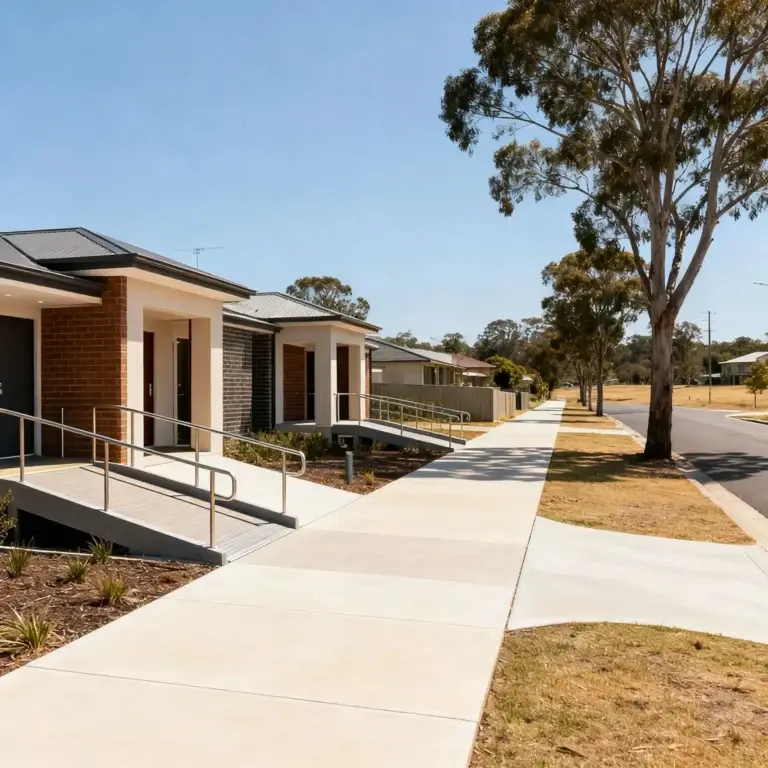
Aged care at home South West Sydney from Guia. Reliable support workers who show up consistently and become part of your family’s everyday routine.

NDIS allied health support sydney from Guia. Reliable support workers who show up consistently and become part of your family’s circle. Peace of mind fo…