


New NDIS plan: your first 30 days, in order
A new plan arrives and nothing tells you what to do first. Here is the order we work through with families in South West Sydney, and the two mistakes that cost the most.


Aged care at home in South West Sydney often hinges on one thing: whether the support worker actually shows up when promised. Families tell us the same worry repeatedly—not about the service itself, but about consistency. When your mum relies on a Tuesday morning visit to help with showering and breakfast, a last-minute cancellation doesn’t just disrupt her routine. It breaks the trust that makes support feel safe. The NDIS—National Disability Insurance Scheme funds personal care and domestic help, but only reliable providers turn that funding into real peace of mind.
Consistency works because it builds predictability into daily life. When the same support worker arrives every week at the same time, your parent knows what to expect. They can plan their day around that visit. The worker learns their preferences—how they like their tea, which chair they prefer, what time suits them best. This familiarity reduces anxiety for both your parent and you. Over time, the support worker becomes less like a stranger and more like part of the routine. That’s when support shifts from feeling transactional to feeling genuinely helpful.
Here’s what that looks like in practice: Guia matches support workers based on fit, not just availability. We roster the same team member to your parent’s home week after week. If your parent needs a Spanish-speaking or Arabic-speaking support worker, we source that match before the first visit. Our staff are qualified, worker-screened, and trained in aged care. When you call to check in or to adjust a visit, you’re speaking to people who know your parent’s name and their story. That’s the foundation of trust—showing up reliably, learning what matters, and treating your parent with the dignity they deserve.
Aged care at home South West Sydney means finding someone reliable to help your mum, dad, or older family member stay in their own home with dignity and support. You’re probably asking: who can I trust to show up consistently? Will they understand what my parent actually needs day-to-day? And how does this fit with My Aged Care funding?
These aren’t small questions. Choosing a support provider for an older person means trusting someone with their safety, their routine, and their independence. You need someone who listens to what matters most—whether that’s helping with personal care, managing the household, or simply being present for a cup of tea and conversation.
What we hear from families is that consistency matters more than anything else. When a support worker cancels last-minute or keeps changing, it breaks the trust your parent has built. They lose confidence. The whole arrangement feels unstable. That’s why reliability isn’t just a nice-to-have—it’s the foundation everything else sits on.
Support at home also means the right cultural and language fit. If your parent speaks Arabic, Spanish, or Auslan, or if they have specific routines and preferences shaped by their background, that needs to be understood and respected from day one. A support worker who gets that isn’t just ticking a box—they’re becoming part of your family’s extended team.
The practical side matters too. Personal care, domestic help, companionship, wellbeing support—these all fit under My Aged Care. But navigating what’s available, what’s funded, and who can actually deliver it consistently in your suburb can feel overwhelming. That’s where clarity and genuine local knowledge make the difference.
Here’s what that looks like in practice. Your mum has a Tuesday afternoon support visit from 2 to 4pm. The support worker arrives on time, lets themselves in with the key you’ve arranged, and starts with a cup of tea together. That ten minutes matters—it’s how they check in on how she’s actually feeling that week.
Next comes personal care. A shower, fresh clothes, and help with grooming. The support worker notices her left shoulder’s been sore and mentions it gently. They don’t rush. They work at her pace, respect her privacy, and treat the whole thing as ordinary—because it’s. After, they help her into the lounge with a light lunch they’ve prepared together: soup, bread, a piece of fruit she actually likes.
While she rests, the support worker tackles the domestic side. Clean sheets on the bed. A load of washing done and folded. The kitchen tidied, the bathroom wiped down, the floor swept. Small things that add up to a home that feels cared for, not chaotic. Nothing gets done without her knowing about it or having a say.
Before they leave, the support worker sits down again. They write a quick note about the week—nothing clinical, just practical. “Mum’s shoulder bothering her. Ate well. Enjoyed the garden chat. ” You get that note. You know what happened. You’re not left guessing or worrying about what you’ve missed.
That’s aged care at home in South West Sydney through Guia. Consistent, dignified, and built around what your mum actually needs week to week. When you’re ready to explore what support might work for your family, enquire about support and we’ll talk through the details at your pace.
Many families think aged care at home support means handing over to a provider and stepping back. That’s not how it works. Support at Home is built on you staying in control of what happens in your parent’s or relative’s home and life.
Here’s the reality. You know your mum’s routines, preferences, and what matters most to her. A support worker’s job is to respect those things and work alongside you, not replace you. Whether it’s personal care, household help, or companionship, the support is tailored to what your family actually needs—not a one-size-fits-all package.
What we hear from families is that the best aged care at home support feels like an extension of the family team. A support worker who shows up reliably, treats your relative with dignity, and communicates with you about how things are going. That means you’re not left guessing. You’re involved in decisions. You can adjust the support if something isn’t working.
The other misconception is that support at home is only for people with major health needs. It’s not. Some older Australians need help with shopping and light housework. Others need personal care and companionship because isolation is affecting their wellbeing. Some need both, some need something in between. My Aged Care funding works the same way—it’s about matching the level of support to what each person actually needs, nothing more.
If you’re researching aged care at home support in South West Sydney, the starting point is always a conversation about what would make life easier for your family right now. When you’re ready to explore what that could look like, enquire about support with Guia and we’ll walk through the options together.
Support at Home is practical, everyday help that lets older Australians stay in their own home while getting the assistance they need. It covers personal care, domestic help, companionship, and wellbeing support—all funded through My Aged Care, not the NDIS.
Here’s what that looks like in practice; a support worker might help with showering, dressing, or toileting in the morning. They might prepare meals, do laundry, or tidy the house. They might accompany you to medical appointments, help with shopping, or simply sit and talk over a cup of tea. The support is tailored to what you actually need, not a one-size-fits-all package.
It’s worth knowing that Support at Home does NOT include nursing care, medication management by a nurse, or therapy that requires clinical qualifications. If your parent or relative has complex health needs, those sit outside home care support—though a good provider will help you understand what does and doesn’t fit, and connect you to the right services.
The real value is consistency and trust. When the same support worker shows up at the same time each week, your mum or dad knows what to expect. They build a relationship. Routines stay steady. And you, as a family member, get peace of mind knowing someone reliable is there. That matters, especially if you’re juggling work, your own family, and caring from a distance.
In South West Sydney, where many families speak Arabic, Spanish, or English at home, language match between the support worker and the older person makes a real difference. It’s not just about translation—it’s about feeling understood and comfortable in your own home.
If you’d like to explore what Support at Home could look like for your parent or relative, we’re here to talk through your situation without pressure. Enquire about support and we’ll help you work out the next step.
Support at Home (Aged Care) is funded differently from NDIS supports. If your family member is over 65 and eligible for My Aged Care, their funding comes through that scheme, not the NDIS. It’s worth knowing the difference so you understand what’s available and how it works in practice.
My Aged Care assessments look at what your family member needs day-to-day: personal care, household help, meal preparation, or companionship. The assessment determines their support level, and funding is allocated accordingly. You then choose a provider — like Guia — to deliver that care at home. The key difference from NDIS is that NDIS supports are plan-based and participant-directed, while My Aged Care funding is assigned to specific support needs and managed through the aged care system.
Here’s what that looks like in practice: your family member might receive two support visits per week — say, a Tuesday morning for personal care and a Friday afternoon for household tasks. Those hours are funded through My Aged Care. A support worker trained in aged care shows up consistently, on time, and knows your family member’s routines and preferences. There’s no pressure to “use it or lose it” — the focus is on what actually helps them stay safe, connected, and independent at home.
Choice and control still matter. You and your family member choose which provider delivers the support. You can change providers if the fit isn’t right. You can adjust the support plan if needs change — if mobility becomes harder, or if your family member wants more social connection. The support worker is there to help with dignity and respect, not to rush through tasks.
If your family member is under 65 and eligible for the NDIS instead, the funding and planning work differently. Either way, the goal is the same: reliable, person-centred support that helps them stay well at home. When you’re ready to explore what’s available, we’re here to answer your questions and help you understand your options.
When you’re arranging aged care at home in South West Sydney, it’s worth knowing exactly where your control starts and stops. This clarity protects both you and your older family member. It also stops confusion down the track about what support can and can’t do.
Here’s what’s genuinely your call to make:
You direct the shape of the support. A good provider listens to what you’ve identified as priorities and builds the schedule around those. If your mum needs help with showering on Tuesday and Thursday mornings, and shopping on Friday afternoon, that’s the agreement you make. If routines shift, you adjust it together.
Here’s what sits outside this support’s scope:
Support workers notice changes — a fall, reduced appetite, confusion — and report them to you so you can act. But they don’t diagnose or prescribe; that boundary keeps everyone safe and clear about roles.
If you’re looking for a provider who respects your authority over these decisions and communicates openly about what’s possible, we’re here to help. Guia has supported older Australians across South West Sydney for two years. All our staff are qualified and worker-screened.
When you’re ready to talk through what aged care at home might look like for your family member, enquire about support. No pressure — just a conversation about what matters most.
Support at Home (Aged Care) sits within your My Aged Care plan, not your NDIS plan — but it’s worth understanding the difference. If your older family member receives NDIS support already, aged care services run alongside it. They cover personal care, domestic help, and companionship for people over 65 (or 50+ for Aboriginal and Torres Strait Islander Australians).
The clearest signal you need aged care at home support is when daily tasks become harder to manage alone. That might look like struggling with showering and dressing, keeping the house clean, or preparing meals safely. It might mean your mum needs help with medication reminders or someone to chat with on lonely afternoons. These are exactly the things aged care support workers are trained to help with — with dignity and respect for how your family member likes things done.
Another common starting point is when you’re doing most of the physical care yourself and it’s becoming unsustainable. If you’re a spouse or adult child handling personal care, household tasks, and emotional support all at once, that’s a sign professional help would ease the load for both of you. Aged care at home support isn’t about replacing family — it’s about making family time feel less strained by everyday survival tasks.
You might also notice your family member withdrawing from activities they used to enjoy because they’re tired from managing daily life alone. A support worker visiting twice a week for personal care and light housework can free up energy for the things that matter — a coffee with a friend, time in the garden, or just feeling less overwhelmed.
If any of these situations sound familiar, it’s worth exploring whether aged care at home support could fit your family’s needs. When you’re ready to talk through your situation, enquire about support with Guia. We’ll listen to what’s happening and help you understand what’s possible.
Margaret is a 74-year-old woman living alone in Bass Hill. She’s independent by nature and wants to stay in her own home. After a fall last year, she needed help with personal care and household tasks. Her daughter researched aged care at home South West Sydney and found Guia through a local support coordinator’s recommendation.
What mattered most to Margaret was consistency; she didn’t want different support workers arriving each week. Guia matched her with two regular support workers who visit on set days. One comes Monday mornings for personal care and a shower. The other visits Thursday afternoons to help with laundry, light cleaning, and grocery shopping. Both workers know Margaret’s routines, her preferences, and what she can do independently.
Within weeks, Margaret felt less anxious about managing alone. She knew exactly when her support workers would arrive. They treated her as someone in control of her own home, not as someone being “looked after”. When Margaret’s daughter rang to check in, Margaret could focus on their conversation instead of worrying about unpaid bills or a full laundry basket.
The support is funded through My Aged Care, not the NDIS. Guia’s team helped Margaret’s daughter understand the difference and navigate the assessment process. Now Margaret has the help she needs while maintaining her independence and dignity. Her daughter knows the support workers are qualified, screened, and reliable.
If you’re caring for an older family member and wondering whether aged care at home could work for them, a complimentary assessment is the best starting point. Our team will listen to what matters most—whether that’s consistency, cultural fit, or specific help with daily tasks—and explain what support might look like in practice. When you’re ready, enquire about support and we’ll arrange a time that suits you.
Support at home for older Australians is funded through My Aged Care, not the NDIS. The funding model works differently from disability support, and it’s worth understanding how it flows so you can plan with confidence.
My Aged Care assigns you to a support level based on an assessment of your needs. That level determines how many hours of support you’re entitled to each week. A support worker’s time is then charged against those approved hours. The actual cost depends on the provider you choose and the specific tasks — personal care, domestic help, companionship, or a mix of all three.
Here’s what that looks like in practice: if you’re approved for ten hours weekly, and you use eight hours for personal care and two for household tasks, those eight and two hours are drawn from your allocation. Different providers price their services differently within the My Aged Care framework, so it’s worth comparing what’s available in South West Sydney before you commit.
Some families find there’s a gap between the hours approved and the hours they actually need. If that’s your situation, you might choose to pay for additional support out of pocket, or adjust the mix of tasks to fit within your allocation. It’s a practical conversation to have with your support coordinator or the aged care provider themselves.
Guia’s team can walk you through how your approved hours translate into real weekly support. We’re transparent about costs and what’s included, so there are no surprises when support starts. When you’re ready to explore what aged care at home in South West Sydney could look like for you or your family member, we’re here to answer your questions in plain language.
When you contact Guia about aged care at home support, the first call is straightforward. We’ll ask about your parent or older family member—what they need help with day-to-day, whether that’s personal care, household tasks, or companionship. We listen for what matters most to them and to you; there’s no pressure, no long forms to fill out on the phone.
After that initial chat, we arrange a home visit within a week. This is where we meet your family member in their own space. We talk through their routine, their preferences, any health or mobility considerations. We also get to know you—what you’re hoping support will look like, what worries you might have. This visit helps us understand the real picture, not just the paperwork.
Once we’ve done that assessment, we match a support worker to your family member. We think carefully about this—considering language, personality fit, experience with their particular needs. If you’re Arabic-speaking, Spanish-speaking, or prefer an Auslan-trained worker, we make that happen. We believe the right match makes all the difference to how support actually feels day-to-day.
Before the first support visit, we brief the worker thoroughly. They’ll know your family member’s routine, preferences, any health notes, and what you’ve asked for. On that first day, the worker arrives on time—that’s non-negotiable for us. They’ll introduce themselves properly, check in on how your family member’s feeling, and start the support plan you’ve agreed on together.
Throughout this process, you’re in control. You ask questions at any point. You decide whether Guia is the right fit. If you’d like to move forward or want to know more about how this works in practice, get in touch with us and we’ll walk you through the next step at whatever pace suits you.
Choosing the right aged care at home provider in South West Sydney means asking the right questions upfront. A good provider will answer clearly and honestly; here’s what matters most to families.
At Guia, consistency and dignity are non-negotiable. We match support workers carefully, honour routines, and show up reliably. Our team is qualified, screened, and trained in aged care. When you’re ready to explore support that feels like a genuine fit, enquire about support with us today.
Finding the right aged care support provider in South West Sydney means knowing what to watch for. Some providers look good on paper but show warning signs once support starts. Here’s what to notice.
Guia operates differently. We’re NDIS-registered and Code of Conduct compliant, with all staff qualified and worker-screened. Our multilingual team — English, Spanish, and Arabic — means cultural fit isn’t an afterthought. We match support workers thoughtfully and show up reliably, every time. When you’re ready to explore aged care at home South West Sydney with a provider you can trust, enquire about support.
When aged care at home support is working well, you’ll notice it in the small, steady things. The same support worker arrives on Tuesday and Thursday mornings, knows your parent’s routine, and doesn’t need to ask where the tea towels live. That consistency matters more than you might think. It builds trust, reduces anxiety, and means your parent isn’t explaining their needs to a different person every week.
Communication flows both ways. The support worker checks in regularly about how things are going, listens when you raise a concern, and lets you know what happened during their visit. You might hear, “Your mum seemed a bit tired today, so we kept the outing short,” or “She’s been asking about her garden. ” This keeps you in the loop without treating you as a bystander in your parent’s own life.
Your parent’s priorities are steering the support, not the other way around. If they want to spend their support time doing the garden rather than deep-cleaning, that’s what happens. If they’d rather have help with cooking than shopping, the plan adjusts. You’ll notice they’re more engaged, more willing to use the support, because it’s built around what matters to them, not what a checklist says they should be doing.
Practical outcomes show up too; your parent is managing their personal care with dignity and confidence. The house runs smoothly without becoming a source of stress. They’re connecting with their community or spending time on hobbies they enjoy. And crucially, you’re not fielding crisis calls or feeling like you’re the only person holding things together.
If you’re seeing these signs—consistency, real communication, your parent’s agency respected, and genuine progress—the support is working. If you’re not, that’s worth raising with your provider. When you’re ready to explore aged care at home support in South West Sydney, enquire about support with Guia.
Not every match works out, and that’s okay. If the support you’re receiving isn’t meeting your mum’s or dad’s needs, you have real options. The key is knowing what steps to take and understanding that you’re in control of the decision.
Start with the provider directly; talk to your support worker or their manager about what isn’t working. Be specific: if visits are running late, if the worker doesn’t speak your language, or if the support doesn’t fit your parent’s routine, say so. Many issues get sorted quickly once the provider knows. If feedback doesn’t lead to change, ask for a different support worker who might be a better fit.
If direct conversation doesn’t help, escalate within the provider; ask to speak with a manager or supervisor about your concerns. They have options—different workers, adjusted visit times, or tailored approaches—that might resolve things without needing to change providers entirely.
You also have the right to switch providers. My Aged Care allows you to change your support provider if the current arrangement isn’t working. There’s no penalty for moving to a provider who understands your parent’s needs better. Here’s what that looks like in practice: you contact your new provider, they work with My Aged Care to manage the transition, and your support continues without a gap.
If you’ve raised concerns and nothing changes, you can lodge a formal complaint with the NDIS Quality and Safeguards Commission. They investigate complaints about registered providers and take breaches of the NDIS Code of Conduct seriously. This is your safety net when other avenues haven’t worked.
At Guia, we believe aged care at home in South West Sydney should feel reliable and respectful. If you’re thinking about a change and want to explore what a different provider might offer, we’re here to talk through it—no pressure, just honest conversation about what your parent actually needs.
If you’ve been researching aged care at home South West Sydney, you’ve probably noticed how much depends on finding the right fit. Not just someone who shows up, but someone who understands your parent or older relative as a person—their routines, their preferences, what makes them feel secure.
That’s where a discovery conversation can help. Rather than making assumptions about what support might look like, we start by listening. What does a typical week look like for your family member right now? Where are the gaps—the mornings that feel rushed, the household tasks piling up, the moments when you wish you had an extra pair of hands? What matters most to them about staying at home?
From there, we can talk through what support at home actually looks like in practice. Personal care, domestic assistance, companionship, transport to appointments—whatever sits within your My Aged Care plan. We’ll also be honest about what we can and can’t do, and how our team works. You’ll know upfront that we’re NDIS-registered, all our support workers are qualified and worker-screened, and we match people carefully based on personality and need, not just availability.
Many families find that simply talking through the options—without pressure—takes away a lot of the worry. You’ll have a clearer sense of what’s possible, what it costs, and whether we’re the right provider for your situation.
Whenever you’re ready, enquire about support and we’ll arrange a time to chat. No obligation, no sales pitch—just a straightforward conversation about what your family member needs and how we might help.
A new plan arrives and nothing tells you what to do first. Here is the order we work through with families in South West Sydney, and the two mistakes that cost the most.

NDIS allied health support sydney from Guia. Reliable support workers who show up consistently and become part of your family’s circle. Peace of mind fo…

Multilingual aged care from Guia. Reliable support workers who show up consistently in South West Sydney. Family-centred care where caregivers become pa…
The My Aged Care Home Support Guide
How to access Australian Government funded home care for an older family member — without losing months to waitlists or guessing at packages.
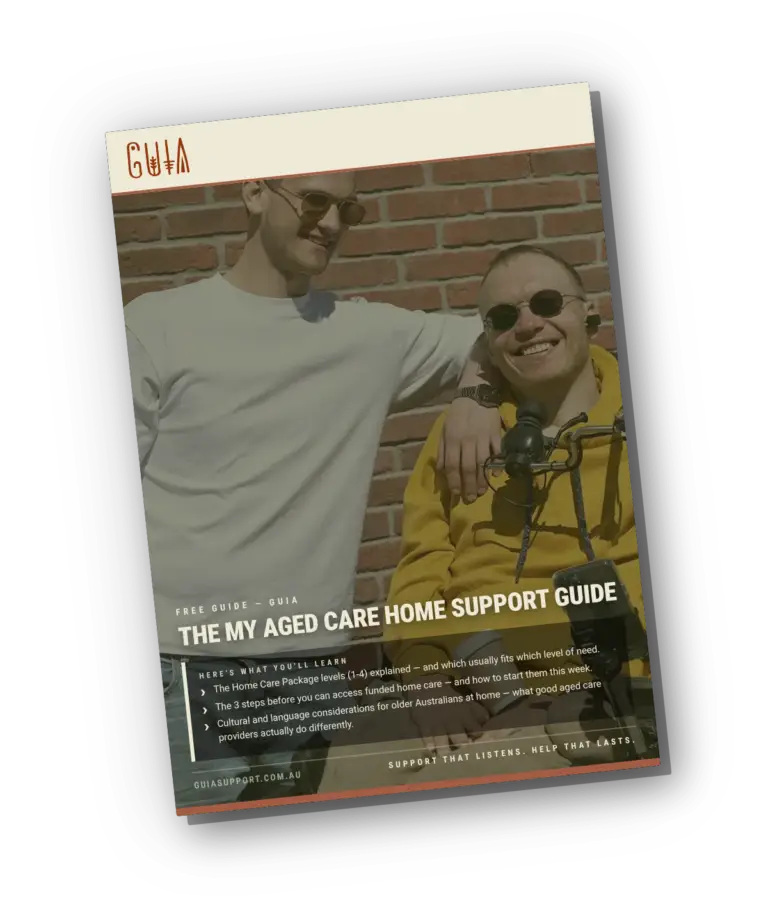
Here's What You'll Learn:
The Home Care Package levels (1-4) explained — and which usually fits which level of need.
The 3 steps before you can access funded home care — and how to start them this week.
Cultural and language considerations for older Australians at home — what good aged care providers actually do differently.
ARE YOUR NDIS SUPPORTS WORKING FOR YOU?
GET A FREE NDIS PLAN MANAGEMENT REVIEW