


New NDIS plan: your first 30 days, in order
A new plan arrives and nothing tells you what to do first. Here is the order we work through with families in South West Sydney, and the two mistakes that cost the most.


NDIS employment support works best when it starts with understanding what’s actually holding your family member back — not just “they need a job”, but whether it’s confidence on the first day, navigating workplace routines, managing sensory or social demands, or building the specific skills an employer needs. Many families worry a support provider will disappear mid-way through, leaving your relative stranded. That fear is real, because inconsistency damages trust faster than almost anything else. The NDIS scheme itself funds employment assistance, but only if the provider you choose shows up reliably and knows how to match support to the actual job.
Employment and capacity building addresses this by pairing your family member with a support worker who stays consistent across the entire journey. That worker doesn’t just drop them at the workplace gate. They understand the specific role, the employer’s expectations, and your relative’s individual strengths and triggers. They’re there on day one, day thirty, and beyond — building confidence through repetition and familiarity. The mechanism is simple: trust compounds over time, and trust only builds when the same person shows up, on time, every time.
Here’s what that looks like in practice. You meet with us first to understand what matters most — whether that’s a particular industry, flexible hours, or a workplace culture that feels safe. We then match your family member with a support worker who fits that picture, and that worker becomes part of your extended team. You’re not starting from scratch with someone new every fortnight; you’re building on something solid. That consistency is how real confidence grows, and how employers see your relative as reliable too.
NDIS employment support helps participants build the skills, confidence, and real pathways to work or greater independence. But what does that actually mean for your family member, and how does it fit into their NDIS plan?
The honest truth is that work looks different for everyone. For some, it means paid employment in a mainstream workplace. For others, it’s voluntary work, a small business, or building the daily living and social skills that make independence feel possible. What matters is what your family member actually wants—not what anyone else thinks they should do.
What we hear from families is worry about consistency and follow-through. You need a support provider who shows up reliably, who listens to what your son or daughter is telling them, and who treats them as capable. Not someone who disappears after a few weeks or treats your family member as a project rather than a person with real goals and real agency.
Here’s what that looks like in practice: NDIS employment support with Guia means a support worker who gets to know your family member over time. They work together on job-readiness, interview skills, workplace routines, or whatever skills matter most. They stay alongside them once they’re in a role, helping them settle and troubleshoot real problems as they come up. If your family member speaks Arabic, Spanish, or uses Auslan, we match them with a support worker who shares that language—because communication and cultural fit actually matter.
It’s worth knowing that employment support is one part of a bigger picture. It often works best alongside community participation, daily living skills, or support coordination—all things we offer. Your family member’s NDIS plan will tell you what’s funded and what’s available to you.
If that sounds like the kind of support you’re after, here’s what happens next: Enquire about support and tell us a bit about what your family member is hoping for. We’ll talk through what’s realistic, what your plan covers, and how we’d work with you both.
Here’s what that looks like in practice. Your son or daughter meets with a Guia employment support worker every Tuesday afternoon at 2pm. The worker arrives on time, knows the family routine, and brings a folder with notes from the week before.
This week, they’re working through a job application together. The support worker sits at the kitchen table, reads the position description aloud, and asks questions that help your family member think through whether the role fits their strengths. “What time would you start? How would you get there? ” They’re not answering for them—they’re helping them answer for themselves. That’s the difference between doing it for someone and building their confidence to do it themselves.
After an hour, they’ve drafted three key points your family member wants to mention in a cover letter. The support worker types them up, prints two copies, and leaves one on the fridge; next week they’ll practice how to talk about these points in a phone interview. Small, steady steps. No pressure.
Between visits, if something comes up—a question about the application deadline, a worry about the interview—your family member knows they can message the worker. That consistency matters. You’re not starting from scratch with someone new each week. The same person learns how your family member thinks, what motivates them, what sensory or routine changes throw them off.
NDIS employment support through Guia means building real skills and real confidence over time. Not rushing toward a job that won’t stick; not abandoning someone after they start. Just steady, person-centred support that treats your family member as capable of more than they might believe right now.
If that sounds like the kind of support you’re after, enquire about support and we’ll talk through what employment support could look like for your family.
Many families think NDIS employment support means helping their family member land a job as quickly as possible. The real picture is broader and more personal than that.
Employment & Capacity Building isn’t just about job placement. It’s about building the skills, confidence, and independence your family member needs—whether that leads to paid work, volunteer roles, or greater autonomy in daily life. Some participants want competitive employment. Others are exploring what’s realistic for them. Some need to build foundational skills first: managing a routine, communicating with a supervisor, handling sensory demands of a workplace.
Here’s what that looks like in practice. A young autistic adult might start with work-readiness support—learning to travel independently to a training location, understanding workplace expectations, practising interview skills. Another participant might focus on life skills that build toward independence: budgeting, meal planning, managing appointments. A third might combine both: part-time employment alongside support to strengthen daily living routines at home.
The key is that your family member’s goals lead the way, not a preset timeline. You’re not paying for a job outcome. You’re investing in the skills and confidence that make your family member feel more in control of their own life. That might mean employment. It might mean something else entirely.
When you’re ready to explore what employment support could actually mean for your family member, we can walk through their situation without pressure. We’ll listen to what matters to them and to you, then match them with a support worker who understands their pace and their goals. If you’d like to talk through what’s possible, enquire about support and we’ll take it from there.
Employment & Capacity Building through the NDIS is practical support that helps participants build the skills, confidence, and pathways toward work or greater independence. It’s not about pushing anyone into a job they don’t want. It’s about exploring what’s possible, at the pace that works for them.
This support includes job-readiness training, help finding and securing work that suits your goals, ongoing workplace support once you’re employed, and life skills that build independence day-to-day. It also covers transition support through major life changes—leaving school, moving into your first job, or shifting into a new role as circumstances change. A support worker might help you practise interview skills, navigate workplace routines, or work through challenges with a new employer.
What it does NOT include: clinical therapy, medical diagnosis, or treatment recommendations. Those sit outside NDIS employment support. If a participant needs allied health—like speech therapy or psychology—that’s a separate NDIS support category, not part of Employment & Capacity Building.
Here’s what matters for families: this support respects your family member’s choice and control. The goal is to build their confidence and independence over time, not to force outcomes. A good employment support provider listens to what your family member actually wants to do, not what fits an easy funding box. They show up consistently, they’re honest about what’s realistic, and they treat your family member as a capable adult, not a project.
At Guia, we match participants with support workers who understand their goals and their communication style. Many of our team speak Spanish or Arabic, which matters if that’s how your family member feels most at home. If NDIS employment support sounds like the kind of help you’re after, we’re here to talk through what that could look like for your situation.
Enquire about support whenever you’re ready. No pressure, no timelines.
NDIS employment support sits within your family member’s plan as either a Core Support or a Capacity Building Support, depending on what they’re working towards. The difference matters because it shapes how the funding works and what your support worker can help with.
Core Supports cover ongoing assistance with daily activities and participation. If employment is part of their everyday life right now, employment-related support may sit here. Capacity Building Supports, by contrast, fund supports that build skills and independence over time — like job-readiness training, workplace confidence, or learning how to manage a new role. Both can include NDIS-funded employment assistance tailored to the participant’s goals.
Here’s what that looks like in practice. A young autistic adult might use Capacity Building funding to work with a support worker on interview skills and workplace communication over three months. Once they’re in a job, ongoing employment support — like check-ins with their manager or help managing shifts — could be funded as a Core Support. The funding categories aren’t rigid; they reflect the participant’s stage and what they need right now.
Your family member (or you, if you’re supporting them) chooses how the funding is used. That’s the principle of choice and control at the heart of the NDIS. You’re not locked into one type of support or one provider. If employment support isn’t working, you can redirect that funding. If they need more hours as they settle into a job, you can adjust the plan at review.
What families often ask is: “How do we know if this funding is enough? ” That depends entirely on the participant’s goals, the job, and the support they actually need. A support worker who knows them well can help you figure out what’s realistic and what the NDIS will cover. That’s where honest conversation matters more than chasing a funding number.
When you’re building NDIS employment support for your family member, it helps to know exactly what’s in your hands and what sits outside the support. Here’s what that looks like in practice.
What’s your call to make:
These choices are yours. A good NDIS employment support provider listens to what matters most to your family and builds the plan around that, not the other way around.
What sits outside this support:
At Guia, we’re here to build your family member’s confidence, skills, and independence — at their pace, on their terms. We show up consistently, respect their choices, and treat them as the capable adult they are. When you’re ready to talk about what NDIS employment support could look like for your family, enquire about support and we’ll walk through it together, no pressure.
Employment & Capacity Building sits in your NDIS plan under “Assistance with Life Stage Transition”. It’s there to help your family member build work skills, confidence, and pathways toward employment or greater independence — whatever that looks like for them.
Here’s what that looks like in practice. If your family member is leaving school and thinking about work but feels unsure where to start, or if they’ve been out of the workforce and want to rebuild confidence, Employment & Capacity Building is designed for exactly that. A support worker helps them explore what kind of work suits them, practise interview skills, or work through the practical steps of getting a job.
You might recognise the need if your family member is struggling with daily routines that get in the way of work — things like managing time, getting ready on schedule, or handling the sensory or social demands of a workplace. That’s where capacity building comes in. It’s not therapy; it’s practical, everyday support that builds real skills over time.
Another signal is if they’ve been offered a job or volunteer role but need someone to help them settle in, understand workplace expectations, or troubleshoot when things feel overwhelming. Many employers are genuinely willing to work with support workers who know the participant well and can help bridge those early weeks.
It’s worth knowing that you don’t have to wait for a plan review to check whether this is already funded in your family member’s current plan. Many plans include it from the start. If it’s there and you’re not using it, that’s worth a conversation with your support coordinator. If it’s not there and you think it should be, a plan review can add it. Either way, the first step is the same: enquire about support and tell us what your family member’s goals are. We’ll help you work out what fits.
An autistic adult in her late twenties had been out of work for three years. Her family worried she’d lost confidence. She had skills—attention to detail, reliability, a genuine interest in systems—but the sensory overwhelm of a standard workplace felt impossible. Her NDIS plan included employment support, but she didn’t know where to start.
Her support coordinator referred her to Guia. We matched her with a support worker who understood autism and workplace adjustment. Together, they mapped what mattered: a role with minimal fluorescent lighting, predictable routines, and a manager willing to learn about her communication style. No pressure to fit into someone else’s idea of “normal work.
Over four months, she and her support worker explored three local employers. They visited each workplace during quiet hours, checked sensory conditions, and talked through what reasonable adjustments might look like. When she found a role in a small office doing data quality checks, her support worker helped her prepare—scripts for the first week, a quiet space to decompress at lunch, a contact person if she felt overwhelmed.
Six months in, she’s still there. Not because she “overcame” anything, but because the support was practical and her employer was genuinely willing. Her family notices she talks about her work. She has money in her account. She feels in control of her week. NDIS employment support worked because it focused on what she actually needed, not what support providers assumed she should want.
If your family member is thinking about work but doesn’t know how to begin, that’s exactly where NDIS employment support starts. When you’re ready to explore what’s possible, enquire about how we match support to your situation.
NDIS employment support sits within your plan’s Core Supports budget. The NDIS uses a price guide to set support rates — what a support worker’s time costs per hour depends on their qualifications, the type of support, and where it happens. Employment assistance, job-readiness coaching, and workplace support all fall under this structure.
Here’s what that looks like in practice. Your support coordinator works with you and your family to identify employment goals in your plan. You then choose a provider — like Guia — and we match you with a support worker experienced in job preparation or ongoing workplace support. The hours allocated come straight from your Core Supports funding. There’s no separate “employment fund” — it’s part of your overall plan budget.
The NDIS doesn’t set a fixed amount for employment support. Instead, your plan reflects the hours and support type you actually need. That might be six hours a week of job-readiness coaching, or two hours weekly for ongoing workplace advocacy once you’re in a role. Your support coordinator helps calculate this based on your goals and circumstances, not on arbitrary limits.
What we hear from families is that clarity matters most; you want to know exactly what’s funded and what isn’t. If your plan includes employment support, those hours are yours to use. If you need additional support beyond what’s allocated — say, extra coaching during a workplace transition — that’s a conversation to have with your coordinator about plan adjustments or gap funding options.
When you’re ready to explore how employment support could work for your family member, we can walk through your plan together and show you exactly how the funding sits. There’s no pressure, no jargon — just honest conversation about what’s possible and what happens next.
Many autistic adults and people with other neurodivergent profiles notice that certain work environments feel impossible, while others click immediately. A noisy open office might overwhelm one person; another thrives there but struggles with unpredictable schedules. That’s not a weakness. It’s real information about what kind of work actually suits you.
When we talk about NDIS employment support, we’re looking at the whole picture. Sensory sensitivities — bright lights, background noise, strong smells — matter as much as the actual job tasks. So do cognitive patterns: whether you need routines to feel steady, how you process instructions, whether you work better with written checklists or face-to-face check-ins. A good employment support worker notices these things and uses them to find roles that play to your strengths, not against them.
Here’s what that looks like in practice. Instead of pushing you toward “any job available,” we start by understanding what environments and routines help you feel confident and focused. If you’re an autistic adult who needs quiet, structured tasks, we won’t match you with a fast-paced customer service role. If you work best with clear visual systems and minimal social demands, we’ll explore roles that offer that. The goal is fit — not just employment, but employment that feels sustainable and lets you actually do the work well.
Cultural and linguistic fit matters too. If you’re more comfortable communicating in Arabic, Spanish, or Auslan, your support worker should speak that language. That’s not a nice-to-have; it’s how you feel genuinely supported and understood during the working day.
When you’re ready to explore employment support that respects how you actually think and work, enquire about support with Guia. We’ll have a straightforward conversation about what matters to you, then match you with someone who gets it.
Choosing the right NDIS employment support provider matters. Your family member deserves someone reliable, respectful, and genuinely invested in building their confidence and skills. Ask these questions before you commit.
At Guia, we answer every one of these honestly. We match support workers thoughtfully, show up consistently, and treat every participant as capable. We’re NDIS-registered, all staff are qualified and screened, and we speak English, Spanish, and Arabic. When you’re ready to explore what genuine employment support looks like, enquire about support.
When you’re choosing NDIS employment support, it helps to know what consistent, reliable support actually looks like. Some providers talk the talk but don’t follow through in ways that matter to your family member’s real working life.
At Guia, we match support workers thoughtfully and show up consistently. We listen first to what your family member actually wants from work, then build skills and confidence step by step. Our team speaks English, Arabic, and Spanish. When you’re ready to explore NDIS employment support that treats your family member as capable and deserving of respect, enquire about support.
Good NDIS employment support shows itself in small, steady ways. The first sign is consistency—the same support worker arrives on the agreed day and time, week after week. Your family member knows what to expect. They’re building trust with someone who understands their pace, their communication style, their goals. That matters more than you might think.
The second sign is real communication flowing both directions. It support worker checks in with you regularly—not just about what’s happening, but asking what matters to your family member right now. Are they still interested in the same kind of work? Has something changed at home that affects their readiness? A good provider listens and adjusts, rather than sticking rigidly to an original plan.
You’ll also notice your family member having more say in what happens next. They’re not being pushed toward jobs that don’t fit them. Instead, the support is built around their interests, strengths, and what independence actually means to them. Maybe that’s paid work. Maybe it’s volunteering. Maybe it’s building confidence in a specific skill first. The point is, their priorities are leading the way.
Finally, watch for real progress on things your family member cares about; not vague promises—concrete steps. They’ve attended three job interviews. They’ve learned how to use the bus to get to a workplace. They’re more confident talking about what they can do. They’re earning money, or they’re closer to it than they were three months ago. These are the outcomes that matter to families, and they’re what good employment support actually delivers.
If you’re seeing most of these signs, the support is working. If you’re not, it’s worth having a conversation about what needs to shift. When you’re ready to explore NDIS employment support that gets these basics right, enquire about support with Guia.
Not every family finds the right fit with their first support provider. That’s normal. If NDIS employment support isn’t working the way you hoped, you have real options—and you don’t need to accept a poor match or give up on the service altogether.
Start with your support worker or the team at Guia directly. A quick conversation about what isn’t landing can often shift things fast. Maybe the timing of visits needs adjusting, or the support worker’s communication style doesn’t click with your family member. These are fixable. Most good providers, including Guia, listen to that feedback and act on it.
If talking to the support worker doesn’t help, ask to speak with a manager. They can look at the bigger picture—whether a different worker might be a better match, or whether the support plan itself needs reshaping. This isn’t confrontational; it’s how the system is meant to work. You’re directing your own support and choosing who delivers it.
You can also request a different support worker from the same provider. Cultural and linguistic fit matters—if your family member works better with a Spanish-speaking or Auslan-trained support worker, say so. Guia’s multilingual team means those options exist in South West Sydney.
If the provider itself isn’t meeting your needs, you can switch. Your NDIS plan belongs to you, and you can change providers whenever it makes sense. There’s no penalty for moving on.
For formal concerns about how a provider is operating, the NDIS Quality and Safeguards Commission handles complaints and investigates breaches of the NDIS Code of Conduct. That’s a backstop if informal conversations don’t resolve things.
The point is simple: you’re in control. If employment support isn’t working, that’s information. Act on it. When you’re ready to explore options or talk through what might work better, reach out.
You’ve been researching NDIS employment support for a while now. Maybe your son or daughter has been out of school for a couple of years. Maybe they’ve tried a few things that didn’t quite fit. Or maybe you’re just starting to think about what work or greater independence could look like for them. Whatever your situation, the pace is yours.
What we hear from families is that the right support makes all the difference. Not someone who shows up once and disappears. Not a programme that treats everyone the same. Real support means a worker who learns what your family member actually wants to do, who shows up consistently, and who treats them as a capable adult with real goals.
Here’s what that looks like in practice with NDIS employment support through Guia. We match your family member with a support worker who fits—someone who speaks their language if needed, understands their communication style, and genuinely believes in their capacity. We work on job-readiness skills, help them explore real work options in South West Sydney, and provide ongoing support once they’re in a role. We also build broader life skills and independence—things that matter whether work happens or not.
We’re NDIS-registered and our team is qualified, worker-screened, and trained in person-centred support. We’ve been operating for two years, and we’ve built our approach on lived experience of disability and family caregiving. That means we get the complexity. We don’t promise overnight outcomes. We work at your family member’s pace.
When you’re ready to explore what employment support could look like for your family, enquire about support and we’ll have a conversation with no pressure. If it feels like a fit, we’ll take it from there. If not, you’ll have clarity either way.
A new plan arrives and nothing tells you what to do first. Here is the order we work through with families in South West Sydney, and the two mistakes that cost the most.

Aged care at home South West Sydney from Guia. Reliable support workers who show up consistently and become part of your family’s everyday routine.

NDIS allied health support sydney from Guia. Reliable support workers who show up consistently and become part of your family’s circle. Peace of mind fo…
The Capacity Building and Employment Pathway Guide
How NDIS Capacity Building and Employment Support work together to build real job-ready skills — for adults with disability who want to work.
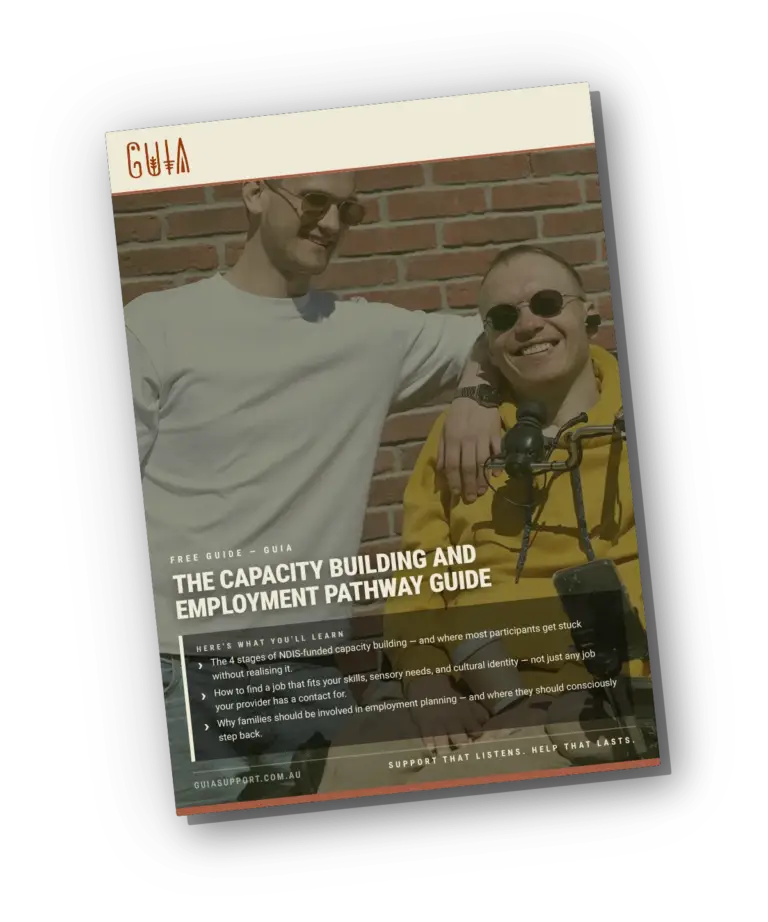
Here's What You'll Learn:
The 4 stages of NDIS-funded capacity building — and where most participants get stuck without realising it.
How to find a job that fits your skills, sensory needs, and cultural identity — not just any job your provider has a contact for.
Why families should be involved in employment planning — and where they should consciously step back.
ARE YOUR NDIS SUPPORTS WORKING FOR YOU?
GET A FREE NDIS PLAN MANAGEMENT REVIEW