
NDIS support for Deaf and hard of hearing South West Sydney
NDIS support for Deaf and hard of hearing South West Sydney
Support workers fluent in Auslan for Deaf and hard of hearing South West Sydney
NDIS support for Deaf and hard of hearing South West Sydney
NDIS support for Deaf and hard of hearing South West Sydney
Support workers fluent in Auslan for Deaf and hard of hearing South West Sydney
ARE YOUR NDIS SUPPORTS WORKING FOR YOU?
GET A FREE NDIS PLAN MANAGEMENT REVIEW
NDIS support for Deaf and hard of hearing South West Sydney means access to support workers and coordinators who understand your communication needs as central to everything else. If you’re Deaf or hard of hearing and directing your own NDIS plan, you deserve providers who listen—literally and figuratively. If you’re a family member or carer, you need to know that the support your loved one receives will respect their independence while giving you the consistency and safeguards that matter to you both.
This page walks through how we support Deaf and hard of hearing participants across South West Sydney—from daily living support to community access, employment pathways, and plan navigation. Our team includes Auslan-trained and multilingual support workers, and we’ve been NDIS-registered since 2022. Below, you’ll find what support looks like in practice, how we match you with the right worker, and how to get started when you’re ready.
NDIS support for Deaf and hard of hearing South West Sydney means access to support workers and coordinators who understand your communication needs as central to everything else. If you’re Deaf or hard of hearing and directing your own NDIS plan, you deserve providers who listen—literally and figuratively. If you’re a family member or carer, you need to know that the support your loved one receives will respect their independence while giving you the consistency and safeguards that matter to you both.
This page walks through how we support Deaf and hard of hearing participants across South West Sydney—from daily living support to community access, employment pathways, and plan navigation. Our team includes Auslan-trained and multilingual support workers, and we’ve been NDIS-registered since 2022. Below, you’ll find what support looks like in practice, how we match you with the right worker, and how to get started when you’re ready.
The NDIS Family Decision Guide
Helping Australian families make confident NDIS decisions for the person they care about — without the jargon, the runaround, or the regret.
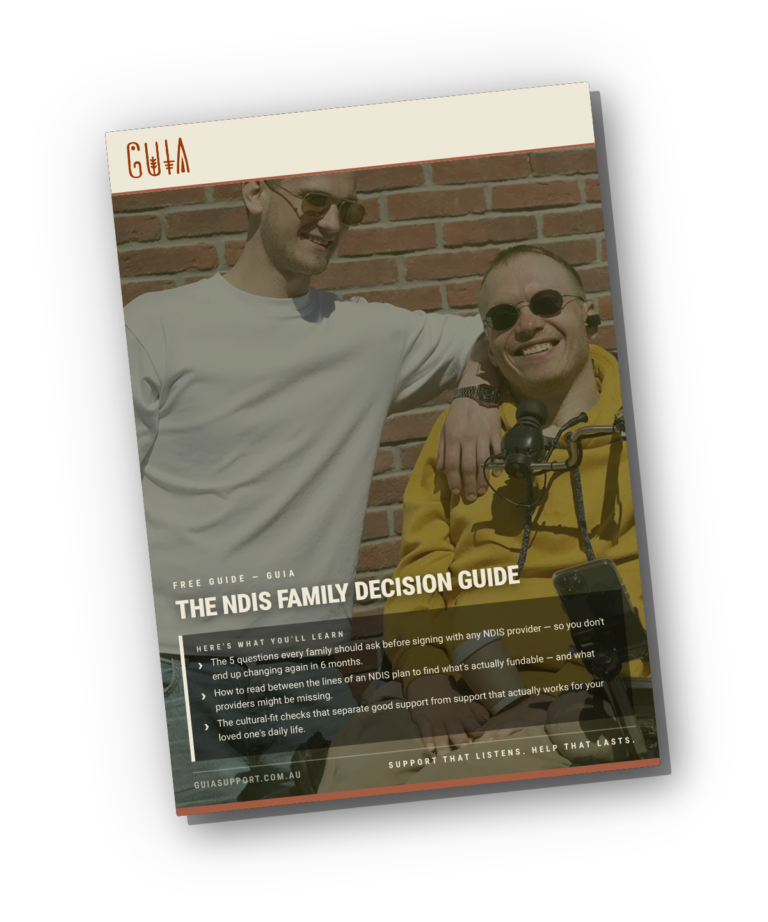
Here's What You'll Learn:
The 5 questions every family should ask before signing with any NDIS provider — so you don't end up changing again in 6 months.
How to read between the lines of an NDIS plan to find what's actually fundable — and what providers might be missing.
The cultural-fit checks that separate good support from support that actually works for your loved one's daily life.
NDIS support for Deaf and hard of hearing in South West Sydney
Communication goes both ways when you’re Deaf or hard of hearing, but too many support providers treat it as a one-way delivery. You make a decision about your life, your family member has concerns about continuity and safety, and the support worker shows up without Auslan or the skills to bridge that gap. That’s not support—that’s a transaction that leaves everyone frustrated.
When your support worker speaks your language—literally—everything shifts. You can direct your own day without relying on family to interpret. Your family member sees consistency and genuine communication, not a workaround. That’s the foundation for real independence and trust to grow.
Read More - Want to see what good support looks like
When you’re Deaf or hard of hearing, communication barriers don’t just make conversations awkward—they shape which providers you can trust. Many families searching for NDIS — National Disability Insurance Scheme support worry that providers won’t understand the specific communication needs their family member relies on. You deserve support workers who speak your language—literally and culturally. That’s not a nice-to-have; it’s the foundation of dignified, effective help.
Auslan-using support workers aren’t an afterthought for us—they’re standard; when your support worker can sign fluently, every interaction feels natural. You’re not waiting for an interpreter, repeating yourself, or managing someone else’s discomfort with your communication style. For families, this means real peace of mind: your loved one can direct their own day without you needing to be the bridge between them and their support. That independence is what good support actually builds.
Written and visual communication runs through everything we do. Phone calls become text check-ins. Appointment reminders include pictures and diagrams, not just words. Video calls with captions, appointment cards with visual icons, support plans that use photos alongside text—these aren’t extras. They’re how we make sure information lands clearly the first time. When communication is clear, decisions happen faster, anxiety drops, and you spend less energy clarifying and more time actually living.
Deaf culture awareness across our team means we get the social and community side, not just the logistics. We understand that connection matters as much as practical help. That’s why our approach to community access and social participation starts with what you actually want to do—not what we think you should do. Our support workers know Deaf community spaces, events, and networks across South West Sydney. They’re trained to support your independence in those spaces, not manage you through them. Over time, NDIS — Finding and Keeping a Job and NDIS — Social and Community Participation compound naturally alongside Deaf and hard of hearing — together they build the daily rhythm and outward connections that make real independence stick.
If you’re ready to explore what this kind of support looks like for your situation, we’re here to talk it through at your pace. No pressure, no jargon—just a straightforward conversation about what matters to you and your family.
What good support looks like for Deaf people
Communication at work, at home, or in the community shouldn’t depend on whether your support worker knows Auslan. Yet many Deaf and hard of hearing participants find themselves explaining their needs repeatedly, or relying on family members to bridge gaps that shouldn’t exist in the first place. That friction costs time, independence, and dignity.
When your support worker communicates in the way that works for you—whether that’s Auslan, written English, or a combination—something shifts. You’re not managing the conversation; the support is; your family can step back from being the translator and focus on being family. That’s the difference between support that fits around your life and support you have to fit yourself into.
Read More - Come talk through what could work for you
Communication that meets you where you are — not where a provider assumes you should be — changes everything. When you’re Deaf or hard of hearing, finding support that doesn’t force you to translate your own needs or repeat yourself constantly matters deeply. Your family member watching this unfold needs to know the provider genuinely understands Deaf communication, not just tolerates it. Under the NDIS — National Disability Insurance Scheme, you have the right to support that matches how you actually communicate — whether that’s Auslan, written English, visual supports, or a combination. That’s not a nice extra. That’s the baseline.
Here’s what that baseline looks like in practice. You get matched with support workers trained in Auslan as standard — not as an afterthought or special request. Your family member doesn’t become the interpreter between you and your support provider. Every appointment, every form, every conversation has a clear communication plan built in from the start. Written information arrives in accessible formats; video calls include captions or Auslan interpretation. The small detail that changes everything is this: the provider meets you halfway, so you don’t spend your energy managing their confusion about how you communicate best.
Deaf culture and communication preferences shape how support actually works day-to-day. Some participants prefer Auslan-only workers. Others want a mix of Auslan and spoken English with visual supports. Your family member might need to understand your communication choices too — not to gatekeep them, but to support your independence with confidence. A provider that builds this into their matching process, rather than treating it as a special accommodation, recognises that your communication style isn’t a barrier to overcome. It’s part of who you are and how you work best. That recognition shifts everything about how dignified and effective the support feels.
The practical side matters equally. When you’re looking at in-home daily living support or community access and social participation, the team needs to understand Deaf-specific communication needs and cultural context. Your family member needs to see that consistency — the same worker showing up regularly, trained properly, and able to communicate with you directly without intermediaries. This is where person-centred matching makes a real difference; you’re not assigned a support worker and told to make it work. You’re matched to someone whose communication skills and Deaf awareness actually fit your needs. That takes planning, but it’s the only way support feels reliable and respectful. Over time, NDIS — Finding and Keeping a Job and NDIS — Social and Community Participation compound naturally alongside Deaf and hard of hearing — together they build the daily rhythm and outward connections that make real independence stick.
If this kind of support — where your communication is the starting point, not the problem to solve — sounds like what you’re after, let’s talk through what’s possible for your situation. Your family member can be part of that conversation too, if you’d like. There’s no rush and no pressure. When you’re ready, Enquire about support.
What happens when support workers don't understand Deaf communication
Communication support that actually matches how you communicate is rare in NDIS. Many Deaf and hard of hearing participants find themselves paired with support workers who don’t use Auslan, forcing you to adapt to their communication style instead of them adapting to yours. For your family, that means worrying whether your loved one is truly understood, or whether they’re just nodding along to keep things moving.
When a support worker signs fluently, or when they’re trained to communicate clearly with someone who is hard of hearing, everything changes. You’re no longer managing the gap between how you communicate and how support is delivered. Your family can trust that conversations are actually happening, not being approximated. That shift—from accommodation to genuine connection—is where real independence starts.
Read More - See exactly what consistent support could look like for you both
When you’re Deaf or hard of hearing, communication isn’t just about hearing words—it’s about being understood in the way that works for you. Many NDIS providers default to spoken English and written notes, leaving you to bridge the gap yourself. That places the burden of adaptation on you, not on the support system. The NDIS — National Disability Insurance Scheme funds support that should meet you where you are, with workers trained in your communication preference—whether that’s Auslan, written English, visual supports, or a combination. At Guia, Auslan-using support workers are standard, not an afterthought.
Here’s what that shift looks like in practice. Instead of arriving at a support session and negotiating how to communicate, your support worker shows up ready to sign, write, or use whatever method you’ve identified as your preference. No fumbling for pen and paper. No repeating yourself three times. No feeling like you’re the one managing the conversation. Your family sees the same consistency—the same worker, the same communication approach, every visit. That reliability builds trust fast, and it means your family can step back from being the translator and let the professional support do its job.
Communication access is only part of what good support looks like for Deaf and hard of hearing adults. You also need workers who understand Deaf culture—the values, the community, the rhythm of how you prefer to live. That cultural awareness shapes everything from how a support worker approaches a social outing to how they help you connect with Deaf community events in South West Sydney. Your family benefits too: they can see that the support isn’t just ticking boxes, it’s honouring who you are. Personal care and daily living support, community access and social participation, and employment assistance all work better when the worker understands your world, not just your disability.
The practical setup is straightforward. You and your family meet to discuss what communication works best and what your goals are. We then match you with a support worker trained in your preferred method and familiar with Deaf culture. Whether you need help with daily tasks, getting out into the community, or building toward work, the foundation stays the same: communication that’s accessible, reliable, and respectful. Your family stays informed every step, and you stay in control of your own decisions. Over time, NDIS — Finding and Keeping a Job and NDIS — Social and Community Participation compound naturally alongside Deaf and hard of hearing — together they build the daily rhythm and outward connections that make real independence stick.
How NDIS support actually works for Deaf people
Communication in the workplace, at home, or in the community should never depend on someone else translating for you. When you’re Deaf or hard of hearing, finding support workers who use Auslan or understand your communication needs as standard—not as an afterthought—changes everything about independence and dignity.
You should be able to direct your own support without having to explain your needs repeatedly or wait for an interpreter to be arranged. When the right support is in place across South West Sydney, you move through your day as yourself—making decisions, connecting with people, and building the life you want without barriers in between.
Read More -Get in touch about Deaf and hard of hearing support in your area
Get in touch about Deaf and hard of hearing support in your area
Communication that actually works is the foundation of good support. When you’re Deaf or hard of hearing, finding an NDIS provider who speaks your language—literally and culturally—changes everything. You need support workers trained in Auslan, or comfortable with written communication, or both. Your family needs confidence that every interaction respects how you communicate best, not how the provider finds easiest. That’s not a nice-to-have. It’s the difference between feeling heard and feeling managed. NDIS — National Disability Insurance Scheme funding exists to remove barriers. The right provider removes the communication barrier first.
Here’s what that looks like in practice. An Auslan-using support worker doesn’t just translate your words—they understand Deaf culture, the rhythm of how you move through your day, and what independence actually means to you. A support worker trained in visual communication uses written notes, diagrams, and clear demonstrations when that’s what works best. Your family sees consistency across visits. No guessing. No repeating yourself. No feeling like you’re the one managing the provider instead of the other way around; that shift builds real confidence on both sides.
Deaf and hard of hearing participants often tell us the same thing: most providers treat communication as an add-on, not a foundation. They hire a general support worker and expect you to adapt. The mechanism is simple—if communication isn’t built in from day one, everything else becomes harder. Daily living support takes longer. Community outings feel stressful. Employment pathways stall because nobody’s bridging the communication gap. When you start with a provider who gets this, those barriers dissolve. Support becomes about what you need, not what the provider assumes.
We match you with support workers who are Auslan-trained, or experienced with written and visual communication, depending on what fits your life. Your family gets a clear picture of how each visit will work—what communication methods are in place, who’s coming, and how we’ll stay connected if anything changes. We offer Community Access & Social Participation support that includes transport and companions who understand how to communicate with you in group settings. We also provide Employment & Capacity Building support tailored to your communication style, so work isn’t held back by the provider’s limitations. Over time, NDIS — Finding and Keeping a Job and NDIS — Social and Community Participation compound naturally alongside Deaf and hard of hearing — together they build the daily rhythm and outward connections that make real independence stick.
How Deaf and hard of hearing support actually works
Communication is the foundation of independence. When you’re Deaf or hard of hearing, finding support workers who sign fluently or understand your communication needs isn’t a nice extra—it’s essential to feeling heard, respected, and in control of your own decisions.
Real support means your family sees you making choices about your own life, not being managed around. Auslan-trained support workers, consistent scheduling, and someone who shows up understanding what you need before you have to explain it again—that’s when both you and your family can relax, knowing the support is built around how you actually communicate and live.
Read More - Get in touch when you're ready to explore what works for your situation
Communication that works both ways is not a luxury—it’s the foundation of real support. When you’re Deaf or hard of hearing, finding an NDIS provider that speaks your language means more than translation. It means a support worker who understands Auslan fluently, or who can write clearly and check understanding with you visually, or who knows how to use relay services without making you feel like a bystander in your own life. The NDIS — National Disability Insurance Scheme funds support that should be accessible from day one—not adapted later because the provider didn’t plan for it.
Here’s what that looks like in practice. An Auslan-using support worker doesn’t just sign what needs to be said—they understand Deaf culture, communication preferences, and the specific context of your daily life. Your family member sees a support worker who treats you as the decision-maker, not as someone to be managed around. Written information arrives before appointments. Visual communication is built in, not bolted on. The small shifts—a support worker check-ing in with you directly, not through an interpreter or a family member—change how much control you actually have over your own life.
Consistency matters because trust builds slowly. When you work with the same support worker week after week, they learn your communication style, your preferences, and what matters to you without needing to ask the same questions repeatedly. Your family member knows who’s coming, when they’re coming, and that they’ll show up on time—no last-minute cancellations that leave you scrambling. That reliability is not about being nice; it’s about respecting your time and your plan. It’s the difference between support that fits your life and support you have to fit yourself around.
The services that work best for Deaf and hard of hearing participants often combine everyday support with community connection. Personal care and daily living support keeps your home life running smoothly—someone who understands your communication needs handling personal care with dignity. Community access and social participation opens doors to activities where you feel included, not just present. Both services are stronger when the team knows Deaf culture and has the communication skills to match. That’s not NDIS support; that’s support built for how you actually live. Over time, NDIS — Finding and Keeping a Job and NDIS — Social and Community Participation compound naturally alongside Deaf and hard of hearing — together they build the daily rhythm and outward connections that make real independence stick.
When you’re ready to explore what good support looks like, start by naming what matters most to you. Do you want an Auslan-using support worker, or written communication with visual backup? How important is cultural understanding to your family? What does consistency look like in your week? Guia has been supporting Deaf and hard of hearing participants across South West Sydney since 2022, with staff trained in Auslan and Deaf-culture awareness built into how we work.
How to know support is making a real difference
When a Deaf or hard of hearing person is choosing their NDIS support, what matters most is whether the support worker can actually communicate with them—not just in passing, but reliably, every visit. You need to know that your support worker speaks your language fluently, whether that’s Auslan, spoken English with clear communication strategies, or a combination both of you have agreed works. Your family needs the same confidence: that communication breakdowns won’t derail your independence or leave gaps in continuity.
The right support worker doesn’t just show up—they show up ready to listen and be understood. When communication flows naturally, you’re not spending energy explaining yourself or managing misunderstandings. Your family isn’t left guessing what happened during a support visit or worrying whether instructions were clearly heard. That clarity is what lets real independence grow, because you can focus on what matters instead of the effort of being understood.
Read More - Start with a quick chat about what consistent support looks like
When you’re Deaf or hard of hearing, communication isn’t just about sound—it’s about access to the same choices, information, and dignity everyone else expects. Many NDIS providers treat communication as an afterthought: a box to tick rather than a foundation for real support. What we hear from families is that they’ve often had to repeat themselves, advocate constantly, or accept lower-quality support because the provider couldn’t or wouldn’t meet communication needs. NDIS — National Disability Insurance Scheme funding exists to remove these barriers, not to work around them. That’s where the difference starts.
Here’s what that looks like in practice: Auslan-using support workers aren’t a specialty add-on at Guia—they’re part of how we match participants to the right person from day one. If you use Auslan, you get a support worker trained in Deaf culture and communication, not someone learning on the job. For participants who prefer written communication, visual schedules, or a mix of approaches, we build those into every interaction. Your family member isn’t left guessing what happened during a support visit because communication is clear, documented, and accessible to everyone involved.
The mechanism matters here. When communication works properly, three things shift at once. First, you—the participant—can actually direct your own support instead of relying on someone else to interpret your needs. Second, your family gets real visibility into what’s happening, which builds confidence that the support is reliable and respectful. Third, the support worker can respond to what you actually want rather than what they assume you need. This isn’t about making things easier for the provider. It’s about you having genuine control and your family having genuine peace of mind.
We support participants across South West Sydney who’ve spent years with providers who didn’t get this. Some have moved from daily living support to Community Access & Social Participation because communication finally worked well enough to build real connections. Others have stepped into Employment & Capacity Building because they could actually tell someone what they wanted to do next. The timeline depends on your situation—there’s no rush—but the pattern is consistent: when communication is solid, everything else becomes possible. We’re NDIS-registered and Code of Conduct compliant, with staff who are qualified, screened, and trained in Deaf awareness as standard practice. Over time, NDIS — Finding and Keeping a Job and NDIS — Social and Community Participation compound naturally alongside Deaf and hard of hearing — together they build the daily rhythm and outward connections that make real independence stick.
If you’re looking for support that speaks to you directly—not about you—and keeps your family informed without making them the middleman, that’s the kind of NDIS support for Deaf and hard of hearing we provide. When you’re ready to explore what this could look like for you or your loved one, Enquire about support.
Building confidence and independence over time
Communication is the foundation of everything—work, relationships, independence, planning your week. When support workers don’t use Auslan or don’t understand Deaf culture, that foundation cracks. You’re either translating constantly, or relying on family to be in the room for conversations that should be yours alone. Neither feels like support.
Auslan-using support workers change that. You can talk directly, without translation delays or someone else interpreting your meaning. Your family can step back from being the bridge between you and every service. That shift—from gatekeeper to genuine support—is where real independence starts to feel possible.
Read More - Start a conversation about what consistent support could mean for you both
Communication breakdowns between you and your support provider can quietly erode the independence you’re building. When a provider assumes speech or doesn’t have Auslan fluency, you’re forced to manage the conversation instead of directing your own support. Your family watches this happen and feels the tension—they want you empowered, but they’re also worried about whether your actual needs are being heard. NDIS support for Deaf and hard of hearing participants works differently when the provider meets you where you communicate. This means Auslan-using support workers as standard, not as an accommodation you have to request. It means written and visual communication options built into every interaction—from planning a support visit to discussing changes to your goals. The NDIS — National Disability Insurance Scheme funds support that removes these communication barriers entirely, not manages them.
Here’s what that looks like in practice. You contact us to discuss what you need. An Auslan-trained support worker arrives on time, every time, ready to communicate in your language. If you prefer written communication or a mix of both, that’s how we work. Your family member isn’t translating or managing the conversation—they’re observing support that respects your authority over your own life. This shift matters more than it sounds. When communication flows naturally, you can focus on what actually needs doing: the household tasks, the daily living support, the community access you’ve planned. Your family feels the difference too. They’re not the bridge between you and your provider. They’re your supporters, not your interpreters.
Deaf culture awareness across our team means we understand the difference between deafness as a medical condition and Deafness as identity and community. This distinction shapes how we work with you. It affects how we listen to what independence means to you—not what a NDIS plan says it should mean. It shapes how we build relationships with you over time, not treat each visit as a transaction. Your family benefits from this too. They see a provider who respects your identity and your choices, not someone trying to fix or manage your deafness. That consistency and cultural respect is what builds confidence in the support itself.
When you’re ready to explore what good support looks like, the practical next step is straightforward. We match you with a support worker whose communication skills and Deaf-culture awareness align with your needs. We offer in-home daily living and personal care support, community access and social participation, and support coordination to help you navigate your NDIS plan with confidence. Your family can ask questions about consistency, safeguards, and how we handle changes. You can ask about your actual day-to-day experience—what you’ll do, how decisions get made, what happens if something needs adjusting. Both conversations matter equally. Over time, NDIS — Finding and Keeping a Job and NDIS — Social and Community Participation compound naturally alongside Deaf and hard of hearing — together they build the daily rhythm and outward connections that make real independence stick.
We’ve been supporting Deaf and hard of hearing participants across South West Sydney since 2022, NDIS-registered and Code of Conduct compliant, with all staff qualified and worker-screened. We built this team on lived experience of disability and family caregiving. We know what it feels like to want support that treats you as a capable adult, not a project. When you’re ready to talk about what support could look like for you or your family member, Enquire about support.
How to get started with Guia
Deaf and hard of hearing adults know what they need to communicate clearly and participate fully. Your family knows too. But many NDIS providers treat communication support as an add-on rather than a foundation, leaving you managing the gap between what’s offered and what actually works for you.
When your support worker understands Auslan, or can read and write with you fluently, everything shifts. You’re not translating your own needs; your family isn’t coaching every interaction. You’re free to focus on the work, the outing, the conversation itself—not the effort of being understood. That’s the kind of NDIS support for Deaf and hard of hearing South West Sydney that builds real independence and trust.
Read More - Start your conversation with our Deaf and hard of hearing support team
Communication that works for you — not against you — is the foundation of good support. When you’re Deaf or hard of hearing, finding an NDIS provider who understands this isn’t a nice-to-have. It’s essential. Guia’s team includes Auslan-using support workers as standard, alongside written and visual communication options for every interaction. This means your support worker arrives already fluent in your preferred way of communicating. No delays. No guessing. No relying on family members to translate or interpret what should be a direct conversation between you and the person supporting you. The NDIS — National Disability Insurance Scheme funds support that enables independence — and that starts with communication you can trust.
What this looks like in practice is straightforward. You meet with a support worker who speaks your language — whether that’s Auslan, spoken English with clear visual supports, or written communication. Your family sees a provider who talks directly to you about what you need, rather than treating your family member as the decision-maker by default. That shift matters more than it sounds. It means you stay in control of your own life. Your family gets to step back from being the constant interpreter or advocate and instead becomes a trusted advisor who’s there if you want them. That’s the difference between support that empowers you and support that creates dependency.
Deaf culture awareness runs through everything we do — not as a checkbox, but as part of how our team thinks. This means understanding that being Deaf isn’t a barrier to overcome. It’s a way of being that shapes how you communicate, connect, and navigate the world. Your support worker won’t treat you as someone with a problem to fix. They’ll treat you as someone with specific communication needs and preferences that deserve respect. When your family sees this approach in action, the relief is real. You’re not being managed. You’re being supported in a way that honours who you are.
The practical side matters just as much. Whether you need help with daily living tasks, community access, or building work-related skills, having a support worker who communicates fluently with you means fewer misunderstandings and more consistency. You know what to expect. Your family knows you’re being heard and understood. We support participants across South West Sydney with in-home daily living support, community access and social participation, and employment and capacity building — all delivered by workers trained in Deaf-culture awareness and equipped with the communication tools you use every day. Over time, NDIS — Finding and Keeping a Job and NDIS — Social and Community Participation compound naturally alongside Deaf and hard of hearing — together they build the daily rhythm and outward connections that make real independence stick.
When you’re ready to explore what good support actually looks like, we’re here to answer your questions — whether you’re the person receiving support or the family member making sure the right fit is in place. We’ve been supporting Deaf and hard of hearing participants since 2022, we’re NDIS-registered, and our team is built on lived experience of disability and family caregiving. That means we get the complexity. We get what matters.
Guia Is Trusted By NDIS Participants, Families And Support Coordinators
Imagine a life designed to empower you!

NDIS Participants South West Sydney Choose Guia
When you’re looking for NDIS support for Deaf and hard of hearing people in South West Sydney, you need a provider who understands your communication needs first. Guia’s team includes Auslan-trained support workers and coordinators who know how to listen—literally and practically. We’ve worked with Deaf and hard of hearing participants and their families since 2022, learning what actually works: reliable workers who show up on time, respect your way of communicating, and help you stay in control of your own decisions. That’s the difference between support that fits your life and support you have to fit into.
Person-Centred From the First Conversation
You know what matters most to you—and we start there; we listen first, then build support around your goals and pace, not ours. Our team includes Auslan-trained support workers who understand deaf culture and communication preferences. Every visit is shaped by what you actually want from your day. That means your priorities stay front and centre, and your support feels personal from the first conversation.
Reliable Consistency Every Single Visit
Deaf and hard of hearing participants and families need consistency to build trust with their support worker. The same person, same time, every week means no repeating your communication needs. No new faces learning your routines. Your schedule stays predictable because we show up reliably, so you can plan your week with confidence.
Culturally Diverse, Multilingual Team
When you’re Deaf or hard of hearing, communication matters more than most. Our team includes Auslan-trained support workers and multilingual staff who speak English, Spanish, and Arabic. You get someone who understands your culture, your communication needs, and your world—not just your support plan. That means real connection from day one, and support that actually fits your life.
Six Years of South West Sydney Experience
Finding a support provider who understands Deaf culture and community takes time. We’ve been embedded in South West Sydney since 2022, building real relationships with Deaf networks, local services, and social spaces. Your support worker isn’t a stranger—they’re connected to your community from day one. That means better local knowledge, genuine cultural match, and support that fits your actual life, not just the hours on paper.
NDIS Quality and Safeguards Commission Compliant
When you’re Deaf or hard of hearing, you need support workers who understand your communication needs—not just tolerate them. Every Guia support worker holds current NDIS Worker Screening clearance and is trained in your preferred communication method. We’re registered and audited to NDIS standards, which means accountability is built in. You get consistent, qualified support that respects how you communicate.
Word-of-Mouth Referrals Build Trust
Families who support Deaf and hard of hearing participants often find us through other families who’ve been there. That word-of-mouth trust matters because it means you’re choosing a provider who’s already proven themselves with people like you. Our multilingual team—including Auslan-trained support workers—understands what accessibility actually looks like. When you’re ready to explore support, that reputation gives you confidence you’re in steady hands.
READY FOR A FREE PLAN MANAGEMENT REVIEW?
Find Unused Funding
Fix Budget Confusion
Plan Supports Better
FAQs For Deaf and hard of hearing
Can NDIS funding cover Auslan interpretation for Deaf participants?
Yes, NDIS funding can cover Auslan interpretation as part of your support plan. If Auslan access is written into your plan, it’s a funded support you can use. We work with Deaf participants across South West Sydney to ensure communication access is built in from the start.
Here’s what that looks like in practice: your support plan lists Auslan interpretation as a support item, and we help coordinate qualified interpreters for appointments, community activities, or support visits. You’re in control of how and when it’s used. Families often ask about consistency—we match you with interpreters who know your communication style, so support feels reliable and personal over time.
Enquire about support — find out how Guia can help with Deaf and hard of hearing.
What assistive technology does NDIS fund for Deaf adults?
The NDIS funds assistive technology that supports Deaf and hard of hearing participants to communicate, work, and participate in community. This includes hearing aids, cochlear implants, captioning systems, visual alert devices, and Auslan interpretation services. What you can access depends on your individual plan and goals.
If you’re a Deaf or hard of hearing adult in South West Sydney, your support worker will help match the right technology to how you actually live day-to-day. If you’re a family member, we recognise you often coordinate these decisions—we work with both of you to make sure equipment is installed properly, maintained reliably, and genuinely used. When you’re ready, we can walk through what’s funded and what makes sense for your situation.
Enquire about support — find out how Guia can help with Deaf and hard of hearing support.
How can NDIS support help Deaf adults continue studying?
NDIS support can help Deaf adults continue studying through funded assistance tailored to your communication needs. This includes Auslan interpreters, note-takers, specialist tutoring, and assistive technology. Support coordinators help you plan how study funding fits your overall goals.
What we hear from Deaf adults and their families is that consistency matters most. You need the same interpreter showing up reliably, understanding your study routine and preferences. Our team in South West Sydney includes Auslan-trained support workers who can help with study sessions, campus access, and connecting you to other Deaf students. Your family can trust that we match you with someone who gets both your communication style and your study goals.
Enquire about support — find out how Guia can help with Deaf and hard of hearing.
How do support workers help Deaf family members communicate together?
Support workers trained in Auslan and deaf communication help Deaf family members connect on their own terms. They work with you and your family to find what communication works best—whether that’s Auslan, lip-reading support, or written communication. NDIS support for Deaf and hard of hearing in South West Sydney recognises that communication is personal and different for every person.
Here’s what that looks like in practice: a support worker might help facilitate conversations between family members, ensure everyone’s understood during appointments or outings, or simply be present so communication happens without strain. You stay in control of how and when support happens. Your family gets the confidence that communication barriers won’t get in the way of connection and safety. When you’re ready to explore what support could work for your situation, we’re here to listen and match you with someone who gets it.
Enquire about support — find out how Guia can help with Deaf and hard of hearing.
What life skills and employment support can my NDIS plan fund?
Your NDIS plan can fund employment support and life skills training tailored to your goals. This includes job-readiness, workplace support, and ongoing advocacy. For Deaf and hard of hearing participants in South West Sydney, we match you with support workers trained in Auslan and deaf-aware communication.
Here’s what that looks like in practice: a support worker might help you prepare for interviews, navigate workplace adjustments, or build confidence in new settings. Families often appreciate knowing that support is consistent, reliable, and respects your independence as the decision-maker. We work with you both to build skills at a pace that feels right.
Enquire about support — find out how Guia can help with Deaf and hard of hearing.
How do I find Deaf-friendly community activities and transport?
We help Deaf and hard of hearing participants find community activities and transport that work for them. Our NDIS support for Deaf and hard of hearing in South West Sydney includes Auslan-trained support workers who can accompany you to group activities, social outings, and help with accessible transport options that suit your communication needs.
What we hear from families is that consistency matters—knowing the same support worker will show up, understand your communication preferences, and help you build real connections in your community. We match you with a support worker who gets Deaf culture and accessibility, so you’re not starting from scratch each time. Your family can feel confident that you’re supported safely and that your independence and choices stay at the centre of what we do.
Enquire about support — find out how Guia can help with Deaf and hard of hearing.
What support do Deaf participants with complex needs receive from Guia?
Deaf participants with complex needs in South West Sydney receive NDIS support tailored to their communication, health, and daily living requirements. We work with Auslan-trained support workers who understand Deaf culture and communication preferences. Support covers personal care, daily living assistance, and community access matched to what each participant actually needs.
Here’s what that looks like in practice: a Deaf participant directing their own support plan, with a family member confident that their loved one’s communication needs and safety are respected every time. Our support workers are screened, qualified, and matched carefully to each person. We show up reliably, listen to what matters, and help build the independence and confidence that works for you.
Enquire about support — find out how Guia can help with Deaf and hard of hearing.
Does NDIS support cover workplace adjustments for deaf and hard of hearing people?
Yes, NDIS support can cover workplace adjustments for Deaf and hard of hearing people. This might include communication aids, interpreter support, or modifications to your work environment. Your NDIS plan can fund these if they’re linked to your goals and support needs.
Here’s what that looks like in practice: you work with your support coordinator to identify what adjustments will help you do your job well. This might be funding for an Auslan interpreter during meetings, captioning equipment, or training for your workplace on Deaf communication needs. We help you and your family understand what’s possible, how to fund it through your plan, and how to make sure adjustments actually happen at work.
Enquire about support — find out how Guia can help with Deaf and hard of hearing.
How do Guia support workers communicate with Deaf participants?
Our support workers communicate with Deaf participants in the way that works best for them. That might be Auslan, written English, lip-reading, or a combination. We match you with workers trained in your preferred communication method. NDIS support for Deaf and hard of hearing in South West Sydney works best when communication is clear and dignified from day one.
What we hear from Deaf participants and families is that consistency matters. You’ll know who’s coming, how they’ll communicate with you, and that they’re trained to support you properly. Your family can feel confident the support respects your communication needs and your independence. We plan the details upfront so there are no surprises on the day.
Enquire about support — find out how Guia can help with Deaf and hard of hearing.
How do I get started with Deaf and hard of hearing support?
Getting started with NDIS support for Deaf and hard of hearing in South West Sydney begins with a conversation about what you actually need. Whether you’re managing your own plan or supporting someone you care for, we listen first and match you with support that fits. Most people start by telling us what matters most—communication access, community connection, daily living support, or something else entirely.
Here’s what happens next. We’ll ask about your communication preferences—Auslan, lip reading, written English, or a mix. We’ll connect you with a support worker who’s trained in Deaf awareness and can communicate the way that works for you. Your family stays in the loop at every step, and you stay in control of your decisions. There’s no rush, no pressure—just a clear path forward when you’re ready.
Enquire about support — find out how Guia can help with Deaf and hard of hearing.
Reach out for a non-obligation NDIS Plan Management Assessment
ARE YOUR NDIS SUPPORTS WORKING FOR YOU?
GET A FREE NDIS PLAN MANAGEMENT REVIEW