
NDIS support for Specific Learning Disability South West Sydney
NDIS support for Specific Learning Disability South West Sydney
Workers who understand NDIS support for Specific Learning Disability South West Sydney
NDIS support for Specific Learning Disability South West Sydney
NDIS support for Specific Learning Disability South West Sydney
Workers who understand NDIS support for Specific Learning Disability South West Sydney
ARE YOUR NDIS SUPPORTS WORKING FOR YOU?
GET A FREE NDIS PLAN MANAGEMENT REVIEW
NDIS support for Specific Learning Disability South West Sydney starts with understanding what you actually need day to day. If you’re an adult with a specific learning disability, you’re navigating planning, work, relationships, and independence on your own terms. If you’re supporting a family member or loved one, you’re often the one researching options, asking the hard questions, and making sure the right support shows up consistently. Both of you deserve to be heard—not as a case file, but as capable people with real goals.
This page covers how Guia supports people with Specific Learning Disability across South West Sydney—through employment and capacity building, community participation, life stage transitions, and the everyday supports that help you stay independent and connected. We’re NDIS-registered and compliant, our team speaks English, Spanish, and Arabic, and we’ve been supporting participants and families since 2022. When you’re ready to explore what support could look like for you, the NDIS website explains how plans work, and we’re here to walk through the rest with you.
NDIS support for Specific Learning Disability South West Sydney starts with understanding what you actually need day to day. If you’re an adult with a specific learning disability, you’re navigating planning, work, relationships, and independence on your own terms. If you’re supporting a family member or loved one, you’re often the one researching options, asking the hard questions, and making sure the right support shows up consistently. Both of you deserve to be heard—not as a case file, but as capable people with real goals.
This page covers how Guia supports people with Specific Learning Disability across South West Sydney—through employment and capacity building, community participation, life stage transitions, and the everyday supports that help you stay independent and connected. We’re NDIS-registered and compliant, our team speaks English, Spanish, and Arabic, and we’ve been supporting participants and families since 2022. When you’re ready to explore what support could look like for you, the NDIS website explains how plans work, and we’re here to walk through the rest with you.
The NDIS Family Decision Guide
Helping Australian families make confident NDIS decisions for the person they care about — without the jargon, the runaround, or the regret.
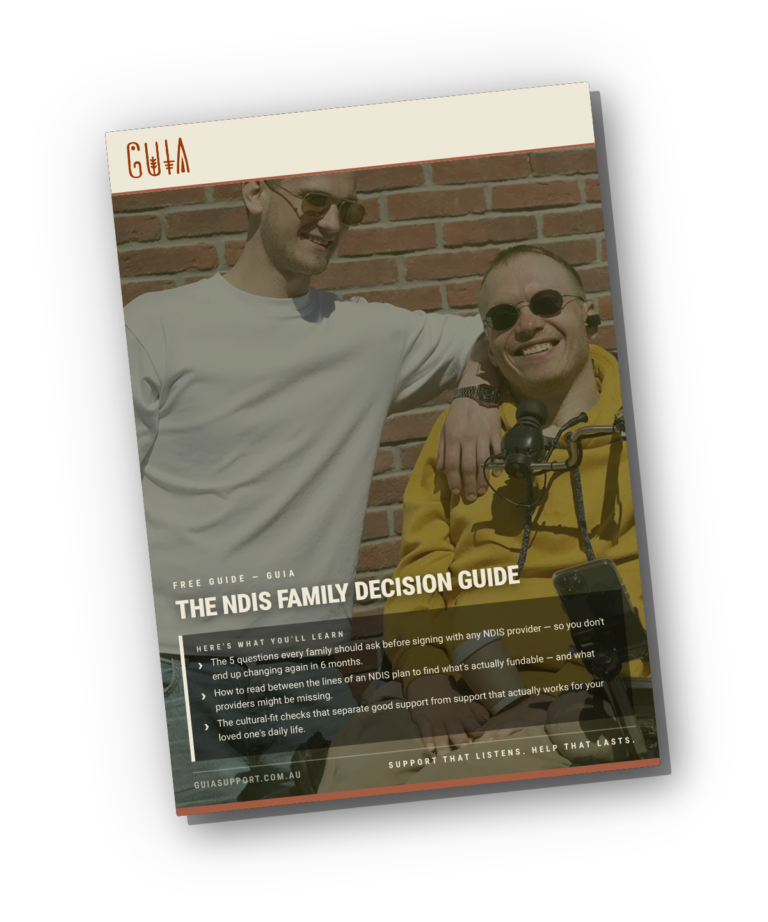
Here's What You'll Learn:
The 5 questions every family should ask before signing with any NDIS provider — so you don't end up changing again in 6 months.
How to read between the lines of an NDIS plan to find what's actually fundable — and what providers might be missing.
The cultural-fit checks that separate good support from support that actually works for your loved one's daily life.
NDIS support for specific learning disability in South West Sydney
Specific learning disabilities affect how you process information—not how smart you’re or what you’re capable of. If you’re an adult with a specific learning disability, you might find that standard instructions don’t stick, or that reading and writing take longer than they do for others. Your family might worry that support workers won’t understand these differences, or that they’ll treat you like the problem needs fixing instead of the environment needing adjustment.
The right support recognises how your brain works best and builds around that. When a support worker understands processing differences, they can explain things in the way that lands for you, give you time without rushing, and help you build confidence in your own capabilities. That’s when real independence becomes possible—and when your family can step back, knowing you’re genuinely supported.
Read More - See what consistent support actually feels like
Specific learning disabilities affect how your brain processes information—not how smart you’re. If you’re an adult with a specific learning disability, you might find reading, writing, maths, or organisation harder than expected, even when you’re capable in other areas. Your family might notice inconsistencies: you excel at some tasks but struggle with similar ones. The NDIS — National Disability Insurance Scheme recognises this, and support designed around how you actually learn and work can make a real difference to independence and confidence.
What changes when you have the right support is practical and immediate. Instead of fighting systems designed for neurotypical processing, you work with someone who understands why written instructions might confuse you but verbal ones click. A support worker trained in specific learning disability knows to break tasks into smaller steps, use visual cues, or allow extra time without making you feel rushed. You stay in control of decisions about your own life—the support is there to help you do what you want to do, not to manage you.
For families, the shift is equally important. You’re not the gatekeeper between your family member and the world. Good support means your loved one can build their own relationships with workers, ask their own questions, and develop real independence over time. You get reliable, consistent people showing up—no last-minute cancellations that derail routines. You also get someone who can explain what’s happening in plain language, not jargon, so you understand the plan and your role in it.
Support coordination and employment assistance are often the starting points. Support coordinators help you understand what’s available in your NDIS plan and match you with workers who get specific learning disability. Employment support focuses on real jobs or volunteer work—building skills, confidence, and pathways that fit how you work best. Both services recognise that specific learning disability isn’t something to overcome; it’s something to understand and work with. The goal is capacity and choice, not dependence. Over time, NDIS — Finding and Keeping a Job and NDIS — Social and Community Participation compound naturally alongside Specific Learning Disability — together they build the daily rhythm and outward connections that make real independence stick.
Guia has been supporting people across South West Sydney since 2022, and we’re NDIS-registered with staff trained in disability support and worker-screened for safety. We work in English, Spanish, and Arabic, and we match support workers based on what matters to you—not just availability.
What good support for specific learning disability looks like
A specific learning disability means your brain processes information differently—and that difference often shows up first in school, then at work, and in how you navigate everyday tasks. You might find reading takes longer, or numbers don’t stick the way they do for others, or instructions need to be written down rather than heard. For you as a participant, that’s just how your mind works. For your family, it’s watching you struggle with things that seem automatic to everyone else, then wondering whether the right support exists to help you build on your strengths instead of just managing around the gaps.
When support workers understand how you actually process information—not just what your diagnosis says—everything shifts. You stop feeling like you’re failing at tasks designed for someone else’s brain. Your family stops being the translator between you and the world. Instead, you get practical help that matches your pace, your learning style, and what you’re actually trying to do next, whether that’s keeping a job, managing a rental, or simply getting through the week without exhaustion. That’s when independence becomes possible.
Read More - Come talk through what could work for you
Specific learning disability affects how your brain processes information—not how smart you’re. You might be strong with big-picture thinking but struggle with reading or maths. Or you might excel at detail work but find organisation overwhelming. Your family sees the inconsistency and wonders why some tasks feel impossible while others come naturally. The NDIS recognises this reality and funds support that builds on your strengths while addressing the gaps that matter most to you.
What makes a real difference is support from people who understand processing differences—not just disability labels. A support worker who knows that you might need written instructions plus a verbal walkthrough, or that you learn better through doing than listening, changes everything. You feel less broken and more capable; your family stops holding their breath before asking you to try something new. That shift happens when the person supporting you has trained in how specific learning disability actually affects daily life.
The NDIS system itself uses words like “assistance with daily personal activities” and “life stage transition support. ” Plain language matters here. When someone explains your plan in straightforward terms—not jargon—you understand what you’re actually paying for and what you can ask for. Your family can help you think through real-life situations instead of guessing what the funding categories mean. That clarity builds confidence on both sides.
Self-advocacy—knowing how to speak up about what works and what doesn’t—is a skill that compounds over time. Support that includes coaching on how to communicate your needs to employers, teachers, or services creates lasting independence. Employment assistance paired with life skills training means you’re building capability, not just getting help through the day. We’ve worked with people who started unable to ask for adjustments and ended up negotiating their own workplace arrangements. Over time, NDIS — Finding and Keeping a Job and NDIS — Social and Community Participation compound naturally alongside Specific Learning Disability — together they build the daily rhythm and outward connections that make real independence stick.
What happens when learning support gets missed early on
Specific learning disability means your brain processes information differently—not worse, just differently. You might excel at hands-on problem-solving but struggle with written instructions, or vice versa. Family members often spot these patterns first: your son reads fluently but can’t follow a multi-step task, or your daughter understands spoken directions instantly but finds written forms overwhelming.
The right NDIS support recognises these processing differences and builds around them, not against them. When a support worker understands how you actually learn and think, they can help you build real independence—not just follow steps. That’s when you start feeling capable, not managed.
Read More - See what consistent support actually feels like
Specific learning disabilities affect how your brain processes information—not how smart you’re. If you’re an adult with a specific learning disability, you might find reading, writing, maths, or organisation tasks harder than expected, even when you’re capable in other areas. Your family may have noticed these patterns for years. The challenge isn’t ability; it’s that standard systems weren’t built for how you learn. It NDIS — National Disability Insurance Scheme recognises this and funds support that matches your actual needs, not assumptions about what you should be able to do.
What shifts when you get the right support is confidence. When a support worker understands processing differences—how you absorb information, solve problems, or manage time—they can help you build real strategies instead of fighting your own brain. You stop feeling broken and start feeling equipped. Your family watches you make decisions independently, even if the pathway looks different from what they expected. That’s not about lowering expectations; it’s about removing the friction between your capability and the world around you.
Many NDIS providers talk about you in meetings without talking to you directly. That reinforces the exact dependency the support should reduce. Good support means the provider speaks to you as a capable adult making your own choices, while also keeping your family informed and involved. It means plain-language explanations when NDIS jargon comes up, so you understand your own plan. It means your support worker shows up reliably, knows your routines, and doesn’t cancel last minute. Consistency builds trust, and trust is where real independence starts.
Here’s what that looks like in practice: you might have a support coordinator who helps you understand your plan in language that actually makes sense. You might access employment support that teaches interview skills or workplace confidence, not just job placement. You might get help with organisation systems—digital tools, paper-based planners, whatever works for your brain—so daily tasks feel manageable. NDIS — Finding and Keeping a Job and NDIS — Social and Community Participation are the kinds of services that build capacity over time, not just manage the problem. Over time, NDIS — Finding and Keeping a Job and NDIS — Social and Community Participation compound naturally alongside Specific Learning Disability — together they build the daily rhythm and outward connections that make real independence stick.
If this sounds like the kind of support you’re looking for—where you’re treated as the expert in your own life and your family’s concerns are heard alongside yours—there’s a clear next step. Guia has supported people with specific learning disabilities across South West Sydney since 2022, with staff trained to explain things plainly and match you with workers who get how you think. When you’re ready to explore what support could look like for you, Enquire about support.
How NDIS support actually works for learning differences
A specific learning disability means your brain processes information differently—and that difference shapes everything from how you learn new tasks to how you prefer instructions explained. When support workers don’t understand that, they default to one-size-fits-all approaches that leave you frustrated and your family worried you’re not getting what you actually need.
Support that’s built around how you think—not against it—changes what becomes possible. You move through tasks with clarity instead of confusion; your family sees you building real confidence, not just getting through the day. That’s the shift we’re here to help you reach.
Read More -Send through a quick enquiry and we’ll walk through what fits your week
Send through a quick enquiry and we’ll walk through what fits your week
Specific learning disabilities affect how your brain processes information—not how capable you are. You might find reading, writing, maths, or organisation takes longer or feels harder, even when you’re intelligent and motivated. For families, this often means watching someone struggle with tasks peers find easy, then wondering why standard support doesn’t quite fit. The right NDIS — National Disability Insurance Scheme support recognises this difference and builds around it, rather than treating you as needing to catch up to an arbitrary standard.
What changes when support workers actually understand processing differences is immediate and quiet. Instead of rushing through a task, a worker trained in specific learning disability takes the time to break instructions into smaller steps, use written notes alongside spoken words, or find the rhythm that works for you. You feel less frustrated because someone’s finally listening to how you actually learn—not how the textbook says you should. For families, this means fewer phone calls about incomplete tasks and more confidence that your loved one is being supported with genuine understanding.
Plain-language explanations matter more than you might think. Many NDIS participants with specific learning disabilities tell us that when coordinators or providers use jargon, they switch off or nod along without understanding. A support worker who explains your plan in simple terms—what the money is for, what you can ask for, why certain choices make sense—hands you real control. You’re not dependent on someone else to translate the system. You know what’s happening and why, which builds confidence to make your own decisions.
Self-advocacy—learning to speak up for what you need—is where many participants find their power. Support that includes life skills coaching, employment assistance, or community participation helps you practise asking questions, setting boundaries, and navigating systems independently. When you can say “I need written instructions, not just verbal ones” or “I learn better with extra time,” you stop waiting for others to guess. Families often find this shift profound: their adult son or daughter becomes more confident, less anxious, and more genuinely independent—not because the disability disappeared, but because the right support was there to build on their actual strengths. Over time, NDIS — Finding and Keeping a Job and NDIS — Social and Community Participation compound naturally alongside Specific Learning Disability — together they build the daily rhythm and outward connections that make real independence stick.
Guia has been supporting people across South West Sydney since 2022, including those with specific learning disabilities navigating NDIS plans. Our team includes workers trained in how processing differences show up in daily life—and how to build support around them, not despite them. We’re NDIS-registered and Code of Conduct compliant, with staff who speak English, Arabic, and Spanish. If you’re ready to explore what good support actually looks like for you or your family member, Enquire about support.
How Guia supports learning differences in practice
A specific learning disability means your brain processes information differently—not slower, just differently. You might excel at some tasks and find others genuinely harder, even when you try your best. That gap between what you can do and what people expect can feel isolating, especially when support workers don’t understand how your mind actually works.
When a support worker gets it—when they know that you need instructions written down, or time to process before responding, or a quieter space to focus—everything shifts. You stop feeling like you’re the problem. Your family stops holding their breath. That’s when real independence starts to build, because support finally matches how you actually think and learn.
Read More - Start with a chat about what consistent support could look like
People with specific learning disabilities often process information differently—not slower, just differently. You might need more time to absorb written instructions, or you might excel at verbal explanations but struggle with forms. Your family may have spent years advocating for accommodations at school, only to find that NDIS support providers use the same one-size-fits-all approach. The challenge isn’t your capability; it’s finding support workers and coordinators who adjust their communication style to match how you actually learn. According to the NDIS — National Disability Insurance Scheme, support coordination and employment assistance are both funded categories that can address exactly this gap.
What changes when you have support workers trained to explain things plainly and check for understanding? You stop having to ask the same question three times. Your family stops feeling like they’re translating between you and every service provider. A support worker who knows to use concrete examples instead of abstract rules, or who writes things down when you ask, transforms what could be frustrating into something that actually works. That’s not extra—it’s the baseline for good support.
Self-advocacy is the mechanism that builds independence over time. When support workers speak directly to you about your goals and decisions—not around you to your family—you learn what you’re capable of asking for. You start recognising which environments bring out your strengths and which ones drain you. Your family sees you becoming more confident in your own choices, which actually reduces their worry, not increases it. This happens because the support is designed to help you as the decision-maker, not to manage you as a project.
Here’s what that looks like in practice: you might work with an employment support coordinator to identify roles that match your processing style, then have ongoing workplace support during your first months on the job. Or you might use support coordination to build a weekly routine that includes time for learning new skills at your own pace. Employment and capacity building services, paired with support coordination, create the structure that lets you build confidence without feeling rushed or patronised. Over time, NDIS — Finding and Keeping a Job and NDIS — Social and Community Participation compound naturally alongside Specific Learning Disability — together they build the daily rhythm and outward connections that make real independence stick.
The difference between NDIS providers and those who understand specific learning disabilities is this: they listen to how you think, not just what your diagnosis says. They speak to you directly about what you want, and they explain their own processes in language that lands for you.
How to track progress and measure success
Specific learning disability means your brain processes information differently—not slower, just differently. You might excel at practical problem-solving but find written instructions confusing. Or you read fluently but struggle to organise your thoughts on paper. For you as a participant, the right support recognises these strengths and works around the actual gaps. For your family, it means someone who doesn’t assume you need help everywhere, just in the places that genuinely matter.
When support workers understand how you actually learn and process, everything shifts. You’re not fighting the system to prove you’re capable—you’re working with people who see your capability first. Your family can step back from being the translator between you and every new service. That’s when real independence starts to take shape, at whatever pace and in whatever form works for your life.
Read More - See how other families in South West Sydney started their support journey
People with specific learning disabilities often process information differently from how most systems are designed to deliver it. That means standard explanations don’t always land. When you’re making decisions about your own support—or when your family member is—you need someone who can explain things plainly, without jargon, and who understands why the usual approach might not work. The NDIS — National Disability Insurance Scheme funds support that meets you where you’re, but only if the provider knows how to communicate in a way that actually sticks.
Here’s what that looks like in practice: a support worker who takes time to explain what’s happening before it happens, uses concrete examples instead of abstract concepts, and doesn’t rush you through decisions. When you’re directing your own support, you need to understand what you’re asking for and why. When your family is helping you think through options, they need confidence that the support worker will respect your input and treat you as the decision-maker, not as someone to be managed around. That shift—from being told what support looks like to being shown, asked, and genuinely heard—changes everything.
Self-advocacy means knowing your own strengths and what you actually need, then being able to say that clearly to the people supporting you. Many people with specific learning disabilities have spent years being told what their limitations are. Building real confidence in naming what works for you takes time and patience from the people around you. A support worker who listens without judgment, who asks clarifying questions instead of assuming, and who genuinely believes you know your own mind—that person becomes your ally in every conversation that comes after.
The practical side matters just as much. Employment support, life skills coaching, and help navigating systems like NDIS—these aren’t one-size-fits-all services. A worker who understands how you process written information, who can break tasks into manageable steps, and who celebrates progress without patronising you, makes the difference between support that feels helpful and support that feels like pressure. Guia’s team includes workers trained in how specific learning disabilities show up in daily life, matched to you personally so the fit is right from day one. Over time, NDIS — Finding and Keeping a Job and NDIS — Social and Community Participation compound naturally alongside Specific Learning Disability — together they build the daily rhythm and outward connections that make real independence stick.
When you’re ready to explore what good support actually looks like for you or your family member, we’re here to answer your questions plainly and help you understand your options. No pressure, no corporate language—just a straightforward conversation about what you need and how we can help.
Building confidence and independence over time
Specific learning disability means your brain processes information differently—not worse, just differently. You might excel at hands-on problem-solving but struggle with written instructions. Or you might read fast but need time to process what you’ve read. When you’re looking for NDIS support for Specific Learning Disability South West Sydney, you need workers who get this. Not workers who assume you need help because you’re slower, but workers who understand how you actually think and learn.
For your family, this shift changes everything. Instead of managing your support like a project, they can step back and watch you build real independence—because your support worker understands your processing style, not just your disability label. That’s when confidence grows for both of you, and you start making decisions together rather than your family deciding for you.
Read More - Have a chat about how this could fit your week
Specific learning disabilities affect how your brain processes information—not how smart you’re. If you’re an adult with a specific learning disability, you might find reading, writing, maths, or organisation harder than expected, even when you understand the concept. Your family might notice you excel in some areas while struggling in others. The NDIS — National Disability Insurance Scheme recognises this uneven profile and funds support that targets your actual gaps, not a one-size-fits-all approach.
What shifts when you have the right support is your confidence in systems that weren’t designed with your processing style in mind. You stop avoiding forms, appointments, or conversations because someone explains them in plain language first. Your family stops being the translator between you and every institution. A support worker who understands processing differences doesn’t just help you complete a task—they help you understand why it matters and what to do next time. That’s the difference between doing something for you and building your capacity to do it yourself.
The mechanism is straightforward: specific learning disabilities often mean you need information delivered differently. Written instructions might blur or feel overwhelming; a verbal walkthrough with time to ask questions works better. Numbers in a budget spreadsheet might confuse you; breaking costs into categories and talking through each one clicks. This isn’t about intelligence—it’s about matching the delivery method to how your brain actually processes. When support workers understand this, they stop treating you like you’re slow and start treating you like you think differently. That respect changes everything.
In practice, support for adults with specific learning disabilities in South West Sydney often starts with employment assistance or life skills coaching. You might work with a support coordinator to map out what’s actually hard (filling in forms, managing a routine, understanding workplace expectations) and what’s not. Then you match with workers trained in patient, step-by-step explanations—people who ask “how do you learn best” instead of assuming. Many participants find that consistent, plain-language support unlocks independence they thought wasn’t possible for them. Over time, NDIS — Finding and Keeping a Job and NDIS — Social and Community Participation compound naturally alongside Specific Learning Disability — together they build the daily rhythm and outward connections that make real independence stick.
If you’re ready to explore what this kind of support could look like for you or your family member, we’re here to talk through your situation without jargon or pressure. We’ve been supporting people across South West Sydney since 2022, and our team includes staff trained to explain the NDIS, your options, and what actually changes when you have the right fit.
How support builds confidence and independence
When you’re learning differently, the gap between what you understand and what others expect can feel wider than it should. You might need more time to process written instructions, or you work best with information presented one way rather than another. That difference is real, and it shapes everything from how you learn new skills to how you take on work or manage daily tasks.
The right support recognises how your mind works and builds around that, not against it. When your family sees you gaining confidence because someone actually explains things in a way that clicks, and when you feel trusted to make your own decisions about the help you need, that’s when real independence starts to grow. NDIS support for Specific Learning Disability South West Sydney works best when it meets you exactly where your processing strength is.
Read More - Start with a chat about what consistent support looks like
Specific Learning Disability means your brain processes information differently — not less capably, just differently. You might excel at some tasks while others take longer or require a different approach. If you’re navigating the NDIS — National Disability Insurance Scheme, you deserve support workers who understand that difference without making you feel slow or difficult. For families, this means finding providers who see your loved one’s strengths first, then build support around the actual gaps — not the stereotypes.
The right support worker notices how you learn best and adapts to that rhythm. If you need written instructions instead of verbal, they write them. If you think better out loud, they listen and ask clarifying questions. If you need extra time to process what’s being asked, they wait. This isn’t about lowering expectations — it’s about removing the friction that makes everyday tasks harder than they need to be. For families, this means watching your loved one move through the day with less frustration and more confidence.
Many people with Specific Learning Disability describe feeling misunderstood by systems designed for the average learner. School, work, and support services often assume a single pace and method work for everyone. When they don’t, the person gets blamed instead of the system. Good support flips that. It asks: “What does this person need to succeed here? ” — then builds it. Your support worker becomes someone who explains things plainly, checks understanding without judgment, and adjusts on the fly.
We work with participants and families across South West Sydney who’ve experienced support that treated them like a checklist item. Employment & Capacity Building and Support Coordination are where real change happens — because they’re built on understanding how you actually think and learn, not how providers assume you should. We match you with workers trained to explain the NDIS, your plan, and your options in plain language. No jargon. No rushing. Over time, NDIS — Finding and Keeping a Job and NDIS — Social and Community Participation compound naturally alongside Specific Learning Disability — together they build the daily rhythm and outward connections that make real independence stick.
If you’re ready to find support that respects how your brain works and treats you as a capable adult making your own decisions, we’re here to listen to what matters most. Your family’s concerns about consistency and safeguards matter too — and they’re built into how we work.
Guia Is Trusted By NDIS Participants, Families And Support Coordinators
Imagine a life designed to empower you!




NDIS Participants South West Sydney Choose Guia
When you’re navigating NDIS support for a specific learning disability, you need a provider who understands how your brain works—not someone reading from a playbook. Guia was founded on lived experience of disability and family caregiving. We’ve spent three years building expertise in how learning disabilities show up differently for each person. That means we match you with support workers who get your pace, your strengths, and what actually helps you learn and grow. You’re the expert on your own life. We’re here to make sure the support system works for you, not the other way around.
Person-Centred From the First Conversation
You know what matters most to your child or yourself — the goals, the routines, the things that actually work. We start there. Every support visit is shaped around what you’ve told us you need, not a one-size . Your support worker listens, learns your pace, and shows up the same way each time. That consistency builds trust and real progress.
Reliable Consistency Every Single Visit
Routines matter when you’re managing a specific learning disability. The same support worker every week means no re-explaining what works for you. No starting over with someone new. Your family plans their week knowing exactly who’s walking through the door. That consistency builds trust, reduces anxiety, and lets real progress happen.
Culturally Diverse, Multilingual Team
When your child learns differently, you need support that gets it. Our team speaks English, Spanish, and Arabic—and more importantly, understands your family’s background and values. The same support worker builds real trust with your child, learning their strengths and needs over time. That consistency and cultural match makes learning feel safer, less isolating, and more possible.
Six Years of South West Sydney Experience
Finding the right support worker matters most when learning looks different. We’ve been part of South West Sydney since 2022, so we know the community, the local schools, and the pathways that work. Your support worker isn’t just trained—they’re connected to your local network from day one. That means genuine continuity and someone who understands your neighbourhood.
NDIS Quality and Safeguards Commission Compliant
You need support workers who understand your child’s learning profile and stick with it. Our team is NDIS-registered and worker-screened—every staff member meets the standards that protect participants. That means consistent, qualified support without rotating faces or last-minute changes. Your routine stays steady. Your child builds trust with the same person. That’s the baseline we start from, every time.
Word-of-Mouth Referrals Build Trust
Most families who work with us found us through other families. Word-of-mouth matters because it means we’ve already earned trust with people in your community. That reputation comes from showing up reliably, matching support workers with real care for the person, and treating every participant as someone deserving dignity. When families recommend us, they’re backing real experience, not marketing.
READY FOR A FREE PLAN MANAGEMENT REVIEW?
Find Unused Funding
Fix Budget Confusion
Plan Supports Better
FAQs For Specific Learning Disability
What NDIS support helps adults with specific learning disability?
NDIS support for adults with specific learning disability in South West Sydney includes employment assistance, life skills training, and daily living support tailored to your goals. Support coordinators can help you navigate your plan. Community activities build confidence and real connections.
Here’s what that looks like in practice: you might have a support worker help with job readiness and workplace skills, or assistance with household tasks and daily routines at the pace that works for you. Your family stays informed and involved throughout; we match you with staff who understand your needs and show up reliably, every time.
Enquire about support — find out how Guia can help with Specific Learning Disability.
What qualifications count as a specific learning disability for NDIS support?
A specific learning disability under the NDIS covers difficulties with reading, writing, spelling, or maths that aren’t caused by intellectual disability, sensory impairment, or acquired brain injury. The NDIS recognises these as lifelong support needs. NDIS support for Specific Learning Disability in South West Sydney can help you build confidence with everyday tasks affected by learning differences.
If you’re a participant, support might focus on employment readiness, life skills, or community participation tailored to how you learn best. If you’re a family member, you’ll want consistency and someone who understands your relative’s strengths alongside the areas where they need help. We match support workers who listen to both of you, show up reliably, and help build independence over time.
Enquire about support — find out how Guia can help with Specific Learning Disability.
How can capacity building help me develop new skills?
NDIS capacity building support helps you develop practical skills at your own pace. Whether it’s literacy, numeracy, organisation, or social confidence, a skilled support worker works with you on what matters most. NDIS support for Specific Learning Disability in South West Sydney can be tailored to fit your learning style and goals.
Here’s what that looks like in practice: a support worker might help you break down a task into smaller steps, practise it regularly, and build your confidence over time. Families often tell us they value knowing their loved one is learning with someone patient and consistent. You stay in control of what you work on and how fast you go.
Enquire about support — find out how Guia can help with Specific Learning Disability.
Can NDIS support help me find work or build employment skills?
Yes. NDIS support can help with employment if you have a learning disability. We offer Employment & Capacity Building support across South West Sydney — job-readiness training, workplace support, and ongoing advocacy tailored to your goals.
Here’s what that looks like in practice: you work with a support worker who understands your learning style and strengths. They help you build confidence, learn new skills, and find or stay in work that suits you. Families often tell us they value the consistency and reliability — someone who shows up and actually knows your situation, not a revolving door of different people.
Enquire about support — find out how Guia can help with Specific Learning Disability.
What community participation supports help adults with learning disabilities?
Community participation supports for adults with learning disabilities focus on building real connections and confidence in settings that matter to you. NDIS support for Specific Learning Disability in South West Sydney can include group activities, social outings, and transport that gets you involved in your community at your own pace.
What we hear from families is that consistency matters most — the same support worker, reliable schedules, and someone who knows your routines and preferences. We match participants with support workers who listen to what you actually want to do, not what we think you should do. Your family stays informed and involved at the level that works for everyone.
Enquire about support — find out how Guia can help with Specific Learning Disability.
How do support workers communicate with learning disabilities?
Support workers adapt communication by listening first to how each person understands best. They might use shorter sentences, written notes, visual supports, or extra time for processing. Our NDIS support for Specific Learning Disability in South West Sydney is built on this person-centred approach — no two participants are the same.
What we hear from families is that consistency matters most. Your support worker learns your preferences, routines, and communication style over time. We match workers carefully and keep the same person with you when possible. That reliability builds trust for both you and your family, so everyone knows what to expect.
Enquire about support — find out how Guia can help with Specific Learning Disability.
Does NDIS funding cover assistive technology for reading or writing?
Yes, NDIS funding can support assistive technology for reading and writing. The technology that works best depends on your specific needs and learning style. NDIS support for Specific Learning Disability in South West Sydney includes equipment and tools that make reading and writing more manageable for you.
Here’s what that looks like in practice: text-to-speech software, speech-to-text tools, specialist keyboards, or screen readers might all be options depending on your plan. A support coordinator can help you explore what’s available and how it fits your goals. Your family can be part of that conversation too, understanding how the technology supports your independence over time.
Enquire about support — find out how Guia can help with Specific Learning Disability.
How do I find a support worker who understands my learning differences?
We match you with support workers trained to understand how learning differences work in practice. When you work with Guia for NDIS support for Specific Learning Disability in South West Sydney, we listen to what helps you learn best. Then we find someone who gets that.
Here’s what that looks like: you tell us about your learning style—what strategies work, what frustrates you, how you prefer information explained. We use that to match you with a worker who has experience and patience with those specifics. Your family stays in the loop about how the support is going; you’re in control of the decisions. We handle the reliability and consistency behind the scenes.
Enquire about support — find out how Guia can help with Specific Learning Disability.
Can NDIS support help with study or training?
Yes. NDIS support can help you build skills and confidence for study or training. Employment & Capacity Building support includes life skills, transition assistance, and job-readiness training tailored to your goals.
Here’s what that looks like in practice: a support worker might help you prepare for a course, develop study routines, or work through challenges as they come up. Your family can be part of planning this—knowing what’s happening, when, and how it connects to your longer-term goals. We match you with someone who understands your needs and shows up reliably.
Enquire about support — find out how Guia can help with Specific Learning Disability.
How do I set up my NDIS plan to get the right support?
Starting NDIS support for a specific learning disability begins with having an active NDIS plan. If you don’t have one yet, you’ll need to apply through the NDIS official site. Once your plan is approved, you can choose support providers like Guia who specialise in learning disability support across South West Sydney.
Here’s what that looks like in practice. You direct your plan and choose which support works for you — whether that’s employment assistance, life skills training, or transition support through major changes. Your family stays involved at whatever level you both want. We match you with a support worker who understands your learning style and needs, and we show up consistently. When you’re ready, we can walk through how your plan funding works and what support actually fits your situation.
Enquire about support — find out how Guia can help with Specific Learning Disability.
Reach out for a non-obligation NDIS Plan Management Assessment
ARE YOUR NDIS SUPPORTS WORKING FOR YOU?
GET A FREE NDIS PLAN MANAGEMENT REVIEW