
NDIS support for Developmental Disability South West Sydney
NDIS support for Developmental Disability South West Sydney
The Right NDIS Support for Developmental Disability South West Sydney Starts With Consistency
NDIS support for Developmental Disability South West Sydney
NDIS support for Developmental Disability South West Sydney
The Right NDIS Support for Developmental Disability South West Sydney Starts With Consistency
ARE YOUR NDIS SUPPORTS WORKING FOR YOU?
GET A FREE NDIS PLAN MANAGEMENT REVIEW
NDIS support for Developmental Disability South West Sydney means different things depending on who you are. If you’re an adult with developmental disability, you need a provider who speaks to you as a capable person making your own choices about your life and support. If you’re a family member or carer, you need consistency, reliability, and the confidence that the person you care for is treated with dignity every single day. Both matter equally. We’ve built our approach around that reality—supporting people with developmental disability across South West Sydney in ways that respect both the participant’s independence and the family’s need for genuine peace of mind.
On this page, you’ll find how we support people with developmental disability through daily living, community connection, employment pathways, and life transitions. We’re NDIS-registered and staffed by qualified, worker-screened professionals who speak English, Arabic, and Spanish—because language matching and cultural understanding aren’t extras in South West Sydney, they’re essential. We’ve been operating since 2022, built on lived experience of disability and family caregiving. When you’re ready to explore what NDIS support could look like for you or your loved one, scroll down to see the specific ways we work, or jump straight to enquiring about support.
NDIS support for Developmental Disability South West Sydney means different things depending on who you are. If you’re an adult with developmental disability, you need a provider who speaks to you as a capable person making your own choices about your life and support. If you’re a family member or carer, you need consistency, reliability, and the confidence that the person you care for is treated with dignity every single day. Both matter equally. We’ve built our approach around that reality—supporting people with developmental disability across South West Sydney in ways that respect both the participant’s independence and the family’s need for genuine peace of mind.
On this page, you’ll find how we support people with developmental disability through daily living, community connection, employment pathways, and life transitions. We’re NDIS-registered and staffed by qualified, worker-screened professionals who speak English, Arabic, and Spanish—because language matching and cultural understanding aren’t extras in South West Sydney, they’re essential. We’ve been operating since 2022, built on lived experience of disability and family caregiving. When you’re ready to explore what NDIS support could look like for you or your loved one, scroll down to see the specific ways we work, or jump straight to enquiring about support.
The NDIS Family Decision Guide
Helping Australian families make confident NDIS decisions for the person they care about — without the jargon, the runaround, or the regret.
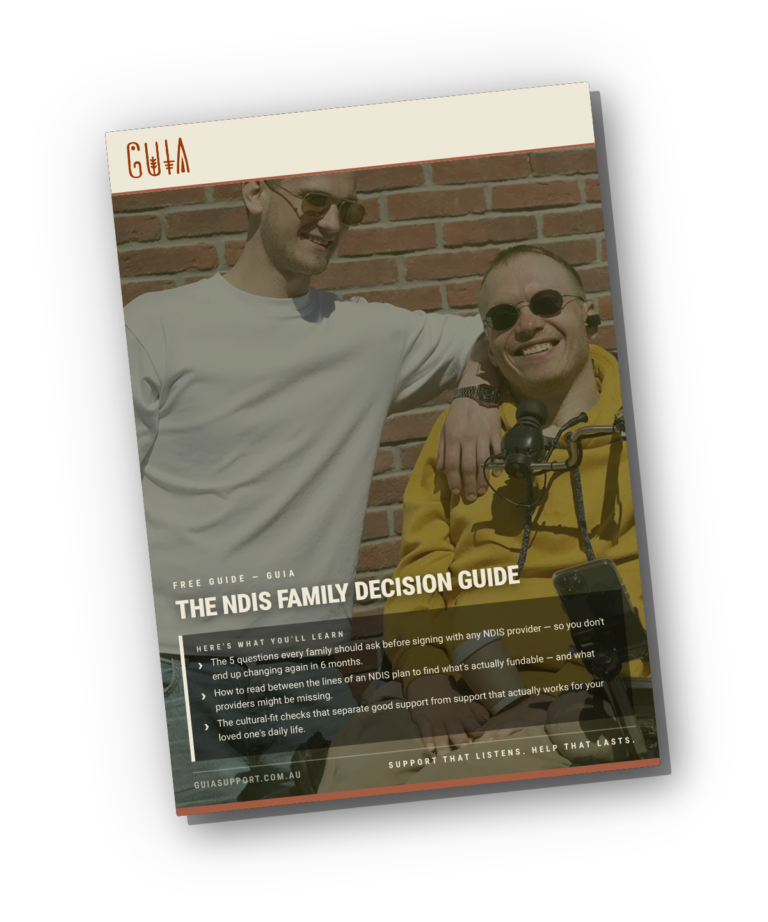
Here's What You'll Learn:
The 5 questions every family should ask before signing with any NDIS provider — so you don't end up changing again in 6 months.
How to read between the lines of an NDIS plan to find what's actually fundable — and what providers might be missing.
The cultural-fit checks that separate good support from support that actually works for your loved one's daily life.
NDIS support for developmental disability in South West Sydney
When a family member has developmental disability, you’re often caught between two roles that shouldn’t exist together. One of you is researching support options and making the big decisions; the other is living their life and wanting a say in who helps them. Most NDIS providers talk about one of you, not both—leaving the other feeling sidelined or overloaded.
What changes when support is built for both of you at once is quiet but real. Your family member gets to stay in the driver’s seat of their own life. You get the reliability, consistency, and continuity that lets you actually step back. That’s when real independence takes root—and when families can breathe.
Read More - See what happens when support actually listens to both of you
When you’re looking for NDIS support for developmental disability, you need a provider who speaks to you directly—not about you. Too many services treat participants as projects to manage, leaving you feeling sidelined from decisions about your own life. Your family, meanwhile, gets caught between wanting to step back and needing reassurance that consistency, safeguarding, and continuity are actually happening. The NDIS — National Disability Insurance Scheme exists to fund support that puts you in control; what matters is finding a provider who actually operates that way.
Here’s what that looks like in practice. A support worker who shows up the same day, same time, every week—not because it’s policy, but because reliability builds trust. Over months and years, that worker learns how you communicate, what routines matter to you, what small adjustments make your day smoother. Your family stops holding their breath about last-minute cancellations. You stop having to re-explain yourself to a new face. That continuity is where real confidence grows—for you and for the people supporting you.
The mechanism is simple. When a support worker understands your specific communication style—whether that’s verbal, non-verbal, written, or a mix—they respond faster and more accurately to what you actually need. Miscommunication drops. Safety improves because the worker anticipates rather than reacts. Your family feels the difference immediately: fewer phone calls to clarify, fewer surprises, fewer moments of wondering if the support is really tailored to your life or just assistance on a schedule. That’s not just comfort—it’s dignity in action.
Building that kind of relationship takes time, and it requires a provider who prioritises person-centred matching from day one. We’ve been supporting participants with developmental disability since 2022, and we’re NDIS-registered and Code of Conduct compliant. Our team speaks English, Arabic, and Spanish—because cultural and linguistic match matters in South West Sydney. We focus on employment support, life stage transitions, and daily living assistance tailored to where you’re right now. When you’re ready to explore what continuous, dignified support actually feels like, the conversation starts with what matters to you. Over time, NDIS — Daily Living Supports and NDIS — Finding and Keeping a Job compound naturally alongside Developmental Disability — together they build the daily rhythm and outward connections that make real independence stick.
Your next step is straightforward. Reach out with your questions—about how we match workers, what continuity looks like in practice, or how we support both you and your family through the transition. There’s no pressure, no sales call disguised as help; just a conversation about whether this kind of support fits what you’re after.
What good support for developmental disability looks like
Developmental disability support works best when both you and your family feel equally heard in the same conversation. Too often, one gets spoken to directly while the other is left wondering where they fit—or worse, becomes the sole gatekeeper for decisions that should belong to the participant. That split creates tension right when you need clarity most.
When support workers show up consistently and know your actual situation—not just what’s written in a plan—everything shifts. You gain confidence in your own choices. Your family gains peace of mind that continuity is real, not promised. That’s the foundation for genuine independence over time.
Read More - Come talk through what could work for you
When someone you love has a developmental disability, support often means two separate conversations. One happens with the participant about their goals and choices. Another happens with the family about consistency, reliability, and continuity of care. Too many NDIS providers speak only to one side—leaving the other feeling unheard or unsure their concerns matter. The NDIS — National Disability Insurance Scheme exists to fund support that serves both. What matters is finding a provider who actually speaks to both at the same time.
Here’s what that looks like in practice. You, as the participant, deserve to hear directly that your support worker will show up on time, know your communication style, and respect your decisions about how your day unfolds. Your family needs to know the same worker will return consistently—not a different person each week—and that someone is tracking what’s working and what isn’t. When one person builds that relationship over months, both conversations become the same conversation. Trust builds faster. Small adjustments happen naturally. Everyone moves toward independence together, not separately.
The mechanism is straightforward. A support worker who knows you learns your routines, your preferences, and how you actually communicate—not from a file, but from showing up the same day at the same time. Your family watches that consistency happen. They see their loved one becoming more confident, not because the support changed, but because the relationship deepened. This kind of continuity is harder for providers to deliver than it sounds. It requires matching workers carefully, training them thoroughly, and keeping them in role long enough to actually know the person they’re supporting.
At Guia, we’ve been supporting people with developmental disabilities across South West Sydney since 2022. We’re NDIS-registered and Code of Conduct compliant. Our team includes staff who speak English, Spanish, and Arabic—because language matching matters as much as reliability does. We focus on In-Home Daily Living & Personal Care Support and Community Access & Social Participation, both built on the principle that the participant leads and the family stays informed. Our support coordinators can also help you navigate your NDIS plan in plain language, so you understand what’s available and what fits your situation. Over time, NDIS — Daily Living Supports and NDIS — Finding and Keeping a Job compound naturally alongside Developmental Disability — together they build the daily rhythm and outward connections that make real independence stick.
What happens when developmental disability support doesn't match your needs
When a support worker shows up reliably, knows your routines, and treats you as the person making the decisions—that’s when real independence starts to build. But many families find themselves caught between wanting their loved one to lead, and needing to stay involved in the details that keep everything running smoothly.
The support that works best is the kind that speaks to both of you at once: respecting your family member’s choices while giving you the confidence that continuity, safeguards, and genuine care are woven into every shift. That’s where the shift from managing a situation to supporting a life actually happens.
Read More - See what consistent support actually feels like
When you’re supporting someone with developmental disability, the relationship between you and their support worker matters more than most NDIS providers acknowledge. A worker who shows up reliably, learns your loved one’s communication style, and remembers what matters to them isn’t just convenient — it’s the foundation of dignity and real progress. Many families tell us that constant staff turnover feels like starting from zero every few weeks. That’s why continuity of care, built on long-term worker relationships, is one of the most underrated elements of good support. The NDIS — National Disability Insurance Scheme funds the hours; what transforms those hours into genuine change is the person delivering them and how well they know your family.
Here’s what that looks like in practice. When a support worker has been with your family for months or years, they notice the small shifts in mood, preference, and capability that strangers miss. They know whether your loved one communicates best through words, gestures, or routine. They understand what a “good day” looks like for them, and they adjust without needing a new care plan every time. For you as a family member, it means you’re not constantly re-explaining your son’s or daughter’s needs, their triggers, their strengths. You’re not spending every visit briefing a new person. That trust, built slowly, is what lets both you and your family member relax enough to actually build independence rather than just manage crisis.
Developmental disability support works best when it’s predictable and personalised. Your loved one benefits from knowing the same person will arrive at the same time, ready to support them towards their own goals — not the provider’s agenda. As a family member, you need confidence that the support is consistent, that safeguards are in place, and that someone genuinely knows your family member as a person. This is why we focus on matching participants with support workers thoughtfully, and keeping those relationships stable over time. In-home daily living and personal care support, community access and social participation, and life stage transition support all depend on this foundation of familiarity and trust.
When continuity breaks down — when workers rotate every few weeks — progress stalls. Your family member has to re-establish trust with each new person, which exhausts emotional energy that could go toward building skills or confidence. From a practical standpoint, a worker who knows your family member can spot early signs of health changes, understand their communication needs, and respond faster in uncertain moments. This reduces crisis calls and hospital visits over time. That’s not a promise we make lightly; it’s what families and support coordinators consistently report when they work with providers who prioritise stable, long-term relationships. Over time, NDIS — Daily Living Supports and NDIS — Finding and Keeping a Job compound naturally alongside Developmental Disability — together they build the daily rhythm and outward connections that make real independence stick.
If you’re looking for NDIS support for developmental disability in South West Sydney that treats your family member as a capable adult and honours your role as their trusted decision-maker, the quality of the relationship between worker and participant matters as much as the service itself. We’ve been operating since 2022, and we’re NDIS-registered with all staff qualified and worker-screened. Our team includes English, Arabic, and Spanish speakers, so language and cultural familiarity are built into how we match support. When you’re ready to explore what continuous, dignified support could mean for your family, Enquire about support.
What support is actually available to you
When you’re looking for support that actually fits your life, you need someone who talks to you directly—not about you in a report. That means the person receiving support hears they’re trusted to make decisions about their own day. And the family member knows there’s consistency, reliability, and someone showing up who understands what matters most.
The right NDIS support for developmental disability builds that trust over time through the same workers, the same routines, and real communication between everyone involved. When that happens, independence grows quietly—not because someone promised it would, but because the participant feels safer taking small steps forward.
Read More -Send through a quick enquiry and we’ll walk you through what’s possible
Send through a quick enquiry and we’ll walk you through what’s possible
When you’re looking for NDIS support for Developmental Disability in South West Sydney, you’re usually juggling two separate conversations at once. One with your loved one about what they want from their life and their support. Another with yourself about what consistency, reliability, and safeguards actually look like in practice. Most provider websites skip the second conversation entirely — they talk at you or around you, not to both of you together. The NDIS — National Disability Insurance Scheme exists to fund support that builds independence and choice. That only works if the provider treats the participant as a capable adult making their own decisions, while also respecting the family’s role in continuity and safety.
Here’s what that looks like in practice. You, as the participant, get to set the direction — what you want to work towards, what matters to you, what a good week looks like. Your family member sees a provider who shows up reliably, knows your communication style without needing to ask every visit, and treats your preferences as non-negotiable rather than something to work around. Over time, that consistency builds something neither of you can force: actual trust. A support worker who’s been there for two years doesn’t need a handover sheet to know you prefer your tea at a certain temperature or that Tuesdays are better than Mondays for trying new things. That knowledge compounds.
The mechanism is simple but often overlooked. Developmental Disability support works best when the same skilled worker shows up regularly — not a rotating roster of strangers, each one learning your needs from scratch. That continuity means the participant builds confidence because they know what to expect. It means the family can step back slightly, trusting that someone knows their loved one well enough to notice small changes or shifts in mood. It means the support worker can actually help build capacity over time, not just manage the day. Personal care and daily living support, community access, employment assistance, life stage transitions — all of these land differently when they’re delivered by someone who knows you.
We’ve been operating since 2022, and we’re NDIS-registered with all staff qualified and worker-screened. We match participants to support workers thoughtfully, not just by availability. Our multilingual team speaks English, Arabic, and Spanish — matching language and cultural familiarity where it matters. When you’re ready to explore what that kind of consistent, person-centred support could look like for you or your family member, Enquire about support. Over time, NDIS — Daily Living Supports and NDIS — Finding and Keeping a Job compound naturally alongside Developmental Disability — together they build the daily rhythm and outward connections that make real independence stick.
What good support looks like in practice
When you’re looking for real support, the person receiving it needs to feel like they’re making their own choices—not being managed. At the same time, you as a family member need to know there’s consistency, reliability, and someone who shows up the same way every time. That’s harder to find than it sounds.
Long-term relationships with the same support workers change everything; your family member builds trust. You stop repeating their story to new faces every month. The worker learns what matters—not from a file, but from showing up Tuesday after Tuesday. That’s the kind of NDIS support for Developmental Disability South West Sydney that actually works.
Read More - When you're ready, we're here to listen
When you’re choosing a support provider for developmental disability, you need someone who talks to you, not about you. That distinction matters more than it sounds; the NDIS — National Disability Insurance Scheme exists to give you choice and control over your support. Too many provider websites forget that—they describe what they’ll do for you in third person, as if you’re not the one making the decision. You deserve to hear directly what changes in your day-to-day life when the right support shows up.
Consistency matters more than most providers admit. When you work with the same support worker week after week, they learn how you communicate, what your routines are, and what helps you feel calm or confident. Your family sees this too—they stop worrying about whether a new face will understand your needs. That trust doesn’t happen in weeks; it builds over months, and it’s one of the most powerful things good support can offer. A worker who knows you shows up on time, remembers what you said last week, and treats you with the dignity you deserve every single visit.
The real mechanism behind this kind of continuity is simple: the same person learns your specific communication style, your preferences, your sensory needs, and your goals. They don’t start from zero each week. Your family member stops being the translator between you and your support worker. You get to direct your own life more fully because the person helping you actually understands what you’re asking for. That’s empowerment in practice, not as a slogan.
Guia builds support around this reality. We match participants with workers trained to listen, and we keep those relationships stable. Whether you need help with daily living tasks, community outings, or building skills toward greater independence, the person supporting you becomes familiar with your world. We’re NDIS-registered and Code of Conduct compliant, and our team speaks English, Spanish, and Arabic—because language and cultural match matter just as much as reliability. Your family can trust that safeguards are built in and that we’re thinking about your long-term growth, not just filling hours. Over time, NDIS — Daily Living Supports and NDIS — Finding and Keeping a Job compound naturally alongside Developmental Disability — together they build the daily rhythm and outward connections that make real independence stick.
If this sounds like the kind of support you’re after, here’s what happens next. Reach out with your questions—about what your NDIS plan covers, how we match workers, what a typical week looks like, or anything else on your mind. There’s no pressure and no jargon. We’ll listen to what you and your family actually need, and we’ll be honest about whether we’re the right fit. When you’re ready to explore further, Enquire about support.
How to know your support is making a difference
A worker who knows your routine, shows up on the same day each week, and remembers what matters to you is rare. Most participants and families cycle through support staff every few months, which means retraining someone new about how you like things done, what sensory needs matter, or what independence goals you’re actually working toward. That constant starting-over drains everyone.
When a support worker stays, everything shifts. You stop explaining yourself from scratch. Your family member stops holding their breath before each new visit. The participant builds real confidence because the person supporting them actually knows their rhythm. That’s the foundation everything else—employment, community, daily living—gets built on.
Read More - See how other families found the right match — start your conversation today
When you’re looking for NDIS support for Developmental Disability, the difference between good support and the right support often comes down to one thing: whether the provider sees you as a person or a task. You deserve to be spoken to directly about what you want from your life and your support. Your family deserves to know that the person showing up each week understands not just your needs but your personality, your routines, and what matters most to you. This kind of continuity doesn’t happen by accident. It happens when a provider commits to matching you with support workers who stay, who learn you over time, and who treat you with genuine respect. The NDIS — National Disability Insurance Scheme gives you the power to choose who supports you. It question is whether your provider uses that power the same way you do.
Long-term worker relationships change what’s possible. When the same support worker comes to your home week after week, they stop needing to ask how you like your coffee or what your Tuesday routine looks like. They notice the small things—the way you communicate on difficult mornings, the sensory sensitivities that matter, the activities that genuinely energise you. That familiarity builds trust faster than any initial assessment ever could. For your family, it means fewer handovers, fewer explanations, and the peace of mind that comes from knowing your loved one is being supported by someone who actually knows them. This isn’t just comfort. It’s the foundation that lets real independence and confidence grow.
The mechanism is straightforward. When a support worker stays in your life for months and years rather than rotating in and out, they develop what you might call “contextual understanding”—they grasp not just what you need help with but why, how you prefer it done, and what your goals actually are. This understanding reduces the friction in every interaction. You spend less time explaining yourself and more time doing what matters. Your family spends less time worrying about whether the support is truly person-centred and more time knowing it’s. That shift in confidence and efficiency compounds over time, especially for participants with developmental disabilities where routine and consistency are often central to wellbeing.
At Guia, we’ve been supporting participants across South West Sydney since 2022, and we’re NDIS-registered and Code of Conduct compliant. Our team includes Spanish-speaking and Arabic-speaking support workers, which matters in a region where cultural and linguistic match can make the difference between feeling truly understood and feeling like you’re constantly translating your own needs. We focus on services like In-Home Daily Living & Personal Care Support and Community Access & Social Participation because these are where continuity and worker familiarity have the most visible impact on your daily life. We also match you with a support worker thoughtfully—not algorithmically—because we know that the right fit is personal. Over time, NDIS — Daily Living Supports and NDIS — Finding and Keeping a Job compound naturally alongside Developmental Disability — together they build the daily rhythm and outward connections that make real independence stick.
If this approach to support sounds like what you’re looking for, the next step is straightforward. You and your family can talk through what matters most to you, what your current plan covers, and how we might fit into your life. There’s no pressure and no obligation to move fast. We’re here to answer your questions and help you feel confident about the choice you’re making.
Building confidence and independence over time
When a support worker shows up week after week, they learn how you take your coffee and what time you prefer your shower. They know your routine so well that changes feel manageable instead of disruptive. That kind of continuity matters most for people with developmental disability—and for families who need to trust that someone genuinely understands their loved one’s needs.
Long-term worker relationships mean fewer explanations, less anxiety about consistency, and real progress on the goals that matter to you. When your support person knows you—not just your plan—independence and confidence grow naturally. That’s the foundation we build with every participant and family we work with in South West Sydney.
Read More - Start with a conversation about what fits your life right now
When a support worker shows up to your home week after week, they learn how you communicate, what routines matter to you, and what kind of help actually feels respectful. That consistency is not a luxury—it’s the foundation of effective support. Many families tell us that continuity of care is what makes the difference between support that feels like an interruption and support that becomes part of your life. The NDIS — National Disability Insurance Scheme funds support for developmental disability, but the quality of that support depends heavily on whether the same person shows up, remembers your preferences, and builds trust over time rather than weeks.
Here’s what that looks like in practice: a support worker who knows your communication style doesn’t need to start from scratch each visit. If you prefer written instructions over verbal ones, or if you need extra time to process requests, or if certain sensory environments make you uncomfortable—these details matter. Your family member sees the same person consistently, which means they can step back from the constant gatekeeping role and actually trust that the support is reliable. That shift from “I have to be there to explain everything” to “I know this worker gets it” is profound for families carrying that weight.
The mechanism is simple: trust builds through repetition and familiarity. When a support worker understands your specific needs without needing to be told every time, you have more control over your own day. You’re not explaining yourself repeatedly. Your family isn’t managing the explanation. The support becomes about what you need, not about what the provider delivers. This is especially important for people with developmental disability, where communication preferences and sensory needs are deeply individual—not something a new worker can guess at, no matter how well-trained they are.
We prioritise continuity because we know it works. Our approach to in-home daily living support and community access focuses on matching you with a support worker who fits your communication style and stays with you over the long term. We’re NDIS-registered and compliant with the Code of Conduct, which means we also provide the safeguards and consistency your family needs—proper screening, training, and accountability. We’ve been operating since 2022 and our team speaks English, Spanish, and Arabic, so language and cultural fit matter in how we match support. Over time, NDIS — Daily Living Supports and NDIS — Finding and Keeping a Job compound naturally alongside Developmental Disability — together they build the daily rhythm and outward connections that make real independence stick.
If this kind of reliable, continuous support for developmental disability sounds like what you’re looking for, the next step is straightforward. We listen first to what matters to you and your family, then match you with someone who can build that relationship over time. When you’re ready to explore how this works, Enquire about support.
How to get started with NDIS support
The difference between a support worker who stays and one who doesn’t often comes down to whether they actually know you. When your family member has developmental disability, consistency matters—not just for routine, but for trust. A new worker every few weeks means retraining them on what matters, how your loved one communicates, what sensory or environmental shifts help them settle. It costs time and emotional energy you shouldn’t have to spend.
Long-term worker relationships change that. The same person learns your family member’s rhythms, preferences, and what independence looks like for them specifically. You stop being the translator and start being the family again. That’s when real capacity building happens—when the support worker knows them well enough to notice small shifts in confidence, to anticipate what helps, and to show up the same way every time.
Read More - See what consistent, dignified support actually changes for you both
When you’re looking for support that actually speaks to you — not about you — the difference shows up in how a provider listens. Most NDIS providers describe what they deliver. Good ones explain what changes for you and your family. The NDIS — National Disability Insurance Scheme exists to fund support that builds your capacity and independence over time. That only works if the provider treats you as a capable adult making decisions about your own life, while also recognising that families often lead the research and everyday coordination. Both perspectives matter equally.
Here’s what that looks like in practice. A support worker who knows you shows up on time, remembers how you prefer to communicate, and learns your routines without needing to ask the same questions every visit. Your family sees consistency — the same person, week after week, building trust with you and confidence in the relationship. That continuity is not a luxury. It’s the foundation that lets real capacity-building happen. Short-term workers cycling through don’t have time to understand your specific communication style or what independence actually means to you.
The mechanism is simple but often overlooked; when a support worker stays with you long-term, they notice what works. They see patterns in your preferences, your energy, your goals. They adjust their approach without making it a formal process. You feel less like you’re being managed and more like you’re being supported. Your family feels confident because they’re not starting from scratch with a new person every few months. That trust takes years to build — and it matters because it’s the trust that lets you take risks, try new things, and actually grow.
Guia has been operating since 2022 as an NDIS-registered provider (Reg # 4050144502) focused on person-centred matching of support workers. This means we prioritise long-term worker relationships and continuity over rapid scaling. Our team — all qualified and worker-screened — includes Spanish-speaking and Arabic-speaking support workers, reflecting the cultural diversity across South West Sydney. We offer In-Home Daily Living and Personal Care Support, Community Access and Social Participation, and Life Stage Transition Support for participants navigating major changes. When you work with us, you’re matched with someone who’ll be part of your journey, not just a transaction. Over time, NDIS — Daily Living Supports and NDIS — Finding and Keeping a Job compound naturally alongside Developmental Disability — together they build the daily rhythm and outward connections that make real independence stick.
If this approach to support — where you’re treated as a capable adult and your family’s role is honoured, not sidelined — sounds like what you’re after, the next step is straightforward. We’ll listen to what matters to you and your family, understand your goals, and talk through how our support could fit. There’s no pressure and no jargon. When you’re ready to explore what good support actually looks like, Enquire about support.
Guia Is Trusted By NDIS Participants, Families And Support Coordinators
Imagine a life designed to empower you!




NDIS Participants South West Sydney Choose Guia
When you’re looking for NDIS support for developmental disability in South West Sydney, you need a provider who listens first and matches support to what actually works for your family. We’ve been supporting participants and families across Cumberland and Canterbury since 2022, and we’ve learned that consistency, respect, and understanding the local community makes the real difference. Our team is NDIS-registered, multilingual—English, Spanish, and Arabic—and built on lived experience of disability and family caregiving. That means we show up on time, every time, and we treat you as the expert on your own life. You’re in control of the decisions. We’re the system that helps you get there.
Person-Centred From the First Conversation
You know what matters to your family—the routines that help, the goals you’re working towards, the pace that feels right. We start by listening to that, then shape every visit around it. Your support worker learns what you need. That consistency—the same person, the same understanding—builds trust and real progress over time.
Reliable Consistency Every Single Visit
Routines matter—especially when disability means change feels harder. We match you with the same support worker every visit. No rotating faces. No explaining your preferences over again. Your week stays predictable because we show up the same day, same time, every time. That consistency lets families breathe and participants build real trust with someone who knows them.
Culturally Diverse, Multilingual Team
When your family speaks Arabic, Spanish, or needs Auslan, support should feel like home—not translation. Our multilingual team arrives understanding your background, your values, your routines. You get a support worker who speaks your language and knows your culture, not someone learning as they go. That’s how dignity and trust build from day one.
Six Years of South West Sydney Experience
Finding a support team that knows your local community makes all the difference. We’ve been working across South West Sydney since 2022, building real connections with families, local services, and community spaces where participants actually want to spend time. Your support worker isn’t new to the area—they know the best routes, the welcoming venues, the people. That local knowledge becomes part of your everyday support.
NDIS Quality and Safeguards Commission Compliant
You need support workers you can trust and rely on. Every Guia team member holds current NDIS Worker Screening clearance and meets NDIS Quality and Safeguards Commission standards—not as a marketing point, but as our baseline. That means consistent, accountable support from people qualified to work with you. No shortcuts. No surprises. Just steady, dignified care you can count on.
Word-of-Mouth Referrals Build Trust
Most families find us through other families. Word-of-mouth from parents and carers who’ve trusted us matters more than any marketing claim. That reputation is built on showing up reliably, treating your son or daughter as a capable adult, and matching them with support workers who stick around. When real families recommend us, you know what you’re getting.
READY FOR A FREE PLAN MANAGEMENT REVIEW?
Find Unused Funding
Fix Budget Confusion
Plan Supports Better
FAQs For Developmental Disability
What NDIS support can adults with developmental disability access?
Adults with developmental disability in South West Sydney can access NDIS support across daily living, community participation, employment, and life transition areas. Your NDIS plan funds the specific supports you need—whether that’s help at home, skills building, or getting out into your community. The support you receive depends entirely on your goals and what matters most to you.
What we hear from families is that the right support worker makes all the difference. You deserve someone reliable who shows up on time, treats you as a capable adult, and helps you build confidence and independence over time. We match participants with support workers thoughtfully, and we’re here to answer questions from both you and your family about how support actually works day to day.
Enquire about support — find out how Guia can help with Developmental Disability.
What counts as a developmental disability under NDIS?
A developmental disability is a lifelong condition that affects how someone learns, communicates, or manages daily tasks. The NDIS recognises conditions like intellectual disability, autism, cerebral palsy, and Down syndrome. If you have NDIS support for Developmental Disability in South West Sydney, your plan funds practical help with daily living, community participation, and building independence.
What matters most is what support you actually need right now. Whether you’re the participant deciding what works for you, or the family member helping coordinate that choice, we listen to both. Your plan should reflect your goals and routines—not force you into a standard box. We work with you to match the right support worker and schedule that fits your life, not the other way around.
Enquire about support — find out how Guia can help with Developmental Disability.
What does life-stage transition support actually involve?
Life-stage transition support helps you navigate major changes—leaving school, moving out, starting work, or ageing. We work with you and your family to plan practical steps, build confidence, and keep things steady during the shift.
Here’s what that looks like in practice: a support worker meets with you to understand what matters most. We help identify skills you’ll need, arrange transport or equipment, and stay present as routines change. Your family stays informed every step. We’re here to make sure the transition feels manageable, not overwhelming.
Enquire about support — find out how Guia can help with life-stage transitions in South West Sydney.
What capacity-building supports help adults with developmental disability?
Capacity-building support helps adults with developmental disability build skills, confidence, and independence in areas that matter to them. Through NDIS support for developmental disability in South West Sydney, we offer employment assistance, life skills training, and transition support tailored to your goals and pace.
Here’s what that looks like in practice: you work with a support worker who listens to what you want to achieve — whether that’s learning to manage money, preparing for work, or building confidence in community spaces. Your family stays informed and involved at every step, knowing support is reliable, consistent, and respectful of your capabilities as an adult making your own decisions.
Enquire about support — find out how Guia can help with developmental disability.
How can families stay involved in my NDIS plan?
Your family stays involved in decisions that matter to you. You lead your NDIS plan, and your family can be part of those conversations if you want them there. We work with both of you to understand what support looks like, what routines matter, and how to keep things consistent.
Here’s what that looks like in practice: your family can attend planning conversations, share concerns about continuity or safety, and stay updated on how support is going. We match support workers who understand your needs and your family’s perspective. Regular check-ins mean everyone knows what’s working and what needs to shift. You’re in charge of your plan—your family’s role is to support that, not replace it.
Enquire about support — find out how Guia can help with Developmental Disability.
What community participation programs does Guia offer for adults with developmental disability?
We offer community participation programs designed around what matters to you. Group activities, social outings, and transport help you build real connections and confidence across South West Sydney. Our NDIS support for developmental disability focuses on your goals, not a checklist.
Here’s what that looks like in practice: a regular Wednesday outing with people you choose, or a skills group that meets your pace and interests. We match you with support workers who show up reliably and respect how you like things done. Your family stays informed and involved at the level that works for your situation.
Enquire about support — find out how Guia can help with developmental disability.
Can NDIS funding cover daily living skills training?
Yes, NDIS funding can cover daily living skills training. Many participants use their plans to build confidence with cooking, budgeting, household tasks, and other skills that support independence. NDIS support for developmental disability in South West Sydney includes employment and capacity-building services designed exactly for this.
Here’s what that looks like in practice: you work with a support worker to identify the skills that matter most to you right now. Your family stays informed and involved at every step. The focus is on building your confidence over time, not ticking boxes. We match you with someone who understands your goals and shows up reliably, week after week.
Enquire about support — find out how Guia can help with developmental disability.
How do your support workers match to my needs?
We match you with a support worker based on what matters most to you—your routines, communication style, cultural background, and the practical help you need day-to-day. If you speak Spanish or Arabic, or use Auslan, we’ll find someone who does; we listen to both you and your family to get the match right.
Here’s what that looks like in practice: we ask you directly about your preferences, and we ask your family what consistency and reliability mean to them. Our team then introduces you to a worker who fits those needs, not the other way around; if it’s not working, we adjust. You’re in control of the decision, and your family has the continuity and trust they need.
Enquire about support — find out how Guia can help with Developmental Disability.
How do I find a support worker who speaks my language?
Yes, we match support workers by language need. Our team speaks English, Arabic, and Spanish. When you contact us, we ask about your language preference and find someone who can communicate with you directly—no interpreters needed unless you want them.
What we hear from families is that language matching matters for trust and clarity. You deserve a support worker who understands not just your words but your cultural context. We take time to get this right, because good support starts with being understood; when you’re ready, let us know your language preference and we’ll work from there.
Enquire about support — find out how Guia can help with Developmental Disability.
How do I get started with an NDIS plan?
Getting started with an NDIS plan begins with the NDIS, not with us. You’ll apply for access, get assessed, and receive a plan that outlines your funded supports. Once that’s in place, you choose which providers help you carry it out — and that’s where we come in.
What we hear from families is that the plan itself can feel overwhelming. That’s why we offer support coordination to help you understand what you’ve got, match it to real goals, and find the right support workers for your situation. We work with both you and your family to build consistency and trust over time.
Enquire about support — find out how Guia can help with Developmental Disability.
Reach out for a non-obligation NDIS Plan Management Assessment
ARE YOUR NDIS SUPPORTS WORKING FOR YOU?
GET A FREE NDIS PLAN MANAGEMENT REVIEW