
NDIS support for Neurological Disability South West Sydney
NDIS support for Neurological Disability South West Sydney
Coordinated NDIS support for Neurological Disability South West Sydney that respects your independence
NDIS support for Neurological Disability South West Sydney
NDIS support for Neurological Disability South West Sydney
Coordinated NDIS support for Neurological Disability South West Sydney that respects your independence
ARE YOUR NDIS SUPPORTS WORKING FOR YOU?
GET A FREE NDIS PLAN MANAGEMENT REVIEW
NDIS support for Neurological Disability South West Sydney is built around people like you — whether you’re navigating changes to movement, balance, memory, or how your body and mind work together, or you’re supporting a family member through the same. Neurological conditions affect everyone differently, and the support that works for one person won’t necessarily work for another. That’s why we start by listening to what matters most to you right now, not what a textbook says should matter.
On this page, you’ll find what support looks like in practice — from daily living help at home to community access, employment pathways, and the coordination that makes your NDIS plan actually work for you. We’ve been supporting people across South West Sydney since 2022, and our team speaks English, Arabic, and Spanish so language doesn’t become a barrier to the help you need. When you’re ready to explore what might fit your situation, scroll down or learn more about how the NDIS works — and then reach out to have a conversation with us about what comes next.
NDIS support for Neurological Disability South West Sydney is built around people like you — whether you’re navigating changes to movement, balance, memory, or how your body and mind work together, or you’re supporting a family member through the same. Neurological conditions affect everyone differently, and the support that works for one person won’t necessarily work for another. That’s why we start by listening to what matters most to you right now, not what a textbook says should matter.
On this page, you’ll find what support looks like in practice — from daily living help at home to community access, employment pathways, and the coordination that makes your NDIS plan actually work for you. We’ve been supporting people across South West Sydney since 2022, and our team speaks English, Arabic, and Spanish so language doesn’t become a barrier to the help you need. When you’re ready to explore what might fit your situation, scroll down or learn more about how the NDIS works — and then reach out to have a conversation with us about what comes next.
The NDIS Family Decision Guide
Helping Australian families make confident NDIS decisions for the person they care about — without the jargon, the runaround, or the regret.
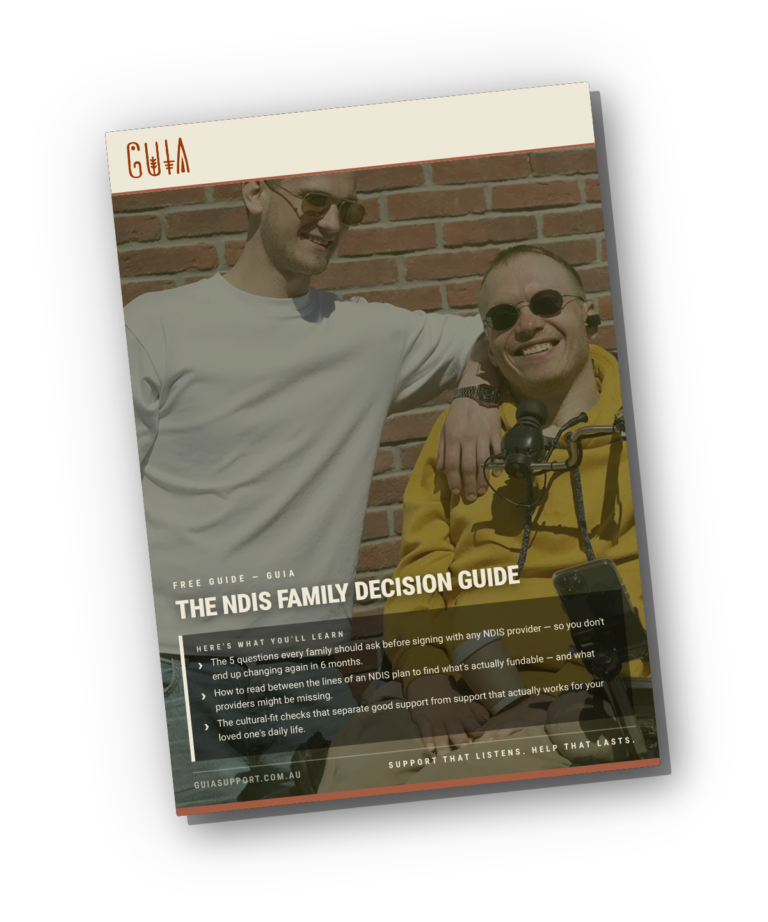
Here's What You'll Learn:
The 5 questions every family should ask before signing with any NDIS provider — so you don't end up changing again in 6 months.
How to read between the lines of an NDIS plan to find what's actually fundable — and what providers might be missing.
The cultural-fit checks that separate good support from support that actually works for your loved one's daily life.
NDIS support for neurological disability in South West Sydney
A neurological condition affects more than just the person living with it. You’re managing appointments, medication changes, fatigue patterns, and how those ripple through work or study. Your family is tracking the same things, often from a distance, wondering if the support you’re getting actually fits what’s happening week to week. When support feels disconnected — when one worker doesn’t know what the last one did — that gap lands on you.
Coordinated care means everyone involved knows the plan and stays with it; you get consistency and dignity as a capable adult directing your own support. Your family gets the continuity and safeguards they need to step back and trust the system is holding. That’s the difference between support that works in theory and support that actually works in your life.
Read More - See what consistent support actually feels like
Neurological conditions affect energy, movement, and how your body responds to activity — and that reality changes what support actually looks like. If you’re living with a neurological disability, you need help that understands fatigue isn’t laziness, that pacing matters more than pushing through, and that some days your needs shift. If you’re supporting a family member with a neurological condition, you’re often managing unpredictability while trying to keep them independent. The NDIS — National Disability Insurance Scheme funds support for exactly this — but only if the provider knows how neurological disability actually works day to day.
What changes for you as a participant is having a support worker who recognises when you need to rest, not push. Someone who shows up consistently so your routine stays stable — because routine protects energy in ways “support sessions” don’t. Your family sees something different: a trained worker who understands your loved one’s condition well enough to spot early warning signs of fatigue or decline, and who communicates those changes back to you. That’s not just reliability; that’s partnership.
The mechanism here is simple but essential. Neurological conditions often involve fatigue that doesn’t match effort — you can rest all day and still wake exhausted. A support worker trained in pacing and fatigue management doesn’t fight that reality. Instead, they build your day around what’s actually sustainable. They break tasks into smaller steps, watch for signs you’re overextended, and adjust in real time. This isn’t about doing less; it’s about doing what matters without triggering a crash that sets you back weeks.
Your support might include help with daily living tasks that preserve your energy for what you choose to do — personal care, household management, or preparation for community activities. Some participants benefit from support coordination to navigate how their condition and funding interact, or from allied health like exercise physiology designed specifically for neurological conditions where standard fitness doesn’t apply. The right combination depends entirely on your condition, your goals, and what your NDIS plan covers. We match you with workers trained for your specific needs, not disability support. Over time, NDIS — Improved Health and Wellbeing and NDIS — Home Modifications compound naturally alongside Neurological Disability — together they build the daily rhythm and outward connections that make real independence stick.
What good support for neurological disability looks like
Neurological disability often means managing symptoms that shift day to day, alongside support needs that don’t fit neatly into standard categories. You’re making decisions about your own care while your family worries whether the right person will show up, understand what you actually need, and stick around long enough to learn your rhythms.
When NDIS support for Neurological Disability South West Sydney is coordinated properly, that tension eases. You get to stay in the driver’s seat of your own life while your family knows someone reliable is backing you up—someone trained, consistent, and genuinely there to help you build the independence and confidence that matter to you.
Read More - Come and talk through what could work for you and your family
Neurological conditions affect how your body and brain communicate—and that means support needs to adapt as symptoms and energy levels change. When you’re living with a neurological disability, some days feel manageable; others bring fatigue, pain, or unpredictable changes that make daily tasks harder. Your family watches this variability and worries about consistency. The NDIS — National Disability Insurance Scheme funds support that’s built to move with you, not against you.
What makes the difference is support workers who understand pacing and fatigue management—not just showing up on time. When a support worker knows that pushing through exhaustion makes tomorrow worse, they help you stay within your window instead of depleting your energy reserves. You get to say “I need a quieter day” without guilt, and the plan adjusts. Your family sees someone who treats your condition as real, not as something you should just push past.
Neurological disabilities often mean coordinating care across multiple needs at once—mobility, fatigue, pain, cognitive changes, or communication differences. One support worker managing household tasks while you’re managing your own symptoms creates gaps. The right approach brings different skilled people into your home when you need them, with clear communication between them so nothing falls through the cracks. Your worker knows what the physio recommended last week and why pacing matters this week.
Here’s what that looks like in practice: a support coordinator helps you map what’s changing in your condition and what you actually need help with right now—not what you needed six months ago. That coordinator connects you with workers trained in fatigue-aware support and links you to allied health when movement or wellness becomes part of your plan. Over time, as your condition evolves, the support adjusts without you having to fight for changes or rebuild relationships with new providers. Over time, NDIS — Improved Health and Wellbeing and NDIS — Home Modifications compound naturally alongside Neurological Disability — together they build the daily rhythm and outward connections that make real independence stick.
You deserve support that treats you as the expert on your own body and your own life. Your family deserves consistency, reliability, and workers who show up understanding that neurological disabilities are real, variable, and worth taking seriously. When you’re ready to explore what coordinated, adaptable support looks like for your situation, Enquire about support.
What happens when neurological support gets delayed or missed
A neurological condition can mean managing multiple systems at once—your own changing needs, your family’s concerns, your NDIS plan, and the providers you’re trying to coordinate. When support isn’t joined up, you end up repeating your story to different people, or your family member carries all the continuity in their head because nobody else does.
Real NDIS support for neurological disability means someone shows up who understands both what you need today and what your family needs to feel confident about tomorrow. That’s when you stop managing the support and start living with it.
Read More - See what consistent, tailored support actually looks like in practice
Neurological conditions often mean your energy, attention, and physical capacity shift day to day. You might feel capable one morning and exhausted the next. Your family watches this unpredictability and worries about gaps in support when you need it most. That’s where coordinated NDIS support makes the difference. Rather than juggling multiple providers with different schedules and approaches, you get one team that understands how your condition affects you — and adjusts accordingly. The NDIS — National Disability Insurance Scheme funds this kind of tailored help, but only if your provider knows how to deliver it.
What good support looks like in practice: a worker who arrives on Tuesday at 2pm knowing you often hit an energy wall mid-afternoon, so they handle the heavier household tasks first. They don’t treat fatigue as laziness or expect you to push through. They pace the visit around what your body can manage that day. Your family stops holding their breath waiting for cancellations or workers who don’t understand why you need to rest. Instead, they see consistency — the same trained person, showing up reliably, adapting in real time.
Neurological disabilities often involve unpredictable symptoms and changing support needs. A provider who works only from a rigid plan fails you both. Good support coordination means your NDIS plan gets reviewed and adjusted as your condition evolves — not every five years, but when it matters. If you develop new symptoms or your mobility changes, the support shifts with you; your family isn’t left scrambling to find new providers mid-crisis. The team already knows you and can pivot.
Guia’s support coordinators and in-home care workers are trained to recognise fatigue patterns, pacing strategies, and the invisible nature of many neurological conditions. We work with you to build routines that protect your energy, not drain it. Our staff speak English, Arabic, and Spanish — so if language support matters to you or your family, that’s built in from day one. We’re NDIS-registered and Code of Conduct compliant, which means your safeguards are real. Over time, NDIS — Improved Health and Wellbeing and NDIS — Home Modifications compound naturally alongside Neurological Disability — together they build the daily rhythm and outward connections that make real independence stick.
The difference between feeling managed and feeling supported comes down to one thing: whether your provider sees you as a person with changing needs, or a task list to tick off. You deserve to direct your own life and make choices about the support you receive. Your family deserves to trust that the people showing up understand what neurological disability actually means — not just the diagnosis, but the daily reality. When you’re ready to explore what that looks like for you, Enquire about support.
How neurological disability support actually works
Neurological disability often means managing multiple appointments, shifting energy levels, and changing support needs—sometimes week to week. When you’re directing your own NDIS plan, or when you’re the family member helping coordinate care, you need support that actually keeps pace with what’s happening now, not what happened last month.
The right support means you’re not starting from scratch every time you meet a new worker. It means your preferences, your routines, and what matters most get carried forward consistently. When coordination happens behind the scenes, you stay in control—and that’s where real independence begins.
Read More -Send us a quick enquiry about your support needs
Send us a quick enquiry about your support needs
Neurological conditions change over time, and so do your support needs. One day you might manage fatigue well; the next, a relapse shifts what’s possible. If you’re directing your own NDIS plan, you need support workers who understand this variability — not providers who assume your needs stay static. For families, this means finding someone reliable enough to adapt without requiring constant renegotiation. The NDIS — National Disability Insurance Scheme funds support that flexes with your condition, but only if your provider is trained to recognise pacing, fatigue patterns, and the difference between a bad day and a genuine change in capacity.
What this looks like in practice: a support worker who shows up knowing your baseline, notices when energy is lower than usual, and adjusts the session without making you feel like a burden. They don’t push through fatigue because “we had this planned. ” They know that respecting your body’s signals today means you’ll have more capacity tomorrow. For you as a participant, this means reclaiming some control — you’re not managing around the provider; the provider is managing around you. For families watching from the sidelines, it’s the difference between trust and constant vigilance.
Many neurological conditions involve unpredictable symptoms — MS, acquired brain injury, Parkinson’s, autoimmune encephalitis, and others all carry this signature. Some days coordination is fine; other days it isn’t. Some weeks cognitive fog is mild; others it’s severe. Standard support training doesn’t teach workers to read these shifts or to understand that pacing isn’t laziness — it’s strategy. Guia’s support workers are trained specifically in fatigue management and how different neurological conditions present day-to-day. That training means fewer surprises and more dignity for you.
Coordinated care across complex needs is where support really matters. If you’re managing multiple symptoms — fatigue, pain, cognitive changes, mobility shifts — you need someone who can hold the whole picture, not just the task in front of them. Support Coordination helps you navigate what services fit your plan and how to sequence them so one doesn’t exhaust you before the next begins. Allied Health and Wellness services, like Exercise Physiology, can be designed specifically for neurological conditions, building capacity without triggering crashes. The goal is coherence, not just coverage. Over time, NDIS — Improved Health and Wellbeing and NDIS — Home Modifications compound naturally alongside Neurological Disability — together they build the daily rhythm and outward connections that make real independence stick.
When your condition is unpredictable, consistency matters more than intensity. You need support workers who know your patterns, respect your pace, and show up reliably so you can build confidence in what’s possible. That’s what Guia builds — support tailored to how neurological disability actually works, not how NDIS marketing describes it. If you’re ready to explore what this kind of support looks like for you or your family member, Enquire about support.
What real support looks like in practice
Neurological disability brings changes that ripple across every part of life — movement, fatigue, memory, mood, confidence. You might find yourself managing symptoms that shift day to day, while your family watches and worries about what support actually holds up over time. What matters most is not just help with today’s task, but coordinated care that understands how everything connects.
When support workers, coordinators, and your own goals all move in the same direction, something shifts. You feel less like a project being managed and more like a person making real decisions; your family stops being the only person holding all the information. That’s the kind of NDIS support for Neurological Disability South West Sydney that actually changes how independent and confident you feel.
Read More - Get in touch when you're ready to explore what consistent support looks like
Neurological conditions change over time, and so do the needs of the person living with them. Your support needs today might shift next month — fatigue might worsen, mobility might fluctuate, or new symptoms might emerge. When you’re choosing an NDIS provider, you need someone who understands this reality and builds flexibility into every plan. That’s the foundation of how we approach NDIS — National Disability Insurance Scheme support for people with neurological disability across South West Sydney.
For you as a participant, this means your support worker isn’t rigidly following a script — they’re reading your energy levels, noticing when fatigue is hitting harder, and adjusting the pace of activities without you having to explain yourself every time. For your family member, it means knowing that the person supporting your loved one has been trained to recognise pacing and fatigue management, not just task completion. Good support adapts in real time, not just when you request a formal plan review.
Neurological conditions often involve invisible symptoms — fatigue, cognitive load, pain, or sensory sensitivity that don’t show on the surface. A support worker trained in these dynamics understands why your loved one might need a quiet break mid-morning, or why a task that seemed manageable last week feels overwhelming today. This isn’t inconsistency; it’s responsiveness to the actual lived experience of a changing condition. The mechanism is simple: awareness prevents frustration and helps the person stay in control of their own support.
Coordinated care matters because neurological conditions often involve multiple moving parts — exercise physiology for mobility, support coordination to navigate your plan, and daily living assistance that respects your energy budget. When these services work together rather than in isolation, you avoid the exhaustion of repeating your story or managing conflicting advice. Your support coordinator and your support workers stay aligned on what’s working and what needs to shift. We provide in-home daily living support, exercise physiology, and support coordination as integrated services, not separate transactions. Over time, NDIS — Improved Health and Wellbeing and NDIS — Home Modifications compound naturally alongside Neurological Disability — together they build the daily rhythm and outward connections that make real independence stick.
Your family’s role is real and important — you know your loved one better than anyone, and good support honours that without making you the gatekeeper. You deserve clarity on what’s happening, confidence that the person supporting your family member is trained and reliable, and the peace of mind that comes from seeing real consistency week to week. When you’re ready to explore what that looks like in practice, Enquire about support.
How to know support is making a real difference
Neurological conditions often mean managing multiple symptoms that shift day to day—fatigue, mobility changes, cognitive effects, or pain that affects what you can do. For you as a participant, that means your support needs aren’t static; they change week to week. For your family, it means watching those changes and wondering whether the support you’ve arranged will actually adapt when things shift.
When support is coordinated—when your support worker, your coordinator, and your family are all tracking the same picture—those shifts become manageable instead of chaotic. You stay in control of your own decisions; your family gets the consistency and safeguards they need. That’s the foundation that lets independence actually grow.
Read More - See how other families in South West Sydney got the support that stuck
Neurological conditions mean your needs can shift week to week. Fatigue, pain, or mobility might change depending on the day. You need support that adapts to that reality, not a fixed schedule that ignores it. Your family needs to know the people helping you understand those shifts too. That’s where coordinated care makes the difference. When your support worker, your family, and any allied health professionals are aligned on what you actually need right now, energy goes to living your life instead of managing confusion. The NDIS — National Disability Insurance Scheme funds this kind of flexibility, but only if the provider you choose is built to deliver it.
What that looks like in practice: a support worker who knows your pacing limits and checks in before pushing a full day of activities. Someone who notices when fatigue is creeping in and adjusts without you having to explain it again. Your family sees consistency in that approach, not a different person every week with different ideas about what you can manage. Over time, you build real confidence in your own body’s signals instead of second-guessing yourself. That confidence compounds. You start making clearer decisions about what you actually want to do, and the support just fits around it.
Training matters here. Support workers who understand neurological disability know that pushing through fatigue isn’t strength—it’s a path to setback. They’re trained in pacing strategies, fatigue management, and how to read the early signs that your body needs rest. That training isn’t disability knowledge; it’s specific to how neurological conditions behave. Your family gains real peace of mind knowing the person supporting you isn’t going to accidentally set you back by overestimating what’s realistic on any given day. This is how support becomes genuinely protective rather than just present.
As your condition evolves—and neurological disabilities often do—your support needs to evolve with it. Some days you might need help with personal care and daily living tasks. Other seasons might call for more community access support or employment assistance as your capacity changes. The right provider doesn’t make you start from scratch each time. They adjust the team, the hours, and the focus without losing the continuity you’ve built. Support Coordination helps you navigate those shifts, and Employment & Capacity Building steps in when you’re ready to explore work or greater independence. Over time, NDIS — Improved Health and Wellbeing and NDIS — Home Modifications compound naturally alongside Neurological Disability — together they build the daily rhythm and outward connections that make real independence stick.
You deserve support that treats you as a capable adult making your own decisions, and your family deserves to know that consistency and safeguards are built into how we work. Guia has been supporting people across South West Sydney since 2022, and we’re NDIS-registered with all staff qualified and worker-screened. We speak English, Spanish, and Arabic, and we match support workers to you based on what actually matters—not just availability. When you’re ready to explore how this kind of coordinated, adaptive support could work for you, Enquire about support.
Building confidence and independence over time
Neurological disability often means managing changes that ripple across daily life—fatigue, memory shifts, balance challenges, or unpredictable good and difficult days. When you’re the participant, you need support that respects your capacity on any given day. When you’re the family member, you need consistency you can count on and someone who notices what actually matters to your loved one.
The right NDIS support for neurological disability in South West Sydney coordinates around those real rhythms instead of forcing you into a schedule that doesn’t fit. You stay in control of your decisions. Your family gets the continuity and reliability that lets them breathe. That’s where genuine independence begins.
Read More - Start with a conversation about what consistent support could mean for you both
Neurological conditions change over time — sometimes week to week. Your energy levels, mobility, or cognitive clarity might shift unpredictably, which means the support you need today won’t be identical to what you’ll need in three months. When you’re researching NDIS — National Disability Insurance Scheme support options, you’re looking for a provider who understands this reality and builds flexibility into how they work with you. support models that treat every participant the same don’t account for the variability that defines neurological disability. What changes is not just the level of help — it’s the approach, timing, and pacing.
Here’s what that looks like in practice. If you’re managing fatigue, a support worker trained in pacing strategies doesn’t just show up and complete tasks. They work alongside you to structure the day so energy is spent on what matters most to you. They understand that pushing through fatigue often makes tomorrow harder, not easier. For your family, this means less worry about whether support is actually helping or accidentally making things worse. You see your loved one respected as someone with expertise about their own body — not managed by someone following a checklist.
Coordination across your needs is the mechanism that makes everything else work. If you’re receiving exercise physiology support for movement and personal care at home, those services need to talk to each other. A support worker who knows your physio’s goals can reinforce them during daily activities. Your family doesn’t have to become the translator between providers. This kind of joined-up thinking prevents the fragmentation that often happens when multiple services operate in silos, each unaware of what the others are doing or what you’ve already told them.
Guia supports people with neurological disability through in-home daily living and personal care support, community access and social participation, and support coordination that keeps everything connected. We’re registered with the NDIS and our team includes staff trained in fatigue management, pacing, and the communication patterns that matter for different neurological conditions. When your condition shifts — and it will — your support adjusts with it, not against it. We’ve been operating since 2022 and we’re built on lived experience of disability and family caregiving, which means we’re not learning on the job. Over time, NDIS — Improved Health and Wellbeing and NDIS — Home Modifications compound naturally alongside Neurological Disability — together they build the daily rhythm and outward connections that make real independence stick.
If this approach to support — flexible, coordinated, and built on understanding how neurological disability actually works — sounds like what you’re looking for, here’s the next step. Reach out and tell us what’s happening for you right now. We’ll listen to both what you need and what your family needs, and we’ll be honest about whether we’re the right fit.
How to get started with NDIS support
A neurological disability often means managing symptoms that shift day to day—fatigue, pain, cognitive changes, or mobility that isn’t consistent. Your family member needs support that tracks these changes, not a rigid schedule that ignores them. You both need someone who shows up understanding that good care means flexibility, not just reliability.
When NDIS support for Neurological Disability in South West Sydney actually listens to what changes and what stays the same, something shifts. You feel less like you’re managing a problem and more like you’re building a life that works around your real needs. Your family stops worrying about gaps in continuity and starts seeing progress in the small things—independence growing where it matters most to you.
Read More - Start with a conversation about what consistent support could mean for you both
Neurological conditions affect how your body and brain communicate. Fatigue, tremor, balance changes, or unpredictable symptoms can make everyday tasks harder to plan. If you’re living with a neurological disability, you need support workers who understand pacing, not just task completion. Your family needs to know that consistency matters—the same person showing up at the same time, who learns your patterns and adapts when your condition fluctuates. The NDIS — National Disability Insurance Scheme funds this kind of personalised, reliable help across South West Sydney.
What changes for you as a participant is control. Instead of managing around a support worker’s schedule or energy, you direct the support to fit your actual day. Some mornings you’ll have more fatigue; a good support worker adjusts without making you justify it. For your family, what shifts is the burden of constant vigilance. You’re not the only person watching for safety risks or managing medication timing. Reliable, trained support means your family can step back from crisis-mode into a genuine carer role.
Coordinated care across complex needs is the mechanism that makes this work. When your support worker understands neurological disability—not as a single diagnosis but as a pattern of fatigue, unpredictability, and changing capacity—they can anticipate what you’ll need before you ask. They know when to push gently and when to pause. They communicate with your other providers (therapists, doctors, coordinators) so nothing falls between cracks. This continuity prevents the exhausting cycle of re-explaining yourself to every new person.
Here’s what that looks like in practice. A two-hour Tuesday morning support visit might start with personal care, then shift to help with a community outing if your energy allows—or rest at home if fatigue is high that day. Your support worker tracks patterns over weeks, so your family and you both see what actually works. Guia’s team includes workers trained in fatigue management and pacing strategies, matched to you personally rather than assigned by roster. We also connect you with community participation programs and employment support if that’s part of your plan as your condition stabilises or changes. Over time, NDIS — Improved Health and Wellbeing and NDIS — Home Modifications compound naturally alongside Neurological Disability — together they build the daily rhythm and outward connections that make real independence stick.
Adaptable support as conditions evolve means your plan isn’t locked into a single approach. Neurological conditions can improve, stabilise, or shift—and your support adjusts with you. You’re not fighting your provider to recognise the change; they’re already watching for it. When you’re ready to explore what good support looks like for your situation, Enquire about support.
Guia Is Trusted By NDIS Participants, Families And Support Coordinators
Imagine a life designed to empower you!




NDIS Participants South West Sydney Choose Guia
When your family member has a neurological disability, you need support that understands the specific challenges they face. You need a provider who listens to what matters most to you both, then builds a plan around that reality. Guia specialises in NDIS support for neurological disability across South West Sydney because we’ve learned that person-centred matching and reliability matter more than promises. We’re here to be the steady system behind your decisions, not to make them for you.
Person-Centred From the First Conversation
When you’re managing a neurological condition, consistency matters—your body knows what to expect. We listen first to understand your goals, then match you with the same support worker who learns your rhythms, your needs, your pace. That reliability means less stress for you and your family, and more energy for what actually matters in your day.
Reliable Consistency Every Single Visit
Routine matters when you’re managing a neurological condition. The same support worker at the same time each week means your home stays predictable. No strangers, no relearning your needs, no cancelled shifts. Families tell us this consistency lets them breathe—they plan their week knowing we’ll be there. That reliability builds trust, and trust builds the foundation for real support.
Culturally Diverse, Multilingual Team
When your support worker speaks your language and understands your culture, everything feels less like a service and more like genuine care. Our multilingual team delivers support in English, Spanish, or Arabic—matched to your background and preferences. You’re not explaining yourself constantly. Your faith, your routines, your way of doing things are already respected. That’s how we build trust and make support feel personal.
Six Years of South West Sydney Experience
Finding support workers who understand your community matters. We’ve been supporting people with neurological disability across South West Sydney since 2022, so your support team knows the local connections, routines, and opportunities that fit your life. That familiarity builds trust fast. You’re not starting from scratch with each new worker—you’re building on relationships that already know your neighbourhood and your needs.
NDIS Quality and Safeguards Commission Compliant
When your support worker changes every week, routines fall apart. We’re NDIS Commission-registered and audited, which means every staff member holds current screening clearance and training. More importantly, it means consistency—the same trained person shows up on your schedule, every time. Your routine stays steady. You build real trust. That’s the foundation everything else rests on.
Word-of-Mouth Referrals Build Trust
Families who support someone with neurological disability often find us through other families. That word-of-mouth trust matters because it means real people have already tested whether we show up reliably, match support workers thoughtfully, and treat their loved one with dignity. When you choose Guia, you’re choosing a provider whose reputation is built on families like yours.
READY FOR A FREE PLAN MANAGEMENT REVIEW?
Find Unused Funding
Fix Budget Confusion
Plan Supports Better
FAQs For Neurological Disability
What NDIS support can help with neurological disability?
NDIS support for neurological disability in South West Sydney covers daily living assistance, community participation, employment support, and specialist coordination. We help adults with neurological conditions build independence and stay connected to community through person-centred support matched to your specific needs.
Whether you’re managing the support yourself or a family member is helping you navigate options, we work with both of you. Our team provides reliable in-home care, help accessing community activities, and support coordination that explains your plan in plain language. We’re NDIS-registered and multilingual, so language or cultural background won’t be a barrier.
Enquire about support — find out how Guia can help with neurological disability.
What NDIS support is available for neurological conditions?
Neurological disability under the NDIS covers conditions affecting the brain, spinal cord, or nervous system — stroke, Parkinson’s, MS, acquired brain injury, and similar conditions. NDIS support for Neurological Disability in South West Sydney helps you manage daily tasks, build independence, and stay connected to your community at the level that suits you.
What that means in practice depends on what you need. Some participants need help with personal care and household tasks at home. Others want support to get out into the community, build confidence, or work toward employment. Families often value the consistency and reliability of regular support — knowing the same trained worker shows up on time, every time. We listen to both what you’re working toward and what your family needs for peace of mind.
Enquire about support — find out how Guia can help with Neurological Disability.
Can NDIS funding cover home modifications for neurological conditions?
Yes, NDIS funding can support home modifications for people with neurological conditions. The scheme covers physical changes that help you stay safe, independent, and connected at home. Whether it’s a ramp, handrails, bathroom adjustments, or assistive technology, modifications are funded when they’re part of your plan.
Here’s what that looks like in practice. You and your family work with your support coordinator to identify what needs to change in your home. Guia can help plan and deliver modifications across South West Sydney—from initial assessment through to installation and training. We listen to what matters to you both: your independence, your family’s peace of mind, and your daily routines staying intact.
Enquire about support — find out how Guia can help with Neurological Disability.
What mobility support can help with neurological disability?
NDIS support for neurological disability in South West Sydney includes mobility equipment, home modifications, and personal care tailored to your needs. A mobility solution might be a wheelchair, walking aid, or transfer equipment—matched to what actually works for your body and your home. Support workers trained in your specific needs help you use equipment safely and maintain independence.
Here’s what that looks like in practice: you work with us to identify what stops you moving around safely—whether that’s stairs, transfers, or getting out into the community. We arrange equipment with proper training, modify your home if needed, and provide reliable support workers who show up consistently. Your family stays informed throughout, and you remain in control of your choices every step.
Enquire about support — find out how Guia can help with neurological disability.
What is exercise physiology and how can it help me?
Exercise physiology is movement therapy designed by accredited exercise physiologists. It helps people with neurological disability build strength, balance, and confidence through tailored physical activity. NDIS support for neurological disability in South West Sydney includes exercise physiology matched to your specific goals and body.
Here’s what that looks like in practice: an exercise physiologist works with you to understand what matters most—whether that’s walking further, managing fatigue, or simply feeling stronger day-to-day. Your family can be part of those conversations, knowing the programme is built on your needs, not a plan. Sessions happen regularly, so you build real progress over time.
Enquire about support — find out how Guia can help with neurological disability.
What happens to my support if my neurological condition changes or flares?
Yes, NDIS support can adapt when your neurological condition progresses or flares. Your support plan isn’t fixed—it’s designed to flex with your actual needs, whether that means more hours during a difficult period or adjusted tasks as your energy or ability shifts.
Here’s what that looks like in practice: if you’re managing your own plan, you can request a plan review with the NDIA when things change. If a family member helps you navigate decisions, they’re part of those conversations too. We work with you both to understand what’s shifted and how your support needs to change—whether that’s different timing, different tasks, or a temporary boost in hours. Consistency matters, so we aim to keep the same support workers where possible, because they know your routines and what helps you feel steady.
Enquire about support — find out how Guia can help with Neurological Disability.
How do I start with NDIS support for my neurological condition?
Your NDIS plan is created by the NDIA, not by us — but we help you navigate what’s in it and find the right support to match your changing needs. For progressive neurological conditions, this means regular check-ins and flexibility as your circumstances shift. NDIS support for neurological disability in South West Sydney works best when you’re clear about what matters most to you right now.
Here’s what that looks like in practice: you direct your plan and choose your support workers. Your family or carer can be part of those conversations if you want them there. We match you with someone who understands your condition, respects your independence, and shows up consistently — because reliability matters when you’re managing a progressive condition. When circumstances change, we adjust with you.
Enquire about support — find out how Guia can help with neurological disability.
What community activities and outings can I access through my NDIS plan?
Community participation supports for adults with neurological disability focus on building real connections and confidence at your own pace. NDIS support for neurological disability in South West Sydney includes group activities, social outings, and transport that gets you where you want to go. We design these around what matters to you, not what we think you should do.
What we hear from families is that consistency and reliability matter most. You need a support worker who shows up on time, knows your routines, and treats you as a capable adult making your own choices. Our team includes Spanish-speaking and Arabic-speaking workers across South West Sydney, so language and cultural match are real options, not afterthoughts. When you’re ready to explore what this looks like for you, we can talk through your goals and build something that works.
Enquire about support — find out how Guia can help with neurological disability.
Does NDIS cover wheelchairs, walkers, and mobility equipment?
Yes, NDIS funding can cover personal mobility equipment like wheelchairs, walkers, and transfer aids. If your NDIS plan includes funding for mobility equipment, you can choose a registered provider to assess, supply, and train you on using the right equipment for your needs.
Here’s what that looks like in practice: a support worker visits your home, understands how you move around and what you need day-to-day, then helps you access equipment that actually fits your life. We handle the paperwork, make sure everything is fitted properly, and train you and your family on maintenance and safety. You’re in control of the choice — we’re here to make it straightforward.
Enquire about support — find out how Guia can help with Neurological Disability.
How do we set up NDIS support for neurological disability?
Starting an NDIS plan focused on neurological disability support begins with contacting the NDIA directly. They’ll assess your eligibility and goals, then fund supports that match your needs. NDIS support for neurological disability in South West Sydney includes daily living assistance, community participation, and specialist coordination to help you navigate your plan.
Whether you’re the person receiving support or a family member helping with the process, both perspectives matter. You’ll work with a support coordinator who speaks your language and understands your situation. They help match you with reliable workers who show up on time and respect your routines and choices. Guia’s team includes staff trained in neurological support, with multilingual capacity in English, Spanish, and Arabic across South West Sydney.
Enquire about support — find out how Guia can help with neurological disability.
Reach out for a non-obligation NDIS Plan Management Assessment
ARE YOUR NDIS SUPPORTS WORKING FOR YOU?
GET A FREE NDIS PLAN MANAGEMENT REVIEW