
NDIS support for Intellectual Disability South West Sydney
NDIS support for Intellectual Disability South West Sydney
Support That Listens: NDIS Support for Intellectual Disability South West Sydney
NDIS support for Intellectual Disability South West Sydney
NDIS support for Intellectual Disability South West Sydney
Support That Listens: NDIS Support for Intellectual Disability South West Sydney
ARE YOUR NDIS SUPPORTS WORKING FOR YOU?
GET A FREE NDIS PLAN MANAGEMENT REVIEW
NDIS support for Intellectual Disability South West Sydney means different things depending on who you are. If you’re an adult with an intellectual disability, you’re looking for support that treats you as capable of making your own choices about your life and your plan. If you’re a family member or carer, you’re often the first to research, and you need to know that any provider you choose will respect your loved one’s independence while providing the consistency and safeguards that matter to you both. We support people with intellectual disability across South West Sydney—in your suburb, at your pace, in a way that works for your life.
This page covers what NDIS support for people with intellectual disability actually looks like in practice, the services we offer, and how to take the next step when you’re ready. We’re NDIS-registered and our team speaks English, Spanish, and Arabic—because the families and participants we work with across Cumberland and Canterbury are diverse, and language shouldn’t be a barrier to good support. You’ll find details about how we match support workers, what happens in your first conversation with us, and how the NDIS itself works if that’s new to you. If you want to explore what support could look like for you or your family member, scroll down or get in touch.
NDIS support for Intellectual Disability South West Sydney means different things depending on who you are. If you’re an adult with an intellectual disability, you’re looking for support that treats you as capable of making your own choices about your life and your plan. If you’re a family member or carer, you’re often the first to research, and you need to know that any provider you choose will respect your loved one’s independence while providing the consistency and safeguards that matter to you both. We support people with intellectual disability across South West Sydney—in your suburb, at your pace, in a way that works for your life.
This page covers what NDIS support for people with intellectual disability actually looks like in practice, the services we offer, and how to take the next step when you’re ready. We’re NDIS-registered and our team speaks English, Spanish, and Arabic—because the families and participants we work with across Cumberland and Canterbury are diverse, and language shouldn’t be a barrier to good support. You’ll find details about how we match support workers, what happens in your first conversation with us, and how the NDIS itself works if that’s new to you. If you want to explore what support could look like for you or your family member, scroll down or get in touch.
The NDIS Family Decision Guide
Helping Australian families make confident NDIS decisions for the person they care about — without the jargon, the runaround, or the regret.
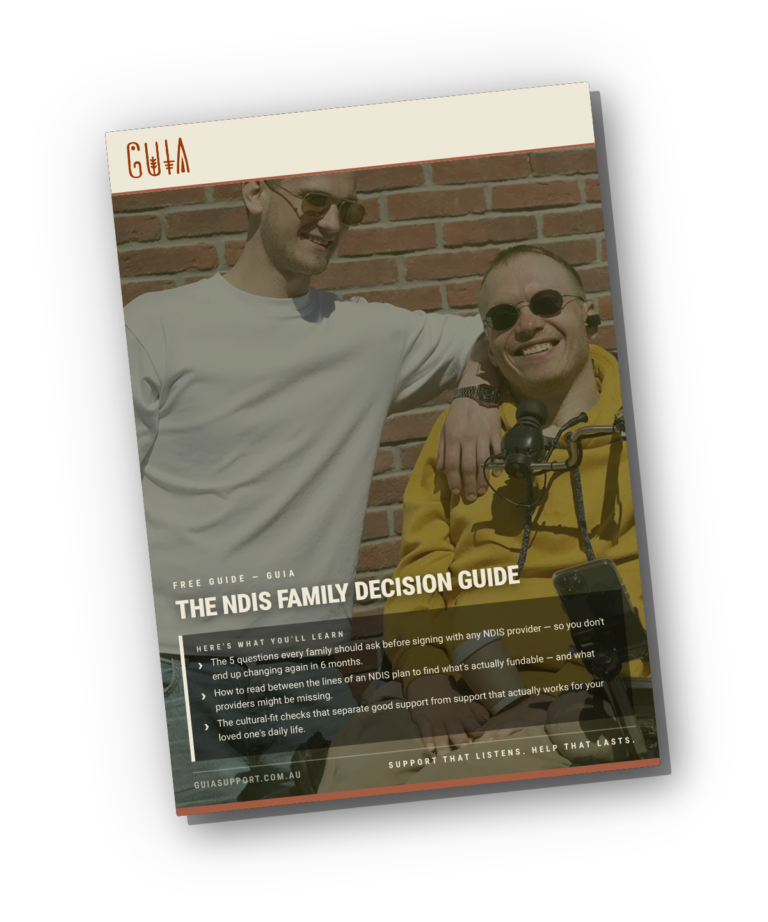
Here's What You'll Learn:
The 5 questions every family should ask before signing with any NDIS provider — so you don't end up changing again in 6 months.
How to read between the lines of an NDIS plan to find what's actually fundable — and what providers might be missing.
The cultural-fit checks that separate good support from support that actually works for your loved one's daily life.
NDIS support for intellectual disability South West Sydney
You’re reading about support for your loved one, but the page keeps talking about them instead of to them. That gap—between what a participant needs to decide for themselves and what families need to know will actually happen—is where real frustration starts.
When support workers show up consistently, speak plainly about what’s changing week to week, and treat your family member as someone steering their own life, everything shifts. That’s when families can step back from managing every detail, and participants feel genuinely in control.
Read More - See what consistent support actually feels like
When you’re looking for support that treats you as a capable adult—not as a project to be managed—the starting point matters. Many people with intellectual disability find themselves spoken about rather than spoken to. Family members often become gatekeepers by default, not by choice. NDIS — National Disability Insurance Scheme funding opens the door to real choice, but only if the provider you choose actually listens to what you want your life to look like.
Here’s what that looks like in practice: A support worker who arrives on Tuesday at 2 p. m., remembers your routine without being reminded, and asks you what you want to do—not your family. A provider that speaks to you directly about your goals, your pace, and your preferences; communication in plain language, not jargon. Consistency that builds your confidence over weeks and months, not promises that sound good on a website.
The mechanism is simple. When support is reliable and respectful, you build trust. When a support worker knows your routines and respects them, you feel safer taking small steps toward independence. When someone listens to what matters to you—not what a clinical assessment says should matter—you’re more likely to try new things. That’s how real confidence grows: through small, repeated experiences of being heard and supported.
We work with participants and families across South West Sydney who need exactly this kind of support. In-home daily living assistance, community access that gets you out and connected, and employment support if you’re ready to build toward work—all matched to your pace and your goals. We’re NDIS-registered, all our staff are qualified and screened, and our team speaks English, Spanish, and Arabic. We’ve been operating since 2022, founded on lived experience of disability and family caregiving. Over time, NDIS — Daily Living Supports and NDIS — Social and Community Participation compound naturally alongside Intellectual Disability — together they build the daily rhythm and outward connections that make real independence stick.
If this kind of support—where you’re heard, respected, and treated as the expert in your own life—sounds like what you’re after, the next step is straightforward. A conversation with us costs nothing. We’ll listen to what matters to you and your family, answer your questions in plain language, and help you figure out if we’re the right fit.
What good support actually looks like
When you’re supporting someone with an intellectual disability, you need a provider who speaks to both of you—not about you. Too many support services treat the participant like a project to manage, leaving families unsure where their concerns fit. Or they speak only to the person receiving support, which can actually reinforce the very dependency everyone’s trying to reduce.
Real support means the participant feels respected as a capable adult making their own decisions, while families get the consistency, reliability, and safeguards they need to trust the arrangement. That’s when independence actually grows—when both voices matter equally from the start.
Read More - Come talk through what could work for you
Good support for people with intellectual disability speaks to you, not about you. It treats you as the decision-maker in your own life, while reassuring your family that consistency, safeguards, and clear communication are built in. The NDIS — National Disability Insurance Scheme funds this kind of support, but not all providers deliver it the same way. What matters is whether the people showing up understand your pace, your preferences, and what builds your confidence over time.
When support works well, you notice it in small things. A support worker who arrives on time, remembers how you like your coffee, and doesn’t rush you through your morning routine. A family member who feels confident leaving the house because they know the support is reliable and respectful. Routines that stay consistent week to week, so you build trust and independence rather than starting fresh each time. That’s the difference between a provider who shows up and one who genuinely understands what good looks like.
Building your skills happens at your pace, not on a timetable someone else set. This means support workers who can explain things clearly, give you time to practise, and celebrate the small wins without making a fuss about it. It means your family can see progress without pressure to move faster; the mechanism is simple: when you feel safe and unhurried, you learn. When you’re rushed or confused, you shut down. Good support creates the conditions for the first one to happen consistently.
Guia provides in-home daily living support, community access, and life stage transition help across South West Sydney. We match you with support workers who speak your language—literally and figuratively; our team is trained, screened, and committed to showing up reliably. We’ve been working with people and families since 2022, and we’re NDIS-registered and Code of Conduct compliant. The practical difference is that when you call us, you’re talking to people who’ve built their practice around dignity, not just service delivery. Over time, NDIS — Daily Living Supports and NDIS — Social and Community Participation compound naturally alongside Intellectual Disability — together they build the daily rhythm and outward connections that make real independence stick.
What happens when the right support comes too late
When you’re looking for NDIS support for intellectual disability in South West Sydney, you need someone who speaks to you both—the person receiving support and the family member making sure it’s the right fit. Too often, support providers talk about participants in third person, as though the decisions belong to everyone except the person living the life. That leaves you feeling sidelined, not heard.
When support is done right, the participant stays in the driver’s seat of their own choices, and the family gets the reliability and consistency they need to trust it. That’s the difference between a provider who manages a project and one who builds real independence over time. Here’s what matters: you both deserve to feel confident in what comes next.
Read More - See what consistent support actually feels like
When you’re directing your own NDIS plan as an adult with an intellectual disability, you need support that treats you as the decision-maker—not as someone being managed. Your family, meanwhile, needs to know that provider is reliable, communicates clearly, and actually listens to what matters most. That’s the gap most NDIS provider websites leave open. They talk about you in third person, or they speak only to your family, which reinforces the very dependency the support is meant to reduce. The NDIS — National Disability Insurance Scheme exists to give you control over your support—and the provider you choose should respect that from day one.
Here’s what that looks like in practice. A support worker shows up on time, every time—no last-minute cancellations that throw your routine off. They speak to you directly about what you need, not around you to your family member. They explain things in plain language, not jargon, so you both understand what’s happening and why. When routines matter—and they do—the same worker comes back consistently. That consistency builds confidence. You know what to expect. Your family knows they can rely on it. Over weeks and months, that reliability becomes the foundation for everything else.
The mechanism is straightforward. Intellectual disability support works best when communication is clear and routines stay stable. Clear communication means you understand your own plan, your choices, and what your support worker is there to do. It means your family isn’t left guessing about what’s happening or whether concerns will be heard. Stable routines mean you’re not spending energy adapting to a different worker or different approach each week—that energy goes toward building skills and confidence instead. When both are in place, participants develop a genuine sense of control. That’s empowerment, not in theory but in your actual day-to-day life.
The most common starting point is a conversation about what your typical week looks like and where support would make the biggest difference. That might be help with daily living tasks, building skills toward greater independence, or connecting with community activities that matter to you. NDIS — Daily Living Supports and NDIS — Social and Community Participation are often where participants see the most immediate change—not because they’re magic, but because they’re tailored to your pace and your goals. Your family member gets a realistic picture of what support looks like, how often it happens, and how progress actually shows up. Over time, NDIS — Daily Living Supports and NDIS — Social and Community Participation compound naturally alongside Intellectual Disability — together they build the daily rhythm and outward connections that make real independence stick.
When you’re ready to explore what good support actually feels like, we’re here to listen—to you and to your family. We’ve been supporting participants across South West Sydney since 2022, and we’re NDIS-registered with all staff qualified and worker-screened. We work in English, Spanish, and Arabic because language shouldn’t be a barrier to the support you deserve.
How NDIS support actually works for you
When you’re looking for support with intellectual disability, you need to know what actually changes for you or your family member—not just hear that a provider “delivers services. ” You need to understand how a support worker shows up on a Tuesday morning, what happens when plans shift, and how decisions stay in your hands, not someone else’s.
The right NDIS support for intellectual disability in South West Sydney means you’re not managed—you’re partnered with. Your family gets the reliability and continuity that lets them step back when they’re ready. You get to build real independence, at your own pace, with someone who knows your routines and respects your choices.
Read More -Send through a quick enquiry and let’s match you with the right support
Send through a quick enquiry and let’s match you with the right support
A person with intellectual disability deserves to be spoken to directly about their own life — not talked about as though they’re not in the room. That principle shapes everything we do. When you’re making decisions about your support, you need a provider who listens to you first and treats your choices as real. Your family needs confidence that this respect for your voice doesn’t mean less consistency or safety — it means more of both. The NDIS — National Disability Insurance Scheme funds support that should build your independence and capability over time, not reinforce dependency or create a gatekeeping dynamic between you and your family.
Here’s what that looks like in practice. When support workers arrive at your home, they know your routines, your preferences, and what matters to you — because we’ve taken time to listen. A consistent Tuesday morning visit isn’t just about getting tasks done; it’s about building trust and rhythm. Your family sees that reliability and knows you’re in steady hands. You feel less like a task list and more like a person whose day is being supported with actual attention to how you work best.
Plain-language communication is how we make this real. We explain your NDIS plan in words that make sense to you, not in funding-category jargon. We help your family understand what’s funded and what isn’t without turning the conversation into a compliance lecture. When you have a question about what support can do or how to ask for a change, you get a straight answer — not corporate language that forces you to keep asking until it clicks.
Skill-building happens at your pace, not a provider’s timeline. Whether that’s learning to manage daily tasks with less help over time, building confidence in community settings, or developing work-readiness skills, the support adapts as you do. We offer In-Home Daily Living and Personal Care Support that meets you where you’re, plus Employment and Capacity Building that grows with your goals. Your family can track real progress because we’re transparent about what we’re working on and why — no hidden agendas, no pressure to spend up to a funding limit. Over time, NDIS — Daily Living Supports and NDIS — Social and Community Participation compound naturally alongside Intellectual Disability — together they build the daily rhythm and outward connections that make real independence stick.
We’ve been supporting people across South West Sydney since 2022, and we’re registered with the NDIS and fully Code of Conduct compliant. Our team includes Arabic, Spanish, and English speakers, because the right support worker speaks your language — literally and culturally. When you’re ready to explore what good support actually feels like, Enquire about support.
What support works best for your situation
When you’re looking for support that actually listens to what you need—not what a support worker thinks you need—the difference shows up in small moments. You get a say in who comes to your home. Your family knows exactly what’s happening on Tuesday afternoons. Nobody talks about you in the third person while you’re standing there.
That’s the shift that matters. NDIS support for Intellectual Disability South West Sydney works best when the participant and their family move together, not when one person becomes the gatekeeper and the other becomes the project. When that happens, independence actually grows—because you’re building it on your own terms, with people you trust, and with your family confident that consistency and dignity are built in.
Read More - When you're ready, we're here to listen and work through what comes next
When you’re supporting someone with an intellectual disability, you need a provider who speaks to you both — not about you. Many families find themselves in conversations where the support worker talks around the participant, treating them as a project to manage rather than a person making their own decisions. That’s the opposite of what good support looks like. The NDIS — National Disability Insurance Scheme exists to fund support that builds your confidence and independence over time. It right provider makes that real by addressing you directly as a capable adult, while also reassuring your family that consistency, safeguards, and clear communication are built into every visit.
Here’s what that looks like in practice. You get a support worker who shows up on time, knows your routines, and explains what’s happening in plain language — not corporate jargon. Your family gets regular check-ins about what’s working, what’s changing, and what you’re building toward. The support isn’t about doing things for you; it’s about doing things with you at a pace that makes sense. Over time, that consistency builds real confidence. You start to know what to expect. Your family stops holding their breath wondering if today’s worker will be different from yesterday’s.
Many families tell us the biggest relief is knowing the person supporting their loved one has been properly trained and screened. It’s not a nice-to-have — it’s foundational. When your support worker understands how to communicate clearly, respects your routines, and has the skills to notice what matters to you, the whole relationship changes. You’re not managing a stranger every week. You’re building a partnership. That’s the mechanism behind real progress: reliability plus respect equals confidence, which then opens the door to skill-building and independence.
The practical side matters too. Whether you need help with daily living tasks, community access to build friendships, or support to develop new skills, the service has to match your actual life — not. In-home daily living and personal care support gives you flexibility and dignity. Community access and social participation helps you build real connections instead of staying isolated. Life stage transition support means you’re not left stranded when things change — school leaving, moving out, or ageing. Each service is built around what you actually need, not what fits the provider’s schedule. Over time, NDIS — Daily Living Supports and NDIS — Social and Community Participation compound naturally alongside Intellectual Disability — together they build the daily rhythm and outward connections that make real independence stick.
If this sounds like the kind of support you’re after — where you’re treated as a capable adult and your family feels confident in the consistency and safeguards — here’s what happens next. Guia has been supporting people with intellectual disability across South West Sydney since 2022, with staff who are qualified, screened, and trained to communicate in plain language. We’re NDIS-registered and Code of Conduct compliant, and we match support workers with real care for what matters to you. When you’re ready to explore what good support actually feels like, Enquire about support.
How to know support is making a real difference
Knowing whether the support is actually working means looking at real changes in your daily life—not just whether visits happen on time. You might notice your family member managing a task they couldn’t before, or feeling more confident in a situation that used to overwhelm them. For families, it’s about seeing genuine progress alongside the consistency and reliability you need to trust the arrangement. Neither of you should have to guess whether support is making a difference.
When NDIS support for Intellectual Disability South West Sydney is measured the right way, both you and your family member know exactly what’s shifting. You see skills building, routines becoming steadier, and independence growing at a pace that feels real. Your family sees a support worker who shows up, knows your loved one well, and can explain what’s happening in plain language. That’s when support stops feeling like something being done to you and starts feeling like something that’s genuinely yours.
Read More - Start a conversation about what consistent support could mean for you both
Support that speaks to you as a capable adult — not about you as a project — changes everything. When you’re making decisions about your own life, you deserve to hear directly how support will work, what it costs, and what shifts for you. Your family member needs the same clarity about consistency, safeguarding, and how the support builds your independence over time. That’s the standard we work to across NDIS support for Intellectual Disability South West Sydney. Too many provider websites talk around participants instead of to them — or speak only to families, leaving participants out of the conversation entirely. We don’t do that.
What good looks like in practice is straightforward communication every single day. Your support worker explains what’s happening before it happens. If routines shift, you’re told why and what comes next. Your family member gets regular updates on what you’re learning, what’s working, and where you might need a different approach. This isn’t about jargon or reports — it’s about being included in conversations that affect your own life. When communication is plain and consistent, confidence builds naturally. You start to feel more in control, not less.
The mechanism is simple: clear language reduces confusion and anxiety. When you know what to expect, your nervous system settles. Routines become genuinely predictable instead of just habitual. Your family member stops having to guess whether support is actually happening or simply hoping things are okay. They can focus on being present in your life instead of managing the uncertainty. Reliability in communication is the foundation everything else is built on.
We match you with support workers who communicate at your pace and in a way that makes sense to you. We offer In-Home Daily Living & Personal Care Support and Employment & Capacity Building — both built on the principle that you’re learning and deciding, not just receiving. Your family member gets a consistent point of contact who knows your situation, knows your preferences, and doesn’t cancel at the last minute. Skill development happens at your pace, not ours. We’re registered with the NDIS Quality and Safeguards Commission, NDIS Code of Conduct compliant, and all staff are qualified and worker-screened. Over time, NDIS — Daily Living Supports and NDIS — Social and Community Participation compound naturally alongside Intellectual Disability — together they build the daily rhythm and outward connections that make real independence stick.
If that sounds like the kind of support you’re after — where you’re heard and your family feels confident — here’s what happens next. Get in touch with us to talk through what you actually need, what we can do, and what the next step looks like. No pressure, no jargon. Just a conversation with people who’ve been doing this since 2022 and genuinely understand how to support adults with intellectual disability in South West Sydney.
How support builds confidence and independence over time
When you’re exploring NDIS support for intellectual disability in South West Sydney, you’re often caught between two separate conversations. The provider talks to your family about what they’ll deliver. Nobody asks you directly what you actually need, what matters to you, or what you want to try next. That split makes support feel like something happening to you, not with you.
Real support means both of you—participant and family—are part of the same plan from the start. You get to say what independence looks like for you; your family gets the consistency and safeguards they need to trust the arrangement. When that alignment happens, everything changes. Support becomes something you’re choosing and directing, not just receiving.
Read More - Start a conversation about what consistent support looks like in practice
When you’re looking for NDIS support for intellectual disability, you need a provider who talks to you as a capable adult — not about you as a case to manage. Many families tell us they’ve read provider websites that describe participants in third person, as if the person with disability isn’t in the room. That approach reinforces dependency instead of building it down. What changes when a provider speaks directly to you, and respects your family’s role at the same time, is the whole quality of the partnership. The NDIS — National Disability Insurance Scheme exists to fund support that helps you direct your own life — and that starts with how a provider communicates with you from day one.
Here’s what that looks like in practice. You get a support worker who arrives on time, knows your routines, and treats your preferences as non-negotiable — not as obstacles to work around. Your family gets regular, honest updates about what’s working and what needs to shift. You’re not waiting weeks to hear back about a question; you’re not left wondering if your support worker will show up. Consistency builds confidence, and confidence builds the willingness to try new things. Over time, you develop real skills because the support is steady enough that you can actually practice and improve, not just get through the day.
The mechanism here is simple: when routines are predictable and communication is clear, participants with intellectual disability can focus energy on learning and growth instead of managing uncertainty. Many providers say they’re reliable, but reliability means the same worker, the same arrival time, the same person who remembers what you talked about last week. It means your family member isn’t the only person who knows your needs — your support worker does too, and can explain it in plain language to others. This shared understanding reduces stress for everyone and creates space for actual progress.
Guia has been supporting participants with intellectual disability since 2022, and we’re NDIS-registered with all staff qualified and worker-screened. We offer in-home daily living support, community access, and employment and capacity building — services designed to meet you where you’re and help you build toward what matters to you. Our team includes Spanish-speaking and Arabic-speaking workers, because cultural and linguistic matching matters in South West Sydney. We also provide support coordination to help you and your family navigate your NDIS plan without the jargon getting in the way. Over time, NDIS — Daily Living Supports and NDIS — Social and Community Participation compound naturally alongside Intellectual Disability — together they build the daily rhythm and outward connections that make real independence stick.
If this sounds like the kind of support you’re after, here’s what happens next. Get in touch with no pressure and no timeline. We’ll listen to what you need, answer your questions, and help you work out whether we’re the right fit. Your family’s concerns matter just as much as your own.
How to get started with Guia support
When you’re looking for NDIS support for intellectual disability in South West Sydney, you need to know exactly what will change for you or your family member—not just hear that support is coming. Too many provider websites talk about participants in the third person, as if the decision belongs to someone else. That leaves you feeling sidelined, and it leaves your family member feeling managed rather than heard.
Real support means speaking directly to you about what you want your life to look like, and speaking honestly with your family about the consistency and safeguards that matter every day. When both conversations happen at the same time, with the same respect, that’s when you actually feel confident moving forward together.
Read More - Find out what changes when the fit is right
When you’re making decisions about support for yourself or your family member, you deserve to hear directly what will actually change. Many NDIS provider websites describe their services in abstract terms — “we deliver personalised support” — without naming what that looks like in practice. Here’s what matters: good support for intellectual disability means someone shows up consistently, speaks plainly, and treats you as the expert in your own life. The NDIS — National Disability Insurance Scheme funds this kind of everyday help, but only if the provider matches your pace and your preferences.
Your family member isn’t a project to be managed — they’re a person building their own skills and confidence over time. When support is reliable and predictable, something shifts. Routines become easier. New skills stick. The person you’re supporting starts to feel more in control of their day. This happens because consistency creates safety, and safety creates the space where real learning takes place. You’ll notice it in small ways at first: your loved one remembering a task without prompting, or asking for help in a way that shows they’re thinking ahead.
The mechanism here is straightforward. When a support worker shows up at the same time each week, uses the same language to explain things, and respects the routines that matter, the person being supported can focus on the task at hand instead of managing uncertainty. For families, this means fewer last-minute cancellations, fewer surprises, and the confidence that the support is actually building toward independence rather than creating dependence. It’s not complicated — it’s just reliable.
What does this look like in practice? A Tuesday afternoon visit at 2pm, the same support worker, working through a practical goal you’ve chosen together — whether that’s managing money, preparing a meal, or building a work-ready routine. The support worker explains things in plain language, checks in on what’s working, and adjusts as you go. Over weeks and months, the skills compound. You’re not waiting for outcomes that may never come; you’re building capacity at a pace that actually makes sense. We support participants who need this kind of steady, skill-focused help through in-home daily living support and employment and capacity building programs. Over time, NDIS — Daily Living Supports and NDIS — Social and Community Participation compound naturally alongside Intellectual Disability — together they build the daily rhythm and outward connections that make real independence stick.
If this sounds like the kind of support you’re after, the next step is straightforward. Tell us what matters most — whether that’s building independence at home, developing work skills, or something else entirely — and we’ll talk through how we might help. We’ve been supporting participants and families across South West Sydney since 2022, and we’re NDIS-registered and Code of Conduct compliant. Your family member deserves support that treats them like a capable adult. You deserve a provider you can trust.
Guia Is Trusted By NDIS Participants, Families And Support Coordinators
Imagine a life designed to empower you!




NDIS Participants South West Sydney Choose Guia
When you’re looking for NDIS support for intellectual disability in South West Sydney, you need a provider who listens first and talks second. Someone who understands that every participant’s needs are different, and every family’s situation is unique. That’s where we come in. We’ve built our practice around people with intellectual disability and the families supporting them — learning what actually works in your home, your suburb, your life. We’re here to be the steady, reliable system behind your decisions, not to make them for you.
Person-Centred From the First Conversation
Many families tell us they’ve had support workers who didn’t quite get their son or daughter’s rhythm. We start differently—by listening to what actually matters to you, then matching a support worker who’ll stick around and learn your family’s way. That consistency means your loved one relaxes, routines stay steady, and real trust builds over time.
Reliable Consistency Every Single Visit
Routines matter when you’re managing intellectual disability. The same support worker, the same time every week—that’s what families tell us matters most. No revolving door of strangers. No cancelled shifts. Your week stays predictable because we show up, consistently, and build real trust with the people we support. That reliability lets you breathe.
Culturally Diverse, Multilingual Team
When your family speaks Arabic, Spanish, or English at home, support should feel like it belongs there too. Our team includes Spanish-speaking and Arabic-speaking support workers who understand your background, your routines, and what matters to you. You’re not translating your life for your support worker. They arrive ready to listen, respect your culture, and help you build the independence you’re working towards.
Six Years of South West Sydney Experience
Finding a support team that actually knows your community makes all the difference. We’ve been supporting people across South West Sydney since 2022—we know the local services, the transport routes, the places where real friendships happen. Your support worker becomes part of your local network from day one, not a stranger cycling through. That consistency builds trust, routine, and genuine connection that lasts.
NDIS Quality and Safeguards Commission Compliant
When you’re choosing who supports your family member, you need to know they’re qualified, screened, and held accountable. Every Guia support worker holds current NDIS Worker Screening clearance and meets our Code of Conduct standards. That means consistent, dignified care from people you can trust—no shortcuts, no surprises. Your peace of mind matters as much as the support itself.
Word-of-Mouth Referrals Build Trust
Most families who work with us found us through other families. That word-of-mouth trust matters because it means you’re choosing a provider with real reputation—not marketing promises. We’ve supported people with intellectual disability since 2022, and families refer us because we show up reliably, respect routines, and treat participants as capable adults. That’s how you know support will feel steady and dignified.
READY FOR A FREE PLAN MANAGEMENT REVIEW?
Find Unused Funding
Fix Budget Confusion
Plan Supports Better
FAQs For Intellectual Disability
What NDIS support can adults with intellectual disability access here?
Adults with intellectual disability in South West Sydney can access a range of NDIS support through Guia. We offer daily living assistance, community participation, employment support, and help with life transitions. All support is tailored to what you need and want to achieve.
If you’re directing your own plan, you choose the support that works for you. If family or carers are involved in decisions, we work with everyone to make sure the support is reliable, respectful, and builds your independence over time. We’re NDIS-registered and our team speaks English, Arabic, and Spanish — so language doesn’t get in the way.
Enquire about support — find out how Guia can help with Intellectual Disability.
What does in-home daily living support actually involve?
In-home daily living support means a trained support worker comes to your home to help with personal care, household tasks, and daily routines — at the level of help that suits you. NDIS support for intellectual disability in South West Sydney is tailored to what you actually need, not a one-size-fits-all approach.
Here’s what that looks like in practice: help with showering, meals, laundry, cleaning, and managing appointments. Your support worker learns your routines and preferences, so you feel comfortable and in control. For families, this means reliable, consistent support you can count on — someone who shows up on time, treats your family member with respect, and keeps you in the loop about what’s happening at home.
Enquire about support — find out how Guia can help with intellectual disability.
What's the difference between at-home support and shared living arrangements?
At-home support means a worker visits your home for agreed hours to help with daily tasks, personal care, or household things. Shared living (SIL) is 24/7 support in a house with other participants, helping you build independent living skills and stay connected to community. Both are part of NDIS support for intellectual disability in South West Sydney — the right choice depends on what you need and want.
If you’re living at home now, at-home support keeps you in your own space with familiar routines while getting help when you need it. If you’re thinking about moving out or building more independence, shared living offers constant support and the chance to live alongside others in a similar situation. Your family can be part of choosing which fits — we listen to what matters to both you and the people supporting you at home.
Enquire about support — find out how Guia can help with intellectual disability.
Can NDIS funding support capacity building for adults with intellectual disability?
Yes, NDIS funding absolutely supports capacity building for adults with intellectual disability. Through support like employment assistance, life skills training, and transition support, you can build confidence and independence at your own pace. NDIS support for intellectual disability in South West Sydney is designed to help you develop real skills for daily life and work.
Here’s what that looks like in practice: a support worker might help you learn budgeting, cooking, or job-readiness skills — whatever matters most to you and your family. We match you with someone who understands your goals and shows up consistently; your family stays informed and involved at the level you both want. The focus is always on what you can do, not what you can’t.
Enquire about support — find out how Guia can help with intellectual disability.
How do your support workers communicate with me?
We communicate clearly and regularly with both you and your family. Your support worker checks in before each visit, confirms what you need that day, and updates your family on progress and any changes. We listen to how you prefer to stay in touch—phone, text, email, or face-to-face conversation.
What we hear from families is that consistency matters most. Your support worker stays the same whenever possible, so you build trust and they learn your routines and preferences. If you need support in Spanish or Arabic, we match you with a worker who speaks your language. We’re also here to answer questions from both you and your family about how support is going.
Enquire about support — find out how Guia can help with Intellectual Disability.
How can families stay involved in their adult child's support?
Family involvement in NDIS support for Intellectual Disability in South West Sydney works best when it’s planned from the start. Your role as a family member is respected and built into how support happens. The participant leads their own decisions, and you stay informed and connected.
Here’s what that looks like in practice. Regular check-ins with your support worker keep you in the loop about how things are going. You can share concerns, celebrate progress, and flag changes in routine or health. Your knowledge of what works for your family member is valuable—good support workers listen to it. We also help coordinate across services so nothing falls through the cracks.
Enquire about support — find out how Guia can help with Intellectual Disability.
What community participation works best for adults with intellectual disability?
Community participation works best when it matches what the person actually enjoys and what builds their confidence. For adults with intellectual disability in South West Sydney, that might be group activities, social outings, or volunteering—whatever helps them feel connected and valued. NDIS support for intellectual disability includes community access that’s tailored to the person, not a one-size-fits-all programme.
What we hear from families is that consistency matters most. A regular Tuesday morning at the local community centre, the same support worker, familiar people—that’s what builds real friendships and trust. We match participants with support workers who understand their communication style and routines, so both the person and their family know what to expect. The participant leads the choices. The family has peace of mind.
Enquire about support — find out how Guia can help with intellectual disability.
Can NDIS support help with cooking, budgeting, and daily living skills?
Yes. NDIS support can help you build cooking, budgeting, and daily living skills at your own pace. Many participants in South West Sydney access employment and capacity building support that includes life skills training tailored to what matters to you.
Here’s what that looks like in practice. A support worker might help you plan a weekly budget, cook a meal you’ve chosen, or work through household tasks step by step. The goal is building your confidence and independence over time, not doing things for you. Your family can be part of planning what skills to focus on first, and we keep everyone in the loop about progress and next steps.
Enquire about support — find out how Guia can help with Intellectual Disability.
Can I request a support worker who speaks my language?
Yes, you can absolutely request a support worker who speaks your language. Our multilingual team includes Spanish-speaking and Arabic-speaking support workers across South West Sydney. We match you with someone who communicates the way that feels right for you.
Language matching matters for dignity and clarity. When your support worker speaks your language, you’re not translating your needs through someone else — you’re expressing them directly. Families also benefit when communication flows naturally. We take time to find the right person for you, not just whoever is available.
Enquire about support — find out how Guia can help with Intellectual Disability.
How do I get my adult family member started with NDIS support?
Getting started with NDIS support for intellectual disability in South West Sydney begins with understanding your current situation. If your family member has an active NDIS plan, you can start exploring support options now. If not, the first step is check-ing eligibility with the NDIS official site.
What we hear from families is that the best starting point is a conversation about what matters most to your family member—not what the system thinks they need. We match support workers carefully, listen to routines and preferences, and show up consistently. Your family member leads their own decisions wherever they can. You’re heard too—we work with families as genuine partners in planning reliable, dignified support.
Enquire about support — find out how Guia can help with intellectual disability.
Reach out for a non-obligation NDIS Plan Management Assessment
ARE YOUR NDIS SUPPORTS WORKING FOR YOU?
GET A FREE NDIS PLAN MANAGEMENT REVIEW