


New NDIS plan: your first 30 days, in order
A new plan arrives and nothing tells you what to do first. Here is the order we work through with families in South West Sydney, and the two mistakes that cost the most.

ARE YOUR NDIS SUPPORTS WORKING FOR YOU?
GET A FREE NDIS PLAN MANAGEMENT REVIEW
Home modifications are changes to the building so it works for the person living in it — a ramp, a level-entry shower, grab rails, a widened doorway, a bathroom rebuilt around a wheelchair. They are the support with the longest lead time and the highest rate of families giving up somewhere in the middle, and almost always for one of two reasons rather than because the NDIS said no.
The first is that a qualified occupational therapist must complete the assessment. That is not a Guia preference, it is the NDIS’s rule: “a qualified occupational therapist must complete minor and complex home modification assessments”. Families who ring a builder first lose months, because the quote is not the evidence — the OT report is.
The second is consent. The NDIS will “only pay for modifications to a home you own or a home if the owner agrees it can be modified”, and “if you’re renting, we need written approval from your landlord”. In a suburb where a lot of families rent, that single sentence is the most common reason a modification never happens. It is worth starting that conversation with the owner before anything else, because everything downstream waits on it.
One piece of genuinely good news, and it is verified rather than reassurance: home modifications are on the Government’s list of critical supports that are not being reset on 1 October 2026. While community participation allocations halve and capacity building daily activities reduce by ten per cent, home modification budgets are explicitly not part of that reset.
Home modifications are changes to the building so it works for the person living in it — a ramp, a level-entry shower, grab rails, a widened doorway, a bathroom rebuilt around a wheelchair. They are the support with the longest lead time and the highest rate of families giving up somewhere in the middle, and almost always for one of two reasons rather than because the NDIS said no.
The first is that a qualified occupational therapist must complete the assessment. That is not a Guia preference, it is the NDIS’s rule: “a qualified occupational therapist must complete minor and complex home modification assessments”. Families who ring a builder first lose months, because the quote is not the evidence — the OT report is.
The second is consent. The NDIS will “only pay for modifications to a home you own or a home if the owner agrees it can be modified”, and “if you’re renting, we need written approval from your landlord”. In a suburb where a lot of families rent, that single sentence is the most common reason a modification never happens. It is worth starting that conversation with the owner before anything else, because everything downstream waits on it.
One piece of genuinely good news, and it is verified rather than reassurance: home modifications are on the Government’s list of critical supports that are not being reset on 1 October 2026. While community participation allocations halve and capacity building daily activities reduce by ten per cent, home modification budgets are explicitly not part of that reset.
Guia Is Trusted By NDIS Participants, Families And Support Coordinators
Imagine a life designed to empower you!



If you rent, nothing else matters until the owner has agreed in writing. Not the OT, not the quotes, not the plan. This is the step that quietly ends most modification requests in this suburb.
The NDIS is explicit: it can “only pay for modifications to a home you own or a home if the owner agrees it can be modified”, and “if you’re renting, we need written approval from your landlord”. There is no way around it and no provider can get you around it.
What we have learned is that the conversation goes better when it is specific and early. “We may need to modify the bathroom at some point” invites a no. “An occupational therapist has recommended a level-entry shower, here is what it involves, the NDIS pays for it, and here is what happens at the end of the tenancy” is a different conversation. Owners mostly say no because they are imagining something unbounded and are being asked to decide with no information.
Two things worth knowing before you ask. Many modifications increase the value and rentability of a property rather than reducing it — a level-entry shower is not a strange thing to inherit. And the question of what happens at the end of the tenancy is legitimate and should be answered up front rather than avoided. We help participants put that in writing, in the owner’s language if that helps, because a real-estate agent forwarding a clear one-page request gets a very different answer to a phone call.
If the answer is still no, that is worth knowing in week one rather than after an OT assessment has been paid for out of the plan. That is the honest reason we ask about tenure before anything else, and it is why we occasionally advise people not to start.
The most expensive mistake in this whole process is ringing a builder first. The quote is not the evidence. The OT report is.
The NDIS states that “a qualified occupational therapist must complete minor and complex home modification assessments”. The assessment is what establishes that the modification is reasonable and necessary — that it relates to your disability, that it will actually work for how you move and live, and that a cheaper option would not do the same job.
For complex modifications there is more. The assessment has to consider whether you will need temporary housing while the work happens, and it requires two itemised quotes, gathered by a building construction practitioner, or a cost estimate from a qualified building cost estimator or quantity surveyor. That is real coordination work, and it is where families without a support coordinator most often stall.
Here is something the documentation does not settle, and we will not pretend otherwise: the NDIS page distinguishing minor from complex modifications does not spell out what makes a given job one or the other. In practice it turns to scale and structural work, but if someone tells you confidently which category your bathroom falls into before an OT has looked at it, they are guessing.
The practical sequence that works: tenure and consent first, then OT assessment, then quotes, then submission. Doing it in that order takes months. Doing it in any other order takes longer.
This is the one page in this set where the honest answer to the October question is good news, and it is worth saying clearly because a lot of families currently assume everything is being cut.
From 1 October 2026 the Government is reducing budget allocations for social, civic and community participation supports by 50 per cent and capacity building daily activity allocations by 10 per cent, applied as plans are reassessed or renewed across twelve months. But budgets for what it calls critical supports are not being reset — and the Department’s own list of those names in-home assistance, home modifications, mobility equipment and specialist disability accommodation.
So if you have been putting off asking about a modification because you assumed the money was about to disappear, that assumption is wrong on the published material. If anything the reverse follows: where a goal can legitimately be met by a modification rather than by ongoing support hours, the modification sits in the part of the system that is not being reduced.
We want to be careful not to oversell that. “Not being reset” is not the same as “guaranteed” — every modification still has to be assessed as reasonable and necessary, and the reset is not the only thing that decides funding. What we can say is that the specific reduction everyone is worried about does not apply here, and that is a real distinction rather than a marketing one.
What has not been published is how a plan is treated where a modification is mid-assessment when the reassessment lands. When operational guidance appears we will read it and tell participants what it says.
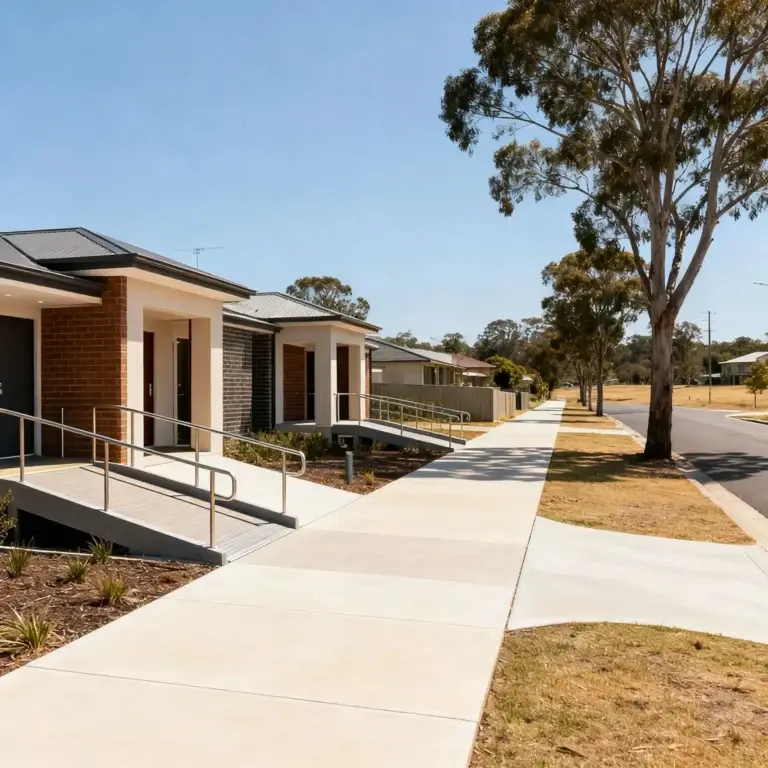
The recurring problems are predictable once you have seen enough of them. Step-up entries at the front and back. Bathrooms sized for a hip bath rather than a wheelchair turning circle. Hallways narrow enough that a doorway widening only moves the pinch point. Laundries at the back down a step. None of that makes modification impossible; it makes the sequencing matter, because fixing the bathroom while leaving the entry untouched produces an accessible room in an inaccessible house.
A good OT assessment looks at the route through the house rather than the fixture. The question is not “can this shower be made level” but “how does this person get from the street to that shower, on a bad day, in twenty years”. That is why the assessments that work tend to recommend a sequence rather than a single job, and why the first modification is often the entry rather than the thing the family originally rang about.
Where the honest answer is that the house cannot reasonably be made to work, we say so. Sometimes the sensible outcome is equipment plus a smaller change, and occasionally it is a conversation about moving. Neither of those is what a modifications provider wants to conclude, and both are better than spending a year and a plan on a house that will still not work at the end of it.
We also flag the boring practical thing nobody mentions: complex work means the house is a building site for a while, and the assessment has to consider whether temporary housing is needed. Families discover that late and it derails otherwise good plans.
Much of Bass Hill’s housing is post-war brick, built long before anyone designed for access. That shapes what is realistic here in a way a generic page cannot tell you.
The recurring problems are predictable once you have seen enough of them. Step-up entries at the front and back. Bathrooms sized for a hip bath rather than a wheelchair turning circle. Hallways narrow enough that a doorway widening only moves the pinch point. Laundries at the back down a step. None of that makes modification impossible; it makes the sequencing matter, because fixing the bathroom while leaving the entry untouched produces an accessible room in an inaccessible house.
A good OT assessment looks at the route through the house rather than the fixture. The question is not “can this shower be made level” but “how does this person get from the street to that shower, on a bad day, in twenty years”. That is why the assessments that work tend to recommend a sequence rather than a single job, and why the first modification is often the entry rather than the thing the family originally rang about.
Where the honest answer is that the house cannot reasonably be made to work, we say so. Sometimes the sensible outcome is equipment plus a smaller change, and occasionally it is a conversation about moving. Neither of those is what a modifications provider wants to conclude, and both are better than spending a year and a plan on a house that will still not work at the end of it.
We also flag the boring practical thing nobody mentions: complex work means the house is a building site for a while, and the assessment has to consider whether temporary housing is needed. Families discover that late and it derails otherwise good plans.
At the 2021 Census, 33.6 per cent of Bass Hill households spoke English at home, Arabic 30.5 per cent and Vietnamese 10.1 per cent. Modifications are the most document-heavy support in the scheme, which makes this the support where language costs people the most.
Count the documents. An OT assessment. Two itemised quotes for complex work. A landlord’s written consent. A service agreement. Correspondence with a builder about access, timing and what happens to the bathroom for three weeks. Every one of those is a place where a family without English gets a worse outcome, not because anyone intends it but because nobody translated anything.
Our team works across English, Arabic, Vietnamese, Spanish and Auslan, and brings in accredited interpreters where we do not hold the language. For modifications we go further than usual on one point: the landlord request and the builder conversation both get put in writing in plain language, because those are the two exchanges where a misunderstanding costs months rather than minutes.
We do not use a family member as the interpreter for the assessment itself. In a home modification assessment the questions are about how someone washes, uses the toilet, gets into bed and manages at night. Those are exactly the answers a relative will soften, and a softened answer produces a report that recommends less than the person needs — which is then the evidence for years.
The cultural piece matters too. Bathrooms and washing practices are not neutral, and a design that ignores how a household actually uses a room produces a modification that gets worked around rather than used. We ask, in the participant’s language, before anything is drawn.
Modifications take longer than anything else in a plan. The honest range is months, and for complex work with quotes and construction it can run past a year from first conversation to finished bathroom.
Most of that time is not the NDIS being slow. It is the sequence: consent, assessment, quotes, decision, scheduling, build. Each step waits on the one before, and each has a queue. Knowing that up front changes how families feel about it, and it changes what you do in the meantime.
What we push for is an interim plan rather than a year of nothing. Often equipment can do part of the job now — a shower chair, a portable ramp, rails that are not structural. Sometimes the answer is more support hours temporarily, because the reason the modification is needed is that someone is currently doing a two-person transfer twice a day. Those are different budget lines and they are legitimate uses of them while the building work is in the queue.
The other thing worth doing while you wait is keeping the evidence current. If the person’s function changes during the wait — and over a year it often does — the assessment that supported the original recommendation may no longer describe them. An out-of-date report is a common reason a modification comes back for more information, which adds another cycle.
We will not put timeframes in writing that we cannot control, and we will not promise a date for work that depends on a builder’s schedule and an owner’s agreement. What we will do is tell you which step you are actually on, which is more than most people get.
Two different decisions, often confused, and the second one is where money goes missing.
For the assessment, the question is whether the OT does home modifications regularly. A generalist OT report that recommends the wrong thing costs the same as a good one and wastes a cycle. Ask how many modification assessments they did last year and whether they will be involved after the report, because a report writer who never sees the finished job never learns what does not work.
For the build, the questions are ordinary building questions plus one NDIS-specific one: are the quotes itemised as the scheme requires, and for complex work were they gathered properly — by a building construction practitioner, or estimated by a qualified building cost estimator or quantity surveyor? A quote that does not meet that standard gets the whole submission bounced.
You should also know the escalation path. We are a registered NDIS provider, every worker holds an NDIS Worker Screening Check, and complaints run to the NDIS Quality and Safeguards Commission, not only to us. That matters more here than elsewhere because a modification gone wrong is not a bad session — it is a bathroom you cannot use and a plan you have already spent.
On price, we will not put figures on this page. Modifications are subject to the NDIS Pricing Arrangements and Price Limits and to actual quotes, and any number written here would be wrong for your house. What we will tell you is what the assessment process requires before anybody quotes anything.
The first question is not what you want built. It is whether you own the house.
We start with a conversation, in your language, at home if that suits. Three things come out of it: who owns the property, what the person actually cannot do at the moment, and what has already been tried. That last one matters because a modification recommended without knowing that equipment was tried and failed reads weaker than one that includes it.
If the property is rented, the landlord conversation starts immediately and in writing, before an OT is booked. If the answer is no, we would rather you knew in week one. If it is yes, we get it in writing and keep it, because “the agent said it was fine” is not what the NDIS asks for.
Then the OT assessment, looking at the route through the house rather than the single fixture, and recommending a sequence where a sequence is what is needed. Then quotes, gathered to the standard the scheme requires. Then the submission, and then an honest conversation about the wait and what to do during it.
Throughout, we write down what is happening in specifics, because a modification that spans a plan reassessment needs a paper trail that shows it was in progress rather than abandoned. That is the single most common way a nearly-finished modification falls over, and it is entirely preventable.
What home modifications in Bass Hill are actually for.
Allied Health
The occupational therapist who has to assess the modification sits here. Getting an OT who does modifications regularly is the difference between a report that unlocks the work and one that wastes a cycle.
Support Coordination
Modifications have more moving parts than any other support — consent, assessment, quotes, build, and a reassessment somewhere in the middle. Coordination is what stops it stalling between steps.
In-Home Daily Living
Help at home, and often the interim answer while a modification sits in a queue. Also on the Government’s list of supports not being reset in October.
Community Access
Getting out of the house. Worth knowing that this is the budget being reduced by half from October, which is exactly the reduction that does not apply to modifications.
Employment Support
Finding and keeping work. Where getting out the door reliably is the barrier, the fix is sometimes at home rather than at the job.
Aged Care
For people over 65 and families managing both systems. Home modification rules differ between the two and the wrong assumption costs months.
What home modifications in Bass Hill are actually for.
If you rent, the owner has to agree in writing. We start there rather than after an assessment has been paid for.
The NDIS requires a qualified occupational therapist to assess. A generalist report that recommends the wrong thing wastes a whole cycle.
Complex work needs two itemised quotes gathered properly. A quote that misses that gets the whole submission bounced.
Equipment or extra hours while the build sits in a queue, rather than a year of nothing happening.
Landlord requests and builder conversations in writing, plainly, with accredited interpreters where we do not hold the language.
Home modifications are named on the Government list of critical supports not being reset. Verified rather than reassuring.
Six reasons Bass Hill families use us for modifications, none of which are awards.
The NDIS can only fund modifications where the owner agrees in writing. We start there, so a no arrives in week one rather than after an assessment has been paid for.
Modifications are the most document-heavy support in the scheme. English, Arabic, Vietnamese, Spanish and Auslan, with the landlord and builder exchanges put in writing plainly.
Home modifications are on the Government’s list of critical supports not part of the 1 October 2026 reset. Verified, not reassurance — and the opposite of what most families assume.
An accessible bathroom in an inaccessible house helps nobody. Assessments here look at the journey from the street, and recommend a sequence when a sequence is what is needed.
We are a registered NDIS provider. Every worker holds an NDIS Worker Screening Check and complaints run to the NDIS Quality and Safeguards Commission, not just to us.
Sometimes equipment, a different room layout or a move beats building work. Saying so costs us the job and saves you a year and a plan.
The NDIS Family Decision Guide
What to sort out before you ask for a home modification in Bass Hill.
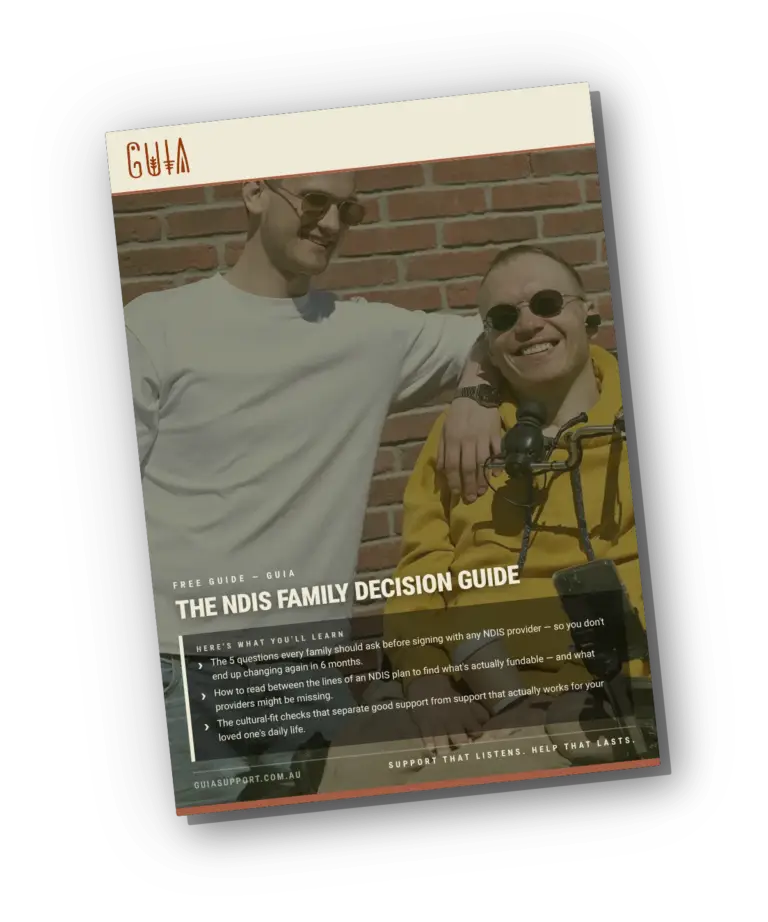
Here's What You'll Learn:
Why an OT report has to come first
What your landlord has to put in writing
Which supports are not being reset in October
Finance Manager
Operations Manager
Community Outreach Coordinator
Yes, but only with the owner’s agreement. The NDIS can “only pay for modifications to a home you own or a home if the owner agrees it can be modified”, and if you are renting it needs written approval from your landlord. That is the first thing to sort out, before an OT is booked, because everything else waits on it. Owners usually say no when they are asked vaguely and asked to decide with no information — a specific written request describing the work, who pays, and what happens at the end of the tenancy gets a very different answer.
A qualified occupational therapist. The NDIS states that “a qualified occupational therapist must complete minor and complex home modification assessments”. A builder’s quote is not the evidence and cannot replace it. For complex modifications the assessment also has to consider whether temporary housing is needed during construction, and it requires two itemised quotes gathered by a building construction practitioner, or a cost estimate from a qualified building cost estimator or quantity surveyor.
No. Home modifications are named on the Government’s list of critical supports that are not being reset. The published changes reduce social, civic and community participation allocations by 50 per cent and capacity building daily activity allocations by 10 per cent, and explicitly exclude in-home assistance, home modifications, mobility equipment and specialist disability accommodation. “Not being reset” is not the same as guaranteed — every modification still has to be assessed as reasonable and necessary — but the specific reduction everyone is worried about does not apply here.
Honestly, the NDIS page on assessments does not spell that out. It distinguishes the two and sets out extra requirements for complex work — temporary housing considerations and two itemised quotes — without defining where the line falls. In practice it turns on scale and whether the work is structural. If a provider tells you confidently which category your bathroom is in before an occupational therapist has assessed it, they are guessing. We would rather say that than invent a threshold.
Months, and for complex work with quotes and construction it can run past a year from first conversation to finished room. Most of that is the sequence rather than the NDIS being slow: consent, then assessment, then quotes, then decision, then scheduling, then the build — each step waiting on the one before, each with a queue. We will not put a date in writing for work that depends on a builder’s schedule and an owner’s agreement. What we will do is tell you which step you are actually on.
Not nothing. Equipment often does part of the job in the meantime — a shower chair, a portable ramp, non-structural rails — and those come from a different budget line. Sometimes the right interim answer is more support hours, because the reason the modification is needed is that someone is doing a two-person transfer twice a day. Also worth doing: keeping the evidence current. Over a year people’s function changes, and an out-of-date assessment is a common reason a submission comes back for more information and adds another cycle.
Yes. Our team works across English, Arabic, Vietnamese, Spanish and Auslan, with accredited interpreters where we do not hold the language. Modifications are the most document-heavy support in the scheme — assessment, quotes, landlord consent, service agreement, builder correspondence — so this is where language costs families the most. We do not use a relative to interpret the assessment itself, because the questions are about washing, toileting and managing at night, and a softened answer produces a report that recommends less than the person needs.
Then we say so. A lot of Bass Hill housing is post-war brick with step-up entries, small bathrooms and narrow hallways, and occasionally the honest conclusion is that equipment plus a smaller change is better value than a rebuild, or that the real conversation is about moving. Neither is what a modifications provider wants to conclude and both beat spending a year and a plan on a house that still will not work at the end of it.
We will not put a figure on this page, because the answer depends on your house and on actual quotes. Modifications are subject to the NDIS Pricing Arrangements and Price Limits as well as to the quoted cost of the work. What we can tell you before anybody quotes anything is exactly what the assessment process requires, so you are not paying for steps in the wrong order.
If a modification is in progress, the most important thing is a paper trail showing it is in progress rather than abandoned. Dates, the OT assessment, the consent, the quotes, any correspondence with the builder. Modifications routinely span a reassessment and the most common way a nearly-finished one falls over is that nothing on file shows where it had got to.
Beyond that: list what the person currently cannot do and what that costs in support hours, because a modification is usually justified by the hours it removes. Gather anything written by someone other than you or us. And say in one sentence what the next twelve months is meant to achieve. Home modification budgets are not part of the October reset, but they still have to be assessed as reasonable and necessary, and evidence is what that assessment runs on.
Reach out for a non-obligation NDIS Plan Management Assessment
We also provide this support in the nearby suburbs below, or see Home Modifications South West Sydney for the full service area.
A new plan arrives and nothing tells you what to do first. Here is the order we work through with families in South West Sydney, and the two mistakes that cost the most.
Aged care at home South West Sydney from Guia. Reliable support workers who show up consistently and become part of your family’s everyday routine.
NDIS allied health support sydney from Guia. Reliable support workers who show up consistently and become part of your family’s circle. Peace of mind fo…