


New NDIS plan: your first 30 days, in order
A new plan arrives and nothing tells you what to do first. Here is the order we work through with families in South West Sydney, and the two mistakes that cost the most.

ARE YOUR NDIS SUPPORTS WORKING FOR YOU?
GET A FREE NDIS PLAN MANAGEMENT REVIEW
Employment support is the part of your NDIS plan that helps you get ready for work, find work, and stay in it. In Bass Hill that usually starts with something ordinary — a first job at the Plaza on the Hume Highway, a few shifts somewhere local, a course at TAFE, a trial that turns into something. It is not a day program with a job-shaped name on it.
The most important thing on this page is that the rules changed recently and a lot of pages have not caught up. Disability Employment Services no longer exists. It was replaced by Inclusive Employment Australia on 1 November 2025. The change that matters most to people in Bass Hill is that you no longer have to be assessed as able to work eight hours a week or more to get in. People reassessed with a work capacity of zero to seven hours became eligible from 16 October 2025. If you were told years ago that you were not eligible for employment help, that advice is now out of date.
The second thing worth being straight about: employment support and community access come out of different parts of your plan. Getting to the door is community participation. Finding and keeping the job is capacity building. Providers who blur those two are usually billing the wrong line, and it is how people run out of one budget while the other sits untouched.
We are a registered NDIS provider working across South West Sydney, and Bass Hill is a suburb we know rather than a postcode we cover. Two thirds of this suburb speaks a language other than English at home, and job-seeking is where that bites hardest — interviews, inductions, rosters, payslips, safety briefings. Our team works across English, Arabic, Vietnamese, Spanish and Auslan, and brings in accredited interpreters where we do not hold the language.
Employment support is the part of your NDIS plan that helps you get ready for work, find work, and stay in it. In Bass Hill that usually starts with something ordinary — a first job at the Plaza on the Hume Highway, a few shifts somewhere local, a course at TAFE, a trial that turns into something. It is not a day program with a job-shaped name on it.
The most important thing on this page is that the rules changed recently and a lot of pages have not caught up. Disability Employment Services no longer exists. It was replaced by Inclusive Employment Australia on 1 November 2025. The change that matters most to people in Bass Hill is that you no longer have to be assessed as able to work eight hours a week or more to get in. People reassessed with a work capacity of zero to seven hours became eligible from 16 October 2025. If you were told years ago that you were not eligible for employment help, that advice is now out of date.
The second thing worth being straight about: employment support and community access come out of different parts of your plan. Getting to the door is community participation. Finding and keeping the job is capacity building. Providers who blur those two are usually billing the wrong line, and it is how people run out of one budget while the other sits untouched.
We are a registered NDIS provider working across South West Sydney, and Bass Hill is a suburb we know rather than a postcode we cover. Two thirds of this suburb speaks a language other than English at home, and job-seeking is where that bites hardest — interviews, inductions, rosters, payslips, safety briefings. Our team works across English, Arabic, Vietnamese, Spanish and Auslan, and brings in accredited interpreters where we do not hold the language.
Guia Is Trusted By NDIS Participants, Families And Support Coordinators
Imagine a life designed to empower you!





Employment support does not come out of the same budget as getting places. It sits in capacity building, and knowing that is the difference between a plan that lasts the year and one that does not.
Two capacity building lines matter here. Finding and Keeping a Job is the general one — help working out what you can do, preparing for interviews, learning the parts of a job that are not the job, and support once you have started so that the first hard week is not the last week. School Leaver Employment Supports, usually shortened to SLES, is the version for young people in the couple of years after school, and it exists because that is the point where most people fall out of the system entirely.
What neither of them is, is transport. Getting to the interview is community participation and comes out of core supports. That distinction sounds pedantic until you watch somebody exhaust their community access budget on work travel in April and then have no way of attending the job they just got. We separate the two on paper before we start, so that when one runs low the other is still there.
The other line worth knowing about is employment related assessment and counselling, which is what you use when the question is not “how do I get a job” but “what work is realistic given how my condition actually behaves”. That is a legitimate thing to spend a plan on and it is chronically under-used, usually because nobody offered it.
We will not put dollar figures on this page. Employment supports are subject to the NDIS Pricing Arrangements and Price Limits, those limits are revised, and a number written here would eventually be wrong and read as a quote. Ask us and we will work it out against your actual plan and the current published arrangements.
If you were told you were not eligible for employment help because you could not work eight hours a week, that advice is out of date. The eight-hour threshold is gone.
Disability Employment Services was replaced by Inclusive Employment Australia on 1 November 2025. It is the specialist disability employment program funded by the Australian Government, and it is separate from your NDIS plan — you can use both, and most people should.
The change that matters most in a suburb like this one is the eligibility floor. Under the old program you generally had to be assessed as able to work at least eight hours a week. Under the new one you do not: people reassessed with a work capacity of zero to seven hours became eligible from 16 October 2025. That is a large number of people who were told, sometimes years ago, that there was nothing available to them. If that was you, it is worth asking again.
What we do not know, and will not invent, is how every provider in this area has implemented it. The program is national; the experience of it is local, and it varies. What we can do is tell you what the Department has published, help you work out whether you are now eligible, and go with you to the first appointment if English is not the language you would choose for that conversation.
One more honest note. Inclusive Employment Australia is not part of your NDIS plan and does not use your NDIS budget. If a provider offers to bill your plan for something that program provides free, that is worth a question. We would rather you spent your capacity building budget on the things only it can buy.
There is a lot of anxiety about the NDIS changes starting 1 October 2026, and a lot of providers being vague about it. Here is the accurate version as it relates to employment.
From 1 October 2026 the Australian Government is reducing budget allocations for social, civic and community participation supports by 50 per cent, and capacity building daily activity allocations by 10 per cent. It applies as plans are reassessed or renewed, progressively across twelve months. Budgets for what the Government calls critical supports — in-home assistance, home modifications, mobility equipment, specialist disability accommodation — are not being reset. That is the Department of Health, Disability and Ageing’s own wording.
Employment supports are not named in that list. We want to be precise about this rather than reassuring: the published material names social, civic and community participation, and capacity building daily activities. It does not say employment supports are being cut, and it does not say they are protected either. Anyone telling you confidently in either direction is going beyond what has been published.
What is worth doing regardless is making the work goal explicit and evidenced in your plan. A reassessment weighs what you can show. “He would like to work one day” is weak. “He completed a six-week trial at a Bass Hill retailer, needed a support worker for the first three shifts and none after that, and the employer has asked him back” is not. We help participants build that record as it happens, not in the fortnight before a plan meeting.
When operational guidance is published we will read it and tell our participants what it actually says, including if it is bad news.
The bus network is the network here. Metro Route M91 runs the Parramatta to Hurstville corridor and services this area, and Transport for NSW has been upgrading stops along it, including on Hector Street at Bass Hill. In practice that means jobs along that corridor are genuinely reachable and jobs that need two changes and a walk at the far end usually are not, whatever the map says.
We build this into the job search rather than discovering it in week two. Before anybody applies anywhere, we work out what the actual journey looks like at the actual start time — not the timetable, the real thing, including how long the wait runs when a bus is full. A job that is a fifty-minute trip on a good day is a job somebody will leave by March, and everyone involved will call it a failure of motivation.
Where the journey is the barrier rather than the work, the honest answer is often travel training rather than more job applications. That is capacity building, it should be time-limited by design, and it makes a much wider set of jobs possible. A worker travels with you, then meets you at the other end, then is on the phone, then is not. Once somebody can do the M91 alone, the number of employers within reach roughly doubles.
One caveat we will not fudge: we can tell you how the routes behave because we use them, but we cannot tell you what a taxi or rideshare will cost on a given morning, and we will not put a figure in writing that we would have to walk back.
Bass Hill has no railway station. For anyone whose job prospects depend on getting somewhere by half past eight in the morning, that is not a detail — it is the single biggest practical constraint on which jobs are realistic.
The bus network is the network here. Metro Route M91 runs the Parramatta to Hurstville corridor and services this area, and Transport for NSW has been upgrading stops along it, including on Hector Street at Bass Hill. In practice that means jobs along that corridor are genuinely reachable and jobs that need two changes and a walk at the far end usually are not, whatever the map says.
We build this into the job search rather than discovering it in week two. Before anybody applies anywhere, we work out what the actual journey looks like at the actual start time — not the timetable, the real thing, including how long the wait runs when a bus is full. A job that is a fifty-minute trip on a good day is a job somebody will leave by March, and everyone involved will call it a failure of motivation.
Where the journey is the barrier rather than the work, the honest answer is often travel training rather than more job applications. That is capacity building, it should be time-limited by design, and it makes a much wider set of jobs possible. A worker travels with you, then meets you at the other end, then is on the phone, then is not. Once somebody can do the M91 alone, the number of employers within reach roughly doubles.
One caveat we will not fudge: we can tell you how the routes behave because we use them, but we cannot tell you what a taxi or rideshare will cost on a given morning, and we will not put a figure in writing that we would have to walk back.
Bass Hill has Bass Hill Public, Bass High and George Bass School, which is a school for students with disability. That last one means this suburb produces more school leavers needing employment support than a generic South West Sydney page would predict.
School Leaver Employment Supports exist for the couple of years after school, and the families who do best start the conversation in the final year rather than the January after. The reason is not paperwork. It is that the useful part of SLES is trying things — a few weeks somewhere, a course, a volunteering shift, a work trial that does not work out — and trying things takes time that nobody has if they start in the summer holidays.
What we push against is the version of school leaver support that quietly becomes a day program. It is easy to fill a week. It is much harder to get someone to twenty-five having actually worked. The test we apply is simple: at the end of this year, will this young person have done something an employer would recognise? If the answer is no two years running, the program is not working regardless of how happy everybody is.
Practically, that means a lot of short, real experiences rather than one long placement. Retail at the Plaza. Warehouse work along the highway. Hospitality. Anything that produces a reference and a story to tell at an interview. Some of it will fail and failing is part of it — a trial that ended badly teaches more than a year of simulated workplace training.
We will not promise a job. Nobody honest will. What we will do is make sure that by the time the plan is reassessed, the young person has tried enough different things to know which direction to argue for, and that there is written evidence of what worked.
At the 2021 Census, 33.6 per cent of Bass Hill households spoke English at home. Arabic was 30.5 per cent and Vietnamese 10.1 per cent. Job-seeking is where that matters most, and it is the part employment services most often get wrong.
The job itself is frequently the easy part. What defeats people is everything around it: the phone screen, the interview, the induction video, the safety briefing, the roster app, the payslip nobody explains, the awkward conversation when a shift needs changing. Every one of those is a language moment, and a support worker who cannot be in that moment ends up doing it for the person, which teaches nothing and lasts until the worker leaves.
Our team works across English, Arabic, Vietnamese, Spanish and Auslan, and where we do not hold a language in-house we bring in an accredited interpreter. We do not use a family member as the interpreter for a conversation about that person’s own work, and we do not use children as interpreters at all. In an employment context that matters more than usual, because the things being discussed — hours, pay, rights, what you are and are not able to do — are exactly the things a relative may answer differently from the person themselves.
We also do the unglamorous translation work of explaining mechanics rather than phrases. Not “supported wage system” but: there is a way your pay can be worked out from what you can actually do rather than a flat rate, it is assessed, and here is who assesses it. That is understandable in any language and it is more accurate than the term.
The cultural half matters too. Rosters that ignore Friday prayers, or an induction scheduled in Ramadan without a conversation, do not get argued about — they get quietly declined, and it gets recorded as the person not being ready for work. Islam is the largest religious affiliation in this suburb at 33.5 per cent. We raise it with employers early, in plain terms, as a scheduling fact rather than a request for special treatment.
Employment support is the easiest support to fake, because activity looks like progress. Somebody attended. Here is the invoice.
Four questions separate providers, and none are about values statements. First: how many of the people you supported last year are working now, and doing what? Nobody will have a perfect number and anybody who refuses to discuss it at all is telling you something. Second: what happens in the first month after somebody starts a job? That is when placements fail, and a provider whose involvement ends at the offer letter is a provider whose placements do not stick.
Third: will you tell me when something is free elsewhere? Inclusive Employment Australia is government funded and does not use your NDIS budget. A provider who never mentions it is either unaware or would rather bill you. Fourth: what is charged for travel, and is it written into the service agreement before the first shift? There is a legitimate per-kilometre component when a worker drives you and legitimate rules about worker travel time. Both belong in writing, not on an invoice as a surprise.
You should also know where complaints actually go. We are a registered NDIS provider, every worker holds an NDIS Worker Screening Check, and the escalation path runs to the NDIS Quality and Safeguards Commission, not just to us. A provider who presents their internal complaints process as the only option is not describing the system accurately.
Finally, be suspicious of guaranteed outcomes. No provider controls whether an employer hires you. What a provider controls is how many real chances you get and how well you are supported when one lands.
No assessment day, no folder, no vocational profile nobody reads. The first conversation is about what you want to be doing and what has stopped you so far.
We start with a conversation, in your language, wherever suits — at home, at the Plaza, on the phone, or with an interpreter on the line. What we are after is not a care plan. It is one job you would actually take, and an honest account of what has gone wrong before. Sometimes the answer is transport. Sometimes it is that the last service put someone in a program for two years. Sometimes it is that nobody has asked.
Then we tell you what your plan can pay for, what Inclusive Employment Australia covers at no cost to you, and where the two overlap. If the honest answer is that you do not need us for most of it, we say that at that point rather than after you have signed.
The first three months are deliberately concrete. Something real gets tried — a course, a trial, a few shifts, a volunteering placement — and we write down what happened in specifics rather than adjectives, because that record is what your reassessment will rest on. If a placement fails we treat it as information, not as evidence that you are not ready.
After that it depends on you. Some people want support for the first fortnight of a job and then nothing. Some want a slower run at it over two years. Both are legitimate, and we will not pretend that needing us less is a failure of engagement.
What employment support in Bass Hill is actually for.
Community Access
Getting to places, including work. Travel sits in core supports rather than the employment budget, and keeping the two separate on paper is what stops one running dry while the other sits untouched.
Support Coordination
The person who turns a plan into working services. If a work goal needs to survive a reassessment, coordination is usually what gets the evidence into the right shape in time.
In-Home Daily Living
Help at home with the ordinary parts of the day. Being reliably out the door on time is a work skill, and it is funded from a different line than the job search itself.
Allied Health
Therapy that builds what you can do. Where the same physical or communication barrier keeps ending placements, allied health is what moves it rather than working around it forever.
Home Modifications
Changes to the house so it works for you. On the Government’s list of critical supports not being reset in October, which makes it worth assessing properly.
Aged Care
For people over 65 and families managing both systems. The rules differ from the NDIS and the wrong assumption costs months.
What employment support in Bass Hill is actually for.
The test is whether an employer would recognise what you did this year. Filling a week is easy and it is not the same thing.
Placements fail in the first month. We are built around the weeks after the offer letter, not the ones before it.
The real trip at the real start time, because Bass Hill has no station and the timetable is not the journey.
Capacity building for the job, core supports for the travel. Blurring them is how people run out in April.
Inclusive Employment Australia is government funded and does not use your plan. We point you at it anyway.
Specifics written down through the year, so a reassessment rests on what you did rather than how last month looked.
Six reasons Bass Hill families use us for work goals, none of which are awards.
Bass Hill has no station. We check the real journey at the real start time before anyone applies, because a fifty-minute trip is a job somebody leaves by March.
Interviews, inductions, rosters and payslips are all language moments. We work across English, Arabic, Vietnamese, Spanish and Auslan, with accredited interpreters where we do not hold the language.
DES became Inclusive Employment Australia on 1 November 2025 and the eight-hour eligibility floor went with it. If you were knocked back years ago, ask again.
Placements fail in the first month, not at interview. Our involvement is built around the weeks after you start, which is the part most services quietly skip.
We are a registered NDIS provider. Every worker holds an NDIS Worker Screening Check, and the complaints path runs to the NDIS Quality and Safeguards Commission, not just to us.
Inclusive Employment Australia is government funded and does not touch your NDIS budget. We point you at it even though saying so costs us the hours.
The NDIS Family Decision Guide
What to ask before you agree to an employment support service in Bass Hill.
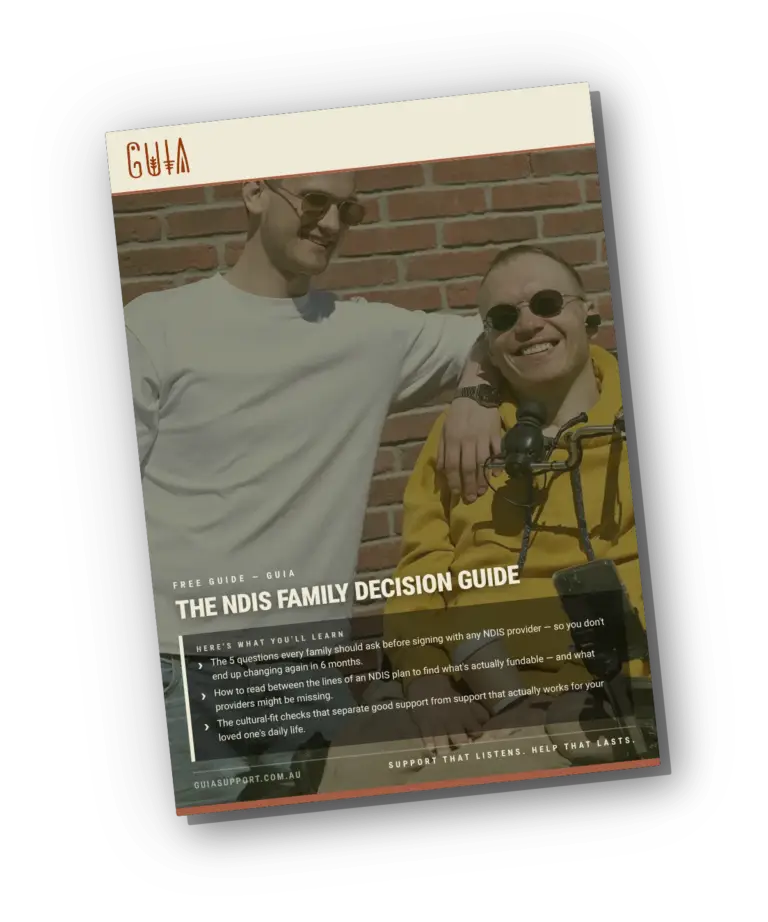
Here's What You'll Learn:
Which budget actually pays for job support
What changed when DES became Inclusive Employment Australia
How to tell a real job path from a busy timetable
Finance Manager
Operations Manager
Community Outreach Coordinator
Almost certainly yes, and this changed recently. Under the old Disability Employment Services program you generally had to be assessed as able to work eight hours a week or more. Inclusive Employment Australia replaced DES on 1 November 2025, and people reassessed with a work capacity of zero to seven hours became eligible from 16 October 2025. If you were told years ago that you were not eligible, that advice predates the change and is worth revisiting.
Partly. Your NDIS plan funds capacity building supports such as Finding and Keeping a Job, School Leaver Employment Supports, and employment related assessment and counselling. Inclusive Employment Australia is funded separately by the Australian Government and does not use your NDIS budget at all. Most people should be using both. A provider who never mentions the free option is one worth asking about it.
School Leaver Employment Supports, for young people in the couple of years after they finish school. It exists because that transition is where most people fall out of the system altogether. The useful part of it is trying real things — a course, a trial, a few shifts, a volunteering placement — which takes time. Families who start planning in the final school year land somewhere good far more often than families who start in January.
The published material does not say so, and it does not say they are protected either. What the Department of Health, Disability and Ageing has published is that social, civic and community participation allocations reduce by 50 per cent and capacity building daily activity allocations by 10 per cent, applied as plans are reassessed over twelve months, with critical supports not reset. Employment supports are not named in either list. Anyone telling you confidently in either direction is going beyond what has been published. We will read the operational guidance when it appears and tell participants what it says.
Yes. Our team works across English, Arabic, Vietnamese, Spanish and Auslan, and where we do not hold a language in-house we bring in an accredited interpreter rather than making do. In an employment context we are stricter than usual about this: we do not use a family member to interpret a conversation about that person’s own work, because hours, pay and capability are exactly the things a relative may answer differently from the person themselves. We do not use children as interpreters at all.
We will not put a figure on this page. Employment supports are subject to the NDIS Pricing Arrangements and Price Limits, those limits are revised, and a number written here would eventually be wrong and read as a quote. We will work it out with you against your actual plan and the current published arrangements, and tell you where Inclusive Employment Australia covers the same ground at no cost to you.
Both, but they come from different budgets and we keep them separate on paper. Finding and keeping the job is capacity building. Getting there is community participation, out of core supports. We check the real journey at the real start time before you apply anywhere, because Bass Hill has no station and a job that needs two changes and a walk is a job most people leave by March. Where the journey is the actual barrier, travel training usually opens more doors than more applications do.
It gets treated as information rather than as evidence you were not ready. Placements fail, most often in the first month, and a trial that ended badly usually teaches more than a year of simulated workplace training. What matters is that the reason is written down accurately — the shift pattern, the travel, a task that needed a change nobody made — because that is what stops the next placement failing the same way.
No, and nobody honest will. No provider controls whether an employer hires you. What we control is how many real chances you get, how well matched they are, and how well you are supported in the weeks after one lands. If a provider guarantees an outcome, ask them what happens when it does not happen.
Four things. First, list what you actually did toward work this year with dates — courses, trials, shifts, interviews, volunteering — not a summary, the real list. Second, for each one write what it produced and what it showed, including the ones that failed and why. Third, gather anything written by someone other than you or us: an employer reference, a TAFE result, a report from a trial. Independent evidence carries further than a provider’s opinion. Fourth, say what you want the next twelve months to look like in one sentence you can repeat, because reassessments move fast.
Work goals get lost at reassessment more often than they get refused, usually because nothing was written down as it happened. We build that record through the year rather than in the fortnight before the meeting.
Reach out for a non-obligation NDIS Plan Management Assessment
We also provide this support in the nearby suburbs below, or see Employment Support South West Sydney for the full service area.
A new plan arrives and nothing tells you what to do first. Here is the order we work through with families in South West Sydney, and the two mistakes that cost the most.

Aged care at home South West Sydney from Guia. Reliable support workers who show up consistently and become part of your family’s everyday routine.

NDIS allied health support sydney from Guia. Reliable support workers who show up consistently and become part of your family’s circle. Peace of mind fo…