


aged care at home south west sydney
Aged care at home South West Sydney from Guia. Reliable support workers who show up consistently and become part of your family’s everyday routine.


A new NDIS plan arrives and a strange quiet follows it. The meetings are over, the paperwork is done, and now there is a document with numbers in it and nobody standing next to you explaining what happens on Monday. Most families we meet in South West Sydney lose the first month to that quiet. Not because they are disorganised, but because nothing tells you which thing to do first.
This is the order we work through with families. It is not the only order that works. It is the one that stops the two things that cost families the most: funding sitting unused because nobody knew it was there, and supports starting in a rush that have to be undone three months later.
Read the plan out loud with another person in the room.
Not because the language is hard, although it can be, but because reading it aloud makes you stop at the parts you have been skimming.
You are looking for four things. What has been funded. How much. How it is managed. And when the plan runs to.
The last one matters more than people expect. Your plan has an end date, and the funding in it does not carry over into the next plan. Money still sitting there on the final day does not become extra money later. It simply stops being available. Families who realise this in month eleven spend the last few weeks trying to book supports they do not really want, from whoever has capacity, which is the opposite of choice and control.
Keep a page in the front of the plan folder and write every question on it, even ones that feel too small. What does that category actually pay for. Can we use this for the driving lessons. Who decides if this is reasonable and necessary. You will not get answers this week and that is fine. The list is what turns your first conversation with a support coordinator from a general chat into a working meeting.
Three different roles get confused constantly, and the confusion costs families months.
Plan management is about money. A plan manager pays invoices, keeps track of what is left in each budget, and sends you statements. They do not choose your supports.
Support coordination is about connecting the plan to actual services. A support coordinator helps you find providers, set things up, sort out problems, and build your own confidence in running the plan. They do not pay invoices.
Your local area coordinator or NDIA contact is your link back to the Scheme itself. They are who the plan conversation happens with.
Check which of these you actually have funded. Plenty of families assume they have a support coordinator because someone helpful rang them once, then discover in month eight that the funding was never in the plan. Better to find out in week two.
Do not try to start everything at once. It looks efficient and it is not.
Six new services beginning in the same fortnight means six sets of paperwork, six new faces, six rosters to learn, and no way to tell which one is actually helping.
Instead, ask a blunt question: which two things, if they started next week, would make the most difference to how this household actually runs.
Usually it is something practical and something restorative. Support with the morning routine so the mornings stop being a fight, and a few hours where someone else is responsible so a carer can sleep, or work, or go to their own appointment. Start there. Add the rest once the first two are steady.
You are allowed to meet more than one provider, say no after meeting them, and change later. None of this makes you difficult.
Useful things to ask in a first meeting:
That last question tells you the most. A provider who has a clear, calm answer to it has had the conversation before and has not made it shameful. A provider thrown by it has not thought about your exit, only your signature.
In South West Sydney, the language question is not a nicety. Support conducted through a family member translating is support that quietly stops being private, and the person receiving it usually notices before anyone else does.
A service agreement is the document between you and each provider. Read it before signing.
What is being charged, and against which budget. Line items should match what you were told in the meeting.
Notice periods, both directions. If they need two weeks from you, you should be able to expect something reasonable from them.
Cancellation terms. Know what happens when your family member is unwell and cannot go. This will happen. Know the cost before it does, not after.
The families who reach the end of a new NDIS plan without unspent funding are not the organised ones. They are the ones who set up something small enough that they kept doing it.
A single page. What was funded, what has been booked, what is left, checked once a month. That is enough. If you are plan managed your plan manager sends statements, and ten minutes reading one is worth more than an elaborate spreadsheet you abandon in March.
Put a reminder in your phone for the same day each month. Then put one more in for three months before the plan ends, which is when you start collecting evidence rather than scrambling for it.
Something significant is missing from the new NDIS plan, or the funding does not reflect what was discussed.
There are two different paths, and they are not the same thing. A plan variation is for a small change to part of the current plan. A plan reassessment is for when the plan needs to change significantly and gets replaced with a new one. Which applies depends on the size of the change, and you will need information and evidence either way. The NDIA sets out both processes here.
Do not wait until the next scheduled check-in if the new NDIS plan is genuinely unworkable. Waiting costs you months of support you were entitled to.
The first month with a new NDIS plan is about building the small number of relationships that make the other eleven months work. Two good support workers who know your routine are worth more than a full calendar of services that nobody in the house looks forward to.
If the first month has already got away from you, that is recoverable. Almost every family we work with has had a slow start at some point. The plan is still there. So is the funding.
We work with participants and families across South West Sydney, in English, Spanish, Arabic and Auslan, and a first conversation about your new NDIS plan costs you nothing.
Read more about our support coordination in South West Sydney, or book a free discovery call and bring your list of questions.
Aged care at home South West Sydney from Guia. Reliable support workers who show up consistently and become part of your family’s everyday routine.

NDIS allied health support sydney from Guia. Reliable support workers who show up consistently and become part of your family’s circle. Peace of mind fo…

Multilingual aged care from Guia. Reliable support workers who show up consistently in South West Sydney. Family-centred care where caregivers become pa…
The NDIS Plan Navigation Guide
How to get the most out of your NDIS plan with Level 2 Support Coordination — without losing time to paperwork or pushy providers.
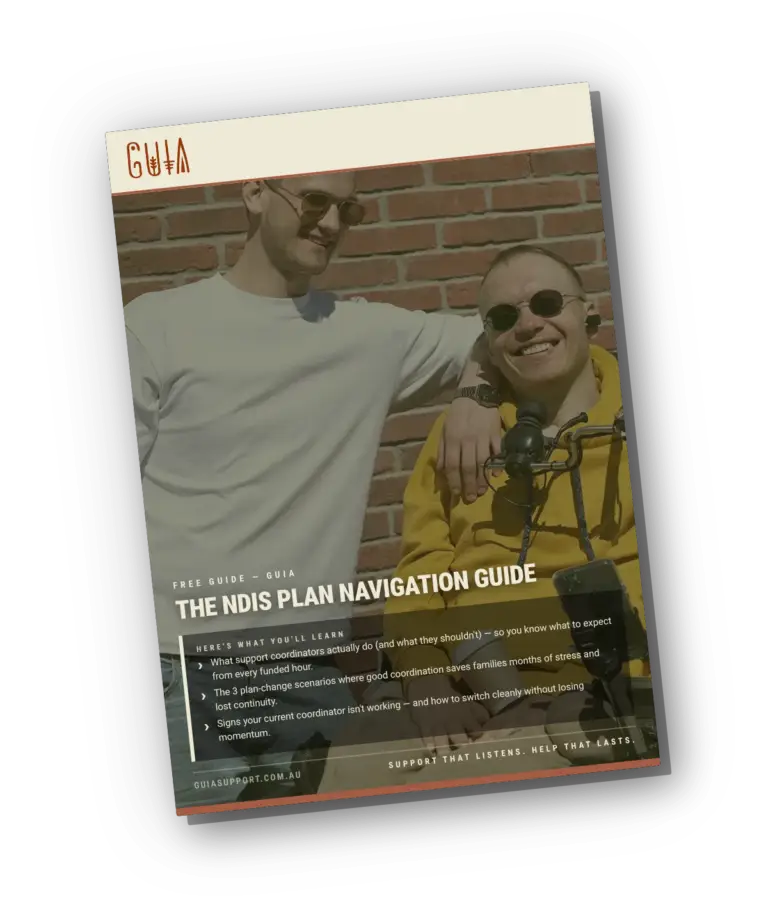
Here's What You'll Learn:
What support coordinators actually do (and what they shouldn’t) — so you know what to expect from every funded hour.
The 3 plan-change scenarios where good coordination saves families months of stress and lost continuity.
Signs your current coordinator isn’t working — and how to switch cleanly without losing momentum.
ARE YOUR NDIS SUPPORTS WORKING FOR YOU?
GET A FREE NDIS PLAN MANAGEMENT REVIEW